
Crawl Space Encapsulation in Chicago
A sealed, dry, usable space instead of a damp dirt hole under your floor. Vapor barrier, drainage, insulation and dry air, scoped to your crawl space and priced per square foot in writing.
- Published pricing: $7 to $14 per square foot
- Drainage installed first when there's standing water, not taped over
- Free crawl space inspection within 48 hours
 Priced per square foot, in writing
What a full encapsulation includes
Encapsulation is a system, not a plastic sheet. A crawl space that skips the drainage or the air step stays damp under prettier packaging.

Cleanout and prep
Old debris, fallen insulation and standing organic material come out first. You cannot seal a mess and expect dry air.

Drainage and sump
Standing water means a drainage channel and a sump pump go in before any liner. Sealing water under plastic just hides it.

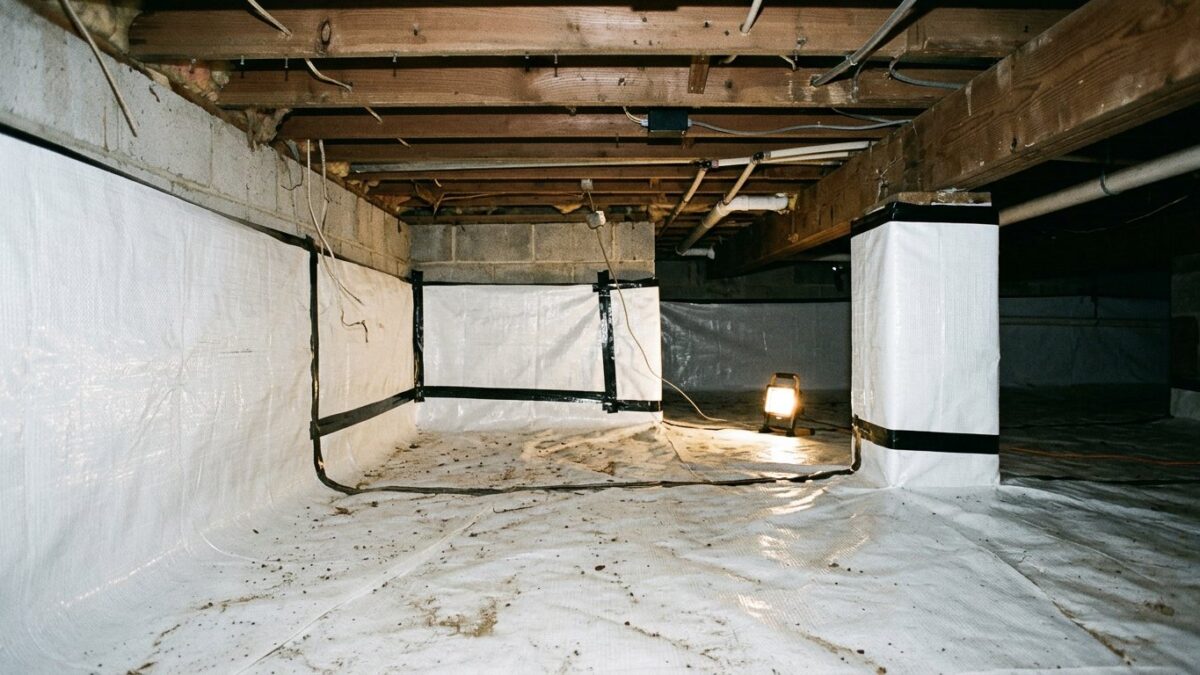
Reinforced vapor barrier
A heavy reinforced liner across the floor and up the walls, seams overlapped and taped, mechanically fastened so it stays put.

Rim joist insulation
The rim joist is where an Illinois winter gets in. Rigid foam sealed against it keeps the floor above warmer and the pipes safer.

Dehumidification
A compact unit sized to the space holds humidity below the mold threshold year-round, drained so you never empty a bucket.

Sealed vents and access
Open vents pump humid summer air into a cool space, which is how condensation starts. They get sealed, and the access gets a real door.
Why are Chicago crawl spaces so damp?
Chicago crawl spaces are damp because bare clay never stops releasing moisture. A dirt floor can push gallons of water vapor a day into the space above it, and vented crawl spaces make it worse in summer: warm humid air pours through the vents, hits cool surfaces below your floor, and condenses.
In this region crawl spaces are usually the odd corner of the house: an addition, a split-level section, or an older cottage. That means they were rarely built with drainage, and the moisture they make doesn't stay put. It rises into the living space, which is why a musty first floor so often traces to the crawl below it, and why insulation between the joists ends up soaked and sagging.
 A typical pre-encapsulation crawl space: bare clay, failed insulation, damp air.
Full encapsulation, or just a vapor barrier?
A bare vapor barrier costs less and helps less. It blocks ground moisture but ignores the vents, the rim joist, the air and any standing water, which is most of the problem in most crawl spaces.
| Full encapsulation | Vapor barrier alone | |
|---|---|---|
| What it does | Seals ground, walls, vents and rim, then dries the air | Covers the dirt floor and stops there |
| Best for | Musty smells, mold risk, cold floors, storage plans | Dry, well-vented spaces needing only a ground cover |
| Cost | $7 to $14 per square foot, all trades in | A few thousand dollars on a typical footprint |
| Humidity result | Held below the mold threshold year-round | Still tracks outdoor humidity through the vents |
| Storage | Clean, lit, usable space | Plastic over dirt; storage stays risky |
If your crawl space is genuinely dry and just needs ground cover, we'll quote the smaller job. That's the point of a written inspection.
Haven't looked in your crawl space in years? We'll crawl it, photograph it, and show you exactly what's down there. Free.
How an encapsulation goes, crawl-through to dry air
Most encapsulations finish in two to three days, one visit, no living-space disruption.
Crawl-through inspection
We measure the footprint, check for standing water and mold, photograph everything and price the scope per square foot. Free, within 48 hours.
Day 0Cleanout and drainage
Debris and failed insulation come out. If there's water, the drainage channel and sump go in now, because sealing a wet floor helps nobody.
Day 1Seal the envelope
Liner across the floor and up the walls, seams taped, vents sealed, rim joist insulated. The space stops breathing dirt.
Day 2Dry it and prove it
The dehumidifier is set and its drain plumbed. We log the starting humidity so you can watch the number fall over the first week.
Day 2 to 3How much does crawl space encapsulation cost in Chicago?
Encapsulation runs $7 to $14 per square foot in the Chicago area. A typical 800-square-foot crawl space lands between $5,600 and $11,200, with drainage and dehumidification the biggest variables.
| Work | Range | What moves the number |
|---|---|---|
| Crawl space encapsulationper square foot | $7–$14 | Access height, standing water, whether drainage goes in first |
| Sump pump with battery backupinstalled | $2,800–$4,500 | Pit condition, backup capacity, discharge routing |
| Downspout extensions and regradingtypical job | $600–$2,500 | Feet of grade to rebuild, soil hauling |
Access height, standing water and whether drainage goes in first move the per-foot price. The pricing guide shows every published range.

The crew that actually crawls it
Every encapsulation quote we write starts with someone on their knees in your crawl space, not a satellite photo and a price per square foot pulled from the ceiling. 20+ years under Chicago-area homes taught us where these spaces hide their problems: the far corner, the rim joist, and the six inches nobody photographs.
- Photographed inspection: you see what we see before you spend a dollar
- Licensed, bonded and insured: $2,000,000 general liability
- Drainage handled by the same crew, not a second contractor
- The honest answer when a $2,000 ground cover is all the space needs
Standing water down there?
A crawl space with standing water has a drainage problem before it has an encapsulation problem. The fix starts with a sump system and sometimes yard drainage outside, then the liner seals a space that's actually dry. We scope both in one visit so you're not buying the steps out of order.
Sump Pump Installation
In this guide
The detail behind every part of this work, written out in full.
- Crawl Space Dehumidifiers: Do You Need One?
- Crawl Space Drainage and Sump Systems
- Crawl Space Encapsulation Cost in Illinois
- Crawl Space Insulation That Survives an Illinois Winter
- Crawl Space Mold and Wood Rot
- Crawl Space Vents: Open, Closed, or Sealed for Good?
- Encapsulation vs. a Vapor Barrier Alone
- Pests, Radon and the Air You’re Breathing From Below
- Sagging Floors Above a Crawl Space
- Standing Water in a Crawl Space
- Vapor Barrier Thickness and Materials
- What Crawl Space Encapsulation Actually Includes
Crawl space encapsulation near you
Serving Chicago and the suburbs: Will, Cook, DuPage, Kane, Kendall, DeKalb and Lee counties.
Crawl space questions, answered straight
How much does crawl space encapsulation cost in Chicago?
Encapsulation runs $7 to $14 per square foot. A typical 800-square-foot space lands between $5,600 and $11,200. Access height, standing water and whether a drainage system goes in first are what move the number inside that range.
Is crawl space encapsulation worth it?
If the space is damp, yes, and you feel it upstairs: musty air gone, warmer floors in winter, insulation that stops rotting, and clean storage you can actually use. If your crawl space is already dry and vented without problems, we will tell you to keep your money.
Should crawl space vents be open or closed in Illinois?
Closed, permanently, once the space is sealed and dried mechanically. Summer venting pumps humid air into a cool space, which condenses and feeds mold. The old open-vent advice predates dehumidifiers and has been walked back by building science for decades.
Can you encapsulate a crawl space that gets standing water?
Yes, but drainage comes first: a perimeter channel and sump pump go in before the liner, and sometimes the real fix starts outside with grading or downspouts. Any company that quotes a liner over standing water is selling you a hidden swamp.
Will encapsulation get rid of the musty smell upstairs?
If the smell traces to the crawl space, yes. Sealing the ground and drying the air removes the moisture that feeds it, and most homeowners notice the difference within a couple of weeks. If the source is elsewhere, the inspection will say so.
Do you insulate the crawl space too?
We insulate the rim joist with sealed rigid foam as part of a full encapsulation, because that is where an Illinois winter actually gets in. Fiberglass batts between the floor joists usually come out; in a humid crawl space they absorb moisture, sag and feed mold.

Find out what's under your floor
A free crawl-through inspection within 48 hours, photos of everything we find, and a per-square-foot price in writing. No surprises billed later, no swamp sealed under plastic.
Or talk to a human right now
(630) 335-1128
Request your free estimate
Tell us what you're seeing. We'll call back fast and be out within 48 hours.