
The quick answer
A foundation crack is serious when it runs horizontally, when it is 1/8 inch wide or wider, when the two sides no longer sit flush with each other, or when it grows between one season and the next. Tight vertical cracks that stay dry and stay the same size are normal in poured concrete. Direction, width and movement decide, not age.
Most homeowners find a crack and ask the wrong first question, which is how bad it looks. The wall does not care how it looks. It cares whether something is still pushing on it. A crack that formed while the concrete cured in 1994 and has not changed since is a scar; a crack that was thinner last spring is a symptom, and that is the one that belongs on a foundation repair visit. This guide gives you the same three-part read our inspectors use, in an order you can work through yourself with a tape measure and sixty days of patience.
What makes a foundation crack serious?
Three things move a crack from cosmetic to structural: the direction it runs, how wide it has opened, and whether it is still changing. Direction tells you which force made it. Width tells you how far the wall has already traveled. Movement tells you whether the force is still working. A crack that fails all three tests is a repair. A crack that passes all three is a pencil mark and a calendar reminder.
Leaking is a fourth signal that sits apart from the other three. Plenty of cracks weep every March for twenty years without the wall shifting a hair. But water in the crack means water in the soil behind it, and saturated clay is what pushes walls out of line, so a leaking crack earns a look even when the wall reads sound.
What we measure at the crack
- Tight vertical crack, dry and unchangedMonitor, no repair
- Width that puts a crack on our repair list1/8 inch or wider
- Growth we treat as meaningfulAny measurable change in 60 days
- Faces offset, one side proud of the otherStructural until proven otherwise
- Horizontal crack in a block wallLooked at the same season
- Urethane injection, leaking crack in a stable wall$450 to $900 per crack
These are the field thresholds we use on inspections across the seven counties we serve, not a code standard. An independent structural engineer may draw the line differently on your particular wall, and that is a healthy second opinion, not a contradiction.
What does the direction of the crack tell you?
Direction is the fastest diagnosis available to a homeowner, because each force leaves its own handwriting. Vertical means the concrete shrank. Diagonal means one part of the house moved down relative to another. Stair-step means the same thing in a block wall, following the mortar. Horizontal means the soil outside is pushing in, and that is the one pattern that is serious by default.
| What you are looking at | What usually caused it | How urgent | The usual answer |
|---|---|---|---|
| Tight vertical crack in a poured wall | Shrinkage as the concrete cured | Low unless it leaks or grows | Monitor, or inject at $450 to $900 if it weeps |
| Diagonal crack from a window or beam pocket corner | Stress at a weak point, often mild settlement | Medium, depends on movement | Measure for 60 days before spending anything |
| Stair-step crack through block mortar joints | Footing settlement or soil movement on one side | Medium to high if wide or offset | Diagnosis first, then stabilization or piers |
| Horizontal crack along a mortar joint mid-wall | Lateral pressure from saturated clay | High | Carbon fiber straps at $600 to $1,000 each, or steel I-beams at $900 to $1,500 |
| Crack with the two faces stepped out of plane | Active movement, not curing | High | Structural repair; sealing alone hides it |
| Hairline crack in the floor slab, faces level | Slab shrinkage | Low | Watch it; the slab is not holding up the house |
Two of those rows have full answers of their own, because they generate the most alarmed phone calls we get: what a horizontal crack actually means and how to read a stair-step crack. If yours matches either description, read those next, then measure.
Why do foundations crack in the Chicago area at all?
The soil here changes size, and your foundation does not. Nearly all of Cook, DuPage, Will, Kane, Kendall, DeKalb and Lee counties sits on dense glacial clay, which swells as it absorbs a wet spring and contracts through a dry August. Every year the ground against your walls and under your footings expands and shrinks a little, and every year the concrete in between takes the difference. Poured walls answer with shrinkage cracks. Block walls answer at the mortar joints, which are the weakest line available.
Winter adds the second mechanism. Water that gets into a hairline crack in November freezes and expands, opening the gap a fraction, and the cycle repeats through every thaw. That is why cracks in this region tend to widen in steps rather than smoothly, and why homeowners notice them in spring. The third mechanism is drainage: most houses built here before the 1970s drain their footings through clay tile pipe that has silted shut over the decades. When that drain stops working, the clay beside the wall holds water instead of shedding it, and wet clay pushes several times harder than dry clay. Cracking is often the first visible receipt for a drainage failure nobody has looked at in fifty years.
What does a serious crack look like in your era of house?
The same crack means different things in different foundations. Find the house you own.
Pre-war bungalows and two-flats
Foundations of brick, stone or early unreinforced concrete crack differently: they part at joints and mortar rather than splitting through solid material. In these houses we pay less attention to hairlines and more to whether courses have shifted, whether mortar is crumbling out by the handful, and whether the wall still reads plumb from floor to joist. A vertical hairline that predates the current owner is usually old news. A joint that has opened enough to see daylight through the parging, or a wall face that leans in at the top, is not.
Post-war block ranches and Georgians
The concrete block foundations of the 1950s and 60s suburbs are the housing stock where crack direction matters most, because block walls fail sideways. A horizontal crack tracking one mortar joint across the middle of the wall is the classic early warning of bowing, and it is the reason we tell block-house owners to look at the wall from the end, sighting down it like a rifle barrel, rather than staring at it head on. The test for a bowing wall takes about a minute and costs nothing, and in these houses it is worth doing the day you see a horizontal line.
1980s and 90s poured walls
This era generates more crack calls than any other, and most of them turn out fine. Poured concrete shrinks as it cures, so vertical cracks near the middle of a wall or beside a window are close to standard equipment. The question is whether the crack is dry. A dry, tight, stable vertical crack in a poured wall gets a pencil mark. One that weeps during spring storms gets urethane crack injection at $450 to $900, done from inside in an afternoon and backed by a 10-year warranty. What should never happen in this house is a single leaking crack getting quoted as a whole-perimeter project.
Newer subdivision homes
Houses built since the late 1990s crack for a reason unique to their age: the backfill around the foundation is still compacting, and so is the fill some of these subdivisions were graded on. Diagonal cracks at basement window corners, drywall cracks upstairs at door headers, and a stoop that has started to tip usually appear in the first ten years and often settle down on their own. What separates normal from serious here is the pattern across the whole house. One diagonal crack is a data point. A diagonal crack plus doors that stopped latching plus a corner that reads low on a level is a settlement pattern, and settlement is fixed with piers at $1,600 to $3,000 each. We see both versions constantly on foundation repair calls in Naperville and the newer Will and Kendall County subdivisions.
When is a crack not worth spending money on?
Plenty of cracks need nothing from us, and we would rather say so here than in your basement after you have spent an evening worrying.
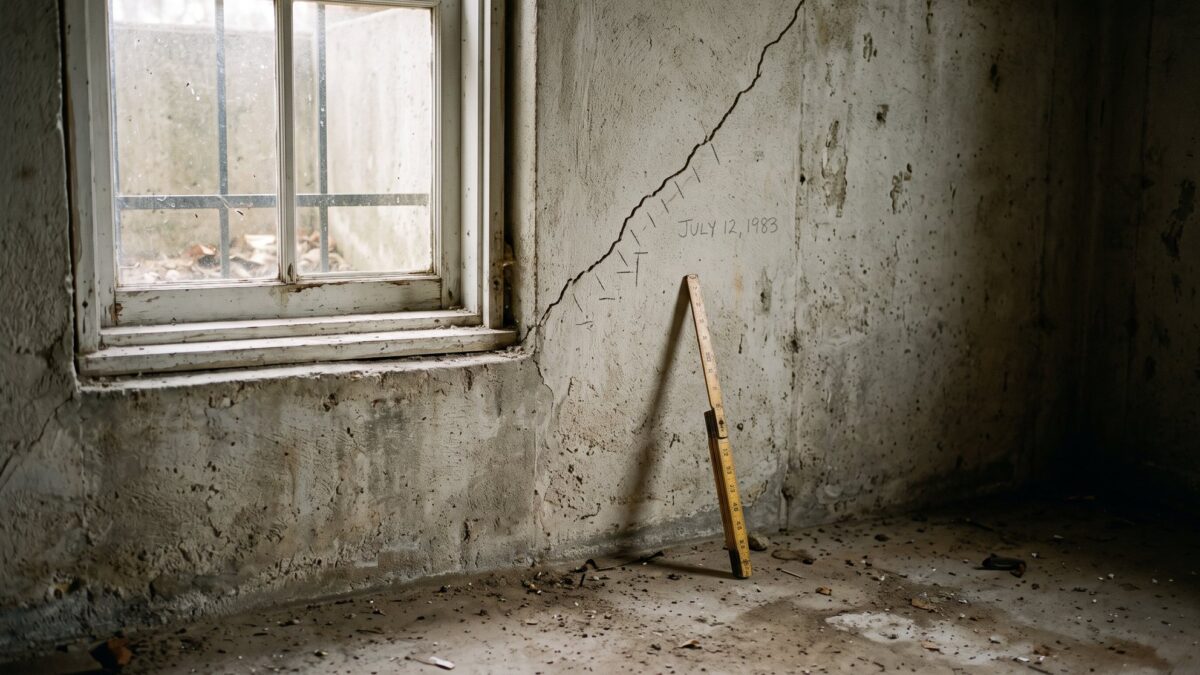
The tight vertical crack that has never leaked. Mark both ends with a dated pencil tick, photograph it straight on with a coin taped beside it for scale, and look again in two months. If nothing has changed, you have a record instead of an invoice. Our full method for that is in monitoring a foundation crack, and the whole exercise costs a pencil.
Cracks in the parging, not the wall. The gray coating troweled over the outside of many older foundations is a finish, not structure, and it crazes and flakes on its own schedule. Cracks that live only in that skin, with sound material behind them, are cosmetic. Tap along the crack: a hollow sound means loose coating, and a $5 tube of masonry caulk is the entire repair.
Water that is not actually coming from the crack. Homeowners often blame the nearest crack for a wet floor that started somewhere else. If the water pools around the floor drain during heavy storms rather than tracking down the wall, you are looking at a sewer issue, and no crack repair touches it. That situation is its own post: why water comes up through a floor drain. A plumber, not a foundation crew, owns that fix.
What should you do next?
First, document the crack tonight for free. Photograph it straight on, measure the widest point, and write the date on the wall in pencil at each end. Ten minutes now gives you the one thing no inspector can produce on the spot: a baseline.
Second, walk outside during the next hard rain. Look at where downspouts discharge, whether the ground slopes toward the wall the crack is in, and whether the window well beside it holds water. Cracks that leak sit downhill from something, and correcting grading and downspouts runs $600 to $2,500, far less than anything with steel in it.
Third, have the crack read by someone who will tell you it is nothing. We measure every crack, say plainly whether it is shrinkage or movement, and price the repair from our published list only if there is one to price. Send us the crack through our free inspection request, or if you would rather describe it out loud, call (630) 335-1128 and we will tell you over the phone which cracks we would come out for.
Questions homeowners ask about foundation cracks
Can I just fill the crack with hydraulic cement myself?
You can, and on a dry, stable crack it changes nothing for better or worse. On a leaking crack it usually fails, because hydraulic cement seals the surface while water keeps traveling through the depth of the wall until it finds the edge of the patch. Injection fills the crack front to back instead. The bigger risk is cosmetic: a patched crack you can no longer measure has lost the movement record you were building.
Does a leaking crack always mean the wall is damaged?
No. Most leaking cracks in poured walls are shrinkage cracks that happen to sit below the water table during wet weeks, and the wall around them is sound. Water tells you about drainage, not about structure. What changes that answer is a leaking crack that is also widening, offset, or running horizontally. In those cases the water is a passenger and the movement is the story, so the diagnosis comes before any sealing.
Why does the crack only show up in spring?
Because spring is when the clay around your foundation is holding the most water it will hold all year. Snowmelt and April rain saturate soil that is still partly frozen underneath, pressure against the wall peaks, and cracks that were dry all winter start weeping. The seasonality is normal and is not by itself a warning. What matters is whether the crack returns each spring at the same width or a little wider every year.
Should I worry about cracks I can see on the outside of the foundation?
Look at whether the crack goes through the wall or only through the coating on it. A crack visible outside that lines up with one inside at the same height is a full-thickness crack and gets measured like any other. A crack that exists only on the exterior face, with nothing corresponding inside, is usually in the parging or the surface. Also check whether it continues up into the brick above, which points at movement rather than curing.
Sixty days of pencil marks answers this question for most homeowners, and costs nothing. If you would rather not wait out a season wondering, we read cracks free within 48 hours, and anything we do repair carries a written warranty, 10 years on urethane injection and 25 transferable years on structural work: call (630) 335-1128.


