Foundation Leveling in Chicago
When the footing itself has settled, the fix is underneath: steel piers driven to soil that can carry the house, then a measured lift back toward level. Warrantied for 25 years and transferable.
- Warranty on piering: 25-year transferable
- Published pricing: piers $1,600 to $3,000 each
- Free settlement inspection within 48 hours
 25-year transferable warranty
What foundation leveling involves
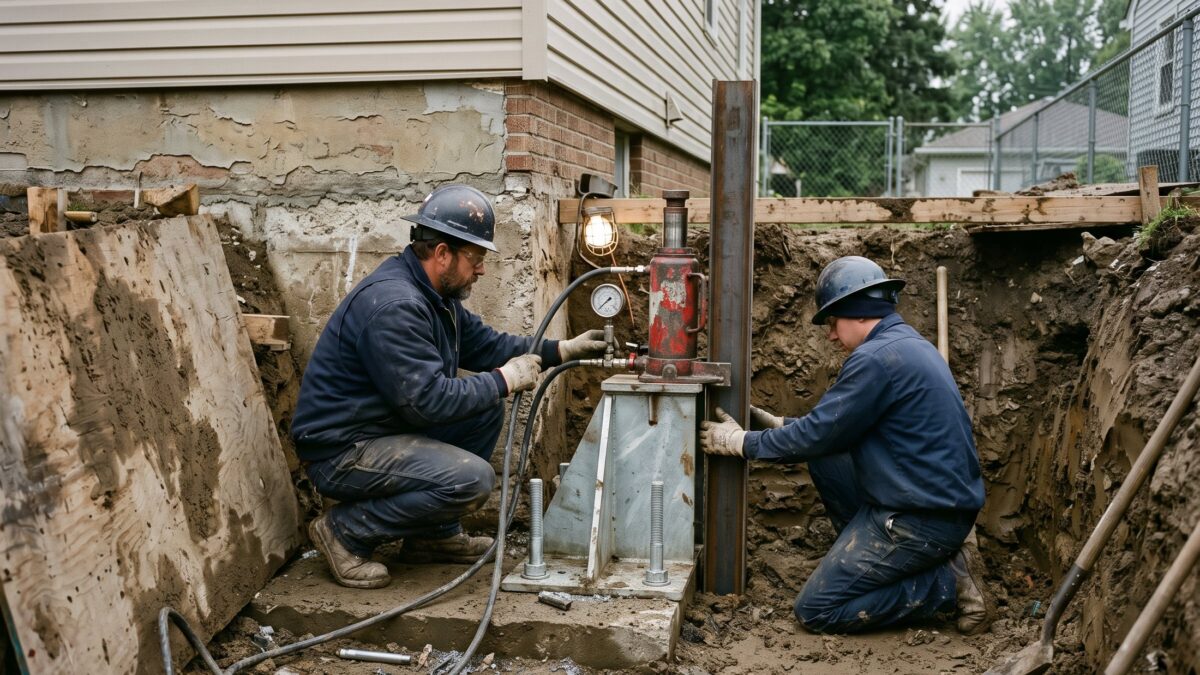
Leveling a settled foundation means giving it new legs that reach past the failed soil. Every piece here serves that transfer of weight.
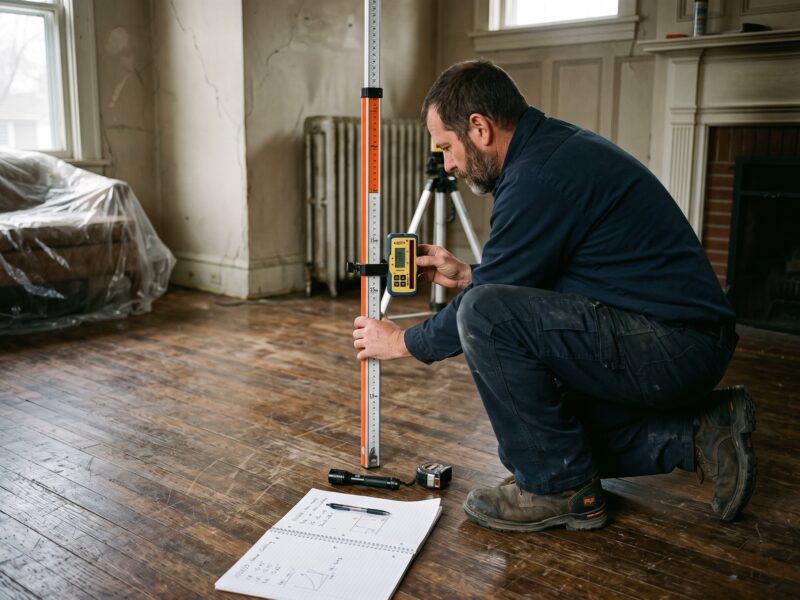
Settlement survey
Elevations shot around the foundation map how far each section dropped, so the pier plan matches the actual movement.
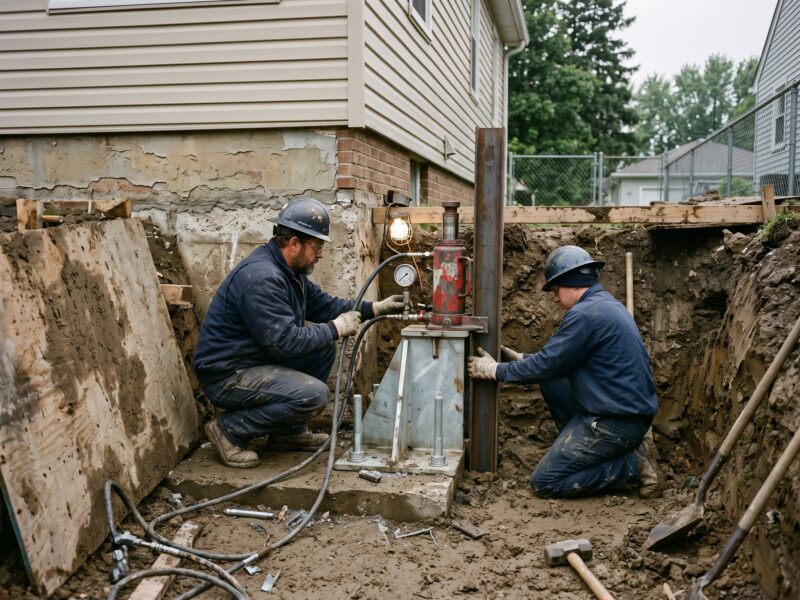
Pier brackets
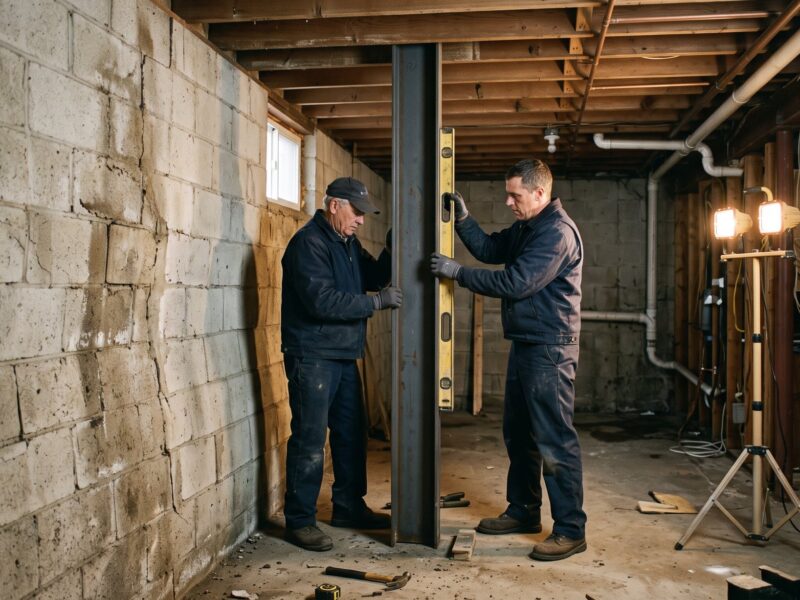
Galvanized steel brackets bolt to the exposed footing and become the hand the house rests on during and after the lift.
Push or helical piers
Steel sections driven or screwed down until they refuse at load-bearing strata, however deep Chicago clay makes that.

The measured lift
Hydraulics raise the settled section in small, monitored increments toward practical level, watched at every bracket.
Crack sealing after the lift
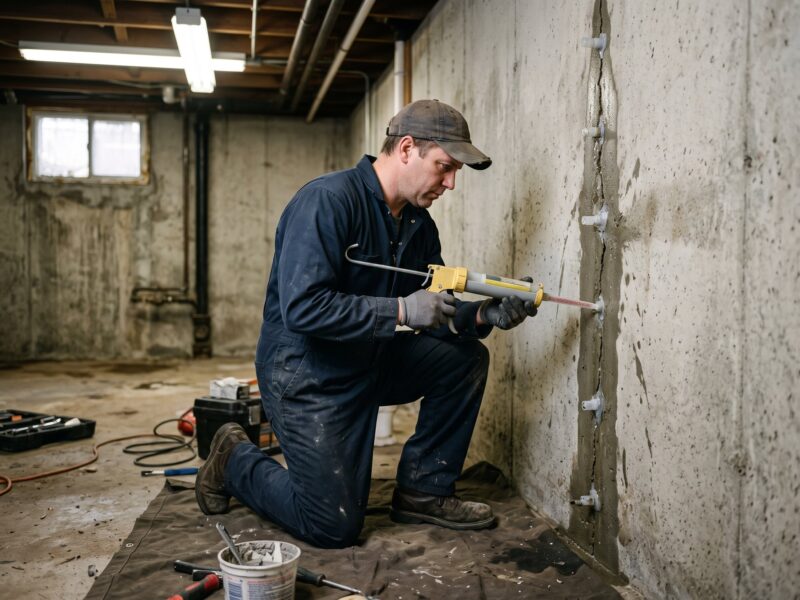
Settlement cracks that closed during the lift get sealed; ones that stay get injected so water never uses them.
Backfill and grading
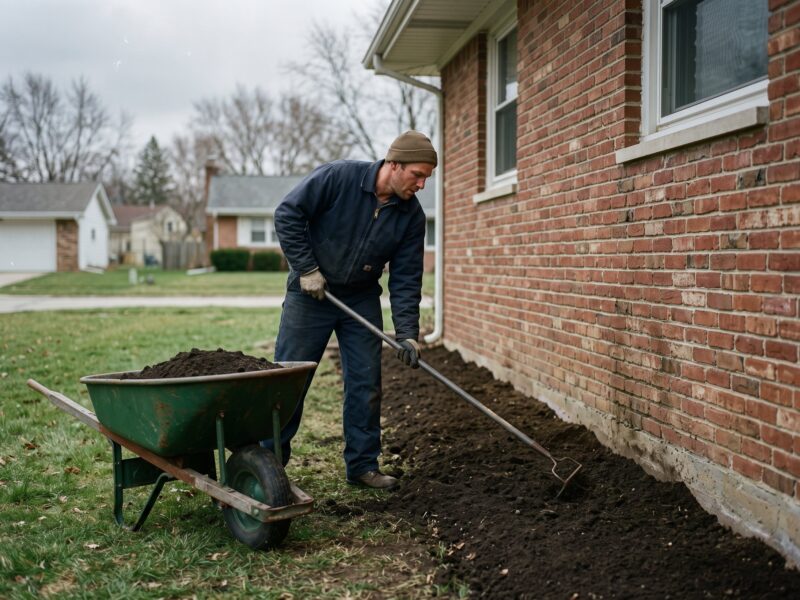
Pier pits close, and the grade goes back sloping away, because the water that softened the soil shouldn't get a second try.
Why do Chicago foundations settle unevenly?
Foundations settle unevenly because the soil under them isn't uniform. One corner of a Chicago house might bear on firm native clay while another sits over the loose backfill of an old utility trench, a filled low spot, or clay that a maple has been drinking dry for thirty years. When a drought season shrinks that weaker soil, the corner above it goes along for the ride.
The house documents the movement precisely: a stair-step crack climbing the block from the sinking corner, a hairline over the patio door, a floor that tilts toward one wall. Uneven is the key word, because it is what separates piering candidates from normal whole-house aging, and it is exactly what the elevation survey measures before anyone proposes steel.
Cracks without settlement? That's the foundation repair page
 Stair-step cracking above a settled corner: the wall drawing you a map.
Push piers, or helical piers?
Both carry the house past the failed soil down to strata that can hold it. Which steel gets used is an engineering call, and here is the honest version of it.
| Push piers | Helical piers | |
|---|---|---|
| How they work | Driven hydraulically, using the house's own weight as the press | Screwed into the soil like a giant threaded anchor |
| Best for | Heavier masonry homes with deep firm strata below | Lighter structures, porches and additions where weight can't drive a pier |
| Depth proof | Drive pressure readings show refusal at load-bearing soil | Installation torque correlates to capacity as it advances |
| Cost | $1,600 to $3,000 per pier, same published range | $1,600 to $3,000 per pier, same published range |
| The choice | Made by load math and soil, not by what's on the truck | Same: the survey decides, and the plan says why |
Concrete lifting is a different trade for slabs and stoops, and it is not what a settled foundation needs.
One corner of the house heading south? The elevation survey measures exactly how far, for free.
How foundation leveling works, survey to sealed cracks
A typical piering job runs three to five days, most of it below grade and out of your way.
Shoot the elevations
We survey the foundation, map the settlement in inches, and design the pier layout against the numbers. Free, within 48 hours.
Day 0Expose the footing
Small pits open at each pier location down to the footing. Landscaping in the work zone gets lifted and saved where it can be.
Day 1Drive to refusal
Brackets bolt on and pier sections drive until pressure readings prove load-bearing strata, whatever depth the clay demands.
Days 2 to 3Lift, lock, restore
The section rises in monitored increments toward practical level, brackets lock, pits close, grade restores, and the 25-year transferable warranty registers to the address.
Days 3 to 5How much does foundation leveling cost in Chicago?
Piers run $1,600 to $3,000 each, and a typical settled corner needs three to five of them, putting most foundation leveling jobs between $5,000 and $15,000. Depth to load-bearing strata and equipment access set the per-pier price.
| Work | Range | What moves the number |
|---|---|---|
| Push or helical piersper pier | $1,600–$3,000 | Depth to load-bearing strata, access for equipment |
| Urethane crack injectionper crack | $450–$900 | Crack length and width, access to the full height |
| Interior support column with footingper column | $1,500–$3,200 | Footing size, condition of the beam above |
Piering is the expensive end of this website, which is why the survey comes first and free: if the movement is old and stable, the honest plan is monitoring, not steel. All ranges live in the pricing guide.
Lifted by the numbers, warrantied for 25 years
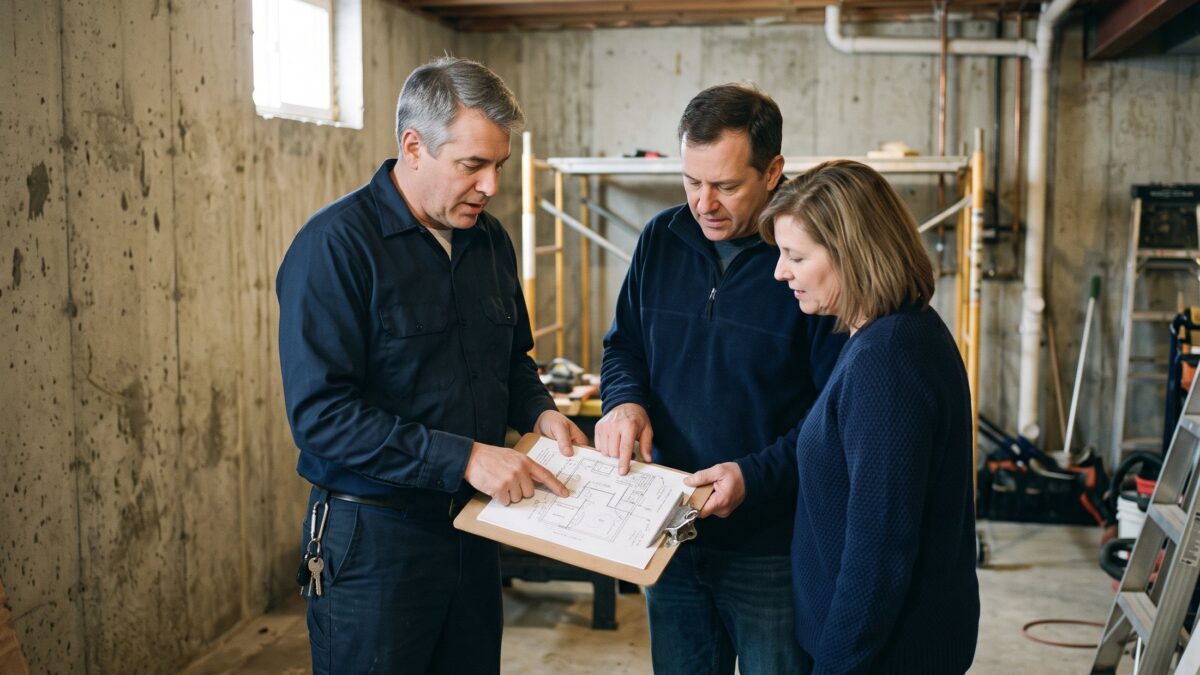
A pier job is only as honest as its measurements, so ours produces paper at every stage: the elevation survey before, the drive-pressure log during, and the final elevations after, all of it yours. In 20+ years of Chicago-area structural work, the packet has settled more arguments with buyers' inspectors than any sales pitch could.
- Elevation survey and drive logs included in your packet
- Licensed, bonded and insured: $2,000,000 general liability
- Piering carries the 25-year transferable warranty, transferable at sale
- The honest answer when old settlement is stable and steel would be theater
Floors sagging but the foundation is fine?
Half the "settling" calls we survey turn out to be interior: a beam or column giving way inside the basement while the foundation sits exactly where the builder left it. That fix is steel columns and footings at a fraction of piering cost, and it has its own page.
House Leveling
In this guide
The detail behind every part of this work, written out in full.
Foundation leveling near you
Serving Chicago and the suburbs: Will, Cook, DuPage, Kane, Kendall, DeKalb and Lee counties.
Foundation leveling questions, answered straight
How much does it cost to level a foundation in Chicago?
Piers run $1,600 to $3,000 each and a settled corner typically needs three to five, so most jobs land between $5,000 and $15,000. The free elevation survey tells you the pier count before you commit to anything.
Can a settled foundation really be lifted back to level?
Back toward level, yes. Piers routinely recover most of the lost elevation, and the lift stops at "practical level": the point where structure, doors and drainage work properly without forcing a fifty-year-old house into cracking itself over the last quarter inch.
How do piers work in Chicago clay?
They bypass it. Pier sections drive or screw through the soft, moisture-cycling clay until they reach strata that refuses further advance, proven by pressure or torque readings. The house then rests on steel standing on that firm layer instead of on soil that changes its mind seasonally.
How do I know it's foundation settlement and not normal aging?
Direction and pattern. Uneven movement leaves a trail: stair-step cracks climbing from one corner, doors sticking on one side of the house, a floor tilting the same way the cracks point. Uniform hairlines with no slope and no progression are usually age, and the survey tells them apart with numbers.
Is foundation leveling covered by the 25-year warranty?
Yes. Piering and underpinning carry the 25-year transferable warranty, registered to the address and transferable at closing, covering the piers' hold on the elevations we leave you with. The elevation record makes the warranty checkable, not just a promise.
Will the pier pits destroy my landscaping?
Each pier needs one small pit at the foundation, dug by hand or mini-excavator. Plants in the footprint get lifted and reset where they can survive it, spoil rides on boards, and the pits close and regrade when the steel locks off. A season later the beds have moved on.

Stop the settling, keep the record
A free elevation survey within 48 hours, a pier plan justified by measurements, and a 25-year transferable warranty that transfers with the house.
Or talk to a human right now
(630) 335-1128
Request your free estimate
Tell us what you're seeing. We'll call back fast and be out within 48 hours.