
Crawl Space Insulation That Survives an Illinois Winter
Batt insulation stapled between the floor joists is the most common thing we find in an Illinois crawl space, and usually the first thing we pull out. It fails for reasons that have nothing to do with the number printed on the package.
- Free measured inspection within 48 hours
- Own crews, published pricing, no upsell scripts
- 1,500+ homes across seven counties
 20+ under Illinois houses
The short answer
Crawl space insulation lasts longest on the foundation walls and the rim joist inside a sealed space, not in batts hung between the floor joists. Fiberglass in a vented crawl takes on summer humidity, sags away from the subfloor and stops holding heat. Sealing the ground and the vents first is what makes any insulation survive here.
Fiberglass works by trapping still air in contact with the surface it protects. Take away either condition and it stops being insulation. In a vented crawl space it loses both: humid air moves through it all summer instead of sitting still, and the weight of the moisture it collects pulls it down off the subfloor. Insulating the floor also puts your ductwork, your water lines and the crawl itself on the cold side of the boundary, which is a strange place to leave equipment you rely on in January.
Illinois punishes that arrangement twice a year. Our winters send subzero air through open block vents into the same bay where the water lines run, and our summers push humid air into insulation that is already holding water from the last storm. Meanwhile the clay outside stays saturated and keeps the soil under the house damp. Sealing the space and moving the insulation to the wall solves the temperature problem and the moisture problem together, which is why it shows up in nearly every scope on the crawl space encapsulation side of our work.
Why does insulation between the floor joists keep falling down?
Batts in a vented crawl fail in a predictable order, and the order is the same in nearly every house we inspect. Nothing about it is an installation defect.
Here is the life of a fiberglass batt in an Illinois crawl space, start to finish.
-
It goes up dry and tight
On the day the house is built the batts fit snugly between the joists, faced side up, wire rods holding them against the subfloor. In a dry, sealed space that assembly would still be working forty years later.
-
Summer air moves through it
Fiberglass slows heat, not air. Humid air crossing a vented crawl passes through the batt rather than around it, so the fibers and the paper facing spend three months of every year in the wettest air in the building.
-
It gets heavy and lets go
Wet fiberglass gains weight and loses loft. The wire rods bend, the facing tears at the staples, and the batt drops an inch or two away from the subfloor. From that moment the floor is being warmed by air, not by insulation.
-
The gap becomes the path
Once a batt hangs loose, cold air runs freely between it and the floor above. The rating on the package is unchanged and completely irrelevant, because the assembly it was rated in no longer exists in your crawl space.
-
Everything useful is left outside
Insulating the floor deliberately puts the crawl into the outdoors. Ducts leak into cold air, water lines sit in it, and the pipes closest to a vent are the ones that split during the first real cold stretch in January.
What we find on the way in
- Batts hanging down, some already on the ground
- Paper facing torn along every staple line
- Dark staining on the underside where the air runs
- Rusted wire rods and rusted duct straps
- Rodent nesting in the low, loose sections
When floor insulation is still the right call
- A crawl that has to stay vented for combustion air until an HVAC contractor reworks it
- A crawl with no ducts or water lines in it at all
- A house being sold this season where sealing is the next owner's decision
How do you insulate a crawl space so it lasts?
The durable version moves the thermal boundary from the floor above down to the foundation wall, so the crawl becomes part of the house instead of part of the yard.
The sequence matters as much as the material, and it starts below the insulation.
-
Handle the water before anything else
Insulation over a wet crawl is money spent on a symptom. Standing water, a seeping wall or a corner that runs every April gets drained to a pit and pumped out first, because nothing above it will survive otherwise.
-
Cover the ground and seal the vents
A reinforced liner over the soil stops moisture rising out of the dirt, and sealed vents stop humid air arriving through the walls. Until both are done, any insulation you install is being asked to work in weather.
-
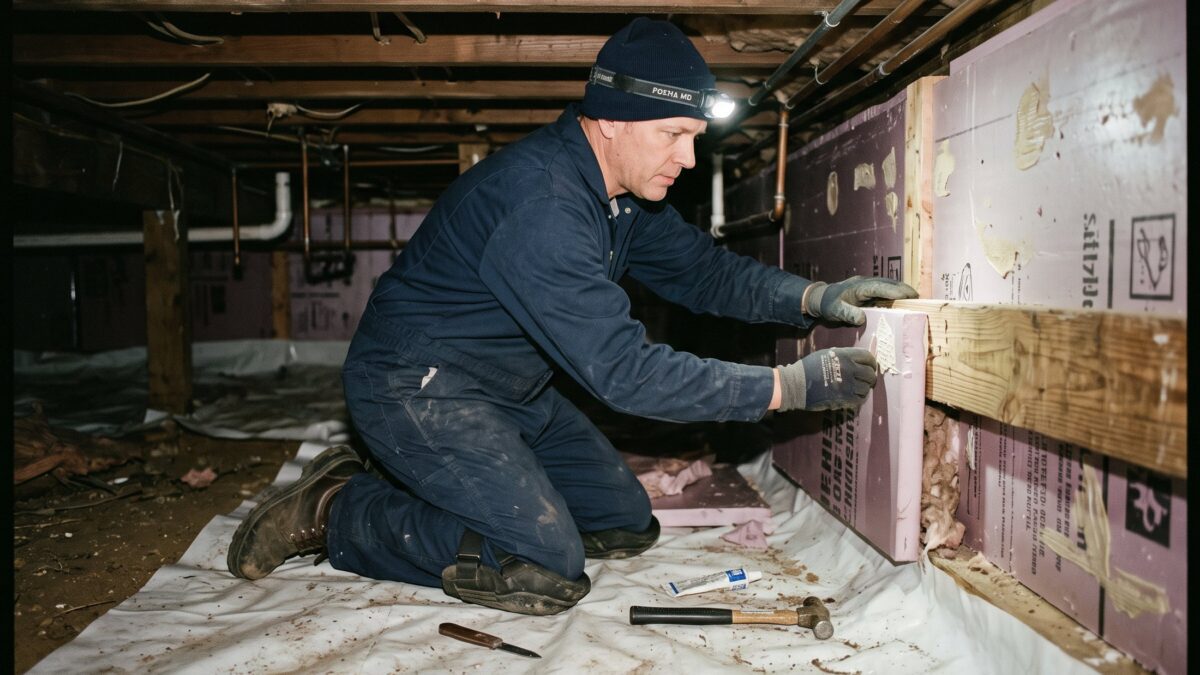
Insulate the rim joist band
The rim is the leakiest strip in most houses: a thin band of wood between the foundation and the floor framing, usually with nothing in it. Air sealing and insulating that band removes the draft people feel at the base of exterior walls.
-
Take the insulation down the wall
Rigid board runs continuously down the inside of the foundation wall, held tight, sealed at the joints and stopped short of the ground so the wood above stays inspectable. Foam plastic generally has to be covered or protected, and how varies by municipality.
-
Bring the space inside the envelope
With the wall insulated, the crawl now sits close to house temperature. Ducts stop losing heat to outdoor air, water lines stop freezing, and the dehumidifier or supply air holds the humidity where it belongs.
What changes upstairs
- The floor over the crawl stops reading cold underfoot
- Drafts at the base of exterior walls settle down
- Ductwork delivers into a space near room temperature
- Water lines come in out of the weather
- Insulation that is not carrying water year after year
What it requires
- The ground covered and the vents sealed first, in that order
- Any combustion appliance reviewed by a licensed HVAC contractor
- A local check on how foam has to be covered where you live
- Enough headroom for a crew to reach the wall and the rim
Floor joists or foundation walls: where should the insulation go?
Both put the same material in the same crawl space. What separates them is which side of the insulation your pipes and ducts end up on.
| Batts between the floor joists | Insulated crawl space walls | |
|---|---|---|
| Where the boundary sits | At the subfloor, crawl stays outdoors | At the foundation wall, crawl comes indoors |
| Ducts and water lines | Left in unconditioned air | Inside the insulated space |
| Behavior in a humid August | Absorbs moisture, gains weight, sags | Unaffected once the vents are sealed |
| How it typically fails | Falls away from the floor, quietly | Fails only if the ground or vents were skipped |
| Frozen pipe risk | The pipe sits in outdoor air | Much lower, though not a guarantee |
| Prep required | None, which is why builders chose it | Liner, sealed vents and drainage first |
| What it costs | Cheap to install, replaced repeatedly | Quoted with encapsulation at $7 to $14 per square foot |
| Who does the work | An insulation contractor | Our crews, as part of the sealed crawl scope |
| Our warranty | Not our scope | Named line by line in the written quote |
Insulation never fixes water. If the crawl floods or the wall seeps after storms, that comes first: see standing water in a crawl space.
Cold floors over the crawl every winter? We measure the space, read the moisture in the wood and put the scope in writing, free within 48 hours.
Which crawl space is yours?
What is already down there, and what can be done about it, follows the year the house went up more closely than anything else.

Pre-war bungalows and two-flats
Shallow crawls under back additions with low headroom and stone or early block walls that are anything but flat. Rigid board rarely sits neatly against those walls, so rim work and a liner usually deliver more than a full wall job.
Rim and liner first
Post-war block ranches
The classic case: block walls, a vent per bay, dirt floor and forty year old batts hanging between the joists. Nearly every one we open has insulation on the ground somewhere and rusted rods still stapled overhead.
Move it to the wall
Split-levels and 1980s poured walls
Poured crawl walls with more headroom and flat faces, often connected to a basement. These take wall insulation well, and because the two spaces share air, the crawl and the basement get scoped as a single project.
Best candidate for wall board
Newer subdivision homes
Crawls under sunrooms and bonus rooms, insulated at the floor by the builder, usually with ductwork running the length of the space. Cold rooms above these crawls are common and rarely a heating system problem.
Seal, then insulate the wallWhat does crawl space insulation cost here?
Wall and rim insulation is quoted inside the encapsulation scope, which we publish at $7 to $14 per square foot. On a 1,200 square foot crawl that arithmetic gives $8,400 to $16,800, and the position within that range depends on headroom, access and what the water is doing.
| Work | Range | What moves the number |
|---|---|---|
| Crawl space encapsulationper square foot | $7–$14 | Access height, standing water, whether drainage goes in first |
| Sump pump with battery backupinstalled | $2,800–$4,500 | Pit condition, backup capacity, discharge routing |
| Downspout extensions and regradingtypical job | $600–$2,500 | Feet of grade to rebuild, soil hauling |
We do not sell insulation on its own into a vented crawl, because the material will end up on the ground the same way the last set did. If yours is staying vented for now, an insulation contractor is the right call. All of our published ranges live on the pricing page.
When insulation is not what your house needs
Cold floors have several causes and only some of them live in the crawl space. These are the ones we hand back.
The ducts are leaking
A disconnected boot or an open seam dumps heated air under the floor instead of into the room above it. That is an HVAC repair, often an afternoon of work, and no amount of insulation compensates for air that never arrives. Have the duct runs checked before you insulate anything.
Call an HVAC techIt is the rim band, not the whole crawl
On a lot of houses the draft is entering along one strip of exposed rim joist above the foundation. Sealing and insulating that band is a weekend of work with hand tools and it is genuinely worth trying first if you are comfortable in the space.
A weekend, not a projectThe crawl is wet
Insulating over standing water or a seeping wall buries the problem behind new material and speeds up what happens to the wood. Drainage comes first, always. How crawl space drainage and sumps work.
Wrong orderYou are selling in the spring
A sealed and insulated crawl is a fifteen year decision, and it is a reasonable thing to leave to the next owner. Document what is down there, price it honestly, and let a buyer decide. How this reads in a sale.
Let the buyer chooseQuestions homeowners ask about crawl space insulation
Should I insulate the crawl space floor or the walls?
The walls, in nearly every Illinois house that can be sealed. Wall insulation brings the ducts and water lines inside the protected space and it is not sitting in moving humid air, so it stays where it was installed. Floor insulation remains the right answer only when the crawl has to stay vented, usually because an appliance draws combustion air from it and that has not been reworked yet.
Can I just replace the fallen batts with new ones?
You can, and in a vented crawl the new ones will follow the old ones down. Nothing about fresh fiberglass changes the conditions that pulled the first set off the subfloor: the same humid air moves through the same space every summer. Replacing batts buys a few winters. Sealing the space first and insulating the wall is what makes the material stop being a consumable.
Does crawl space insulation lower my heating bill?
It usually helps, though we will not put a number on your bill because too much of it depends on your furnace, your ductwork and how the rest of the house is built. What people notice first is comfort rather than cost: floors that stop feeling cold in the morning and drafts that quiet down at the base of exterior walls. Any contractor promising a specific percentage is guessing.
Do I need a vapor barrier under the insulation?
You need the ground covered, which is a different job from insulating. A liner over the soil is what stops moisture rising out of the dirt into the space, and it goes down before any insulation goes up. Thickness is chosen for how the space gets used, from a 6 mil builder sheet up to 12 and 20 mil reinforced liners that hold up to crews and storage.
Will insulating the crawl space stop my pipes from freezing?
It substantially reduces the risk, because a sealed and insulated crawl sits far closer to indoor temperature than to outdoor temperature. Lines running tight against an exterior rim or through an uninsulated corner still deserve their own attention, and a long unheated run on the windward side of the house is worth wrapping. Treat it as a large improvement rather than a guarantee.
Is spray foam or rigid board better on crawl space walls?
Both are used, and the choice usually comes down to how flat and how sound the wall face is. Old stone and rough block take a sprayed product better; flat poured walls take board cleanly. What matters more than the product is that the ground is covered first, the joints are sealed, and the foam is covered or protected the way your local building department requires.
The vents decide whether any of this lasts
Every durable version of crawl space insulation assumes the vents are closed and staying closed. That single decision changes which side of the boundary your pipes are on, how much water the framing carries in August, and whether new material is still doing its job in ten years. Read the vent question before you buy insulation.
Open, closed or sealed for good?

Insulate the crawl once, in the right place
Free written scope within 48 hours, published square-foot pricing, and 0% for 12 months financing if you want to spread it out.
Or talk to a human right now
(630) 335-1128
Request your free estimate
Tell us what you're seeing. We'll call back fast and be out within 48 hours.