Basement Waterproofing in Plainfield, Illinois
Plainfield's drainage was engineered on paper: swales, detention basins and builder grading, all drawn before the fences and patios went in. When the plan stops working, water finds your basement. We put it back where the engineers meant it to go, warrantied for life.
- In Plainfield constantly from the Joliet and New Lenox corridor
- lifetime, fully transferable warranty on interior systems
- Written inspection within 48 hours, free
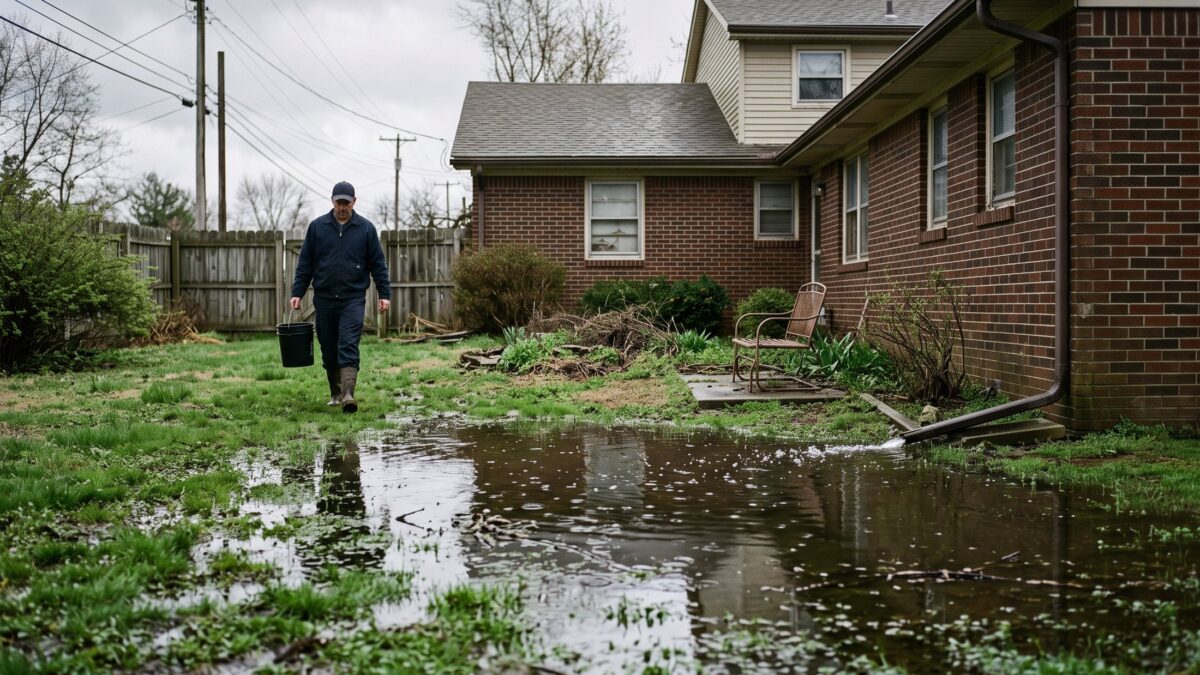 First ring: twenty to thirty minutes out
Who does basement waterproofing in Plainfield?
ProSeal Basement Waterproofing serves every Plainfield subdivision and the historic downtown with interior drain tile at $95 to $160 per linear foot, full perimeter systems with sump and battery backup at $8,000 to $16,000, and yard drainage from $600. The ranges are published online, and the quote you get in Plainfield lands inside them.
Plainfield needs a waterproofing company that can read an engineered drainage plan, because most of the town was built to one. Thousands of houses went up on flat former farmland between 1995 and 2010, every lot depending on swales and detention basins doing exactly what the drawings said. Ten or twenty years of sheds, fences and landscaping have quietly rewritten those drawings, and diagnosing the edit is the actual job.
See the full basement waterproofing system, wall to discharge
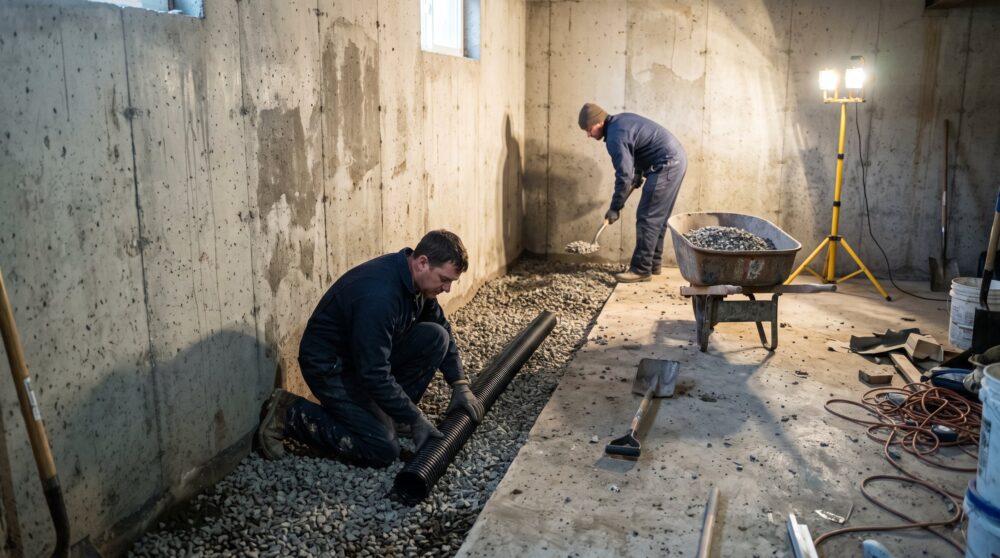 Drain tile at the footing: the permanent answer when yard fixes are not enough.
What does basement waterproofing in Plainfield include?
A Plainfield waterproofing job starts outside and works inward, because on this town's flat lots the cheapest fix is often in the yard. Six systems cover the range, and the inspection prices only what your house needs.
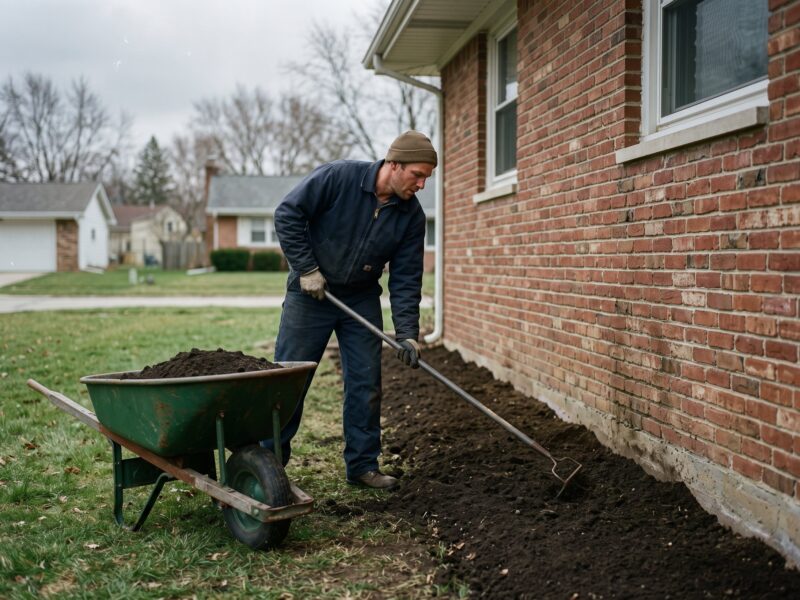 Yard drainage & regrading
Restoring the positive pitch that fifteen years of settling backfill erased.
Learn more
Yard drainage & regrading
Restoring the positive pitch that fifteen years of settling backfill erased.
Learn more
 Sump pumps & battery backup
The original builder pump is the same age as the house; most are living on borrowed time.
Learn more
Sump pumps & battery backup
The original builder pump is the same age as the house; most are living on borrowed time.
Learn more
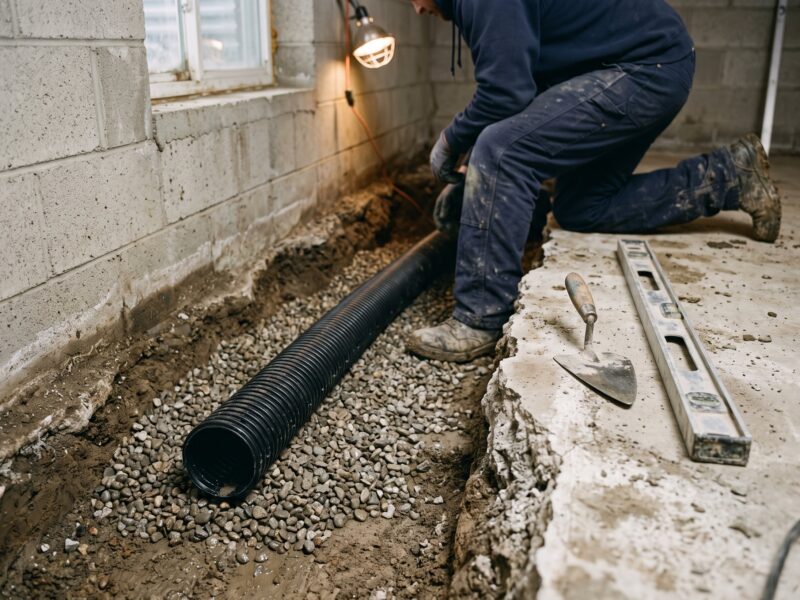 Interior drain tile
Perforated pipe at the footing for basements where the water is truly groundwater.
Learn more
Interior drain tile
Perforated pipe at the footing for basements where the water is truly groundwater.
Learn more
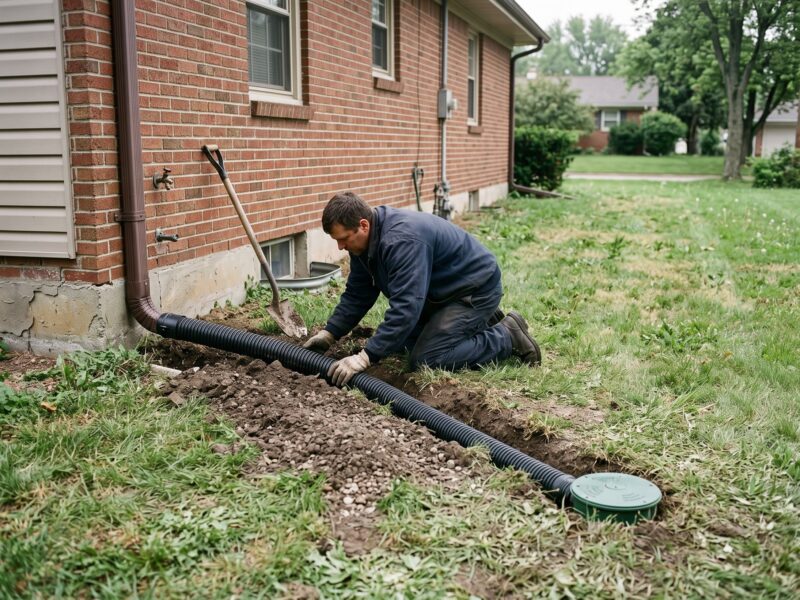 French drains
For lots where a filled-in swale sends the neighborhood's runoff at your wall.
Learn more
French drains
For lots where a filled-in swale sends the neighborhood's runoff at your wall.
Learn more
 Leaking crack injection
Settlement cracks in poured walls sealed full depth from $450.
Learn more
Leaking crack injection
Settlement cracks in poured walls sealed full depth from $450.
Learn more
 Crawl space encapsulation
For the older stock near downtown and additions on the boom-era houses.
Learn more
Crawl space encapsulation
For the older stock near downtown and additions on the boom-era houses.
Learn more
Why do Plainfield basements take on water?
Plainfield basements take on water for two different reasons: the newer subdivisions have drainage plans that stopped matching the ground, and the historic centre sits with the DuPage River and its floodplain. The right fix depends entirely on which Plainfield you live in.

The 1995 to 2010 subdivisions
Poured walls backfilled into clay that grew corn the year before. The walls are mostly sound; the trouble is grading that flattened as the backfill consolidated, an original sump aging out, and downspouts dumping at the foundation.
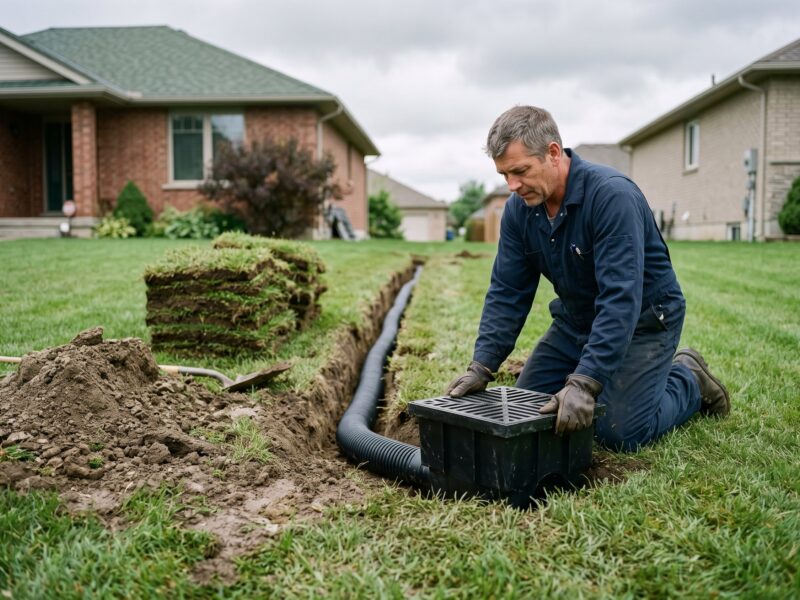
Swale and detention country
Along Route 59, 127th Street and Van Dyke Road, every lot drains through swales to detention basins, exactly as drawn. A fence footing here, a raised patio there, and the water that was supposed to leave the block now sits on it.

Downtown along Lockport Street
The historic centre is the old exception: earlier foundations, mature grades and the DuPage River close enough that part of the neighborhood sits in mapped floodplain. Here the water is real groundwater, and the FEMA map comes first.
What makes Plainfield drainage different?
Plainfield drainage is engineered rather than natural, and that is the key fact about the town's water. The subdivisions were built on flat farm fields with almost no native fall, so the entire design leans on graded swales between lots and detention basins at the low points. When every piece performs as drawn, the system is excellent. When one link fails, the water has no plan B, and the flat ground gives it nowhere to go but down into backfill clay against somebody's basement.
The DuPage River is the other half of the story. It runs straight through downtown Plainfield, and its floodplain is a genuine constraint on the older part of town. River-corridor homeowners get a different conversation from us: the flood map check before any quote, honest talk about what drainage can and cannot do inside a floodplain, and a system scoped for groundwater rather than river water.
 A drainage trench doing what the original swale was drawn to do.
Signs your Plainfield basement needs waterproofing
Six symptoms fill our Plainfield call log, and on houses this young most of them trace to drainage rather than to the wall itself. The free inspection sorts the $900 problems from the $9,000 ones.

The builder's sump running nonstop
A fifteen or twenty year old original pump cycling all storm is either drowning in recycled roof water or genuinely undersized. The yard gets checked before anyone quotes a bigger pit.

Water at the floor-wall joint
The cove joint is where saturated backfill clay finally pushes through. On boom-era poured walls this usually starts small and grows each spring the grading gets worse.

A swale holding water for days
The swale between your lot and the neighbor's should drain within a day of rain. Standing water means the plan has been edited somewhere downstream, and your foundation absorbs the difference.
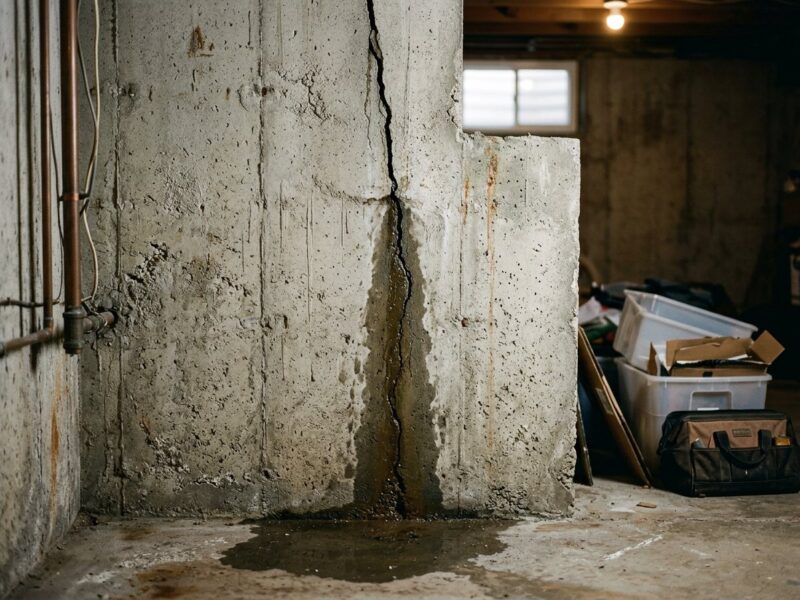
A settlement crack that runs in rain
Poured walls settling into consolidated farm clay crack, and some cracks become spouts. A $450 to $900 injection ends most of them in a single morning.

Damp air off the finished basement
Plainfield basements are finished at a high rate, which hides moisture until the smell arrives upstairs. Seasonal mustiness is a water symptom, not a cleaning problem.

White mineral bloom on the wall
Efflorescence means water is moving through the concrete and leaving its minerals behind. On a wall backfilled into row-crop clay, it is the earliest cheap warning you get.
Sump screaming through every storm? Tell us the subdivision; in Plainfield the year it was platted usually predicts the problem.
How does basement waterproofing work in Plainfield?
Four steps take a Plainfield basement from wet to warrantied, and because the town sits in our first ring, the schedule moves fast. Most full systems are done in two to four days.
Walk the lot, then the basement
In Plainfield the inspection starts outside: the swale, the downspouts, the grade against the wall, and the flood map if you are near the DuPage. Then we trace the water indoors. Free, within 48 hours.
Day 0Price the cheapest honest fix first
If restored grading and buried downspouts will keep your backfill dry, that is the written quote, at $600 to $2,500. Interior systems get proposed only when the water is genuinely groundwater.
Day 0, same visitInstall and flood test
Trench, tile, gravel, sump with battery backup, fresh concrete, then a flood test you watch. In finished basements only the bottom drywall course along the run comes out.
Days 1 to 4Register the warranty
Interior systems carry the lifetime, fully transferable warranty, registered to the address and fully transferable, which buyers in a town this young actively ask about.
On completionInterior or exterior waterproofing: which fits Plainfield lots?
Interior drain tile wins on most Plainfield houses for a local reason: after ten or twenty years of decks, patios, sprinkler lines and landscaping, exterior excavation destroys exactly the yard investment these subdivisions are known for.
| Interior drain tile | Exterior excavation | |
|---|---|---|
| Best for | Cove-joint seepage and saturated backfill clay, the standard Plainfield case | Walls with failed exterior damp-proofing across whole faces |
| Your landscaping | Untouched; the entire job happens inside the basement | Excavator access lanes through beds, decks and sprinkler lines |
| On boom-era poured walls | Pairs naturally with crack injection where settlement has opened leaks | Rarely justified when the wall itself is structurally sound |
| Near the DuPage corridor | Handles groundwater; river flooding is an insurance question we name honestly | Digging in floodplain clay is slow and weather-hostage |
| Cost | $95 to $160 per linear foot | A multiple of interior cost, priced per wall after inspection |
| Season | Installs all winter; frozen ground is irrelevant indoors | Waits on workable ground, which flat wet clay delays |
Where a wall honestly needs exterior work, the quote says so with the reasoning attached. The inspection is a diagnosis, not a product pitch.
When do Plainfield basements flood?
Plainfield water follows the calendar, and flat ground makes the wet months wetter: what falls here leaves slowly. Each season has a right move.
Spring: saturation season
Snowmelt and rain load the flat clay for weeks, the DuPage runs high past downtown, and swales that drain slowly stop draining at all. Cove joints weep and sumps earn their keep. Our busiest Plainfield months.
March to MaySummer: the cloudburst test
Violent storms drop an inch in thirty minutes, detention basins fill, and the power fails right when every sump on the street is running. Battery backup is the difference between a story and a claim.
June to AugustFall: the regrading window
Dry, workable ground makes fall the season to rebuild lost pitch, bury downspouts and reopen swales, the $600 to $2,500 work that spares many Plainfield houses a system entirely.
September to NovemberWinter: the inside season
Interior drain tile installs at full speed while the ground is frozen, and winter calendars book fastest. Systems finished by February meet the March melt already tested.
December to FebruaryHow much does basement waterproofing cost in Plainfield?
Basement waterproofing in Plainfield costs $95 to $160 per linear foot for interior drain tile, with a full perimeter system including sump and battery backup at $8,000 to $16,000, and many Plainfield houses need only the $600 to $2,500 drainage tier. Same published ranges townwide, from Wallin Woods to the river corridor.
| Work | Range | What moves the number |
|---|---|---|
| Interior drain tileper linear foot | $95–$160 | Length of the run, slab thickness, what has to be moved off the walls |
| Sump pump with battery backupinstalled | $2,800–$4,500 | Pit condition, backup capacity, discharge routing |
| Exterior French drainper linear foot | $45–$90 | Trench depth, where the water can legally go |
| Downspout extensions and regradingtypical job | $600–$2,500 | Feet of grade to rebuild, soil hauling |
Every range lives on the pricing page, and your written Plainfield quote lands inside it.
Where we waterproof in Plainfield
We cover all three Plainfield ZIPs, and each sends its own call. From 60544 and the downtown blocks off Lockport Street come the river questions: floodplain checks, older foundations, real groundwater. From 60585 and the 127th Street corridor come swale disputes and sumps that never rest. From 60586, Springbank and the Van Dyke Road side come settled grading, short downspouts and the occasional leaking settlement crack. Wallin Woods sends a little of everything.
Plainfield sits in our first ring, twenty to thirty minutes from the crews' base in the Joliet and New Lenox corridor, so we are in town constantly. Standard inspections happen within 48 hours, active flooding gets 24/7 response, and there is no trip charge.
 Morning start: Plainfield is one of the first stops on the route.
Plainfield basement waterproofing questions, answered straight
Is my house in the DuPage River floodplain?
If you are in older Plainfield near downtown, possibly yes; parts of the historic centre genuinely sit in it. Look up your address on the FEMA flood map before spending anything. It is free, takes two minutes, and it changes the right order of work: flood coverage first, then drainage scoped for groundwater rather than river water.
My builder said the basement was waterproofed. Why is it leaking at twenty years?
Builders damp-proof, which is a spray coating with a service life, not a waterproofing system. Add fifteen to twenty years of backfill consolidation flattening your grading and an original sump at the end of its lifespan, and a dry house starts leaking on schedule. The fix is usually cheaper than the word "waterproofing" suggests.
My sump pump runs constantly. Do I need drain tile?
Often not in Plainfield. On flat lots with settled grading, the pump frequently recycles its own discharge and your roof water in a loop. We walk the yard before quoting anything, because rerouting the discharge and restoring pitch can cut a sump's workload more cheaply than any interior system.
Water stands in the swale between my lot and my neighbor's. Whose problem is it?
Practically, it becomes the low house's problem. Those swales are engineered drainage, and sheds, fences and fill dirt added over the years often block them. We can regrade your side and intercept the flow with a French drain from $45 per linear foot; blockages on someone else's lot are a conversation we help you document.
How much does basement waterproofing cost in Plainfield?
The same published ranges we hold everywhere: $95 to $160 per linear foot for interior drain tile, $8,000 to $16,000 for a full perimeter system with sump and battery backup, $2,800 to $4,500 for a sump with backup alone, and $600 to $2,500 for the drainage work that solves many Plainfield houses outright.
Can you waterproof a finished basement without wrecking it?
Yes, and in Plainfield we do it weekly, because these subdivisions finished their basements at a very high rate. The bottom drywall course along the work line comes off and goes back on, floors and framing get protected, and everything beyond the trench line stays exactly as you finished it.
Do I really need a battery backup on my sump pump?
In Plainfield, yes. The storms that fill sump pits here are the same ones that drop the power, and on flat ground the inflow does not pause while the grid recovers. A backup sized to your pit runs $2,800 to $4,500 installed with the primary, and it is the single most claim-preventing dollar in the system.
How do I choose a waterproofing company in Plainfield?
Ask whether pricing is published before anyone enters your house, whether the warranty transfers to a buyer without fees, and whether they will walk your lot before proposing an interior system. In a town where the honest fix is often grading, a company that only sells drain tile will find drain tile every time.
Is the wet basement also showing cracks?
On Plainfield's boom-era houses, water and movement usually share one cause: backfill clay that is both holding moisture against the wall and still consolidating under the house. If the seepage comes with diagonal cracks off the window corners or a dropped stoop, one inspection covers both trades.
Foundation Repair in Plainfield
Basement waterproofing near Plainfield

Put the drainage plan back to work
A free inspection within 48 hours, the cheapest honest fix quoted first, and a lifetime, fully transferable warranty on every interior system.
Or talk to a human right now
(630) 335-1128
Request your free estimate
Tell us what you're seeing. We'll call back fast and be out within 48 hours.