
Crawl Space Drainage and Sump Systems
A pit in the dirt is not a drainage system. What makes a crawl space stay dry is the pipe and stone that feed the pit, and the discharge that keeps the water from coming back.
- Free measured crawl inspection within 48 hours
- Sealed pits, battery backup, discharge run properly
- $2,000,000 general liability carried on every crew
 Crawl drainage systems: lifetime, fully transferable warranty
The short answer
A crawl space drainage system is perforated pipe bedded in washed stone around the inside perimeter, pitched to a sealed pit where a pump lifts the water out and away from the house. The pipe collects, the pit stores, the pump discharges. Without all three, water simply relocates to a lower spot in the same crawl.
The pump gets the attention and does the least interesting part of the job. Collection is what actually determines whether a crawl space stays dry, because water in clay soil travels sideways slowly and will never find a hole eight feet away on its own. Perforated pipe wrapped in fabric and buried in washed stone gives that water a fast lane it does not have otherwise. The pit is just the end of the lane, and the pump is the elevator at the end of it.
Crawl spaces in this region make that harder than basements do. Headroom is short, the access door is often a hatch behind the furnace, and every bucket of clay comes out through it by hand. Frost depth also puts the discharge line at risk from December to March, which is a real failure mode here and not a theoretical one. Those constraints shape how we design the system, and they are part of why a crawl space encapsulation scope quotes differently from a basement of the same square footage.
How does a crawl space sump system work?
A crawl system moves water in one direction: from the perimeter soil, into stone, into pipe, into a pit, and out through a discharge line. Each stage exists because the one before it cannot do the next job.
This is how a crew builds one, in sequence.
-
Shoot the floor for the low point
A crawl floor is never flat. We shoot elevations across the space to find the genuine low corner, because putting the pit at the convenient corner instead of the low one means gravity fights the system for the rest of its life.
-
Hand dig the perimeter channel
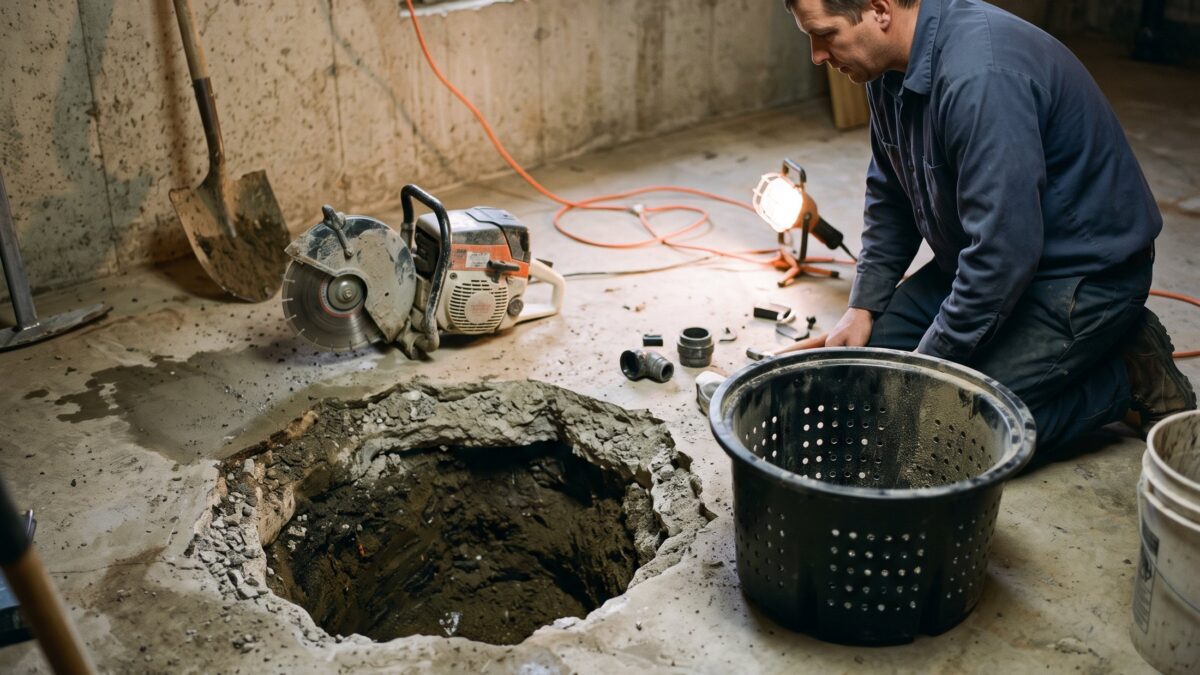
A narrow channel is cut in the soil beside the footing all the way around the wet portion of the crawl, pitched toward the pit. There is no machine that fits, so this is shovels, buckets and a crew working on their knees.
-
Set pipe in washed stone and fabric
Perforated pipe is laid in the channel, surrounded with washed stone and separated from the clay by filter fabric. The stone holds water while the pipe carries it, and the fabric keeps silt from doing to this pipe what it did to the original.
-
Sink the pit below the pipe
The pit is set deep enough that the pipe enters above the pump shutoff level rather than at the floor line, so the perimeter can actually drain into it. It gets a sealed, gasketed lid, because an open pit in a sealed crawl is a moisture source.
-
Run the discharge and back up the power
The line leaves through the rim, gets a check valve, and is carried far enough from the wall that the water does not return through the same soil it just left. A battery backup sits alongside the primary, because storms and outages arrive together.
What a proper crawl system gives you
- Water collected from the whole perimeter, not one puddle
- A pit that stays sealed against the crawl air
- A discharge point chosen for the lot, not for convenience
- Backup power for the exact night you will need it
- Interior systems carry our lifetime, fully transferable warranty
What it asks of you
- A dedicated outlet that stays live and never gets borrowed
- A test with a bucket twice a year, spring and fall
- The discharge outlet kept clear of mulch, snow and leaves
Why do crawl space sump pumps fail?
Crawl pumps fail more often than basement pumps for one unglamorous reason: nobody visits them. A basement pump gets noticed. A crawl pump runs unwatched behind a hatch for years.
These are the five failures we are called out to correct most often.
-
The pipe silts shut
Pipe laid straight into clay with no stone and no fabric packs solid within a few seasons. The pump still runs, the pit still fills slowly, and the far end of the crawl quietly goes back to holding water. From above, nothing looks wrong.
-
The pit is too shallow
A pit dropped in at floor level cannot accept pipe below the pump shutoff, so the perimeter never drains and the pit only catches what walks in. This is the most common design error we find in crawl spaces someone else installed.
-
The discharge freezes
A line pitched back toward the house, or ending in a buried elbow packed with ice, gives the pump nowhere to send water in January. The motor runs against a plug until it quits. See frozen discharge lines in an Illinois winter.
-
The power goes out mid-storm
Straight-line winds knock the grid down at the same moment the pump is needed most. Without a battery backup, a crawl space fills in silence and nobody finds out until the smell reaches the living room a week later.
-
Nobody ever looks
Floats snag on the pit wall, check valves stick, lids get left off, and debris finds its way into an open pit. All of these are five-minute problems that turn into flooded crawl spaces because the hatch has not been opened since the install.
How to catch it early
- Pour a bucket in and watch the pump cycle and stop
- Listen for a rapid on-off chatter, which means a stuck check valve
- Walk the discharge outlet after the first freeze
- Look for a fresh stain line on the crawl walls each spring
Signs it already failed
- A dry pit after two days of steady rain
- Silt or mud fanning across the liner
- Wet insulation or a musty smell in the room above
- A pump running constantly and never shutting off
Own pit in the crawl, or route it to the basement sump?
Most Illinois houses with a crawl space also have a basement, and the first question is whether the crawl gets its own pump or drains into the one that already exists.
| Dedicated pit in the crawl | Routed to the basement sump | |
|---|---|---|
| How water travels | Short run to a pit at the crawl low point | Gravity line through or under the knee wall |
| Requires | Room for a pit and a power circuit | The basement pit sitting genuinely lower than the crawl |
| Published cost | Adds a sump pump with battery backup at $2,800 to $4,500 | Pipe and tie-in only, priced with the drainage scope |
| Redundancy | Two independent pumps, two failure points | One pump carrying both loads |
| If one system floods | The other keeps working | Both go down together |
| Service access | Means crawling to it | Everything serviced standing up in the basement |
| Winter risk | A second discharge line to keep clear | One discharge line to watch |
| Best case for it | A crawl below basement level, or a detached crawl | A shallow crawl sitting well above the basement floor |
Whichever way it goes, pump selection and pit depth get decided on site after we measure inflow, not from a catalog. Our sump pump installation page covers how we size and set them.
Not sure your crawl pump still works? We test it, measure the inflow and put the findings in writing, free within 48 hours, with 24/7 availability when water is rising.
What kind of crawl space are you working with?
How a crawl was built decides where the pit can go and whether gravity is on your side. Four patterns account for nearly every crawl we open a hatch on.

Pre-war bungalows and two-flats
A shallow crawl under a rear addition, often with a rubble or early block wall and no footing to speak of. Headroom under thirty inches is normal, and the only access is a hatch cut through a closet floor.
Its own small pit
Post-war block ranches
Half the footprint is basement, half is crawl, split by a knee wall. The crawl floor usually sits above the basement slab, which makes a gravity tie-in to the existing pit genuinely practical.
Often route to the basement
1980s and 90s poured additions
Poured crawl walls under a family room, joined to the original foundation at a cold joint that leaks before anything else does. Water enters at the seam and runs the length of the addition.
Perimeter pipe, then a pit
Newer subdivision homes
A builder pump sitting in an open pit with a short discharge, working fine until the backfill settles. The pit is usually right, the discharge and the backup usually are not.
Upgrade, do not replaceWhat does a crawl space drainage system cost?
A sump pump with battery backup runs $2,800 to $4,500, and perimeter drain tile runs $95 to $160 per linear foot. Most crawl jobs are a combination of the two plus the liner.
| Work | Range | What moves the number |
|---|---|---|
| Interior drain tileper linear foot | $95–$160 | Length of the run, slab thickness, what has to be moved off the walls |
| Sump pump with battery backupinstalled | $2,800–$4,500 | Pit condition, backup capacity, discharge routing |
| Crawl space encapsulationper square foot | $7–$14 | Access height, standing water, whether drainage goes in first |
| Downspout extensions and regradingtypical job | $600–$2,500 | Feet of grade to rebuild, soil hauling |
Headroom and door width move crawl labor more than linear footage does, so we measure both before quoting and show them on the estimate rather than burying them. All published ranges are on the pricing page.
When a crawl space does not need a pump
Plenty of crawl spaces are damp without ever holding water, and a pump there is money spent on a problem you do not have.
The crawl has never held water
A crawl with dry soil and no stain line on the walls has a vapor problem, not a drainage problem. A sealed liner handles vapor on its own. Before you buy anything, put a $30 hygrometer down there for a month and read what it tells you.
No pump neededThe pump you have just needs service
A snagged float, a stuck check valve or a pit half full of gravel accounts for a large share of the pumps we are called to replace. Cleaning and testing is a fraction of a replacement. Start with sump pump maintenance.
Service, not replaceThe water backs up out of a drain
If water rises through a floor drain or a cleanout during heavy rain, that is the sanitary or combined sewer, not groundwater, and a sump will not touch it. That job belongs to a licensed plumber and possibly a backflow device. The two look alike on a wet floor and separate easily once you know what to smell for.
Not our workThe gutters are doing it
Leaders discharging beside a crawl wall put more water into that soil in one storm than the water table does all spring. Extensions and regrading run $600 to $2,500, carry a 5-year warranty, and deserve a season of watching before you consider a pump.
Cheapest real fixQuestions homeowners ask about crawl space sumps
Do I need a sump pump in my crawl space?
Only if liquid water arrives there. The test is evidence, not opinion: a stain line on the walls, mud fans across the soil, or water you have actually seen standing. Crawl spaces that are merely damp need sealing and drying, not pumping. Crawl spaces that puddle after storms need collection and a pump, because a liner over wet clay just gives the water something to sit on top of.
Where is the crawl space sump allowed to discharge?
The general Illinois principle is that clear water from a sump goes to the surface of your own property, away from the foundation and away from your neighbor, and not into the sanitary sewer. Specific requirements vary a great deal by village and by which sewer system your street is on. Ask your municipality before the line is trenched, and we will route it to whatever they tell you.
Can one sump pump handle a basement and a crawl space?
Frequently yes, when the crawl floor sits high enough that a gravity line can reach the basement pit. It saves a pump and a circuit and keeps everything serviceable while standing up. The tradeoff is that one failure now takes out both spaces at once. On houses where the crawl sits low, or where the crawl is under a detached wing, a separate pit is the only workable answer.
What happens to the crawl pump in a power outage?
Without backup, nothing happens, which is the problem. Illinois storms take the grid down at the exact hour the ground is delivering the most water. A battery backup gives the system a bridge through that window and an alarm so you know it is on. In a crawl space that alarm matters more than in a basement, because you are not going to walk past the pit and notice.
Do I need a permit for a crawl space sump pump in Illinois?
Sometimes. Illinois leaves this to individual municipalities, so one village wants a plumbing permit and an inspection for the discharge, and the next village next door does not. Interior work is treated differently from anything that trenches across a yard or connects to a public system. Call your building department before work starts, or ask us and we will confirm what your village requires for the scope.
How often should a crawl space sump be checked?
Twice a year is the honest minimum, once before the spring thaw and once before the first hard freeze. Pour a bucket of water in and watch the pump start, run and shut off cleanly. Look at the pit for silt, check that the lid is sealed, and walk outside to the discharge point. Ten minutes twice a year prevents most of the crawl space floods we get called to.
The discharge line decides whether it comes back
A crawl pump that dumps water four feet from the wall is running the same gallon around a circuit all night. Where the line ends, how it is pitched and how it survives a freeze matter as much as the pump itself, and they are the part most installs get wrong.
Where sump water should actually go

Have the crawl measured before you buy a pump
Free inspection within 48 hours, published pricing, 0% for 12 months, and a lifetime, fully transferable warranty on the system we install.
Or talk to a human right now
(630) 335-1128
Request your free estimate
Tell us what you're seeing. We'll call back fast and be out within 48 hours.