
Crawl Space Dehumidifiers: Do You Need One?
A dehumidifier is the last piece of a dry crawl space, never the first. Put one in a vented crawl over wet soil and it will run all summer trying to dry the state of Illinois.
- Free crawl space moisture reading within 48 hours
- Sealed, drained and dried in one scope
- Own crews, no commissioned salespeople
 Sealed crawl systems, 1,500+ homes
The short answer
A crawl space dehumidifier removes water vapor from air in a sealed, lined crawl space and drains the condensate to a sump or a drain. It is worth installing once the space is closed off and liquid water is handled. In a vented crawl over bare soil it runs constantly and never wins.
Air holds water as vapor, and how much it can hold depends on temperature. Warm summer air carries a great deal of it. Push that air into a crawl space where the soil and the walls sit near ground temperature all year, and the air cools, its capacity drops, and the moisture it was carrying condenses out onto the coolest surfaces it can find: the ductwork, the pipes, the joists and the underside of your subfloor. That is the mechanism behind most crawl space moisture problems, and it runs backwards to what people expect.
This region gives that mechanism a long season to work in. Illinois summers are humid for months, the soil under a house stays cool through August, and a vented crawl invites the two together every single day. Meanwhile the same crawl needs to survive January without freezing pipes. That combination is why sealing, drainage and a dehumidifier are treated as one system in a crawl space encapsulation scope rather than three separate purchases made in three separate years.
Why is my crawl space so humid in the summer?
Crawl space humidity is not one source. It is usually three or four adding together, and a dehumidifier that fights all of them at once is a dehumidifier you will replace early.
These are the sources we measure on a typical Illinois crawl.
-
Bare soil evaporating
Uncovered earth under a house gives up moisture continuously, and it never runs out because the ground behind it is a reservoir. Even soil that looks dry on top releases water into the air above it every hour of every day.
-
Humid outdoor air through the vents
On a July afternoon the air coming through a foundation vent carries more moisture than the cool crawl can hold. It condenses on the first cold surface it touches. Vents were meant to dry a crawl space and in this climate they often do the opposite.
-
Cold surfaces making their own water
Air conditioning ducts and cold supply lines running through a warm crawl sweat exactly the way a glass of ice water does. That drip lands on insulation, on the soil, or on top of a liner, and it looks like a leak because it behaves like one.
-
The stack effect pulling it upstairs
Warm air leaving the top of a house pulls replacement air in at the bottom, and in most homes a real share of that comes straight out of the crawl space. Whatever the crawl air is carrying, the rooms above are breathing a version of it.
-
Water that is actually standing
If there is liquid water on the floor or in the soil, everything above is a footnote. Vapor coming off open water swamps every other source combined, and no appliance is going to outrun it.
How to check yours
- Leave an inexpensive hygrometer in the crawl for a full month
- Read it on the most humid week of the summer, not in April
- Feel the joists and the duct wrap for dampness by hand
- Look for rusty nail heads and dark staining on the subfloor
What high humidity does down there
- Wood stays damp, and damp wood grows things
- Insulation absorbs moisture and falls out of the joist bays
- The smell rises into the rooms directly above
- Metal fasteners, ducts and strapping start to corrode
What does a crawl space dehumidifier actually do?
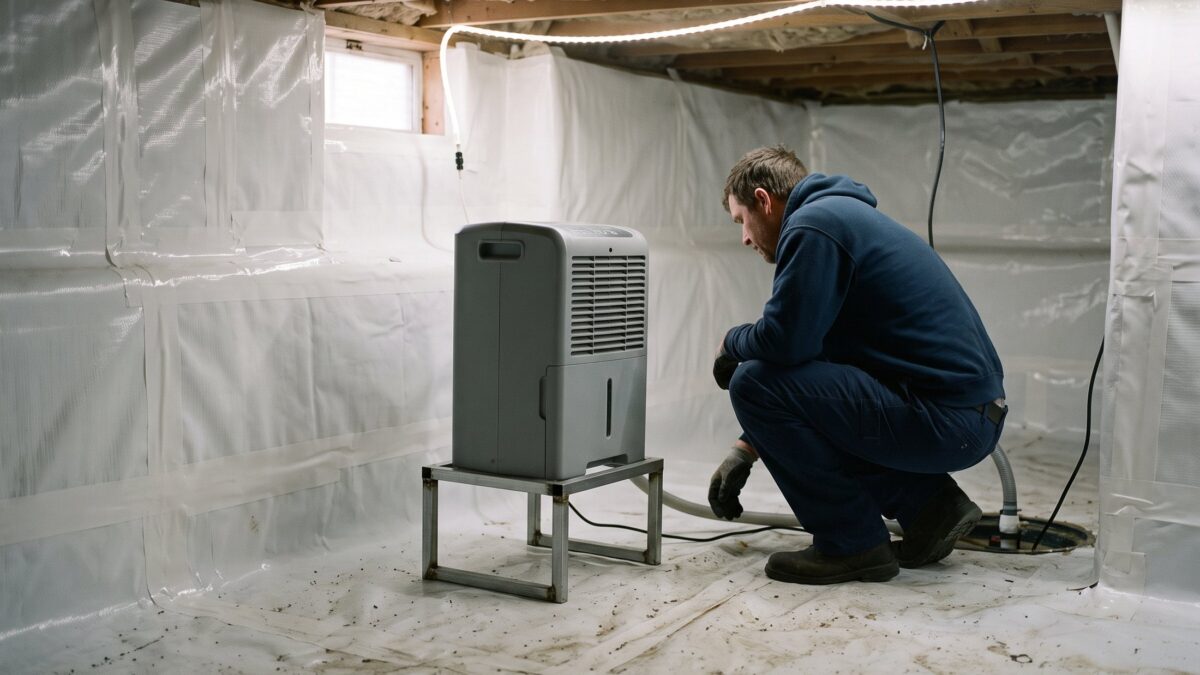
A dehumidifier pulls crawl air across a cold coil, condenses the moisture out of it, drains that water away and returns drier air to the space. It is a simple machine with one demanding requirement: the space has to be closed.
Here is what makes one work rather than just run.
-
Seal the space first
Vents get closed and sealed, the rim joist is air sealed, and the access door is weatherstripped. Until the crawl stops exchanging air with the outside, the machine is dehumidifying whatever the weather sends it and the meter never stops turning.
-
Cover the ground
Heavy liner across the soil and up the walls removes the largest single moisture source in the space. This is the step that turns the dehumidifier from a full-time job into a part-time one, and skipping it is what burns units out.
-
Drain the condensate somewhere permanent
The water it collects has to go to a sump pit, a floor drain or a condensate pump. A bucket you have to empty is fine on a rental unit and useless in a crawl space nobody visits between Thanksgiving and Easter.
-
Set a target and let it hold it
The unit runs off a humidistat rather than a timer. We aim to hold crawl air well under sixty percent relative humidity, which is the range where wood, insulation and metal stop getting into trouble, and we set it once rather than chasing it.
-
Hang it and keep it serviceable
A unit suspended from the joists stays out of any water that ever arrives and drains by gravity. It still needs its filter changed and its coil looked at, so it goes where a person can actually reach it through the access door.
When one earns its keep
- The crawl is sealed and lined but summer readings stay high
- Ductwork or supply lines run through the space and sweat
- There is finished living space directly above the crawl
- Someone in the house reacts to the air in the summer
When it is the wrong purchase
- Liquid water is still arriving on the floor
- The vents are still open to the outside
- The rim joist leaks air you can feel on a windy day
- Nobody plans to ever open the hatch and service it
Should crawl space vents be open or sealed?
Foundation vents were code for decades and are still cut into most Illinois crawl walls. The question is whether leaving them open helps a house in this climate.
| Vented crawl | Sealed crawl with a dehumidifier | |
|---|---|---|
| What happens in July | Humid outside air condenses on cool surfaces | Crawl air is conditioned and held at a target |
| What happens in January | Cold air on pipes and the floor above | Space stays closer to house temperature |
| Wood and insulation | Cycle wet and dry all season | Stay dry once the space is dried out |
| Floor above | Cold underfoot in winter | Noticeably warmer in the same rooms |
| Running cost | None, and no control either | A dehumidifier that cycles rather than runs flat out |
| Upfront cost | Nothing today | Encapsulation at $7 to $14 per square foot |
| What it needs from the house | Nothing | Sealed vents, sealed rim, a lined floor, a drain for condensate |
| Where it makes sense | A high, genuinely dry crawl in open country | Nearly every crawl space we see in this region |
Sealing a crawl changes how combustion appliances down there get their air, so that gets checked before anything is closed up. More on the tradeoffs at crawl space vents: open, closed or sealed for good.
Want to know what your crawl air is doing? We take moisture readings, check the wood and give you the numbers in writing, free within 48 hours.
Which houses actually need one?
A dehumidifier belongs in a crawl space when the space is sealed and the house above it is living with the air. The era of the house tells you how likely that is.

Pre-war bungalows and two-flats
The crawl under a back addition connects to the basement and shares its air, so moisture from the crawl becomes moisture in the whole lower level. Sealing usually matters more here than the appliance does.
Seal first, then measure
Post-war block ranches
Bedrooms sit directly over the crawl with nothing but a subfloor between them. This is the era where homeowners notice the smell first and the humidity second, and where a dehumidifier changes the room fastest.
Usually worth it
1980s and 90s additions
Poured crawl walls with fiberglass stuffed in the joist bays and a leaky rim above it. Air sealing the rim often drops the readings more than any machine you could hang.
Air seal, then decide
Newer subdivision homes
Tight houses with ductwork routed through the crawl, which sweats all summer. The space is often already half sealed, so finishing the job and adding a unit is a short step.
Good candidateWhat does it cost to seal and dry a crawl space?
Crawl space encapsulation runs $7 to $14 per square foot, and that scope is what makes a dehumidifier worth owning. On a crawl that also holds water, drainage is priced on top of it.
| Work | Range | What moves the number |
|---|---|---|
| Crawl space encapsulationper square foot | $7–$14 | Access height, standing water, whether drainage goes in first |
| Interior drain tileper linear foot | $95–$160 | Length of the run, slab thickness, what has to be moved off the walls |
| Sump pump with battery backupinstalled | $2,800–$4,500 | Pit condition, backup capacity, discharge routing |
| Downspout extensions and regradingtypical job | $600–$2,500 | Feet of grade to rebuild, soil hauling |
We quote the dehumidifier as a line inside the encapsulation scope rather than as a published unit price, because the right size depends on the square footage, the headroom and how tight the space ends up. Every other range we work from is on the pricing page.
When a dehumidifier is the wrong answer
We turn down dehumidifier work regularly, because in a lot of crawl spaces it would be selling somebody a machine to fight a problem a cheaper fix already solves.
There is still water on the floor
Vapor coming off standing water will outrun any unit you hang. Get the water collected and pumped first, then measure again. Standing water in a crawl space covers how to find where it is arriving from.
Drainage firstThe vents are still open
Running a dehumidifier in a vented crawl means paying to dry outdoor air as fast as it arrives. The unit will not fail, it will simply never shut off, and you will replace it years early. Seal the space or skip the appliance.
Money burnedThe dryer or a bath fan vents into the crawl
A dryer duct that came apart, or a bath fan someone terminated in the crawl instead of through the roof, pumps warm wet air under your house every day. Reconnecting a duct is a small job for a handyman and it is not our trade.
Not our workThe numbers say you are fine
Put a hygrometer down there through one full Illinois summer. If the readings sit in a comfortable band during the worst week of August and the joists are dry to the touch, you do not need a dehumidifier and nobody should be selling you one.
Costs almost nothingQuestions homeowners ask about crawl space dehumidifiers
Do I really need a dehumidifier in my crawl space?
Not automatically. You need one when the space is already sealed and lined, the liquid water is handled, and summer readings still sit high enough to keep the wood damp. Plenty of crawl spaces settle into a reasonable range from sealing alone, and we would rather install nothing than install a machine to solve a problem the liner already solved. Measure for a season before you decide.
Can I just put a hardware store dehumidifier down there?
You can, and people do, but understand what you are buying. Portable units are built for a warm laundry room, not a fifty-five degree crawl, and many lose capacity badly as the space cools. They also collect into a bucket somebody has to empty. A unit intended for a crawl space is built to work at those temperatures and drains itself. If you try a portable one, at least give it a hose to a drain.
Where does the water it collects go?
Into a sump pit, a floor drain, or a small condensate pump that lifts it to one of those. Gravity is the option we prefer, because it has nothing to fail. What we will not do is leave a bucket in a space nobody enters for months, since a full bucket means a dehumidifier that has quietly stopped doing anything while you assumed it was working.
Will a dehumidifier get rid of the musty smell upstairs?
Usually, once the source is dry. That smell is microbial growth on damp wood and it fades as the wood dries, though it takes weeks rather than days. If the smell persists in a crawl that now reads dry, something is still wet: insulation left in place, a duct sweating, or growth on wood that needs cleaning. <a href="/crawl-space-encapsulation/crawl-space-mold-wood-rot/">Crawl space mold and wood rot</a> covers that.
Does it run all winter in Illinois?
Far less than in summer, and that surprises people. Cold outdoor air holds very little moisture, so once a crawl is sealed the winter load is small and a properly set unit barely cycles from December through March. The heavy work happens between May and September. A dehumidifier that runs hard in January is telling you the space is not sealed or something is leaking into it.
How much does it add to the electric bill?
That depends on the unit, the size of the crawl and how tight the space is, and we do not publish an energy figure we cannot stand behind for your house. What we can say is the direction: a sealed, lined crawl asks far less of a dehumidifier than a vented one, so the sealing work is what keeps the running cost down. Ask for the unit specifications and read the rated draw before you buy.
What goes into sealing a crawl space?
A dehumidifier is one line on a scope that also covers the liner, the walls, the rim joist, the vents and the access door. Seeing the whole scope in order makes it obvious why the appliance comes last and what it is actually being asked to do.
What crawl space encapsulation includes

Get real numbers out of your crawl space first
Free moisture readings and a written scope within 48 hours, published pricing, and 20+ of Illinois crawl spaces behind the recommendation.
Or talk to a human right now
(630) 335-1128
Request your free estimate
Tell us what you're seeing. We'll call back fast and be out within 48 hours.