
Vapor Barrier Thickness and Materials
Thickness is the number everyone asks about and close to the least useful thing on a liner spec. What the material is reinforced with, how far up the wall it runs and how the seams are finished decide whether it is still working in ten years.
- Seams lapped and taped, edges terminated
- Free crawl space inspection within 48 hours
- 20+ of Illinois crawl spaces, 1,500+ homes
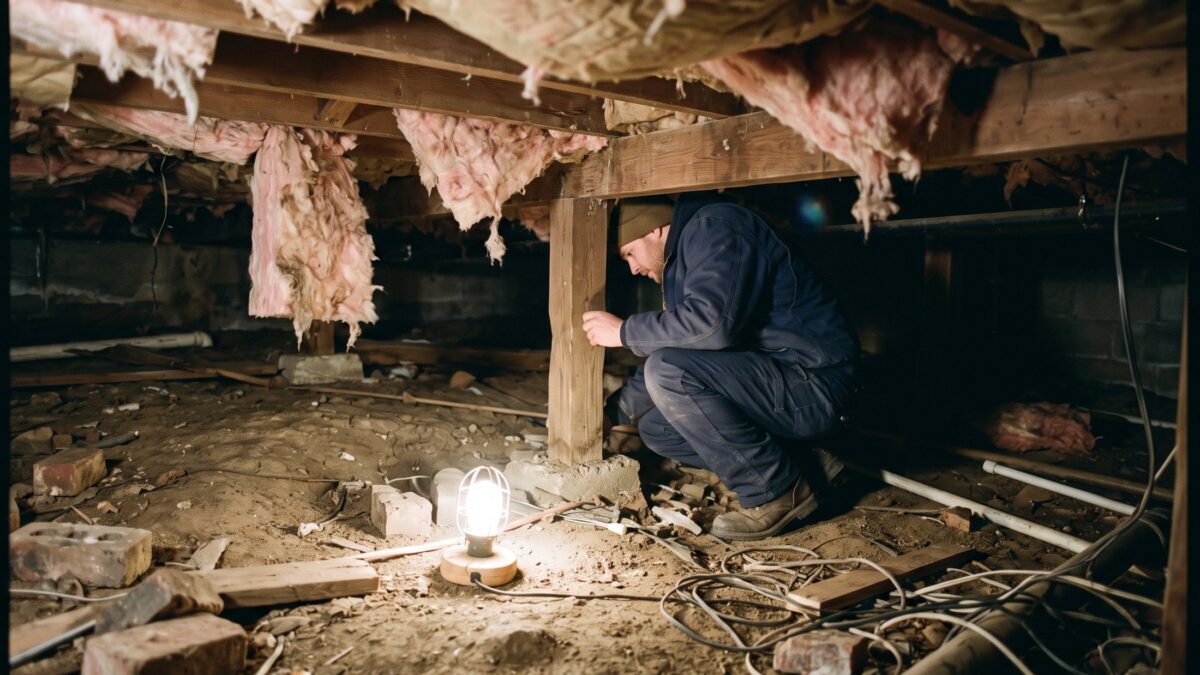 Reinforced liner, sealed terminations
The short answer
A crawl space vapor barrier should be a reinforced liner rather than thin sheeting. Builder grade poly stops vapor on day one and then tears under knees and tools. Coverage matters more than the mil number: the material has to run up the stem walls, wrap the piers, and have lapped and taped seams with a sealed top edge.
A vapor barrier does one job. Bare soil under a house releases water vapor continuously, and impermeable material laid over that soil cuts the release off at the source. Almost any plastic film does that on the day it is installed, which is why thickness alone is a weak way to compare products. What separates a liner that keeps working from one that quietly stops is whether it survives contact: knees, tool bags, a technician dragging himself toward a shutoff. Once it tears or gets shoved aside, the soil is open to the air under your floor again.
That contact happens more often here than people expect, because our crawl spaces are rarely sealed rooms nobody enters. Full basements dominate the region, so a crawl is usually a service chase under an addition, a split-level wing or an older rural house, holding the shutoffs, the sump or the ductwork feeding the room above. Somebody is down there every couple of years. Liner in a working crawl has to be built for that. The crawl space encapsulation overview shows where it fits in the rest of the system.
How thick should a crawl space vapor barrier be?
Thickness is shorthand for durability, not for vapor performance. Nearly any plastic sheet blocks vapor; only a reinforced one survives the next decade of people crawling across it.
Here is what actually separates a liner that lasts from one that shreds.
-
What the mil number tells you
Mils measure thickness, and thickness mostly predicts puncture resistance. A thin sheet and a heavy liner block vapor at comparable rates the day they go down. The difference appears the first time a knee, a pipe wrench or a sharp stone finds them.
-
Reinforcement is the real spec
A string or scrim grid laminated between layers stops a small puncture from running into a two foot tear. That grid, more than the raw thickness, is what lets a liner be walked on by a technician servicing a sump, a water heater or a furnace, and still be intact afterward.
-
Coverage beats thickness
A heavy liner that stops at the base of the wall leaves block and brick wicking moisture into the space all summer. Carrying the material up the stem wall and terminating it near the top does more for the crawl than doubling the mils on the floor ever will.
-
Seams and edges decide the rest
Seams get generous overlap and a tape made for the liner, not whatever was in the truck. The wall termination is fastened mechanically and sealed along the top edge, so the material cannot peel down and pool during the first humid stretch.
-
The details everyone skips
Piers and columns get wrapped and sealed one at a time. The sump basin gets a lid the liner ties into. The access hatch gets its own gasketed cover. Leave any of those open and the rest of the work is largely decorative.
What a good liner spec says
- Reinforced material, not plain sheeting
- Runs up the stem walls and terminates sealed
- Seams lapped and taped, not simply butted
- Piers, basin lid and hatch all detailed
- Rated to be crawled on for service access
Spec sheet warning signs
- A thickness number offered as the entire specification
- Floor coverage only, with the walls left bare
- Loose laid, with no fastening or sealing described
- Ordinary duct tape at the seams
Why does builder grade poly stop working?
Almost every crawl space we open already has plastic in it. It is usually thin, torn and shoved into a corner, which tells you exactly how that approach ends.
Five ways the original sheeting fails, roughly in the order we find them.
-
Nothing ever held it down
Loose laid sheeting rolls up the first time anyone crawls toward a furnace or a shutoff. Once the edges lift, the soil is open to the air again and the plastic is doing nothing more useful than hiding the dirt from view.
-
It tears exactly where it matters
The tight spots around piers, ducts and pipe runs are where everyone drags themselves across the material, so those become the first holes. Vapor takes the shortest route out of the ground, and the shortest route is now a tear you cannot see from the hatch.
-
It floats
When water pools on the soil, unfastened sheeting lifts, slides and traps water underneath where nothing can dry. Plastic over standing water is a pond with a lid on it, which is the reason drainage always goes in before liner.
-
It stops at the floor
Block and brick stem walls move moisture on their own without any help from the soil. Cover the dirt and leave the walls bare and you have addressed part of the source while the rest keeps feeding the space every humid week.
-
Nobody closed the openings
Open foundation vents, an unsealed rim joist and a bare access hatch keep delivering outdoor humidity no matter what is on the ground. Then the plastic gets blamed for failing at a job it was never asked to do.
What we usually find under a house
- Sheeting balled up against one wall
- Bare soil showing along every traffic path
- Water sitting on top of the plastic
- Stem walls and rim joist completely untouched
What has to happen before new liner
- Standing water gets pipe, stone and a pump first
- Debris and soaked insulation come out and stay out
- Soft framing gets replaced rather than covered
Thin sheeting or a reinforced liner?
Both are plastic and both stop vapor. Only one is still doing it after the next furnace service call.
| Builder grade poly | Reinforced liner | |
|---|---|---|
| Vapor performance when new | Good the day it is laid | Good, and still good after service visits |
| Puncture resistance | Tears under a knee or a dropped tool | Scrim reinforced, meant to be crawled on |
| Typical coverage | Floor only, loose laid | Floor, stem walls and piers, all sealed |
| Seams | Overlapped and left alone | Overlapped and taped with a compatible seam tape |
| Wall termination | None | Mechanically fastened, top edge sealed |
| Behavior over water | Floats and traps it underneath | Installed after drainage, over graded ground |
| Life in a crawl people enter | A few years before it is in pieces | Built to outlast the next owner or two |
| Where it honestly belongs | A dry crawl nobody ever enters | Any crawl that is part of a conditioned house |
| Warranty | None worth the name | Terms written into the scope before work starts |
Material is only half the decision. Whether the vents get closed and the air gets dried is the other half, and that is the line between a barrier and a sealed space: encapsulation versus a vapor barrier alone lays it out.
Not sure what is under your house now? We crawl it, photograph what is down there and write up what the liner actually needs, free within 48 hours.
What does the house tell you about the liner?
Crawl spaces in this region are usually one wing or addition on a house that otherwise has a basement, and the era decides which liner detail carries the weight.

Pre-war bungalows and two-flats
Crawl under a rear addition or porch on rubble or early brick stem walls. Irregular, gritty surfaces mean the wall termination has to be fastened and sealed carefully, and the material takes real abuse going in through a small hatch.
Wall detail is everything
Post-war block ranches
Shallow block crawls under an added wing, with vents at grade and batts falling out of the joists. The liner goes down only after the insulation and debris come out, and the rim gets sealed at the same visit.
Clear it, then line it
Split-levels and 1980s poured walls
Smooth poured stem walls, better headroom and a cleaner floor, which makes for the tidiest liner terminations we install. The weak point sits at the change in floor level where the rim joist meets the wing.
Easiest to seal well
Newer subdivision homes
A small crawl under a sunroom or bump-out with thin builder poly already down, loose and floor only. Upgrading it is straightforward work, and it is usually the fastest crawl job on the schedule.
A direct upgradeWhat does the liner cost on its own?
We do not price liner as a standalone product. It sits inside the published crawl space encapsulation range of $7 to $14 per square foot, along with the sealing and air handling that make the liner worth installing.
| Work | Range | What moves the number |
|---|---|---|
| Crawl space encapsulationper square foot | $7–$14 | Access height, standing water, whether drainage goes in first |
| Interior drain tileper linear foot | $95–$160 | Length of the run, slab thickness, what has to be moved off the walls |
| Sump pump with battery backupinstalled | $2,800–$4,500 | Pit condition, backup capacity, discharge routing |
Where a crawl holds water, the drainage and pump that go in underneath the liner are quoted at their own published rates rather than blended into the square foot price, and the drainage portion carries a 5-year warranty. All of it is listed on the pricing page.
When you do not need new liner
Some crawl spaces need nothing from us, and a couple of them need something we do not sell. That is worth saying plainly on a page about buying plastic.
There is already a rat slab down there
A thin concrete floor over the soil has done part of the job. It still passes vapor at the perimeter and through cracks, but the answer there is sealing edges and joints rather than lining the whole floor. Have someone look before assuming a full liner applies.
Partial job at mostYour existing plastic was installed properly
It happens. Crawl to the wall and check the edges: if the material is fastened and sealed at the top, unbroken across the traffic paths and dry underneath, it is doing its job. Money then belongs on the vents and the air, not on replacing something that works.
Check before you buyThe water is coming from a pipe
Clear water with no storm behind it usually means a fitting or a shutoff is weeping, and a liner over that just hides it. Shut off every fixture and watch the meter for fifteen minutes. If it moves, that is a licensed plumber before it is anything else.
Not our workTrades are about to be down there
If new ductwork, a water heater or a repipe is scheduled for the next few months, wait. Fresh liner is exactly what gets cut, dragged and left folded back by the next crew through the hatch. Sequence it last and you only pay for it once.
Wait a seasonQuestions homeowners ask about crawl space liner
How many mils should a crawl space vapor barrier be?
For a crawl anyone will ever enter, the honest answer is thick enough to be reinforced, which in practice means a scrim or string reinforced liner rather than the plain sheeting builders roll out. Thin poly and heavy liner block vapor at similar rates on installation day, so the number you should be comparing is not the mil rating alone but whether the product is reinforced and how far the coverage runs. We spec ours on the estimate so it can be compared directly.
Does the vapor barrier have to go up the walls?
In our scopes it does. Block, brick and even poured stem walls pass moisture on their own, so a floor only installation leaves a meaningful part of the source uncovered. Running the liner up the wall and terminating it sealed near the top also anchors the material, which is what stops it creeping back off the floor over the following winters. Floor only work costs less and delivers less, and any quote should say clearly which one it is.
Can I install a crawl space vapor barrier myself?
In a dry, tall, empty crawl with easy access, yes, and plenty of people do. The parts that go wrong for homeowners are the ones that do not look like work: cutting and sealing around piers, fastening and sealing the wall termination, and getting the seams lapped in the right direction. If the space holds water, has soft framing or has less than about two feet of headroom, the labor stops being a weekend and starts being a reason to get a quote.
Do you have to remove the old plastic first?
Yes, and we do. Old sheeting hides the actual condition of the soil, often has water trapped underneath it, and prevents us from grading the ground properly before new material goes down. It also gets in the way of any drainage trench that has to be dug. Removal and disposal are part of the scope on our estimates rather than an extra discovered halfway through the job.
Will a vapor barrier alone dry out my crawl space?
It will make a real difference and it will rarely finish the job. Covering the soil removes the largest moisture source, but with the vents still open the space keeps taking on humid summer air, and the walls keep contributing if they are bare. In a crawl that never sees standing water and has decent air movement from the house, a good liner can be enough. Measure for a month with a hygrometer and let the readings decide.
Does fastening the liner damage the foundation wall?
No. The fasteners are small, they go into the upper portion of the stem wall well away from anything structural, and they are set in a sealed termination strip rather than driven at random. On rubble and old brick walls we adjust the method to suit what is actually there. If a wall is already cracked, bowing or crumbling, that gets addressed as its own repair first, and we will point it out at the <a href="/our-process/">inspection</a>.
Is a liner alone enough for your crawl?
Liner is one component of a sealed crawl space, and for some houses it genuinely is the whole answer. For others it is a third of one. The comparison page walks through what changes when the vents get closed and the air gets dried, and how to tell which of the two your crawl space needs before you spend anything.
Compare the two approaches

Find out what is actually under your floor
A free crawl space inspection within 48 hours, photographs of what we find, published pricing, and the liner spec written out before you decide.
Or talk to a human right now
(630) 335-1128
Request your free estimate
Tell us what you're seeing. We'll call back fast and be out within 48 hours.