
Crawl Space Vents: Open, Closed, or Sealed for Good?
Foundation vents were meant to dry the space under your floor. From May through September in northern Illinois they do the opposite, and the framing, the ductwork and the air upstairs all pay for it.
- Written diagnosis within 48 hours, free
- Published square-foot pricing, no commissioned salespeople
- 20+ under Chicago houses, 1,500+ homes
 Free crawl space inspection within 48 hours
The short answer
In the Chicago area crawl space vents should be closed and sealed rather than opened seasonally. Warm humid summer air entering a cool crawl condenses on joists, pipes and ductwork, so venting adds moisture instead of removing it. Sealing only works after the ground is covered and any standing water has been drained.
Vents come from an old idea that moving air dries wood out. That holds only when the air arriving is drier than the air it pushes out. Soil a few feet down sits in the fifties all year, so every surface in a crawl space stays cool while August air shows up warm and loaded. Air that cools cannot carry what it was holding, and it drops the difference on the coldest things down there: duct metal, water lines, the underside of the subfloor and the dirt itself.
Two seasons, two separate bills. Through a Chicago summer, open vents feed condensation into a space that was already damp, because the dense clay under most houses here stays wet for days after a storm. In January those same openings run cold air across water lines and under the floor you are paying to heat. Opening them in spring and closing them in fall splits the difference badly and fixes neither. The crawl space encapsulation overview covers what goes in when the vents come out of service.
Why does opening the vents make a crawl space wetter?
Ventilation dries a space only when the incoming air holds less moisture than the air it replaces. In northern Illinois that stops being true around the middle of May.
Follow one humid afternoon of outside air from the vent to your floor joists.
-
Humid air crosses the vent
Eighty degree air carrying a full load of summer moisture enters through the block vents and meets a space that has been sitting cool since March. Nothing about that exchange favors drying, no matter how much of it you allow.
-
It gives up water on cold surfaces
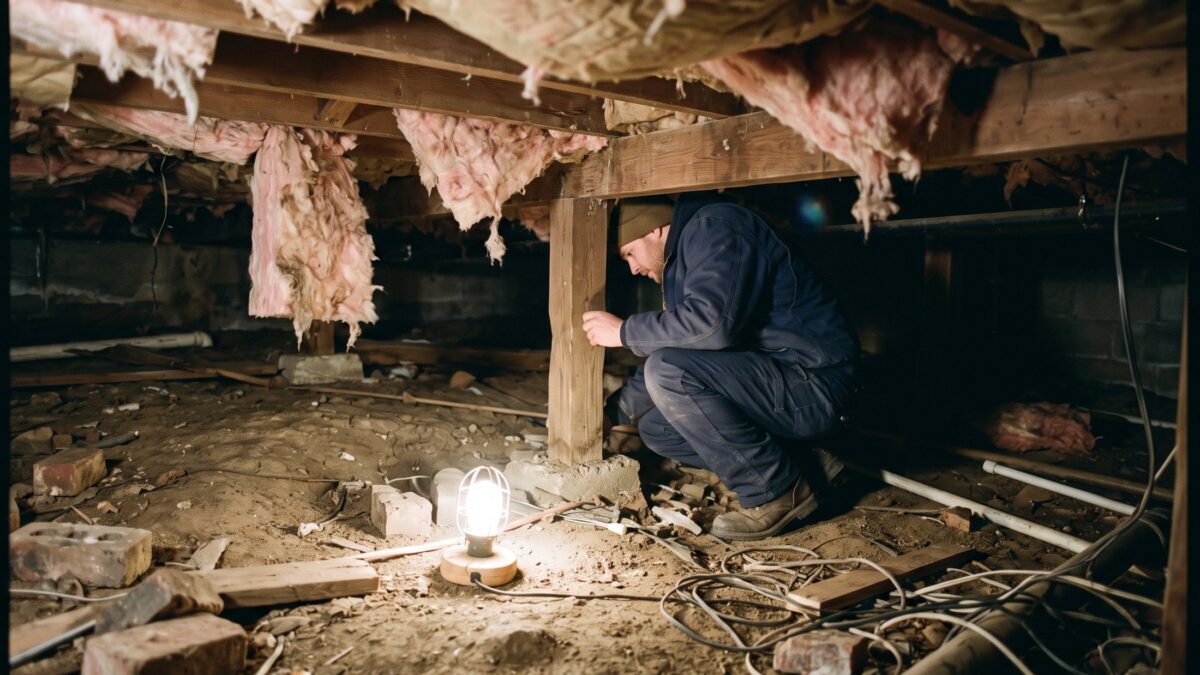
Cooling air sheds moisture. The cold things in a crawl space are the duct trunk, the copper lines and the underside of the floor, which is why homeowners find beaded metal and dark, damp batts when they finally go down there in July.
-
The ground keeps feeding it
Exposed soil is an open water source. Moisture moves up out of the dirt without stopping, and in a vented crawl it has nowhere to go except into the air and the wood, so the space never dries between storms.
-
Framing takes on what the air offers
Wood absorbs moisture from the air around it and gives it back slowly. Once structural wood holds above roughly twenty percent moisture content, decay fungi have what they need, and a vented crawl through a humid stretch reaches that easily.
-
The house pulls it upstairs
Warm air rising through a house has to draw replacement air from somewhere, and the lowest opening wins. A real share of what you breathe on the first floor started in the crawl, which is why a damp crawl announces itself as a smell in the hallway.
Signs you are living with this
- Batt insulation hanging down, dark on the underside
- Beads of water on duct metal and cold lines in summer
- A musty smell on the first floor that peaks in July
- Cupped hardwood or springy spots over the crawl
- Rust on joist hangers, nail plates and duct seams
When the vents still have a job
- A fuel-burning appliance drawing combustion air from the crawl, until a licensed HVAC contractor reworks it
- Active standing water, which has to be drained before anything gets closed
- A radon system that routes soil gas on purpose and belongs to a licensed mitigator
What does it take to seal a crawl space properly?
Sealing is a sequence, not a vent cover. Close the openings before the water and the ground are handled and you have trapped moisture with nowhere to go.
This is the order our crews work in, and a skipped step tends to surface within a year.
-
Get the water out first
Standing water, a wet corner after storms or a spring that runs every April gets solved before anything is closed. That usually means perforated pipe in washed stone around the inside perimeter and a pit with a pump at the low corner.
-
Cover every square foot of ground
A reinforced liner goes over the soil and up the walls, seams lapped and sealed, fastened at the top. Thickness is chosen for traffic: 6 mil is a builder sheet, while 12 and 20 mil liners survive crews, storage and the occasional technician.
-
Close the vents for good
Each vent is blocked, insulated and sealed from the inside so it stops working as an air path. The access hatch and any crawl door get the same treatment, because one loose hatch undoes an entire row of sealed vents.
-
Seal and insulate the rim band
Most of the air leakage in a crawl lives at the rim joist where the framing meets the foundation. Sealing and insulating that band keeps warm indoor air off cold wood and takes the February draft out of the floor above.
-
Control the humidity that is left
A sealed crawl still needs a target. A dehumidifier draining to the pit, or supply air from the heating system, holds the space under about sixty percent relative humidity, which is the number that keeps wood and stored belongings out of trouble.
What you end up with
- A clean liner instead of dirt, and usable storage
- Floors that stop reading cold in February
- Water lines inside the sealed envelope
- A humidity number you can actually check
- A space a technician will crawl into without argument
What it asks of you
- Combustion appliances reviewed by a licensed HVAC contractor first
- A dehumidifier is equipment: it wants power and a drain
- Outside water still has to be fixed outside, before any of this
- Hatches and vents stay sealed once they are sealed
Vented or sealed: which belongs under your house?
Set the two against the things that actually change season to season and the decision stops being a matter of taste.
| Vented crawl space | Sealed crawl space | |
|---|---|---|
| Summer humidity | Tracks the outdoor dew point, worst in July and August | Held under about sixty percent by design |
| Winter floors | Outside air under the subfloor, draft at the rim | Space stays close to indoor temperature |
| Water lines | Sitting in whatever the weather sends | Inside the sealed envelope |
| Wood moisture | Rises and falls with the weather | Low and steady once the ground is covered |
| Smell on the first floor | Crawl air rises into the house all day | Crawl air is dry and cut off from the soil |
| Pests and bare soil | Vents are an entry and the dirt stays damp | Liner and sealed vents remove both |
| What it costs today | Nothing | $7 to $14 per square foot |
| What it asks later | Nothing to maintain, nothing improving either | A pump and a dehumidifier to test |
| Our warranty | Not applicable | Written into the quote with the scope |
Neither column matters much while roof water is landing at the foundation. Downspouts and grade get handled first: see yard drainage.
Not sure whether yours should be sealed? We read the humidity and the wood, hand you the diagnosis in writing, and quote from published ranges, free within 48 hours.
What is actually under your floor?
Crawl spaces changed with the era that built them, and so did the reason they stay damp. Those four eras account for nearly every vented crawl we open up around here.

Pre-war bungalows and two-flats
The crawl usually sits under a rear addition or an enclosed porch, dug shallow over bare dirt with a stone or early block wall. Vents are small, access is a hatch in a closet, and nobody has been down there in years.
Liner first, then drainage
Post-war block ranches
Block walls with a cast vent in nearly every bay, fiberglass stapled between the joists and clay underfoot. The batts hang low and read dark on the bottom face, which is a written record of every humid August since installation.
Seal, then rebuild the rim
Split-levels and 1980s poured walls
A poured crawl under the bedroom wing, very often sharing air with the basement through an open doorway or a knee wall. Whatever that crawl does to its air, the basement breathes, so the two get treated as one space.
Treat both as one
Newer subdivision homes
Crawls under bonus rooms and sunrooms with a thin builder sheet over the soil that has long since slid into a pile in the corner. The grade outside has usually settled back toward the wall since the sod went down.
Grade first, then sealWhat does sealing a crawl space cost?
We publish this one by the square foot. Crawl space encapsulation runs $7 to $14 per square foot, so a 900 square foot crawl works out between $6,300 and $12,600, with the spread decided by what has to happen to the water first.
| Work | Range | What moves the number |
|---|---|---|
| Crawl space encapsulationper square foot | $7–$14 | Access height, standing water, whether drainage goes in first |
| Sump pump with battery backupinstalled | $2,800–$4,500 | Pit condition, backup capacity, discharge routing |
| Downspout extensions and regradingtypical job | $600–$2,500 | Feet of grade to rebuild, soil hauling |
Where the ground stays wet, the perimeter drain and the pit are quoted as their own lines instead of being buried inside a square-foot number, so you can see what you are buying. Every range we work from sits on the pricing page.
When we tell people to leave the vents alone
A fair number of the crawl spaces we look at are not the problem, and a few of them should not be sealed at all this year.
The crawl is already dry
Hang a $30 hygrometer from a joist and read it through a humid stretch in July. If it holds in the fifties with the vents wide open, that space is drier than most finished basements in this region and there is nothing here worth buying.
Costs $30 to checkA fuel-burning appliance lives down there
A furnace or water heater that pulls combustion air from the crawl changes what sealing means entirely, and that belongs to a licensed HVAC contractor rather than a waterproofing crew. We will not close vents around one until that has been sorted out properly.
Not our tradeThe water is coming off the roof
One downspout discharging at the corner of a crawl wall delivers more water in a single storm than the soil releases in a month. Extensions and regrading run $600 to $2,500 under a 5-year warranty and deserve a season of watching. Start with the grade.
Cheapest real fixYou need this summer, not a project
If the house is going on the market in spring or the budget is not there yet, a dehumidifier sized for the space will hold the humidity down while the ground stays open. It is a stopgap and we will call it one. What a dehumidifier can and cannot do.
Buys you a seasonQuestions homeowners ask about crawl space vents
Should I close my crawl space vents in winter?
Closing them for winter helps with cold floors and frozen lines, and most people who do it never open them again. The trouble is the reopening. Vents that come open in May start the condensation cycle all over again on a schedule, so you get the benefit for four months and pay for it during the four that actually damage wood. If they are worth closing in December, they are worth sealing permanently.
Is it legal to seal crawl space vents in Illinois?
Modern residential code recognizes both vented and unvented crawl spaces, with conditions attached to the unvented version around ground cover and how the space gets its air. Illinois lets municipalities adopt and amend their own codes, so the details and any permit requirement depend on your village or city. Call your local building department before work starts, and ask any contractor which office they are pulling from.
Will closing the vents trap moisture and make things worse?
It will, if closing the vents is all you do. Bare soil releases moisture continuously, and with no ventilation and no ground cover that moisture has nowhere to go but into the wood. That is why the liner goes down before the vents are closed and why a humidity target comes with the job. Sealed done properly is drier than vented. Sealed done halfway is worse than either.
Do I still need a dehumidifier after the crawl is sealed?
Usually yes, at least through the first summer. Sealing removes the two big moisture sources, outside air and open ground, but it does not remove what is already stored in the framing and it cannot dry the space by itself. A dehumidifier draining to the sump pit, or a supply run from the furnace, gives the space a way to hold a number instead of drifting.
Will sealing the crawl keep my pipes from freezing?
It helps a great deal, because the pipes end up inside the insulated envelope rather than in outdoor air moving through vents. Water lines running tight to a rim joist or against an uninsulated wall still deserve attention, and a long stretch of unheated crawl on a windy corner is worth insulating separately. It is a strong improvement, not a guarantee against a record cold snap.
Does crawl space work come with a warranty?
It does, and which one applies depends on what is in the scope. Interior waterproofing systems carry a lifetime, fully transferable warranty. Drainage work carries a 5-year warranty. Your quote names the warranty attached to each line before you sign anything, rather than leaving you to guess which bucket a crawl space job falls into. Ask any contractor the same question, in writing. The full terms, including what transfers when you sell the house, are published on our <a href="/warranty/">warranty page</a>.
What actually goes into a sealed crawl space?
Closing the vents is one line on a scope that runs six or seven deep. The order the work happens in decides whether the space stays dry, and the liner thickness, the fastening, the rim detail and the humidity target all belong in writing before a crew shows up. Here is the full scope, item by item, with nothing assumed.
See what encapsulation includes

Get the vents decided by a reading, not a rule of thumb
Free written diagnosis within 48 hours, published square-foot pricing, and 20+ spent under houses in this weather.
Or talk to a human right now
(630) 335-1128
Request your free estimate
Tell us what you're seeing. We'll call back fast and be out within 48 hours.