Pests, Radon and the Air You're Breathing From Below
The air on your first floor did not arrive through a window. A good share of it came up out of the crawl space, carrying whatever is down there with it. We can change what that air is made of, and we will tell you plainly which parts are not ours to touch.
- Free written diagnosis within 48 hours
- Humidity measured and left on a meter you can read
- Straight handoffs when the problem is not moisture
 Drainage systems: lifetime, fully transferable warranty
The short answer
A house pulls its replacement air in near the ground, so crawl space air ends up in the rooms above it. A bare dirt crawl sends up water vapor, mold odor and whatever pests are nesting down there. Sealing the ground and holding the humidity down changes that air. Radon is a separate test and a separate licensed specialist.
Houses breathe upward. Warm air rises and leaks out through the attic and the upper floors, and the air replacing it gets drawn in low: through the crawl hatch, the rim joist, the gaps around every pipe and wire that passes through the floor. The pull runs hardest on a cold January night and again on a humid August afternoon, when the difference between inside and outside is biggest. Whatever the crawl space air is carrying, water vapor, mold spores, the smell of wet soil, rides that current into the rooms above it.
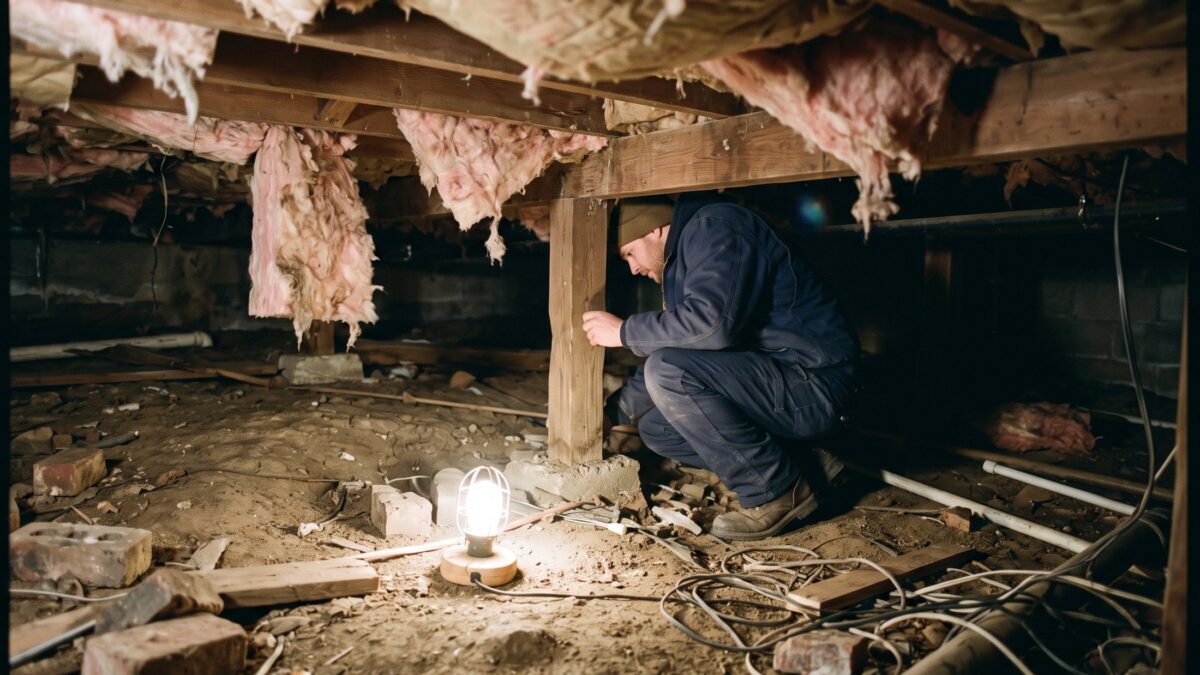
In our seven counties the space feeding that current is usually bare clay with the foundation vents rusted open. Clay stays wet for days after a storm, so the air down there runs heavy with moisture most of the year, and the same openings that let it in let the mice in behind it. Sealing the ground and closing the vents is not a comfort upgrade. It changes what the house inhales, every hour, all year. That work is crawl space encapsulation, and it starts with the dirt.
Why does crawl space air end up in your living room?
Air does not stay where you put it. A house behaves like a chimney, and the crawl space sits at the bottom of it acting as the intake.
Follow one cubic foot of air through the house and the path becomes obvious.
-
Warm air leaves at the top
Heat rises and escapes through attic hatches, recessed light housings, the chimney chase and every unsealed penetration in the ceiling. This happens continuously, and it happens fastest when the temperature difference between inside and outside is largest.
-
The house pulls replacement air in low
Whatever leaves the top has to be made up somewhere, and a building takes it wherever the shell is leakiest and nearest the ground. That means the crawl hatch, the seam where the subfloor meets the mudsill, and every hole drilled for plumbing and wiring.
-
The crawl space becomes the intake
A dirt floor with open vents is effectively a filter box full of soil. The air passing through it picks up moisture evaporating from the ground, spores from damp framing, and the earthy odor everyone recognizes but nobody can locate.
-
It mixes into the rooms you use
That air does not stay in the joist bays. It moves up wall cavities and duct chases into the living room and the bedrooms, and if any ductwork or a return runs through the crawl space, the furnace blower distributes it deliberately.
-
The symptoms surface upstairs
Now you get the complaints: a musty smell strongest on humid days, air conditioning that cools without ever feeling dry, allergy symptoms that ease when the family goes away for a week. None of them point downward on their own.
How to confirm it yourself
- The smell is worst on a humid day or when the blower runs
- It fades noticeably within a day or two of leaving the house
- A meter in the crawl reads far higher than the same meter in the kitchen
- Ductwork, a return or the water heater lives down there
What weakens the theory
- The odor is sharp and sewage-like rather than earthy
- It is confined to one closet or one bathroom
- The crawl space still reads dry through a wet August
What is actually rising through the floor, and who fixes each one?
Four different problems use that same upward path, and only two of them are ours. Sorting them takes a meter and a flashlight, not a nose.
This is the order we work through it on an inspection, and where each item goes.
-
Water vapor, first and biggest
Moisture is the largest thing coming up by volume, and it feeds nearly everything else on this list. Covering the ground and holding the humidity down with a dedicated dehumidifier is the single change that moves every other number. This one is ours.
-
Mold and the musty smell
Damp framing, paper-faced insulation and stored cardboard grow the organisms that produce that odor. Take the moisture away and growth stops, though heavy visible growth already on the joists sometimes calls for a remediation contractor before we seal anything.
-
Pests and what they leave behind
Mice, insects and the occasional larger visitor come in through open vents and gaps at the rim. Droppings and nesting material keep producing smell long after the animal has gone. Pest control removes the tenants; we close the doors afterward.
-
Radon and other soil gas
Radon comes up out of the ground, so a sealed liner covers one of the paths it uses, and mitigation contractors often want that liner intact before they design a system. A liner is not a radon system. Test first, then call a licensed mitigation contractor.
-
Sewer gas and combustion air
A sharp sewage odor is a dry trap or a cracked drain line, which is a plumber. And if a furnace or water heater sits in that crawl space, an HVAC contractor confirms its combustion air before anyone seals a single vent.
What we own
- The ground moisture, and everything it feeds
- Sealing the vents, the hatch and the rim joist openings
- Drainage and a sump where water genuinely enters
- Holding humidity down and leaving a meter you can read
- A lifetime, fully transferable warranty on the drainage system
What we hand off
- Radon testing and mitigation: a licensed specialist, every time
- Live rodents or wildlife: pest control before any liner goes down
- Sewer odor: a licensed plumber
- Combustion air for any appliance down there: an HVAC contractor
Is sealing a crawl space better than leaving the vents open?
Venting a crawl space made sense as a theory and fails as physics in a humid Illinois summer, because outdoor air brought against cool framing gives up its moisture there. Compare the two on what you actually breathe.
| Sealed and conditioned | Vented dirt crawl | |
|---|---|---|
| What the floor is | A sealed liner separating soil from air | Bare dirt, evaporating whenever it is damp |
| Summer humidity | Held down year round by a dehumidifier | Humid outdoor air condenses on cool framing |
| Musty odor upstairs | Drops off once the ground is covered | Rises with the stack effect all season |
| Mold on framing | Loses the moisture it needs to keep growing | Returns every warm, wet stretch |
| Pest access | Vents, hatch and rim gaps closed and screened | Open vents are an open door |
| Winter pipe freezing | Inside the thermal envelope, far less risk | Exposed to whatever the night gets down to |
| Radon | Covers the soil, which a mitigation contractor often wants in place, but it is not a radon system | No effect either way, so test regardless |
| Insulation | Rim insulation stays dry and keeps working | Wet batts sag, fall out and insulate nothing |
| Our warranty | A lifetime, fully transferable warranty on the drainage system | Nothing to warrant |
Sealing only works when the humidity is actively managed afterward, and any fuel-burning appliance down there has to be sorted out first. The full argument over open and closed sits on crawl space vents.
Smell coming up through the floor? We measure the crawl space humidity, find the openings feeding it and put the findings in writing, free within 48 hours.
Which does your house need?
Where the crawl space sits, how it was vented and what shares the space with it all change depending on when the house went up. These four cover most of what we open across the seven counties.

Pre-war bungalows and two-flats
Crawls tucked under rear additions and enclosed porches, with the access hatch inside a closet so everything down there vents straight into the hallway. Rubble stone walls, a dirt floor and no vapor control of any kind.
Seal the hatch and the ground
Post-war block ranches
Long, low crawls with a vent every few blocks and paper-faced batts stapled up between the joists. The paper stays damp all summer, the batts sag out, and the smell settles into the back bedrooms first.
Vents closed, rim treated
1980s and 90s poured wall homes
Drier than the older stock, but often hosting the furnace or the water heater along with a return duct. Sealing here has to start with an HVAC contractor confirming combustion air before a vent gets closed.
Confirm combustion air first
Newer subdivision homes
Built with a liner and a dehumidifier, then quietly let go: a unit that failed two summers back, a vent someone opened, a hatch never put back. Air complaints here are maintenance, not construction.
Usually a service callWhat does changing that air cost?
Our published rate for crawl space encapsulation is $7 to $14 per square foot, which puts a 1,200 square foot crawl between $8,400 and $16,800 once it is multiplied out, with drainage the line that moves the number most.
| Work | Range | What moves the number |
|---|---|---|
| Crawl space encapsulationper square foot | $7–$14 | Access height, standing water, whether drainage goes in first |
| Interior drain tileper linear foot | $95–$160 | Length of the run, slab thickness, what has to be moved off the walls |
| Sump pump with battery backupinstalled | $2,800–$4,500 | Pit condition, backup capacity, discharge routing |
Radon mitigation is not on this list and never will be, because it is designed and installed by a licensed mitigation contractor and priced by them. Pest removal is billed by a pest control company. Everything we do publish sits on the pricing page.
When this is not our job at all
Air quality complaints from below have four common causes and we only fix two of them. Here is where the other two go.
Your radon test came back elevated
A sealed liner is not a substitute for a radon system. If a test comes back high, the fix is a licensed radon mitigation contractor designing a depressurization system with a fan and a vent stack, then verifying it works. We seal crawl spaces for moisture. We do not test for radon and we do not mitigate it.
Not our workSomething is living down there
Droppings, chewed insulation and a smell that comes and goes with the weather is a pest problem before it is a moisture problem. Get the animals removed and the entry points documented by a pest control company first. A liner installed over an active infestation seals the mess in rather than out.
Pest control firstThe odor is sewer, not soil
A sharp sewage smell rather than an earthy, mushroomy one usually means a dried-out floor drain trap, a failed wax ring or a cracked drain line under the slab. That is a licensed plumber, and no crawl space work will touch it. Sorting one smell from the other takes about ten minutes.
Call a plumberYou have not measured anything yet
A $30 hygrometer left in the crawl space for two weeks tells you more than any sales visit will. If it reads comfortably low through a humid Illinois July, the crawl is behaving and you do not need us this year. Buy the meter before you buy a system.
Costs almost nothingQuestions homeowners ask about crawl space air
Does encapsulating a crawl space reduce radon?
A sealed liner covers the soil, which closes one of the routes soil gas uses, and mitigation contractors often want a sound liner in place before they design around it. That is the honest limit of the claim. Real mitigation moves gas out of the ground with a fan and a vent stack discharging above the roofline, and it is designed, installed and verified by a licensed contractor. Test first, then let the result decide. We do neither the testing nor the mitigation.
Should I test for radon before or after encapsulation?
Both, if you want a clear picture. Test first so you know your starting point, and if the result is elevated, bring the mitigation contractor in before we seal so the two systems get coordinated rather than fought over. Then test again afterward, because any change to how a house moves air can shift the number in either direction. Kits are cheap and sold locally, and Illinois licenses measurement professionals if you want a formal result.
How do I know the smell in my house is coming from the crawl space?
Run three checks before anyone quotes you. Put a meter in the crawl and another one in the kitchen for a week and compare the humidity readings. Notice whether the odor gets stronger when the furnace or air conditioner blower kicks on, which points at ductwork running through the space. And notice whether it fades after a couple of days away from the house. Two out of three pointing down is enough to open the hatch.
Will sealing the vents make the air worse instead of better?
It would, if sealing were the whole job. A closed crawl space with wet dirt still in it is a box that traps moisture, which is exactly why the liner and an actively controlled dehumidifier are one system rather than two products. Sealed and dry is better air than vented and damp, by a wide margin. And any fuel-burning appliance in that space needs its combustion air confirmed by an HVAC contractor before a single vent closes.
Do mice and insects really get in through the crawl space?
Constantly. Foundation vents, the gap around a hatch that no longer sits flat, and the openings cut for plumbing and cable all read as doorways to something small. Sealing the crawl space closes those doors, and it removes the damp conditions insects are drawn to. What it does not do is evict anything currently living there, which is why we ask for pest control to go first when there are fresh signs.
Is a musty crawl space a health problem or just unpleasant?
We install drainage and liners, so we are not going to tell you how anyone in your house will react to anything. What we can tell you is what we measure: humidity high enough to sustain mold growth on the framing, air moving upward out of that space into the rooms above, and an odor whose source is organic. Those are facts about the building. What to do with them medically is a conversation with a doctor.
Does a sealed crawl space still need a dehumidifier?
Covering the ground removes the source, but a crawl space is still connected to a house full of moisture and it still has walls that can wick. The dehumidifier is what holds the number down through a humid August and proves the system is working rather than just looking finished. Sizing it, draining it and knowing when it has quit is its own subject.
Crawl space dehumidifiers explained

Change what the house breathes, starting with the dirt
Free written diagnosis within 48 hours, 1,500+ homes across the seven counties, and an honest handoff when the problem belongs to someone else.
Or talk to a human right now
(630) 335-1128
Request your free estimate
Tell us what you're seeing. We'll call back fast and be out within 48 hours.