
Basement Waterproofing in Chicago, Illinois
Combined sewers under most of the city, a century-old clay tile loop under every bungalow, and a gangway too narrow for any machine: Chicago basements play by their own rulebook. We install the interior systems that rulebook demands, backed by a lifetime, fully transferable warranty.
- Serving the bungalow belt from the Joliet and New Lenox corridor
- Interior systems backed by a lifetime, fully transferable warranty
- Free written inspection within 48 hours
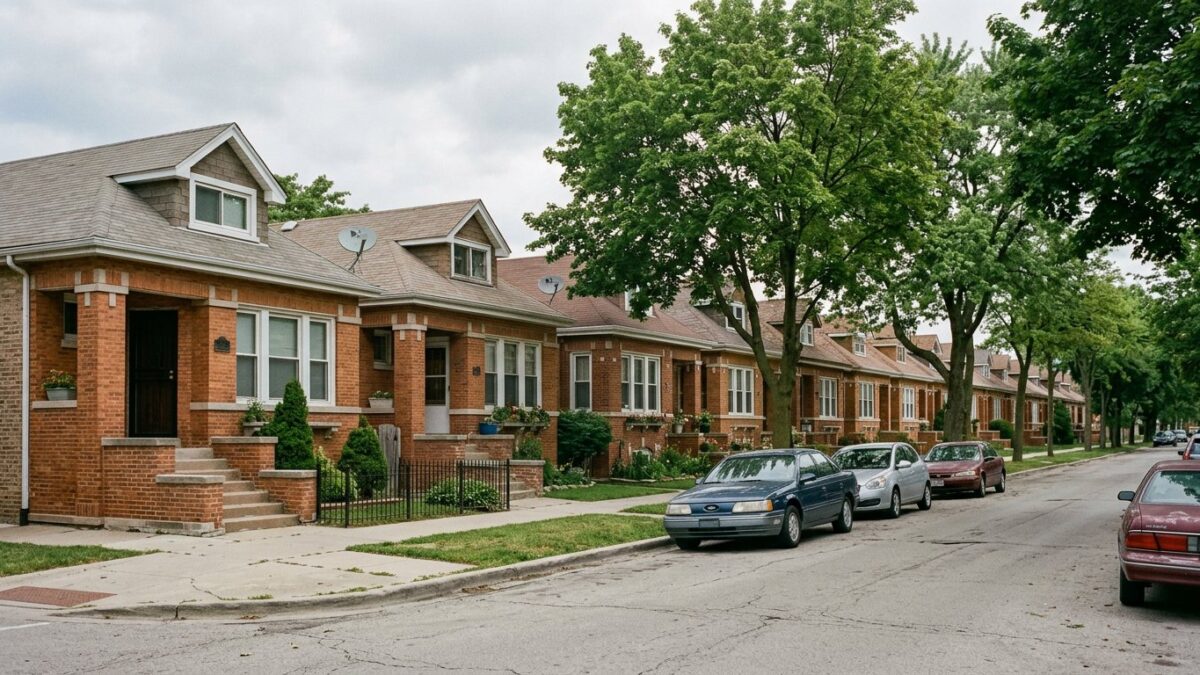 In the bungalow belt week in, week out
Who does basement waterproofing in Chicago?
ProSeal Basement Waterproofing installs interior drain tile, sump pump systems and crack injection across Chicago's south, southwest and northwest side neighborhoods from a base in the Joliet and New Lenox corridor. Interior drain tile runs $95 to $160 per linear foot, a full perimeter system with a sump and battery backup runs $8,000 to $16,000 on most bungalows and two-flats, and the pricing is published before we ever cross the city line.
A Chicago waterproofing company has to be able to tell you two things straight: whether the water in your basement is seepage or a sewer backup, and whether your lot can physically take exterior work. Most city lots cannot. Twenty-five feet of frontage and a gangway a shoulder wide rule out excavation on a huge share of addresses, which makes the interior system the honest recommendation here, not the fallback.
See the full basement waterproofing system, wall to discharge
 Everything a city basement needs comes in through the front door.
What does basement waterproofing in Chicago include?
Six systems cover what Chicago housing actually needs, and the free inspection prices only the ones your basement calls for. On a standard city lot, nearly all of this work happens entirely indoors.
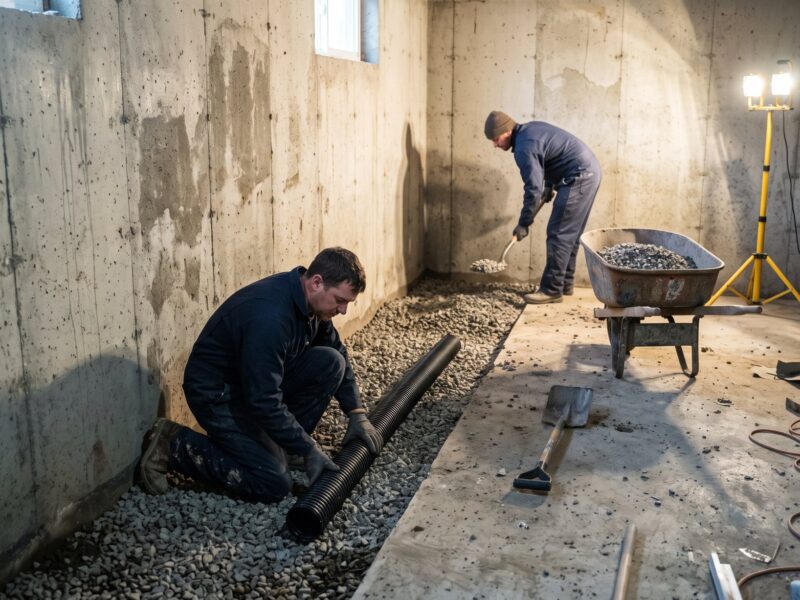 Interior drain tile
The workhorse for bungalows and two-flats: installed entirely from inside, no gangway required.
Learn more
Interior drain tile
The workhorse for bungalows and two-flats: installed entirely from inside, no gangway required.
Learn more
 Sump pumps & battery backup
Most bungalows never had one; we cut the pit, set the pump and add the backup.
Learn more
Sump pumps & battery backup
Most bungalows never had one; we cut the pit, set the pump and add the backup.
Learn more
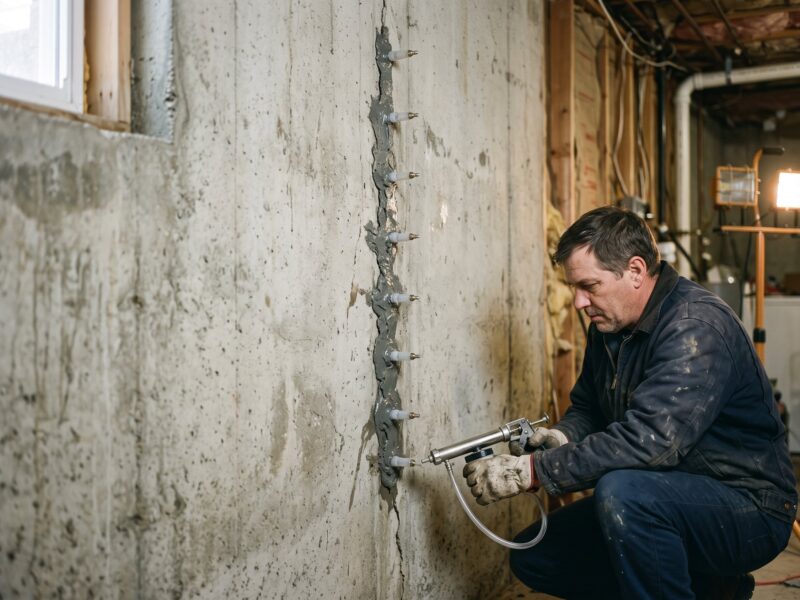 Leaking crack injection
Cracks in the city's early poured walls sealed full depth from $450.
Learn more
Leaking crack injection
Cracks in the city's early poured walls sealed full depth from $450.
Learn more
 Yard drainage & downspouts
Roof water redirected so it stops feeding the foundation on a twenty-five-foot lot.
Learn more
Yard drainage & downspouts
Roof water redirected so it stops feeding the foundation on a twenty-five-foot lot.
Learn more
 French drains
For rear yards along the alley that hold water and send it toward the house.
Learn more
French drains
For rear yards along the alley that hold water and send it toward the house.
Learn more
 Crawl space encapsulation
For rear additions and cottages with dirt under the back room.
Learn more
Crawl space encapsulation
For rear additions and cottages with dirt under the back room.
Learn more
Why do Chicago basements leak?
Chicago basements leak for reasons the suburbs mostly do not share: a hundred-year-old clay tile drain silted shut, a brick foundation that was never waterproofed, and a sewer main carrying storm and sanitary water through the same pipe.
The bungalow belt
Roughly eighty thousand brick bungalows went up between about 1910 and 1930, most with six and a half feet of basement head and an original clay tile drain loop now a century old. When that loop silts shut, the floor-wall joint is where the water shows up first.

Two-flats and workers' cottages
On the same blocks, two-flats and cottages share the bungalows' age and their plumbing: original cast iron, original drains, foundations of brick or early concrete. A garden unit puts living space at the wet end of the building, which raises the stakes on every leak.

The twenty-five-foot lot
The defining constraint in Chicago is not the wall, it is the lot. With a neighbor eight feet away and a gangway no machine fits down, exterior excavation is frequently impossible, so the system that works is the one that installs from inside.
Is it seepage or sewer backup in Chicago?
The single most important question about water in a Chicago basement is where it arrived: up through the floor drain, or in at the walls and the floor-wall joint. Most of the city runs combined sewers that carry storm and sanitary flow in one pipe, and in a heavy rain the main can surcharge, pushing water up the lowest opening in the house, which is the floor drain. That is a backup, not seepage, and no waterproofing system stops it. The Deep Tunnel has made it rarer without making it gone.
Water arriving at the walls and the cove joint is a different animal, and that one is ours. The city sits on lakebed clay that holds water against foundations, the water table runs shallow near the lake and the river corridors, and the clay tile loops that were supposed to relieve bungalow footings are mostly packed with a century of silt. That is groundwater, and drain tile, a properly sized sump and a battery backup end it. The free inspection names which problem you have before anyone quotes anything.
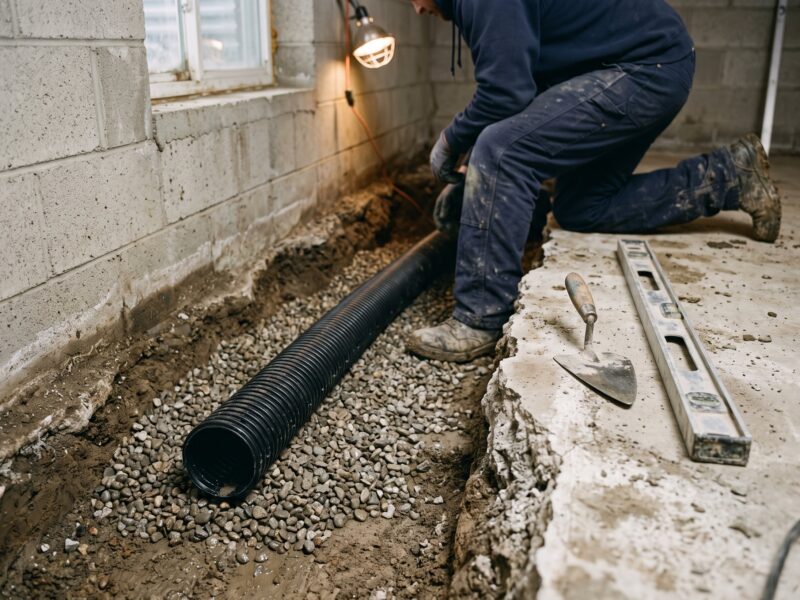
See how interior drain tile replaces a silted clay tile loop
 Cutting a sump pit into a bungalow floor that never had one.
Signs your Chicago basement needs waterproofing
Six symptoms fill our Chicago call log, and the first job of the inspection is sorting which trade each one belongs to. One of them is not a waterproofing problem at all, and we say so at the door.

Water up the floor drain in storms
The combined main surcharging, not seepage. The fix is plumbing: a backwater valve or overhead sewer conversation with a licensed plumber. We name it honestly and never quote a system for it.

A wet line where floor meets wall
Groundwater under hydrostatic pressure finding the cove joint, the classic call from bungalows whose original clay tile loop has silted shut. This is exactly what interior drain tile exists to fix.

White bloom on brick or block
Efflorescence is the mineral trail water leaves as it moves through masonry. On a brick foundation it means the wall itself is wicking, and drainage takes the pressure off before the mortar starts to go.

A musty garden unit or basement
Damp basement air rises through the whole building, and in a two-flat it is a tenant's living space too. If the smell peaks each spring, the source is seasonal groundwater, not housekeeping.

No sump, or one that never stops
Most bungalows were built without a sump at all, and where one exists it is often undersized. Constant cycling means real groundwater; silence during a storm can mean the pit sits in the wrong place.
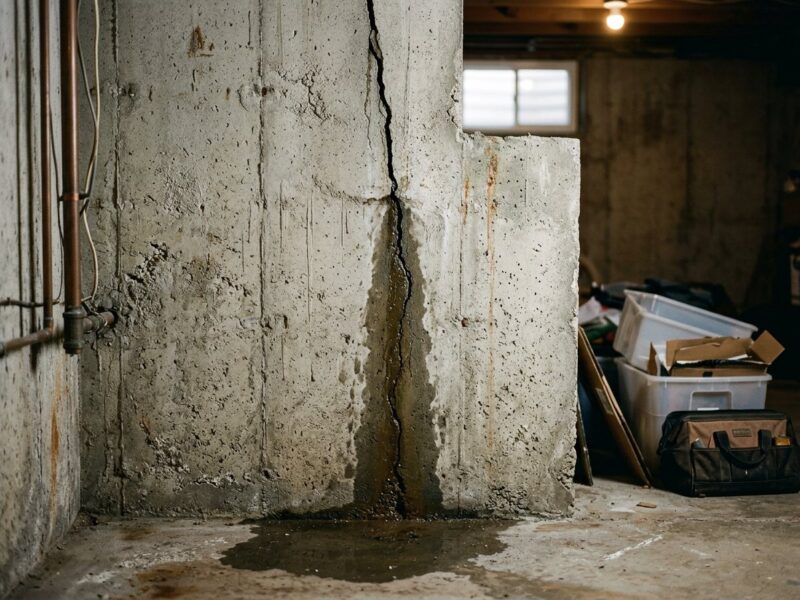
A wall crack that runs in the rain
The city's early poured walls crack like anyone's, and a crack that becomes a spout usually closes for $450 to $900 with urethane injection, done in a morning from inside.
Floor drain burping in every storm? Tell us which block. The answer changes completely between a backup and seepage, and the inspection sorts it for free.
How does basement waterproofing work in Chicago?
A Chicago waterproofing job runs four steps from phone call to warranty, with one extra discipline up front: the backup-versus-seepage call gets made before any system is priced.
Sort backup from seepage
We trace where the water arrived: floor drain means a surcharged main and a plumbing referral, walls and cove joint mean groundwater and a written waterproofing plan. Free, within 48 hours, and honest either way.
Day 0Scope the drains, plan the system
On a bungalow we talk through the original clay tile loop, whether rodding buys time, and where a sump pit fits in a low basement. The plan is written for your lot, not a generic one.
Day 0, same visitInstall from the inside
Trench at the footing, tile, gravel, sump and battery backup, fresh concrete, then a flood test you watch. No machine in the gangway, no yard torn up, and six and a half feet of head is enough for the crew.
Days 1 to 4Register the warranty
The lifetime, fully transferable warranty is registered to the address and transfers to the next owner, paperwork that matters on blocks where bungalows pass through generations of the same family and beyond.
On completionInterior or exterior waterproofing: which works on a Chicago lot?
Interior drain tile wins in Chicago more decisively than anywhere else we work, because on a standard city lot the exterior option is often not merely expensive, it is physically impossible.
| Interior drain tile | Exterior excavation | |
|---|---|---|
| Best for | Cove-joint seepage and silted original drains, which is most of the city | Walls whose exterior face is failing and can actually be reached |
| On a 25-foot lot | Installs entirely from inside; the gangway never matters | Needs machine access that a gangway simply does not provide |
| Next to a neighbor | No excavation, so the adjacent building is never put at risk | Hand-digging eight feet down beside another structure is neither safe nor sensible |
| In a low basement | The trench is in the floor; six and a half feet of head is plenty | Depth of dig is outside, but staging equipment on a tight lot rarely pencils |
| Cost | $95 to $160 per linear foot | Several times interior cost where it is possible at all |
| Season | Installs all winter; the work never leaves the basement | Weather plus lot logistics narrow the window sharply |
Where a wall genuinely needs exterior work and the lot allows it, we price it honestly. On most Chicago addresses the interior system is not the compromise, it is the correct engineering.
When do Chicago basements flood?
Chicago basement water keeps a calendar, and the combined sewers add a wrinkle the suburbs lack: the worst storms can hit a basement from two directions at once.
Spring: saturated clay season
Snowmelt loads the lakebed clay and cove joints start weeping across the bungalow belt. Sumps that exist run hard, and basements without one find out why they need it. Booking the free inspection early beats booking the emergency.
March to MaySummer: surcharge season
Short violent storms are the ones that surcharge the combined mains and send water up floor drains across whole neighborhoods at once. They also cut power, which is the entire argument for a battery backup on every sump we set.
June to AugustFall: the cheap-fix window
Dry ground makes fall the season for downspout extensions, grading corrections and rodding the old clay tile to see what is left of it, the $600 to $2,500 work that spares you a bigger spring.
September to NovemberWinter: install season
Interior drain tile ignores frozen ground because the entire job happens in the basement. Winter is when Chicago scheduling moves fastest, and a system installed now is finished before the March melt tests it.
December to FebruaryHow much does basement waterproofing cost in Chicago?
Basement waterproofing in Chicago costs $95 to $160 per linear foot for interior drain tile, and a full perimeter system with a sump and battery backup lands between $8,000 and $16,000 on most bungalows and two-flats. A city address pays the same published ranges we hold in every suburb, quoted in writing at the free inspection.
| Work | Range | What moves the number |
|---|---|---|
| Interior drain tileper linear foot | $95–$160 | Length of the run, slab thickness, what has to be moved off the walls |
| Sump pump with battery backupinstalled | $2,800–$4,500 | Pit condition, backup capacity, discharge routing |
| Exterior French drainper linear foot | $45–$90 | Trench depth, where the water can legally go |
| Downspout extensions and regradingtypical job | $600–$2,500 | Feet of grade to rebuild, soil hauling |
All ranges are published on the pricing page; your written Chicago quote comes from them and nowhere else.
Where we waterproof in Chicago
The bungalow belt keeps our Chicago calendar full. Garfield Ridge, Clearing and Ashburn on the southwest side send silted clay tile and cove-joint seepage. Beverly, Morgan Park and Mount Greenwood send the same brick stock with the occasional stone foundation mixed in. Portage Park and Jefferson Park mirror it all on the northwest side, and Bridgeport and Brighton Park send two-flats with garden units and original cast iron. ZIPs 60629, 60638, 60634, 60643, 60655 and 60618 cover most of that map.
We will be straight about geography: we are based in the Joliet and New Lenox corridor, not in the city, and Chicago is forty minutes to an hour depending on what the Stevenson is doing. It is a real drive and we make it constantly. Inspections still book within 48 hours, and standing water gets a 24/7 response.
 Loaded for the city: the morning run up to the bungalow belt.
Chicago basement waterproofing questions, answered straight
Water comes up my basement floor drain in a heavy rain. Is that seepage?
No. Water arriving up the drain instead of in at the walls means the combined sewer main is surcharged, and the lowest opening in your house happens to be that drain. Waterproofing does not touch it. The fix is a licensed plumber and a conversation about a backwater valve or overhead sewers, and we will tell you exactly that at the inspection without charging you for the visit.
My bungalow has original clay tile drains. Can they be cleaned instead of replaced?
Sometimes, and rodding and scoping the line is worth doing first because it is cheap and it shows you what you actually have. But a hundred-year-old clay loop with root intrusion and separated joints is at the end of its life, and cleaning it buys a season, not a decade. Interior drain tile is the permanent replacement.
Can you install drain tile in a basement with six and a half feet of headroom?
Yes, routinely. The trench is cut into the floor at the footing, so ceiling height changes nothing about the system itself, only how the crew moves. Low bungalow basements are the majority of our Chicago work, and the sump pit, discharge line and battery backup all fit the same as they would under nine-foot ceilings.
Does homeowners insurance cover basement water in Chicago?
Read the policy carefully. Standard Illinois policies exclude seepage and groundwater outright, and sewer backup is typically covered only if you carry a specific backup rider, which in a combined-sewer city is worth asking your agent about. Prevention is the cheaper path either way, and our quote tells you what prevention actually costs.
How much does basement waterproofing cost in Chicago?
The same published ranges as everywhere we work: $95 to $160 per linear foot for interior drain tile, $8,000 to $16,000 for a full perimeter system with sump and battery backup, $2,800 to $4,500 for a sump with backup on its own, and $450 to $900 per injected crack. A bungalow footprint is compact, which often keeps the total near the low end.
How do I choose a basement waterproofing company in Chicago?
Ask whether they can explain the difference between sewer backup and seepage before selling anything, whether the warranty transfers to the next owner without fees, and what they do when a gangway rules out exterior work. A company that quotes excavation on a standard city lot without walking the lot has already answered for you.
Do you really come to Chicago from the Joliet area?
Yes, constantly, and we will never pretend to have a city office we do not have. The drive is forty minutes to an hour depending on the Stevenson, we batch city work so crews are in the bungalow belt most weeks, and inspections book within 48 hours like everywhere else we serve.
Can you waterproof a two-flat with tenants in the garden unit?
Yes, and we plan the job around the occupancy. The trench work runs along the perimeter walls, the crew contains dust with barriers and negative air, and most systems finish in two to four days. A dry garden unit protects the rent as well as the building, and the lifetime, fully transferable warranty stays with the address.
Is the wet wall also bowing or cracked?
In Chicago the water and the structure fail together more often than apart: the same lakebed clay holding water against a brick foundation is pushing on it too, and mortar that stays wet is mortar washing away. If the seeping wall also shows a stair-step crack or a bulge, one inspection covers both trades.
Foundation Repair in Chicago
Basement waterproofing near Chicago

Dry the bungalow, keep the warranty
A free inspection within 48 hours, an honest call between backup and seepage, and a lifetime, fully transferable warranty registered to the address.
Or talk to a human right now
(630) 335-1128
Request your free estimate
Tell us what you're seeing. We'll call back fast and be out within 48 hours.