
House Leveling in Chicago
Sagging floors, bouncy hallways and doors that quit latching upstairs, corrected from the basement: new columns on real footings, sistered joists and main beams brought back toward level.
- Published pricing: support columns $1,500 to $3,200 installed
- Lifted in stages, measured in fractions of an inch
- Free structural inspection within 48 hours
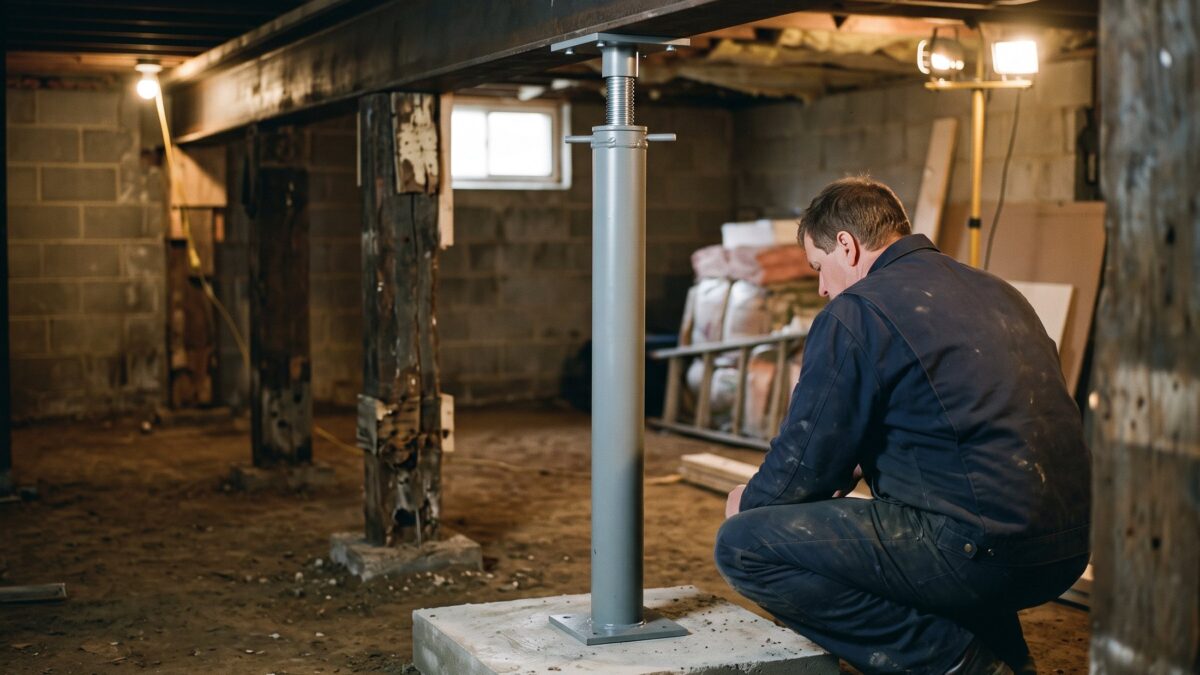 Measured lift, documented in writing
What house leveling replaces and reinforces
In a basement house, floor slope almost always traces to the wood and steel skeleton below it. These are the pieces that get corrected, and most homes need one or two, not the catalog.
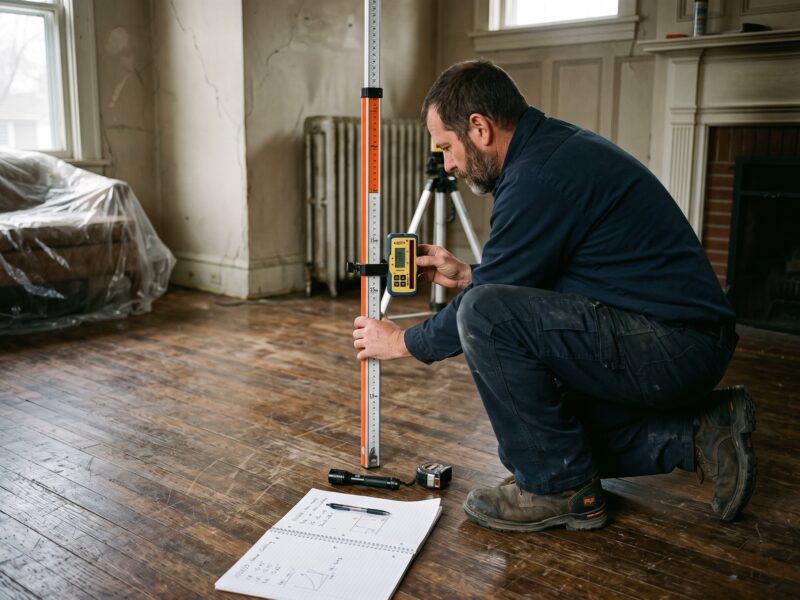
The measurement
A laser survey maps the floor in fractions of an inch, so the fix targets the actual low line instead of a guess.

Steel columns
Adjustable steel columns replace rusted posts and wood props, each on its own footing, each carrying its share of the house.

Poured footings
A column is only as good as what it stands on. New footings spread the load into soil that can hold it.

Sistered joists
Cracked or over-notched joists get new lumber or LVL bolted alongside, doubling the member without opening the floor above.

Main beam repair
Crushed, checked or under-sized beams get reinforced or replaced, because every joist upstairs answers to this one member.

Trim and door correction
As the structure comes back toward level, doors and trim get eased where the house spent years learning the old slope.
Why do floors sag in Chicago houses?
Floors sag because something between the slab and your feet gave up a little: a wood post that rotted at the bottom, a steel column rusted at the slab line, a main beam checked under a century of load, or joists notched by three generations of plumbers. The floor above faithfully reports whatever happened below.
Chicago's housing stock makes certain patterns familiar. Bungalows carry heavy plaster interiors on beams sized a century ago. Post-war ranches used wood posts sitting on, and eventually in, damp slabs. Split-levels hide their columns behind finished walls where nobody checks them. Damp basements accelerate all of it, which is why leveling calls and waterproofing calls so often visit the same address.
 A door out of square: the upstairs evidence of a downstairs problem.
Adjustable steel columns, or permanent posts?
Both hold the beam up. The difference is what happens over the following decades, and in Chicago clay, decades is when the interesting movement happens.
| Adjustable steel column | Fixed post (wood or lally) | |
|---|---|---|
| Adjustment | Threaded head fine-tunes the lift now and years from now | What you install is what you live with |
| In damp basements | Powder-coated steel on a raised footing shrugs it off | Wood wicks moisture and rots from the bottom up |
| Load path | Rated capacity on an engineered footing | Often stands on bare slab, which cracks and settles |
| Cost installed | $1,500 to $3,200 with footing | Cheaper up front, until it isn't |
| Future leveling | A wrench and a level, staged over weeks | Cut it out and start over |
Existing posts that are sound stay; we replace what failed, not what's working.
Marble rolls across the living room on its own? Get the slope measured before it gets worse. The laser survey is free.
How house leveling works, survey to snug doors
Install day is quick; the lift itself is deliberately slow. Most corrections stage over days to weeks.
Laser survey
We map the floors, find the low line, and trace it to the member that caused it. You get the drawing with numbers on it. Free, within 48 hours.
Day 0Footings and steel
New footings get dug and poured at each column point, and the adjustable steel goes in snug, taking the load without lifting yet.
Days 1 to 2The staged lift
The house comes up in fractions of an inch per visit, letting plaster, trim and pipes adjust gradually instead of cracking in protest.
Over 1 to 4 weeksFinal level and report
The last measurement gets compared against day zero, doors get eased, and the whole record, footings to final numbers, goes in your packet.
Final visitHow much does house leveling cost in Chicago?
A new steel support column with its footing runs $1,500 to $3,200 installed, and most sagging-floor corrections need one to three of them. Beam and joist repair is priced per span in the written survey.
| Work | Range | What moves the number |
|---|---|---|
| Interior support column with footingper column | $1,500–$3,200 | Footing size, condition of the beam above |
| Steel I-beam wall bracingper beam | $900–$1,500 | Ceiling height, footing condition at the base |
| Push or helical piersper pier | $1,600–$3,000 | Depth to load-bearing strata, access for equipment |
If the survey shows the foundation itself has settled, the fix moves to piers and the foundation leveling page is your read. Every published range lives in the pricing guide.
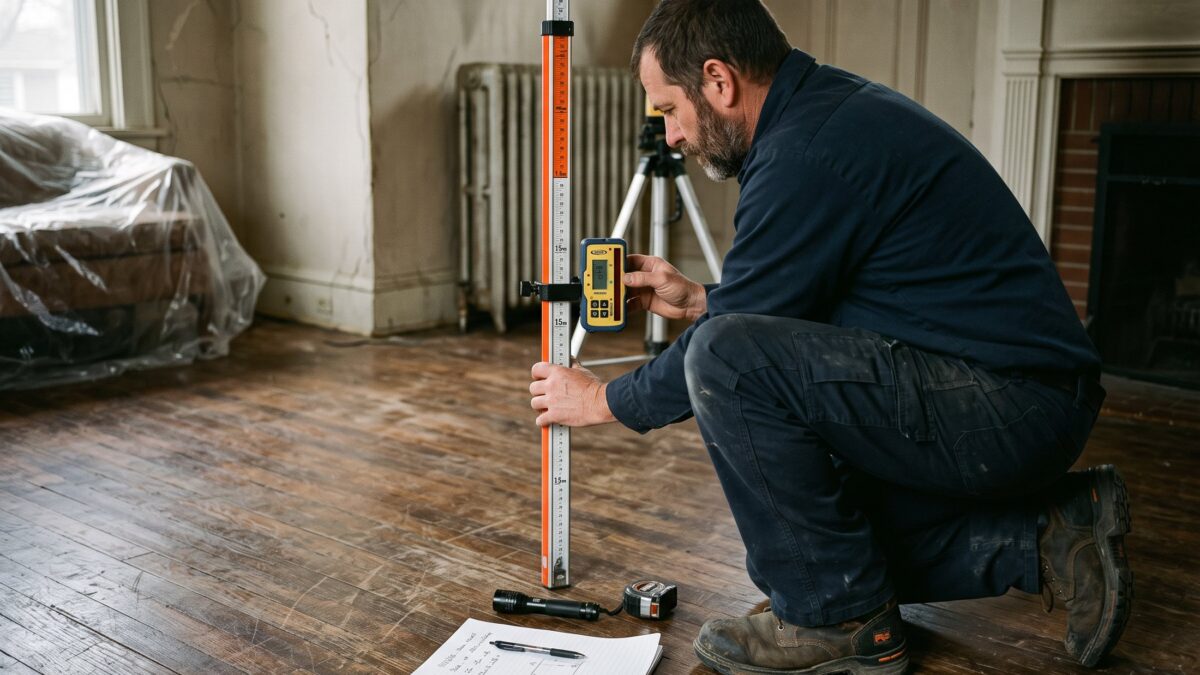
Leveled by people patient enough to do it slowly
The wrong way to level a house is fast. A beam jacked an inch in an afternoon cracks plaster, pops trim and stresses pipes, and we have spent 20+ years cleaning up after crews that did exactly that. Our lifts move in fractions of an inch and finish when the laser and the doors agree, not when the truck needs to leave.
- Laser-documented before, during and after, in writing
- Licensed, bonded and insured: $2,000,000 general liability
- Staged lifts that protect plaster, trim and plumbing
- The honest answer when the slope is stable and living with it is fine
Is the foundation itself sinking?
When the low corner of the floor lines up with a stair-step crack outside, the problem is below the basement: the footing has settled, and no interior column can fix a foundation that's still moving. That work is piers, and it has its own page with its own published prices.
Foundation Leveling
In this guide
The detail behind every part of this work, written out in full.
House leveling near you
Serving Chicago and the suburbs: Will, Cook, DuPage, Kane, Kendall, DeKalb and Lee counties.
House leveling questions, answered straight
How much does it cost to level a sagging floor in Chicago?
Most sagging-floor corrections run $1,500 to $3,200 per steel column with footing, and typical jobs need one to three columns. Beam or joist repair adds a per-span price set at the survey. The laser survey itself is free and tells you exactly which pieces your floor needs.
Will leveling my house crack the drywall?
A rushed lift will; a staged one mostly won't. We raise in fractions of an inch across multiple visits so the structure adjusts gradually. Hairline cracks at old stress points can still appear, and a decades-old sag rarely closes to zero without some cosmetic touch-up, which we tell you before we start.
How do I know if my sagging floor is serious?
Slope you can see, doors that stopped latching, a bounce that rattles the cabinet, or a gap opening between floor and baseboard all earn a measurement. The survey separates a stable old sag you can live with from active movement that gets more expensive every season it's ignored.
Can you level a floor without lifting the whole house?
Yes, and that is what house leveling in a basement home actually is: correcting the beam line and joists from below. Whole-structure lifting on hydraulics is for slab houses and major elevation changes, a different animal we would tell you honestly if your house needed it.
Why did the posts under my beam fail?
Usually moisture. Wood posts wick water out of damp slabs and rot from the bottom, and cheap steel columns rust at the floor line, both slowly enough that nobody notices for twenty years. It is also why we look at basement water while we're down there; the two problems share a cause.
How long does house leveling take?
Footings and columns install in a day or two. The lift itself stages over one to four weeks in short visits, on purpose: the slow schedule is what protects your finishes. You are never out of the house, and there is no wrecked landscaping because everything happens in the basement.

Get the floor measured, then get it level
A free laser survey within 48 hours, a written plan naming every column and footing, and a lift staged gently enough that your plaster never notices.
Or talk to a human right now
(630) 335-1128
Request your free estimate
Tell us what you're seeing. We'll call back fast and be out within 48 hours.