
Basement Waterproofing in Lockport, Illinois
Lockport water obeys the bluff. Below it, basements sit close to the water table and take on groundwater; above it, the ground sheds water fast and the problems change entirely. We build the system for your side of the slope, warrantied for life.
- Lockport sits in our first ring, 48 hours to a written inspection
- Interior systems carry a lifetime, fully transferable warranty
- Standing water answered 24/7
 Home ring: fifteen to twenty minutes from our crews
Who does basement waterproofing in Lockport?
ProSeal Basement Waterproofing waterproofs Lockport basements from a base fifteen to twenty minutes away in the Joliet and New Lenox corridor, with published pricing on every system. Interior drain tile costs $95 to $160 per linear foot, a full perimeter system with a sump and battery backup runs $8,000 to $16,000 on most houses, and a written scope arrives before any work is scheduled.
Lockport asks more of a waterproofing company than most towns because elevation decides the diagnosis. A house near the canal level needs groundwater management; the same floor plan up on the bluff usually needs grading, gutters or a crack sealed. And on the old stone foundations near downtown, the whole priority order flips: keeping water away from the wall matters more than catching it inside, because saturation is what eats the mortar.
See the full basement waterproofing system, wall to discharge
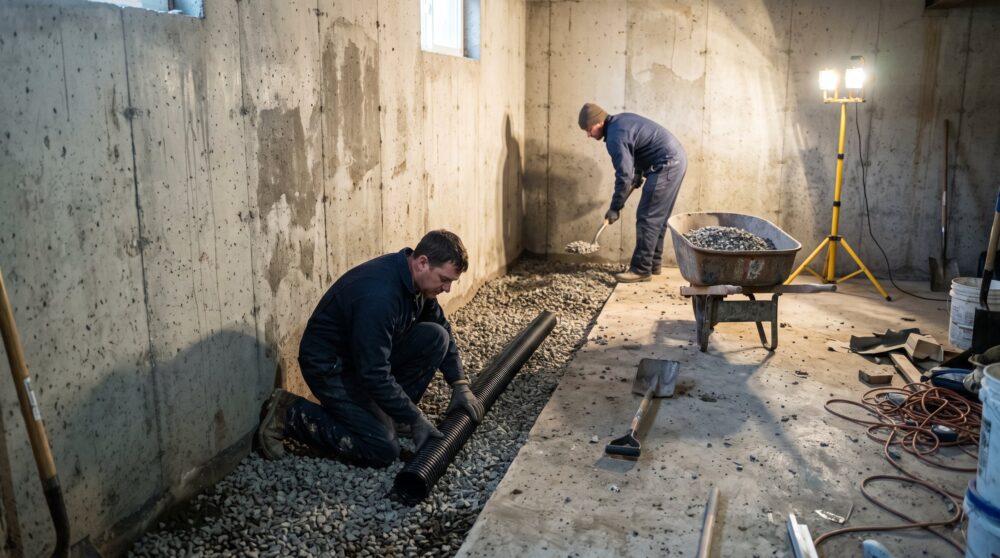 Drain tile at the footing: the fix for houses that sit low to the water table.
What does basement waterproofing in Lockport include?
A Lockport waterproofing plan pulls from six systems, and the free inspection prices only what your side of the bluff actually calls for. Our own crew installs every one at the published ranges.
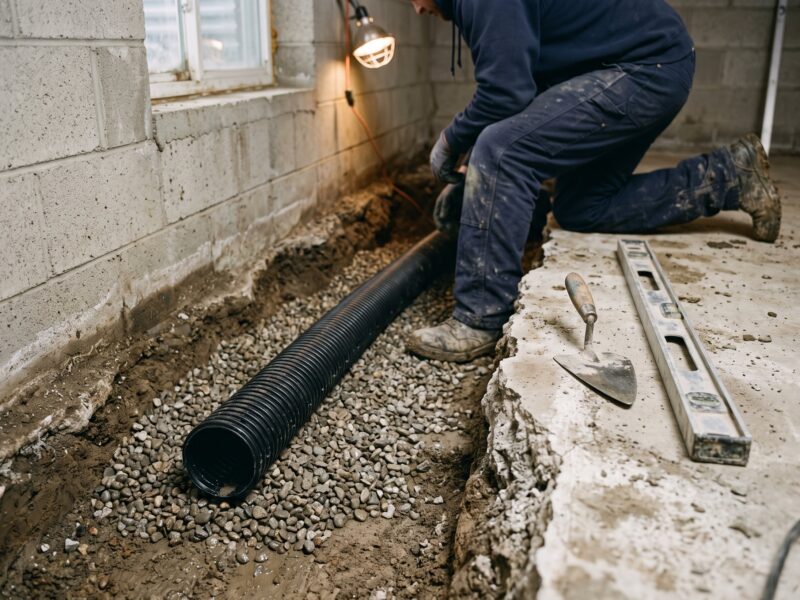 Interior drain tile
Footing-level drainage for the low-lying blocks that live near the water table.
Learn more
Interior drain tile
Footing-level drainage for the low-lying blocks that live near the water table.
Learn more
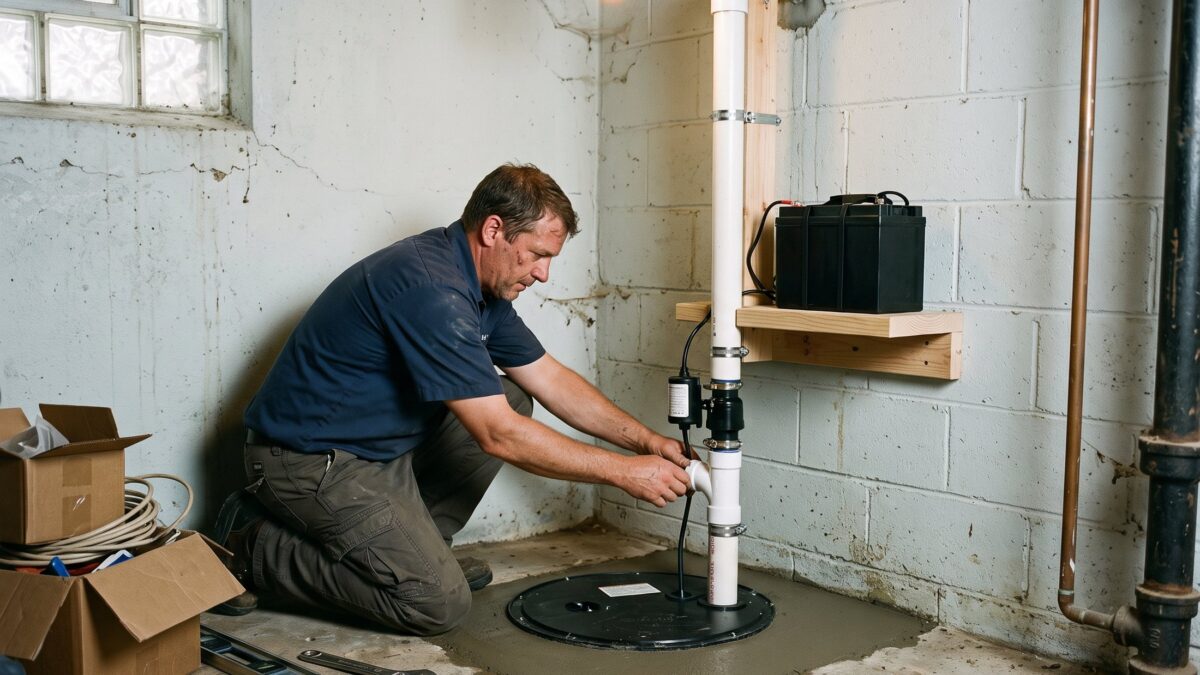
 Sump pumps & battery backup
Capacity for basements that collect groundwater all spring, power or no power.
Learn more
Sump pumps & battery backup
Capacity for basements that collect groundwater all spring, power or no power.
Learn more
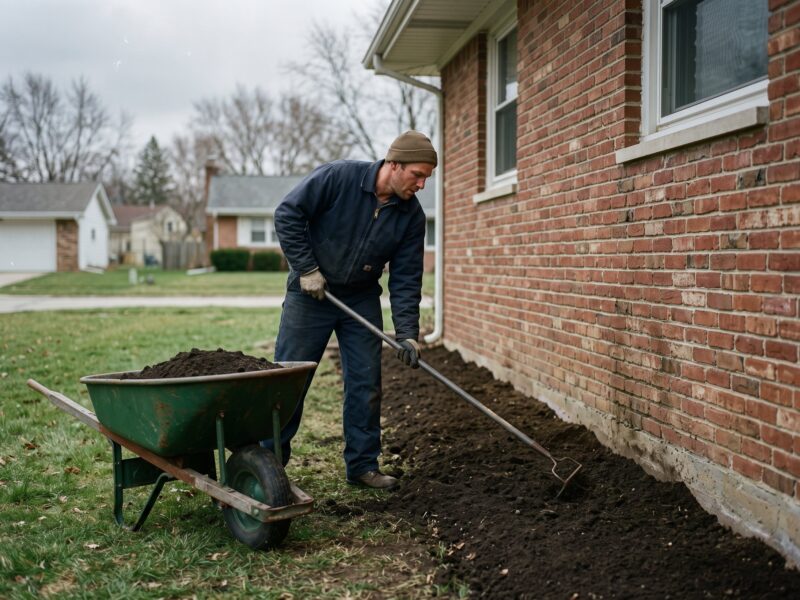 Yard drainage & regrading
Often the whole answer on bluff lots where water is arriving from the surface.
Learn more
Yard drainage & regrading
Often the whole answer on bluff lots where water is arriving from the surface.
Learn more
 French drains
For yards on the slope that pass runoff downhill toward a neighbor's wall, or catch it from one.
Learn more
French drains
For yards on the slope that pass runoff downhill toward a neighbor's wall, or catch it from one.
Learn more
 Crawl space encapsulation
Older cottages and additions near the canal corridor included.
Learn more
Crawl space encapsulation
Older cottages and additions near the canal corridor included.
Learn more
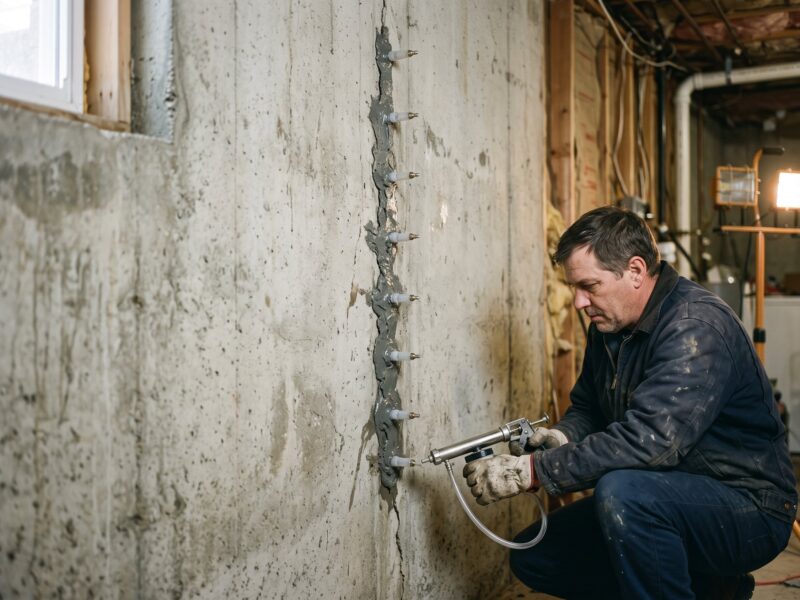 Leaking crack injection
Poured-wall cracks in the newer stock sealed full depth from $450.
Learn more
Leaking crack injection
Poured-wall cracks in the newer stock sealed full depth from $450.
Learn more
Why do Lockport basements leak?
Lockport basements leak for reasons that sort by elevation: groundwater below the bluff, saturated stone near the old canal district, and surface water on the higher ground. The right fix for one address can be the wrong fix one street over.

Below the bluff
The low-lying streets near the canal level sit close to the water table, and wet springs prove it: cove joints weep, sump pits refill, and floors sweat. This is genuine groundwater, and drain tile with real sump capacity is the honest answer.

The stone foundations downtown
Canal-era limestone walls were laid with soft lime mortar and no membrane. Water moving through them is not just a wet floor, it is slowly dissolving the joints, so the first job is keeping water off the wall, not just collecting it inside.

Up on the bluff and beyond
The post-war block and newer poured walls on the high ground drain fast. When they leak it is usually surface water: settled grading, short downspouts or a single cracked wall, which is $600 to $2,500 of correction rather than a full system.
What makes Lockport groundwater different?
Lockport groundwater behavior changes over a shorter distance than almost anywhere else we work, because two canals and a bluff divide the town. The Illinois and Michigan Canal and the Sanitary and Ship Canal both pass through, and the ground climbs sharply away from them. Houses on the low side share their elevation with the water, so their soil stays loaded long after a storm. Houses on the high side shed water quickly and rarely see a true high water table.
That elevation change is why we refuse to quote Lockport by phone. Two identical symptoms on either side of the slope can need opposite fixes: a $10,000 perimeter system where groundwater is real, or a $900 regrading where roof water is the whole story. The inspection reads the lot before anyone prices the basement, and the written plan says which side of the problem your house is on.
 Low ground near water: where Lockport basements meet the water table.
Signs your Lockport basement needs waterproofing
Six symptoms drive most Lockport waterproofing calls, and each one points somewhere different on the price sheet. The free inspection exists to match yours to the cheapest fix that actually works.

Water at the floor-wall joint
Hydrostatic pressure pushing groundwater under the footing. On the streets below the bluff this is the signature symptom, and it is drain tile work, not caulk work.

White mineral bloom on the wall
Efflorescence means water is traveling through the wall itself. On block it signals seepage; on old stone it is a warning that the mortar is being washed, which raises the urgency.

A sump that cycles all spring
Below the bluff, a busy sump can be normal groundwater that needs backup capacity. On the high ground, the same cycling usually means the pit is drinking your own roof water.

Musty air on the first floor
Basement humidity rides the stack effect upstairs. A smell that returns every wet season points to seasonal groundwater or a damp crawl space, both fixable at a known price.
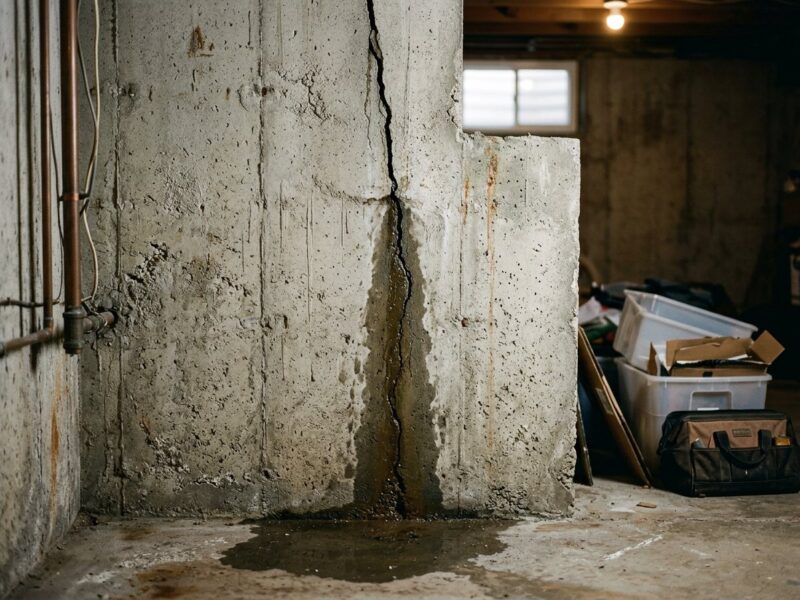
A poured-wall crack that runs
The newer subdivisions crack as concrete cures and settles. When a hairline becomes a leak, a $450 to $900 urethane injection usually closes the case in one visit.
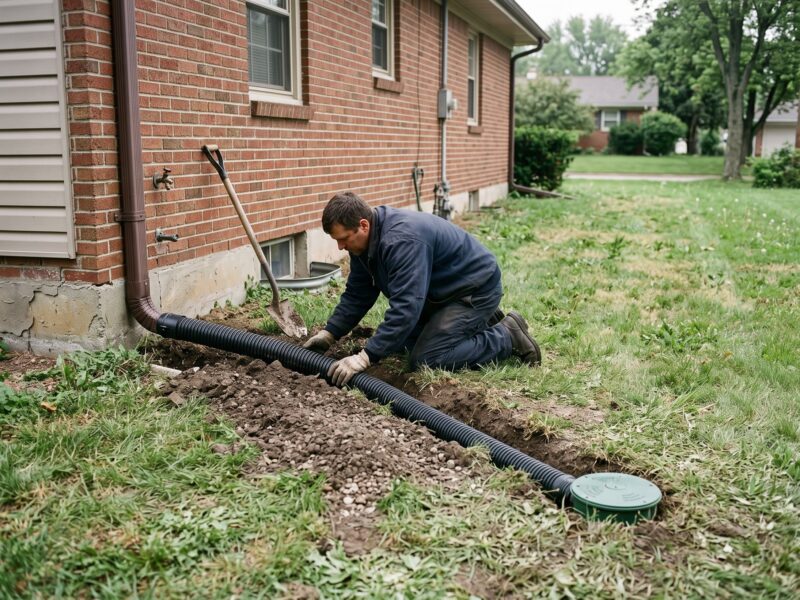
Roof water dumping at the wall
Short downspouts and settled grading feed storm water straight to the foundation. On bluff lots this is the most common cause we find, and the cheapest one to end.
Same puddle in the same corner every wet week? Tell us the street and which side of the bluff you sit on; the answer often starts there.
How does basement waterproofing work in Lockport?
A Lockport waterproofing job moves through four steps, and because the town sits in our first ring, none of them waits on a long drive. Most full systems finish in two to four days.
Read the lot, then the basement
The inspection starts outside: elevation relative to the canal level, grading, downspouts, then the water's path indoors. Free, in writing, within 48 hours.
Day 0Match the plan to the wall
Stone foundations get a drainage-first plan that protects the mortar; block and poured walls get the interior system detail they were built for. The written scope explains the choice.
Day 0, same visitInstall and flood test
Trench, tile, gravel, sump with battery backup, fresh concrete, then a hose test you watch before we call it done. Finished rooms lose only the bottom drywall course along the run.
Days 1 to 4Register the warranty
Interior systems carry the lifetime, fully transferable warranty, registered to the address so it follows the house to its next owner.
On completionInterior or exterior waterproofing: which works in Lockport?
Most Lockport basements are best served by interior drain tile, but this is the rare town where the exterior side of the ledger gets real weight: on a canal-era stone wall, stopping water before it reaches the masonry protects the mortar that holds the wall up.
| Interior drain tile | Exterior drainage & excavation | |
|---|---|---|
| Best for | True groundwater below the bluff and cove-joint seepage | Keeping water off walls that should not be soaked, stone above all |
| On stone foundations | Works, but only as the second layer of the plan | Grading, gutters and exterior drainage come first to spare the mortar |
| On the bluff lots | Rarely needed; the ground already drains | Regrading and French drains usually end the problem outright |
| Lot access | None required; the system installs from inside | Needs digging room along the treated wall or across the yard |
| Cost | $95 to $160 per linear foot | French drains $45 to $90 per linear foot; grading from $600 |
| Season | Installs year-round, frozen ground irrelevant | Best in dry fall ground; saturated spring soil slows digs |
The inspection decides the order, not a product preference. On some Lockport houses the exterior work is the whole job; on others it never comes up.
When do Lockport basements flood?
Lockport basement water keeps a seasonal schedule, and the low streets and the high streets read it differently. Knowing your season is how a cheap fall fix replaces a spring emergency.
Spring: the low ground pays
Snowmelt and rain lift the water table, and the blocks near canal level feel it first: weeping cove joints and sumps that never rest. Our busiest weeks, which is when the 48 hours promise earns its keep.
March to MaySummer: the cloudburst test
Short violent storms overwhelm gutters and knock out power, the exact combination that drowns a primary-only sump. Every system we install in Lockport gets the battery backup argument for this reason.
June to AugustFall: the outside season
Dry ground makes fall the window for regrading, downspout burials and French drains, the $600 to $2,500 corrections that decide whether spring water ever reaches the wall. On stone foundations this is the priority work.
September to NovemberWinter: the inside season
Interior drain tile installs straight through winter because the whole job happens under the house. Scheduling is fastest now, and the system is running before the melt arrives.
December to FebruaryHow much does basement waterproofing cost in Lockport?
Basement waterproofing in Lockport costs $95 to $160 per linear foot for interior drain tile, with a complete perimeter system, sump and battery backup landing between $8,000 and $16,000 on most homes. Lockport pays the same published ranges as every town on our map, and bluff-lot jobs often close for far less because grading and drainage carry the day.
| Work | Range | What moves the number |
|---|---|---|
| Interior drain tileper linear foot | $95–$160 | Length of the run, slab thickness, what has to be moved off the walls |
| Sump pump with battery backupinstalled | $2,800–$4,500 | Pit condition, backup capacity, discharge routing |
| Exterior French drainper linear foot | $45–$90 | Trench depth, where the water can legally go |
| Downspout extensions and regradingtypical job | $600–$2,500 | Feet of grade to rebuild, soil hauling |
Every range lives on the pricing page, and your written Lockport quote lands inside it.
Where we waterproof in Lockport
One ZIP, 60441, but several different waterproofing towns inside it. The historic blocks around State Street and the canal district send us saturated stone walls and drainage-first plans. The streets below the bluff and out toward the Fairmont area send true groundwater calls: cove joints, tired sumps, spring flooding. Up on the bluff, around Dellwood Park and along the Route 7 corridor, the calls are grading, downspouts and the occasional leaking poured-wall crack.
Lockport is home-ring territory: fifteen to twenty minutes from our base in the Joliet and New Lenox corridor, inspections inside 48 hours and usually sooner, 24/7 response when water is standing, and no trip charge anywhere in town or Lockport Township.
 Older Lockport blocks: modest houses over basements that predate waterproofing.
Lockport basement waterproofing questions, answered straight
Should I waterproof the inside of a stone foundation in Lockport?
Interior drain tile does work on stone, but the order of operations flips. A modern wall can simply have its water managed; a stone wall needs the water kept away from it, because soaking is what dissolves lime mortar. In Lockport we fix gutters, downspouts and grading first on stone houses more often than anywhere else we work, and add interior drainage only where groundwater truly demands it.
Why does my neighbor's basement stay dry when mine floods on the same street?
In Lockport the usual answer is elevation. The bluff drops enough over a short distance that two houses a block apart can sit in completely different relationships to the water table. Yours is not the badly built one; it is simply the lower one, and the system gets designed for that.
How much does basement waterproofing cost in Lockport?
The same published ranges as everywhere we work: $95 to $160 per linear foot for interior drain tile, $8,000 to $16,000 for a full perimeter system with sump and backup, $2,800 to $4,500 for a sump with battery backup on its own, and $600 to $2,500 for grading and downspout work. Which end of that sheet you land on depends heavily on your elevation.
Does living near the canals mean my basement will flood?
Not by itself. The canals matter mostly because the ground near their level sits closer to the water table, so low-lying houses deal with groundwater more often than houses on the bluff. The inspection reads your actual elevation and your actual symptoms; plenty of houses near the water stay dry with nothing but good grading and a healthy sump.
My sump runs constantly every spring. Do I need drain tile?
It depends on where the water is coming from. Below the bluff, constant spring cycling is often honest groundwater, and the fix is capacity: a properly sized pump, a battery backup, and drain tile if water is also reaching the floor. On higher ground the same symptom usually traces to roof water recycling through the pit, which $600 to $2,500 of exterior work ends.
Do you waterproof finished basements in Lockport?
Yes, without tearing them out. The bottom course of drywall along the wet wall comes off and goes back on, flooring and framing get protected, and everything beyond the work line stays untouched. You watch the flood test before the trim is reinstalled.
How do I choose a basement waterproofing company in Lockport?
Ask whether their pricing is published before a visit, whether the warranty transfers to a buyer without conditions, and what they would do differently on a stone foundation than on a poured one. That last question does real work in Lockport; a company with one answer for both walls should not be working on the old stock.
How fast can you get to a Lockport house?
Fifteen to twenty minutes. Lockport sits in our home ring, so standard inspections happen within 48 hours and often same-week, and active flooding is answered 24/7. There is no travel surcharge this close to base.
Is the wet wall a stone wall?
On Lockport's canal-era foundations, water and structure are the same problem: every gallon that moves through the wall carries a little lime mortar with it. If your damp basement has stone or rubble walls, or a block wall with a horizontal crack, one inspection covers the drainage and the masonry together.
Foundation Repair in Lockport
Basement waterproofing near Lockport

Dry on your side of the bluff, in writing
A free inspection within 48 hours, a plan built for your elevation and your wall, and a lifetime, fully transferable warranty registered to the address.
Or talk to a human right now
(630) 335-1128
Request your free estimate
Tell us what you're seeing. We'll call back fast and be out within 48 hours.