
Crawl Space Encapsulation Cost in Illinois
Encapsulation is sold by the square foot, and the square footage is the easy part. Access, water and whatever has to come out of there first are what decide whether your crawl prices at $7 a foot or at $14.
- $7 to $14 per square foot, published
- Written estimate within 48 hours
- 0% for 12 months financing available
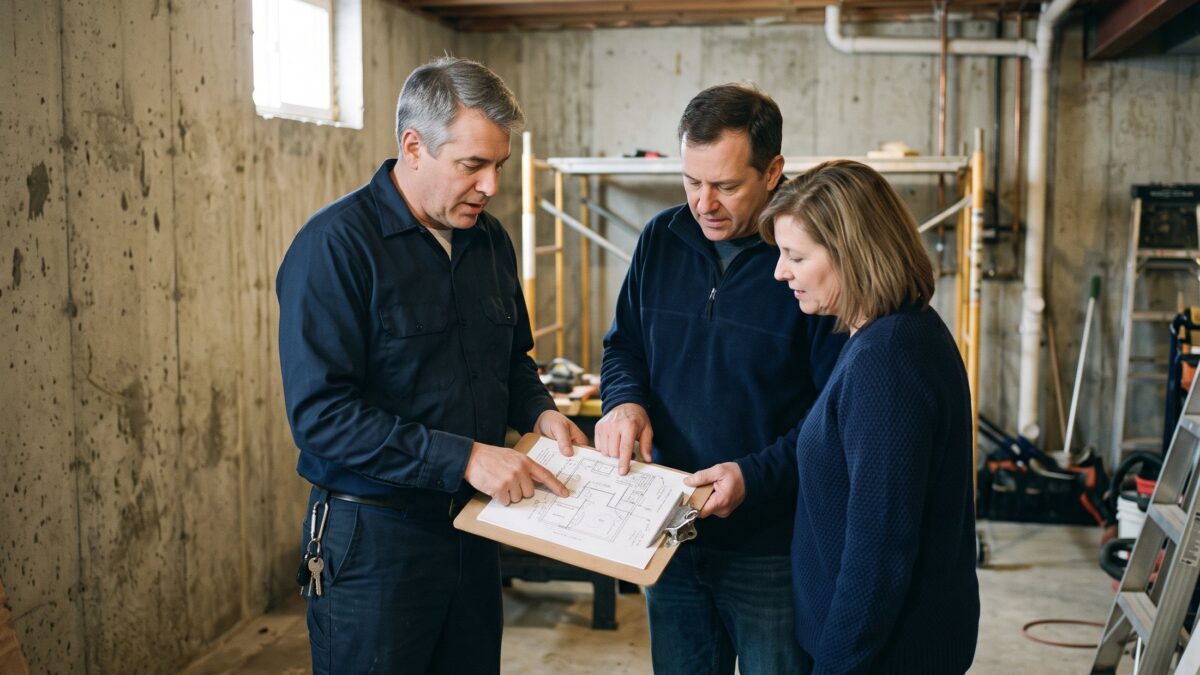 Published pricing, 1,500+ homes
The short answer
Crawl space encapsulation costs $7 to $14 per square foot in Illinois, so a 1,000 square foot crawl works out to roughly $7,000 to $14,000. Drainage is quoted separately: perimeter pipe runs $95 to $160 per linear foot and a sump pump with battery backup runs $2,800 to $4,500 installed.
A square foot price exists because most of what encapsulation consumes scales with floor area. Liner, seam tape, fasteners and the hours spent unrolling and detailing all track the footprint fairly closely. What does not scale with area is how hard the space is to move around in, and that is where two crawls of identical size end up thousands of dollars apart. A technician working on his back in eighteen inches of headroom does perhaps half the work per hour of one who can kneel, and every bag of debris still has to fit through the hatch.
The regional picture matters to the arithmetic here. Full basements are the norm across Will, Cook, DuPage, Kane, Kendall, DeKalb and Lee counties, so the crawl spaces we price are usually small: an addition, a sunroom, the low wing of a split-level, or an older rural house that predates basements. Small footprints mean the fixed costs, cleanout, mobilization, a dehumidifier, weigh heavier on the per foot math than they would on a big southern crawl. The crawl space encapsulation overview explains what that money is buying.
What pushes a crawl space quote to the high end?
Two crawl spaces of identical size can price at opposite ends of the range. The gap is almost always how hard the space is to work in and how much has to leave before productive work starts.
These are the five things we measure at the inspection, ordered by how much they move the number.
-
Headroom and the way in
A crawl you can kneel in gets finished in roughly half the hours of an eighteen inch space where everything moves on a creeper. If the entry is a twenty two inch opening through a basement wall, every roll of liner and every bag of debris passes through that hole by hand.
-
What has to come out
Old sheeting, soaked batts, rodent nesting and leftover construction scrap get hauled up and disposed of. A swept crawl adds nothing to the price. A crawl holding forty bags of wet insulation and debris adds a day of labor before anyone installs anything.
-
Whether water stands down there
Damp soil takes a liner. Water that pools takes a graded trench, perforated pipe in stone, a sealed basin and a pump before the liner is worth installing. That is a separate line, and it is the single largest add on most crawl space quotes.
-
How far the liner runs
Floor only costs less than floor plus stem walls, piers, a sealed basin lid and a finished termination at the top of the wall. Both versions sit inside the same published band, which is exactly why two quotes with the same number can describe different jobs.
-
Air handling and the openings
A dehumidifier sized to the volume, a condensate route, insulated vent covers, rim sealing and a gasketed access door. Leaving these out lowers a quote nicely and leaves you with a sealed space that still reads humid in August.
Toward $7 per square foot
- Standing headroom and a full size access door
- Dry soil that shows nothing after a storm
- Space already emptied of debris and old insulation
- A simple rectangle with few piers and ducts in the way
Toward $14 and past it
- Belly crawl headroom, or hatch only entry
- Water that needs drainage before anything gets sealed
- Soft framing a carpenter has to address first
- A chopped up footprint with piers and duct runs to work around
What is quoted separately from the square foot price?
The square foot price buys a sealed envelope. It does not buy getting water out of the ground, replacing wood that already failed, or stopping the water outside.
Each of these appears as its own line on our estimates, with its own published range.
-
Drainage under the liner
Perforated pipe bedded in washed stone along the low side of the crawl, pitched toward a basin. It is priced like interior drain tile, $95 to $160 per linear foot, and it carries a 5-year warranty.
-
The basin, pump and backup
A sealed pit with a lid the liner ties into, a pump sized to the measured inflow and a battery backup, at $2,800 to $4,500 installed. In a crawl the lid seal earns its keep as much as the pump does, because an open pit undoes the vapor barrier above it.
-
Structural wood
Sill plates, joist ends and girders that have already gone soft get replaced before anything is sealed over them. A rusted or settled post is support column replacement at $1,500 to $3,200. Covering rot buys you nothing but a tidier view of it.
-
Outside water control
Downspout extensions and regrading run $600 to $2,500 and often belong at the top of the list rather than the bottom. Water that never reaches the crawl wall is water no liner and no pump ever has to deal with.
-
Remediation and restoration
Visible mold growth is quoted by a licensed remediation contractor, not folded into our number. So is any flooring or drywall above that has to be opened up to reach damaged framing from the other side.
Should appear as its own line
- Perimeter drainage, by the linear foot
- The basin, pump and battery backup as one item
- Debris removal and disposal
- Any structural wood replacement
- Dehumidifier size, model and condensate route
Ask every quote these
- Does the price include hauling the old insulation out?
- Does the liner climb the walls, or only cover the dirt?
- Who handles mold, and is it inside this number?
- What happens to the price if water shows up mid job?
What separates a low quote from a high one?
Line the two ends of the range up against real conditions and you can usually place your own crawl space before we get there.
| Low end, near $7 | High end, $14 and up | |
|---|---|---|
| Headroom | Three feet or more, work happens on knees | Under two feet, everything happens on a back |
| Entry | Exterior door or a full size hatch | A small opening cut through a basement wall |
| Soil condition | Dry and graded, nothing standing | Wet clay, or puddles after every storm |
| What is down there now | Empty and swept | Wet batts, debris, torn sheeting, nesting |
| Shape | Open rectangle | Piers, duct runs and tight bays to work around |
| Drainage needed | None | Trench, pipe and a sealed basin, quoted on top |
| Wood condition | Sound framing throughout | Soft sill plates and joist ends to replace first |
| Air handling | One correctly sized dehumidifier | Dehumidifier, insulated vent covers, rim sealing, new hatch |
| Season | Any month, the work is under the house | Same inside, though outside drainage waits for thaw |
The one thing that never moves our number is who is standing in your kitchen. Ranges are published, crews are on payroll, and nobody here earns more by selling you a bigger job. Compare that against what you are quoted on the pricing page.
Want a real number for your crawl space? Measure the length and the width, and we will put the price in writing free within 48 hours.
What does the era of the house do to the price?
Crawl spaces around here are pieces of a house rather than whole foundations, and the era they came from predicts the labor before we ever lift the hatch.

Pre-war bungalows and two-flats
A crawl under a rear addition or porch, entered through a small opening in the basement wall. Short headroom and a hand carried job push these to the top of the range even when the footprint is tiny.
Small but slow
Post-war block ranches
Added wings over shallow block crawls with vents at grade. Budget for debris and wet insulation removal, and expect the smell in the bedrooms above to be part of why you called us.
Cleanout drives the cost
Split-levels and 1980s poured walls
A poured stem wall crawl under the lower wing, usually taller and far easier to work in. Rim joist sealing at the change in floor level is the line item people forget to compare between quotes.
Often mid range
Newer subdivision homes
A small crawl under a bump-out or sunroom next to a full basement. Clean, reachable and quick, so these land near the bottom of the range unless the grading outside has settled back toward the house.
Lowest per footThe published ranges we quote from
Encapsulation is $7 to $14 per square foot in every county we serve. A 600 square foot crawl is therefore roughly $4,200 to $8,400 before drainage, and a 1,200 square foot crawl roughly $8,400 to $16,800.
| Work | Range | What moves the number |
|---|---|---|
| Crawl space encapsulationper square foot | $7–$14 | Access height, standing water, whether drainage goes in first |
| Interior drain tileper linear foot | $95–$160 | Length of the run, slab thickness, what has to be moved off the walls |
| Sump pump with battery backupinstalled | $2,800–$4,500 | Pit condition, backup capacity, discharge routing |
| Downspout extensions and regradingtypical job | $600–$2,500 | Feet of grade to rebuild, soil hauling |
Those last three are not automatic. They appear on your estimate only when the crawl actually needs them, and they are listed at their own published rates so you can strike one and still understand the total. Every number here also lives on the pricing page.
When the money belongs somewhere else
Not every crawl space is worth encapsulating this year, and a few are worth nothing at all beyond a cheap meter. Here is when we say so out loud.
It is 180 square feet
Below roughly three hundred square feet the per foot math stops describing reality, because mobilization, cleanout and a dehumidifier cost about the same in a closet sized crawl as in a big one. Ask us for the number rather than multiplying, and expect it to look high per foot and reasonable in total.
Ask, do not multiplyThe readings say you are fine
A $30 hygrometer left on the soil for a month through summer settles the question for the price of lunch. Stable readings in the 50s in the worst week of August mean the space is behaving, and no quote should talk you out of your own data.
Free to verifyYour gutters are writing the check
When water only turns up under the house after a storm, the fix may be sitting in the yard. Extensions and regrading are $600 to $2,500, carry a 5-year warranty, and are worth a full season of watching before anyone quotes you a system. Grading and slope covers what good looks like.
Cheapest real fixDry air is all you actually need
A crawl with sound framing, no standing water and intact sheeting sometimes just needs the air handled. A correctly sized dehumidifier costs a fraction of a full scope, and a month of readings tells you plainly whether it was enough.
Start smallerQuestions homeowners ask about encapsulation pricing
How much does crawl space encapsulation cost in Illinois?
Our published range is $7 to $14 per square foot. Multiply it by your footprint and you have the honest bracket: a 500 square foot crawl comes to roughly $3,500 to $7,000, and a 1,000 square foot crawl to $7,000 to $14,000. Where a job lands inside that band comes down to headroom, access, how much has to be hauled out and how far the liner runs. Drainage, a pump and any structural wood are quoted separately at their own published rates.
Why is encapsulation priced by the square foot at all?
Because most of the job scales with floor area. Liner, tape, fasteners and the hours spent placing and detailing all follow the footprint. It is a fair starting point and a poor finishing point, which is why we measure headroom, the access opening and the debris load before committing to a number. A per foot rate quoted over the phone without any of that is a guess wearing a decimal point.
Does the price include a dehumidifier?
Yes, in our full scope, unless the crawl can be conditioned from the existing HVAC system instead. Sealing the space removes the outdoor humidity but not the moisture the house itself sheds downward, and there is no longer a vent for it to leave through. A unit sized to the volume with a real condensate route is part of the number, and the estimate names the size so you can compare it against anyone else.
Is encapsulating a crawl space cheaper than waterproofing a basement?
Usually, but only because the footprint is smaller. Per square foot, crawl work is slower and harder than basement work, since material and spoil move by hand through a small opening. A full perimeter interior system in a basement runs $8,000 to $16,000, and a typical crawl encapsulation lands under that simply because there is less ground to cover. Comparing the two on a per foot basis is not a useful exercise.
Does encapsulation pay for itself?
Some of it comes back and some of it does not, and we would rather say that than promise a percentage. Sealing a vented crawl usually makes the floor above warmer and the air upstairs less musty, and it stops the slow moisture damage that eventually turns into joist and sill work costing more than the encapsulation did. What we will not do is quote you a resale figure, because that depends on your street and your buyer, not on our liner.
Do you offer financing for crawl space work?
We do, at 0% for 12 months, and the terms are on the estimate rather than in a separate conversation at the kitchen table. Because our pricing is published, financing does not change the price of the work in either direction. If the crawl needs drainage as well as encapsulation, we will show you both lines and you can stage them across two seasons if that suits the budget better.
What exactly are you buying at that price?
A number only means something next to a scope. Before you compare two crawl space quotes, it is worth knowing what a complete encapsulation covers, which parts of the envelope get sealed, and which items are legitimately quoted on their own line rather than folded into the square footage.
See the full scope

Get your crawl space priced in writing, not guessed at
A measured inspection and a written number within 48 hours, published ranges either way, and 0% for 12 months if you go ahead.
Or talk to a human right now
(630) 335-1128
Request your free estimate
Tell us what you're seeing. We'll call back fast and be out within 48 hours.