
Interior Drain Tile in Chicago
The system under the floor that ends cove-joint seepage for good: perforated pipe at the footing, pitched to a sump, buried under restored concrete. Installed year-round, warrantied for life.
- Published pricing: $95 to $160 per linear foot installed
- Warranty: lifetime, fully transferable
- Installs in any season, frozen ground included
 Lifetime transferable warranty
What goes under the floor, piece by piece
Drain tile is a simple machine with no moving parts. Its job is to give water a permanently easier path than your carpet, and every piece below serves that one idea.
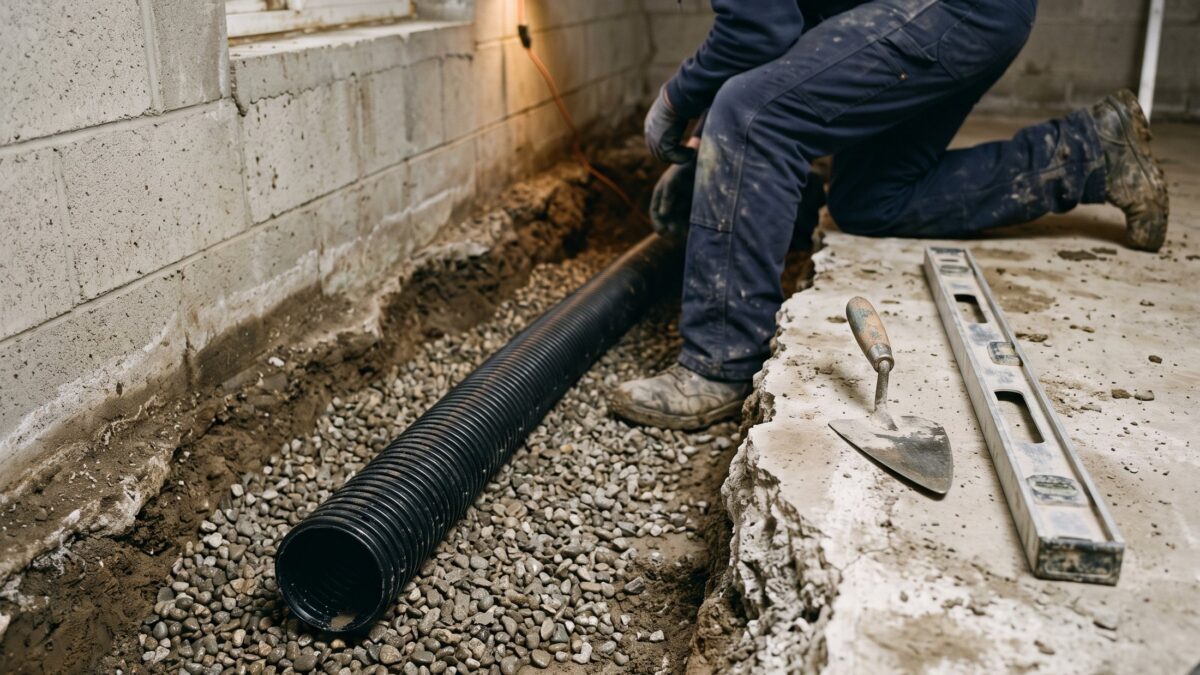
The trench
A channel sawed and broken along the wall, down to the footing, where hydrostatic pressure delivers the water first.
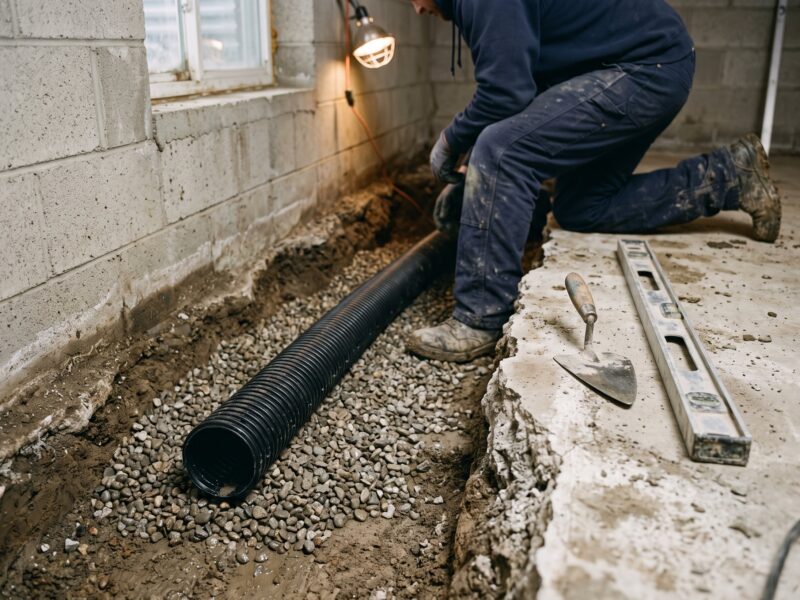
Perforated pipe
Rigid or corrugated pipe, holes down, laid at the footing and pitched so collected water moves instead of sitting.
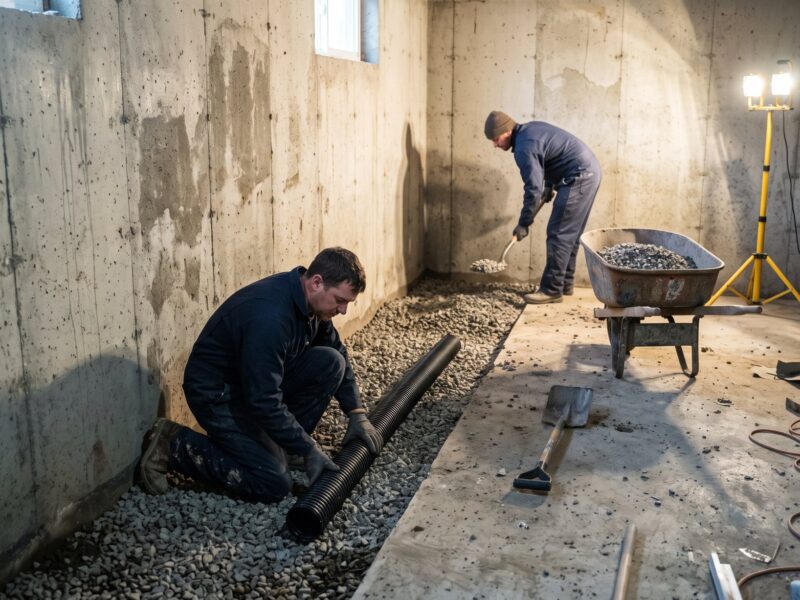
Washed gravel bed
Clean stone around the pipe keeps clay fines out and lets water reach the perforations for the life of the house.

Wall drainage path
Weep holes and a wall gap let block walls drain into the tile instead of weeping through their face into the room.

The sump connection
Every foot of tile drains to a sealed basin, where the pump and battery backup lift the water out of the house.

Restored concrete
New concrete troweled level with the old slab closes the system. A month later, guests can't find the seam.
How does interior drain tile actually work?
Interior drain tile works by lowering the water pressure at the base of your foundation. Water in saturated clay pushes toward the basement through the cove joint, the seam where floor meets wall, because that is the path of least resistance. The tile makes itself the easier path: water enters the gravel and pipe before it can rise above slab level, and gravity walks it to the sump.
It is a hundred-year-old idea that Chicago builders installed on day one, in clay pipe segments that silted shut decades ago. Most bungalows and post-war houses here are running on original tile that stopped working before their current owners were born. The modern system is the same physics in materials that don't clog: PVC and washed stone doing what farm tile did, permanently.
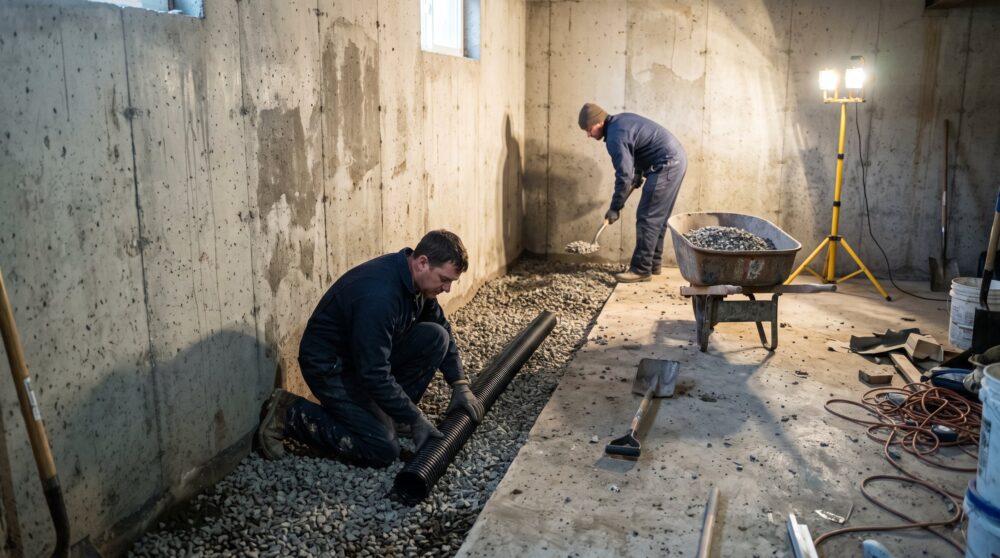 Pipe and washed gravel at the footing: the permanently easier path.
Interior drain tile, or exterior drain tile?
Both collect water at the footing. One does it from a trench inside the basement; the other requires excavating the yard down to the footing. For an existing Chicago home, interior wins on cost, season and disruption almost every time.
| Interior drain tile | Exterior drain tile | |
|---|---|---|
| Where it sits | Inside the footing, under the basement floor | Outside the footing, at the base of the excavated wall |
| Best for | Existing homes with cove seepage or hydrostatic pressure | New construction, or walls already excavated for membrane work |
| Cost | $95 to $160 per linear foot | Excavation economics; priced per wall after inspection |
| Disruption | Concrete work inside; 2 to 4 days | Landscaping, decks and walks along every treated wall |
| Season | Year-round, frozen ground irrelevant | Weather-dependent; winter digs in clay are rough |
On new builds and full excavations we install exterior tile too. For a lived-in house, the math almost always lands inside.
Water at the floor-wall seam after every hard rain? That's the cove joint, and this is the system built for it.
How a drain tile installation goes, saw cut to seam
A full perimeter takes two to four days. A single wall takes less, and the price scales by the foot.
Trace and measure
We find where water enters, measure the run that needs tile, and price it by the foot against the published range. Free, within 48 hours.
Day 0Cut the channel
Floor coverings come up along the run, the slab edge is sawed under dust control, and the trench opens to the footing. Finished walls lose only the bottom course.
Day 1Lay and pitch the tile
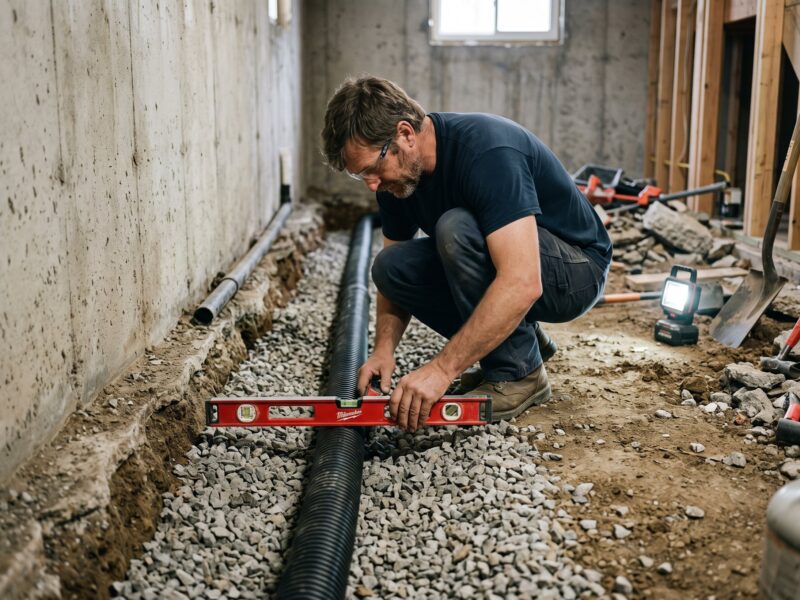
Pipe goes in on washed gravel, holes down, pitched to the basin. We check the slope with a level because water doesn't take instructions.
Day 2Close and water-test
New concrete restores the floor, the system gets flooded on purpose while you watch it drain, and the lifetime, fully transferable warranty registers to the address.
Day 2 to 4How much does interior drain tile cost in Chicago?
Interior drain tile runs $95 to $160 per linear foot installed. A typical single wall lands around $3,000 to $5,000; a full perimeter with the sump system runs $8,000 to $16,000 on most Chicago homes.
| Work | Range | What moves the number |
|---|---|---|
| Interior drain tileper linear foot | $95–$160 | Length of the run, slab thickness, what has to be moved off the walls |
| Sump pump with battery backupinstalled | $2,800–$4,500 | Pit condition, backup capacity, discharge routing |
| Exterior French drainper linear foot | $45–$90 | Trench depth, where the water can legally go |
Length of the run, slab thickness and what has to move off the walls set the per-foot price. Every published range lives in the pricing guide.

Installed by people who check the pitch twice
Drain tile fails two ways: pipe laid flat, and gravel skipped to save a day. Both are invisible under fresh concrete, which is why the trade attracts shortcuts. Our crews have put tile under Chicago-area floors for 20+ years, the pitch gets verified with a level before a single stone covers it, and the warranty assumes we'll never be back.
- Pitch checked and photographed before the gravel goes in
- System water-tested in front of you before the pour
- Licensed, bonded and insured: $2,000,000 general liability
- lifetime, fully transferable warranty, registered to the house
The tile is half the system
Every foot of drain tile ends at a sump basin, and the system is only as reliable as the pump that empties it. If your pump is a decade old or has no battery backup, pairing the tile with a new sump system costs less in one mobilization and closes the loop properly.
Sump Pump Installation In this guide
The detail behind every part of this work, written out in full.
Interior drain tile near you
Serving Chicago and the suburbs: Will, Cook, DuPage, Kane, Kendall, DeKalb and Lee counties.
Drain tile questions, answered straight
What does interior drain tile cost per foot in Chicago?
$95 to $160 per linear foot installed, including the trench, pipe, washed gravel and restored concrete. The sump system it drains to is priced separately at $2,800 to $4,500 with battery backup, and both numbers are published before anyone visits your house.
Does interior drain tile stop water from coming through the floor?
Yes, when the water is rising from hydrostatic pressure under the slab, which is the usual cause. The tile relieves that pressure at the footing before water can rise above floor level. Water from a backing-up floor drain is a sewer problem, a different trade, and the inspection tells you which you have.
Do I need drain tile on the whole perimeter or just one wall?
Whatever the water says. If seepage tracks one wall that faces the driveway grade, one wall gets tile and the price scales by the foot. Full perimeters make sense when multiple walls seep or when you're finishing the basement and want it settled forever.
Is old clay drain tile worth cleaning out instead of replacing?
Rarely. Bungalow-era clay tile is segmented, shifted and full of a century of fines; rodding buys months, not decades. New PVC and washed gravel in the same trench line costs a known number and carries a lifetime, fully transferable warranty instead of a maybe.
Can drain tile go in during winter?
Yes. The entire job happens inside the basement, so frozen ground is irrelevant. Winter is often the fastest time to schedule it, and it beats waiting for the spring thaw to prove the problem again.
Will the new concrete match my floor?
The strip is poured level and troweled to blend, and it cures a shade lighter before evening out over months. If you're planning flooring on top, the seam disappears entirely; keep the receipt and warranty for the next owner instead.

End the cove-joint leak permanently
A free inspection within 48 hours, a per-foot price from a published range, and a lifetime, fully transferable warranty under the new floor. Water gets one path, and it isn't your carpet.
Or talk to a human right now
(630) 335-1128
Request your free estimate
Tell us what you're seeing. We'll call back fast and be out within 48 hours.