Basement Waterproofing in Naperville, Illinois
In Naperville the water is rarely the expensive part. The theatre room, the wet bar and the drywall in front of the leak are. We find the leak with a small inspection cut instead of a demolition, fix it from the published price list, and back the system with a lifetime, fully transferable warranty.
- Finished basements opened surgically, never gutted
- Interior systems warrantied: lifetime, fully transferable
- Free written inspection within 48 hours
 In Naperville every week
Who does basement waterproofing in Naperville?
ProSeal Basement Waterproofing installs interior drain tile, sump pump systems and yard drainage across Naperville, working from a base in the Joliet and New Lenox corridor. Interior drain tile runs $95 to $160 per linear foot, a full perimeter system with a sump and battery backup falls between $8,000 and $16,000, and the whole price list is published online before you ever book the free inspection.
Naperville homeowners do their homework, compare three bids and read the fine print, and that is exactly the customer our model was built for. There is no commissioned closer in your basement and no price invented in your driveway. What we bring that a price sheet cannot is the specific craft this city demands: getting water out from behind a fully finished lower level while wrecking as little of it as possible.
See the full basement waterproofing system, wall to discharge
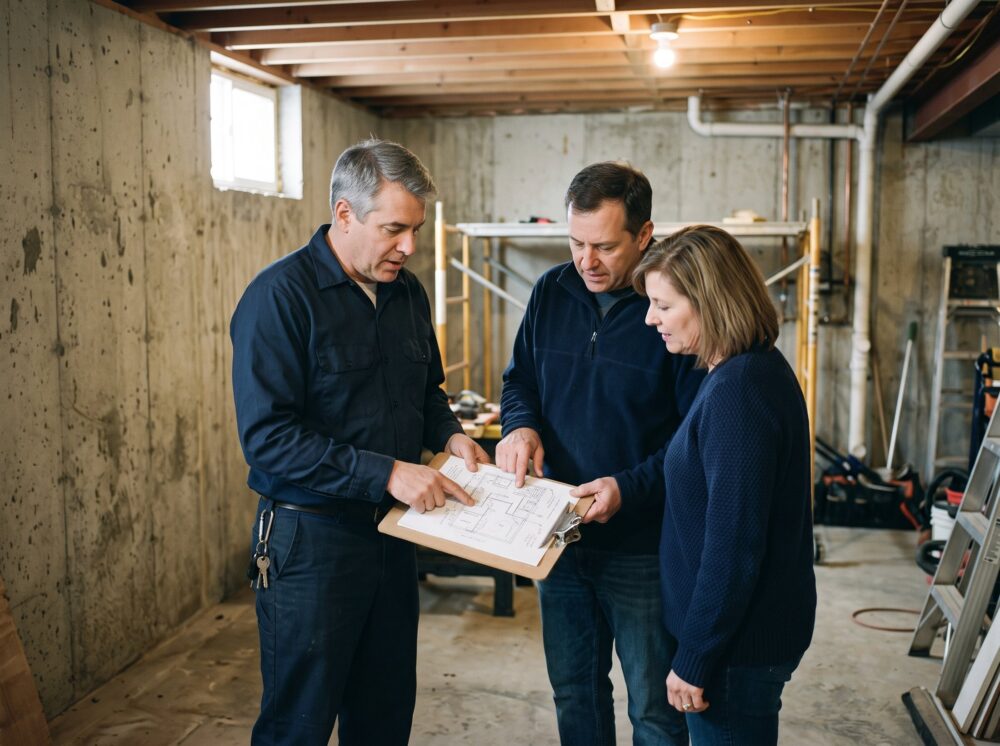 The written scope comes first. Naperville homeowners compare bids; ours reads clean.
What does basement waterproofing in Naperville include?
Six systems cover every way water gets into a Naperville lower level, and the free inspection prices only what your house needs. Each one installs from the published ranges, by our own crew, with the finished space protected.
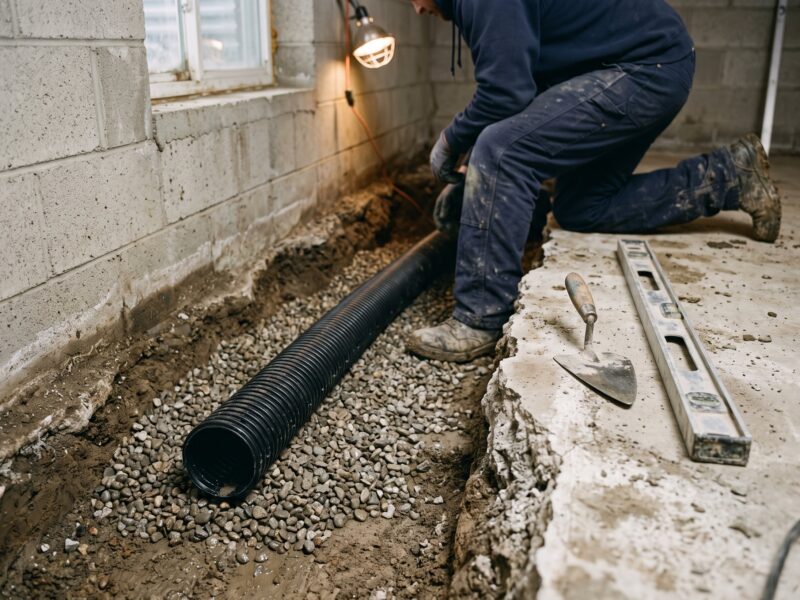 Interior drain tile
The perimeter fix, installed behind a single removed strip of drywall rather than a gutted room.
Learn more
Interior drain tile
The perimeter fix, installed behind a single removed strip of drywall rather than a gutted room.
Learn more
 Sump pumps & battery backup
Sized for the storms that flood a theatre room the same night they cut the power.
Learn more
Sump pumps & battery backup
Sized for the storms that flood a theatre room the same night they cut the power.
Learn more
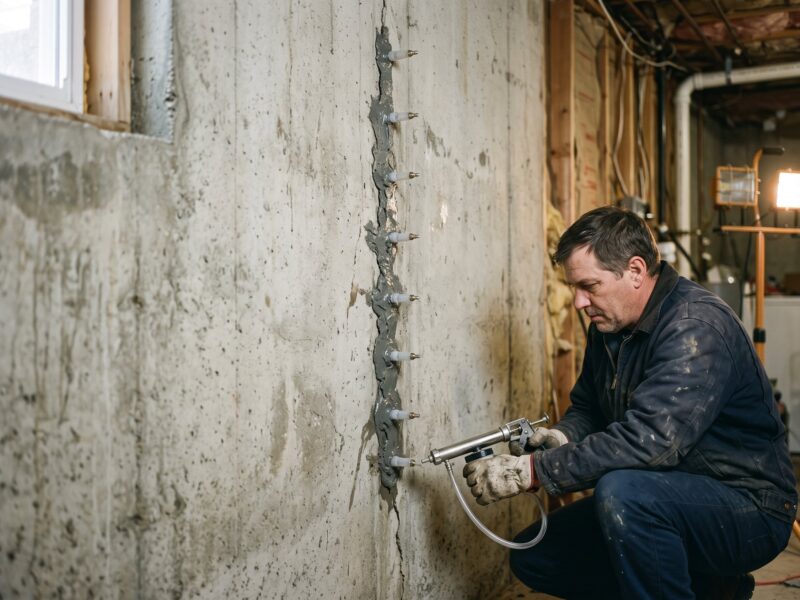 Leaking crack & rod hole injection
The classic Naperville poured-wall fix, sealed full depth from $450.
Learn more
Leaking crack & rod hole injection
The classic Naperville poured-wall fix, sealed full depth from $450.
Learn more
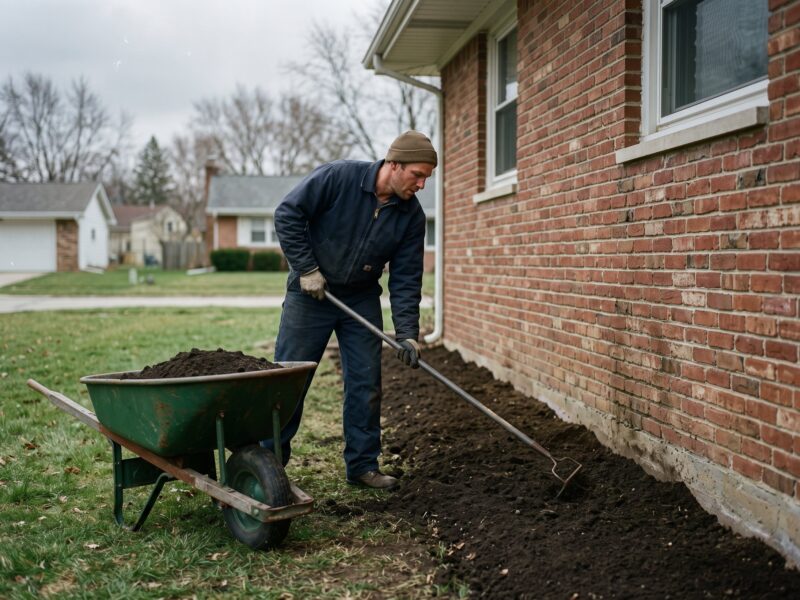 Yard drainage & regrading
For big subdivision lots whose grading has settled toward the house since the builder left.
Learn more
Yard drainage & regrading
For big subdivision lots whose grading has settled toward the house since the builder left.
Learn more
 French drains
For low corners and swales that hold water between neighboring lots.
Learn more
French drains
For low corners and swales that hold water between neighboring lots.
Learn more
 Crawl space encapsulation
For additions and the older stock near the historic district.
Learn more
Crawl space encapsulation
For additions and the older stock near the historic district.
Learn more
Why do Naperville basements leak?
Naperville basements leak quietly. The dominant stock is poured concrete from the 1980s through the 2000s, walls that rarely fail wholesale but weep through small defects hidden behind finished drywall, sometimes for years before the baseboard gives the secret away.
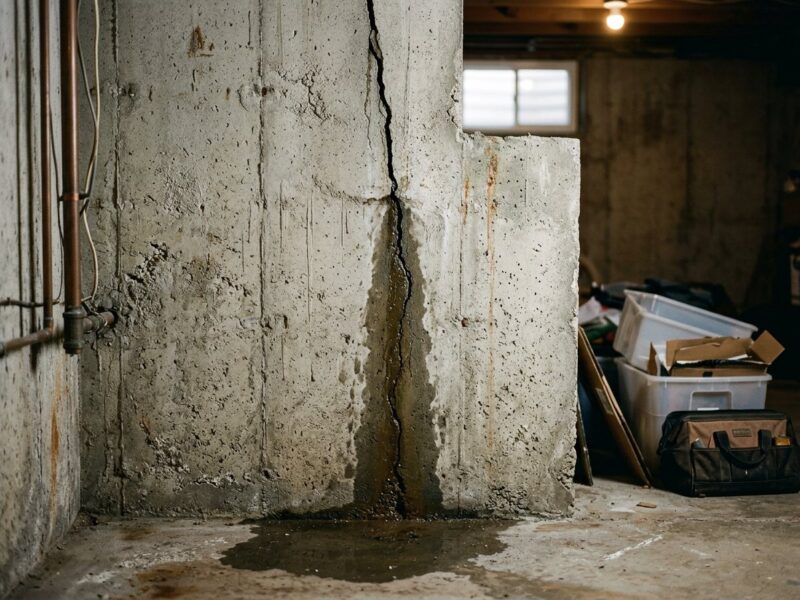
The 1980s and 1990s subdivisions
Cress Creek, Ashbury and their era of poured walls are now decades into service, and the original rod hole plugs and cold joints are reaching the age where a few give up. Each is a small, cheap defect; drywall is what makes it expensive.

The finished lower levels
Nowhere we work has more finished basements per street. Built-ins, wet bars and theatre rooms mean a leak is measured in finish damage, not gallons, and the fix has to be planned around the room, not through it.

The historic district near the Riverwalk
The blocks around the Riverwalk hold much older houses on entirely different foundations. These walls seep the old-fashioned way, through masonry and age, and they get their own playbook rather than the subdivision one.
Where does Naperville basement water come from?
Naperville basement water comes from two directions: the sky and the map. The West Branch of the DuPage River runs through the middle of town with the Riverwalk alongside it, and Springbrook Creek drains the south side, so the lowest-lying blocks feel wet years first. The newer subdivisions sit on graded farm clay with engineered detention, ground that sheds storms well when everything works and holds water against footings when grading or discharge has drifted out of spec.
The signature Naperville failure is smaller and sneakier than a flood. A rod hole or a cold joint in a poured wall starts weeping behind the finished drywall and stays invisible until the baseboard cups or the carpet edge smells musty. By the time it shows, the water has often been coming for a year or two. Our inspections in this city start from that assumption and hunt the secondary evidence first.
See how interior drain tile intercepts water before the finish does
 Graded farm clay after a storm: the water the detention system did not take.
Signs you need basement waterproofing in Naperville
In a finished basement the first witness is rarely the wall. It is the baseboard, the carpet and the air. Six signals bring Naperville homeowners to the phone, and each points to a different fix at a different price.

A musty smell that returns after rain
Odor on a weather schedule is moisture on a weather schedule. In a finished lower level it is often the only early warning you get, and it deserves a leak trace, not an air freshener.
Cupped or swollen baseboard
Baseboard drinks from the bottom. Cupping, peeling paint or a dark line at the floor edge means water has been arriving behind the wall long enough to soak the trim.
A damp spot that maps to one wall point
A stain that always blooms in the same place usually marks a rod hole or crack leak directly behind it. A $450 to $900 injection often ends it in a morning.

Water at the floor-wall joint
Groundwater under pressure takes the cove joint first. Once it appears on the slab edge in a finished room, the perimeter conversation has arrived.

A sump pump cycling around the clock
A pit that never rests is moving real groundwater or recycled roof water. Capacity fixes one, $600 to $2,500 of yard work fixes the other, and the inspection tells them apart.

White mineral bloom in the unfinished corners
The utility room and storage areas show what the finished walls hide. Efflorescence on exposed concrete means moisture is moving through the wall somewhere.
Baseboard cupping in the finished basement? That is usually a two-hour leak trace, not a demolition. Get it found before the drywall pays for it.
How does basement waterproofing work in a finished Naperville basement?
A Naperville waterproofing job runs four steps, and the whole method is organized around one promise: the finished space survives the fix. Most full systems take two to four days.
Trace the leak, not the rumor
We read the secondary evidence, cupped trim, stains, rusted tack strip, then open a small inspection cut at the low point instead of stripping the wall. Free, within 48 hours.
Day 0Scope in writing, priced from the list
The written plan says what we found, what it needs and what it costs from the published ranges. Take it, compare it against your other two bids, and call us back.
Day 0, same visitOpen the minimum, install, flood test
Drain tile needs roughly the bottom eighteen inches of the affected wall. We score, remove and stack that strip, cut the slab, install tile, sump and backup, pour back, and test while you watch.
Days 1 to 4Hand back a reinstatement-ready room
The work line comes back clean and square for your drywall contractor, and the lifetime, fully transferable warranty registers to the address and transfers at closing.
On completionInterior or exterior waterproofing: which fits Naperville homes?
Naperville forces an honest version of this comparison, because both methods cost something the homeowner cares about: interior work borrows a strip of the finished basement, exterior work borrows the landscaping. For most poured-wall seepage the interior system wins on cost, season and disruption.
| Interior drain tile | Exterior excavation | |
|---|---|---|
| Best for | Cove-joint seepage and hydrostatic pressure, the common Naperville pattern | A wall face failing from the outside, the rarer case |
| The finished basement | Bottom strip of drywall off and back; the room survives | Interior untouched, which is its one real advantage here |
| The landscaped lot | Yard never opened | Mature landscaping, patios and irrigation lines sit in the dig path |
| Rod holes and cold joints | Pairs with $450 to $900 injections from inside, no digging | Excavating a whole wall to reach one weeping rod hole is overkill |
| Cost | $95 to $160 per linear foot | Several times interior cost; priced per wall after inspection |
| Season | Installs year-round, frozen ground irrelevant | Weather-dependent and hard on saturated detention-basin clay |
Where a wall genuinely needs exterior membrane work we say so and price it. Matching the method to the failure is the whole job.
When do Naperville basements leak?
The Naperville water calendar rewards homeowners who move early, because in a finished basement the cost of waiting is paid in drywall and flooring, not just in water.
Spring: discovery season
Snowmelt and rain load the clay, the river and creek run high, and the leaks that spent winter hiding behind drywall finally show at the baseboard. Book the leak trace at the first musty week, not the third.
March to MaySummer: the power-outage test
Short violent storms drop inches in an hour and knock out power, which is precisely when a primary-only sump lets a theatre room flood. The battery backup earns its $2,800 to $4,500 on one bad July night.
June to AugustFall: the outside-work window
Dry ground makes fall the season for regrading, downspout burials and French drains, the $600 to $2,500 fixes that keep roof water off the foundation before the ground freezes.
September to NovemberWinter: the install season
Interior drain tile happens entirely indoors, so winter scheduling is fast and the system is finished, tested and warrantied before the spring melt tries it.
December to FebruaryHow much does basement waterproofing cost in Naperville?
Basement waterproofing in Naperville costs $95 to $160 per linear foot for interior drain tile, with a full perimeter system including a sump and battery backup landing between $8,000 and $16,000 on most homes. Those are the same published ranges every town gets; what makes the Naperville math different is that the system usually costs less than the finishes it protects.
| Work | Range | What moves the number |
|---|---|---|
| Interior drain tileper linear foot | $95–$160 | Length of the run, slab thickness, what has to be moved off the walls |
| Sump pump with battery backupinstalled | $2,800–$4,500 | Pit condition, backup capacity, discharge routing |
| Exterior French drainper linear foot | $45–$90 | Trench depth, where the water can legally go |
| Downspout extensions and regradingtypical job | $600–$2,500 | Feet of grade to rebuild, soil hauling |
Every range lives on the pricing page, and your written Naperville quote lands inside it.
Where we waterproof in Naperville
We cover all four Naperville ZIPs, 60540, 60563, 60564 and 60565, and the calls follow the map. The historic district near the Riverwalk sends older-foundation seepage and crawl space questions. Cress Creek and the north-side stock of its era send aging rod holes and silting perimeter systems. Ashbury, White Eagle, Tall Grass and the Springbrook Creek corridor send finished-basement leak traces and sump upgrades, and the Route 59 corridor and Knoch Knolls fill in everything between.
We will be straight about the map: Naperville is not next door to our shop. The drive from the Joliet and New Lenox corridor runs thirty to forty-five minutes depending on which side of the city and the time of day, and we make it constantly, with inspections booked inside 48 hours and 24/7 response when water is standing in a finished room.
 Subdivision Naperville: poured walls, big lots, and a finished room below almost every one.
Naperville basement waterproofing questions, answered straight
How do I find a leak behind my finished basement walls?
Read the secondary evidence before touching drywall: cupped baseboard, a musty smell that follows the rain, discoloration low on the wall, rusted carpet tack strip. Then open a small inspection cut at the lowest point of the suspect wall. Done in that order, finding the leak is usually a two-hour job rather than a demolition, and the inspection that starts it is free.
Can you waterproof my Naperville basement without gutting the finished space?
Yes, and in this city that is most of our value. Interior drain tile needs only the bottom eighteen inches or so of the affected wall, so we score, remove and stack that strip, cut the slab, install the system, and hand the room back square and ready for reinstatement. Built-ins get worked around rather than through.
How much does basement waterproofing cost in Naperville?
The published ranges apply here like everywhere: $95 to $160 per linear foot for interior drain tile, $8,000 to $16,000 for a full perimeter system with sump and battery backup, $450 to $900 for a single injected crack. Nothing in a Naperville address changes the list; the stakes change because the finishes usually cost more than the fix.
I am getting three quotes. What should I compare?
Good, keep doing that. Compare three things line by line: whether the price was published before a salesperson entered your house, whether the warranty transfers to the next owner without fees, and whether the scope explains how the finished space will be protected and handed back. A quote that is vague on the third point was written for an unfinished basement.
I live near the Riverwalk. Is river flooding my real risk?
Check your address against the FEMA flood map first; the lowest blocks along the West Branch of the DuPage River genuinely deserve that look. But most of the water we chase in Naperville is groundwater and roof water arriving at the walls and cove joint, which drainage solves. River water in a mapped floodplain is an insurance conversation before it is a contractor one, and we will tell you which yours is.
Do I really need a battery backup on my sump pump?
In this city, emphatically yes. The storms that fill a sump pit fastest are the same ones that drop the power, and a primary-only setup fails at the exact moment it matters. With a finished lower level downstream of that pit, the $2,800 to $4,500 backup system is the cheapest insurance in the whole catalog.
Will homeowners insurance pay for my wet basement?
Usually not for seepage. Standard Illinois policies exclude groundwater coming through walls, floors or the cove joint, and sump overflow needs a specific water backup rider that many homeowners discover too late. That gap is the financial argument for fixing the leak at the $450 injection stage instead of after the flooring claim gets denied.
My basement stayed dry for twenty years. Why is it leaking now?
Because the defects age on their own schedule. Rod hole plugs and cold joints from the 1980s and 1990s can hold for decades and then give up quietly, and grading that was correct at the closing has had twenty years to settle toward the house. A dry history is good evidence, but it is not a warranty, and the fix for a first leak is usually the small one.
Is the leaking wall also cracked?
Water and movement often share a crack in a poured wall, and in Naperville both problems hide behind the same drywall. If the damp spot traces to a crack that has width or a direction to it, one inspection covers both trades, and the structural answer comes with measurements rather than alarm.
Foundation Repair in Naperville
Basement waterproofing near Naperville

Keep the finished basement finished
A free leak trace within 48 hours, a fix scoped around the room instead of through it, and a lifetime, fully transferable warranty registered to the address.
Or talk to a human right now
(630) 335-1128
Request your free estimate
Tell us what you're seeing. We'll call back fast and be out within 48 hours.