
Basement Waterproofing in Aurora, Illinois
The Fox River splits downtown Aurora around actual islands, and everything about basement water here follows from that fact. River-corridor stone houses fight constant groundwater while the Eola and Orchard Road subdivisions fight their own gutters. We diagnose which fight is yours, then win it under a lifetime, fully transferable warranty.
- Fox Valley visits grouped so the drive stays our problem
- Interior systems warrantied: lifetime, fully transferable
- Free written inspection within 48 hours
 Fox Valley route: Aurora scheduled in weekly blocks
Who does basement waterproofing in Aurora?
ProSeal Basement Waterproofing installs interior drain tile, sump pump systems, French drains and yard drainage throughout Aurora, at $95 to $160 per linear foot for drain tile and $8,000 to $16,000 for a full perimeter system with a sump and battery backup. The ranges are published, the inspection is free, and the quote you sign in Aurora comes from the same sheet as everywhere else we work.
Aurora is the second-largest city in Illinois, and its basements span four building eras from pre-1900 mill-town stone near the river to poured walls finished in the 2010s past Eola Road. A waterproofer who prescribes before asking your address will get at least three of those four eras wrong. Our estimators diagnose first, and nobody on the visit is paid by the size of the system.
See the full basement waterproofing system, wall to discharge
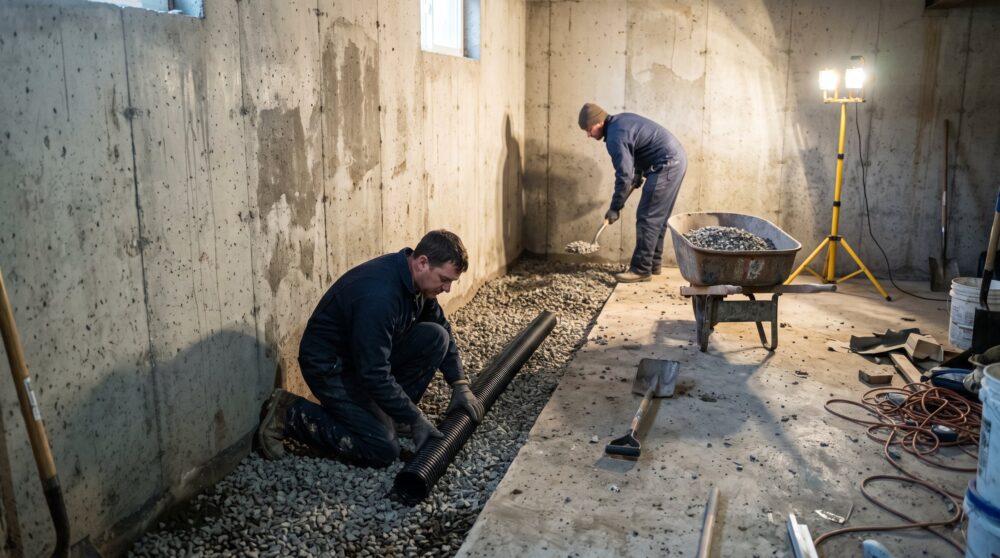 Footing-level drain tile: the answer to groundwater that never really leaves the Fox corridor.
What does basement waterproofing in Aurora include?
Six systems cover everything Aurora water does, from river-table seepage downtown to ponded backyards off Orchard Road. The inspection prices only what your house needs, and our own crew installs all of it.
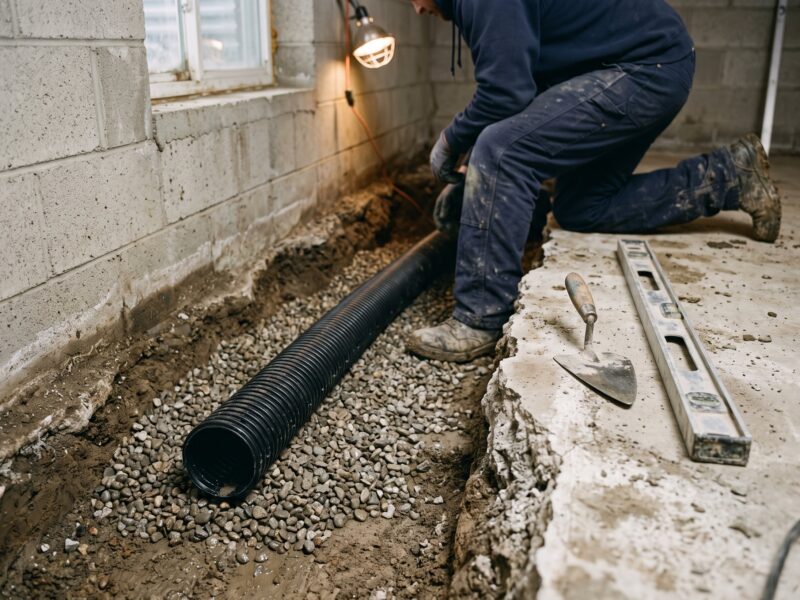 Interior drain tile
The backbone fix where the Fox keeps the water table high year-round.
Learn more
Interior drain tile
The backbone fix where the Fox keeps the water table high year-round.
Learn more
 Sump pumps & battery backup
Sized for river-corridor volumes, backed up for the storms that drop the grid.
Learn more
Sump pumps & battery backup
Sized for river-corridor volumes, backed up for the storms that drop the grid.
Learn more
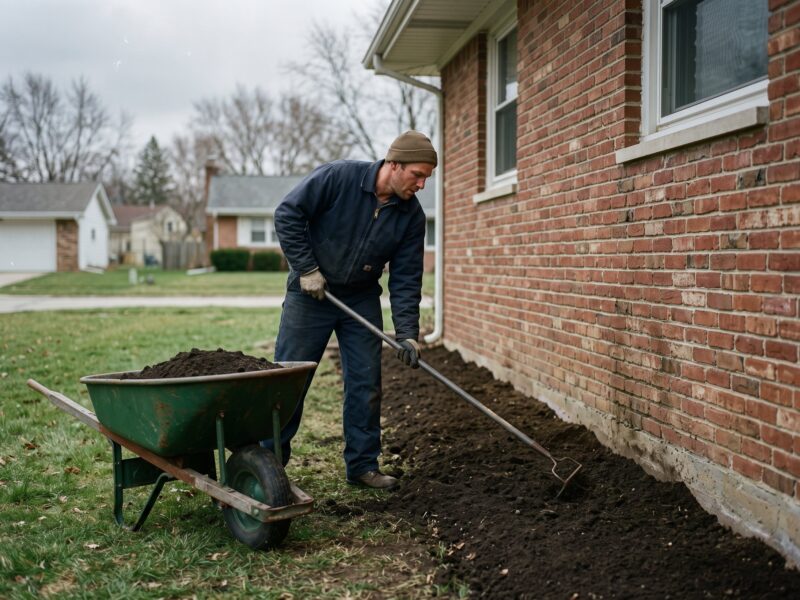 Yard drainage & regrading
Often the whole answer on graded farm clay in the newest subdivisions.
Learn more
Yard drainage & regrading
Often the whole answer on graded farm clay in the newest subdivisions.
Learn more
 French drains
For Blackberry Creek lots that collect the neighborhood's runoff.
Learn more
French drains
For Blackberry Creek lots that collect the neighborhood's runoff.
Learn more
 Crawl space encapsulation
Additions and older near-side cottages with dirt underneath.
Learn more
Crawl space encapsulation
Additions and older near-side cottages with dirt underneath.
Learn more
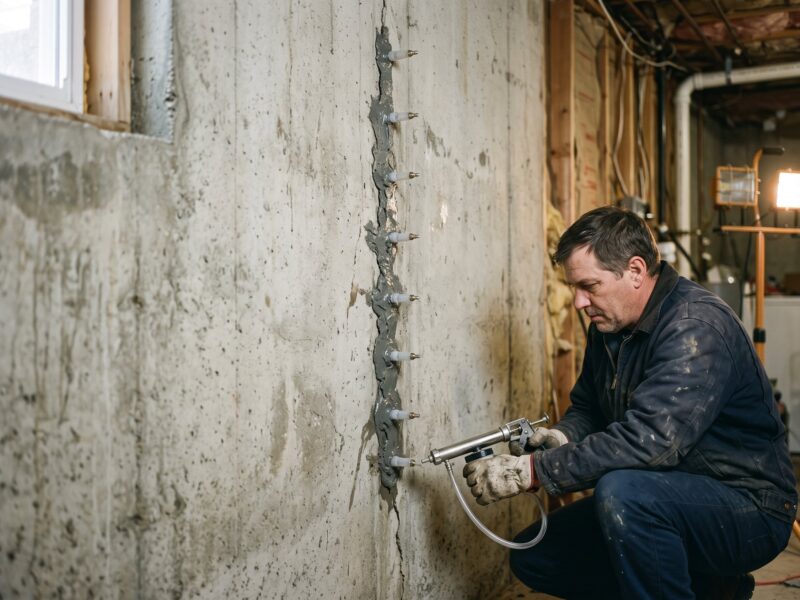 Leaking crack injection
Poured-wall cracks on the far east and west sides, sealed from $450.
Learn more
Leaking crack injection
Poured-wall cracks on the far east and west sides, sealed from $450.
Learn more
Why do Aurora basements leak?
Aurora basements leak for opposite reasons at opposite ends of the same city: constant groundwater near the Fox River, and mishandled surface water out on the graded farm clay. Selling one neighborhood the other neighborhood's system is the most common mistake we are hired to undo.

The river wards and near sides
Pre-1900 limestone, rubble and brick foundations went in when Aurora was a mill town, with no membrane and no footing drain. Sitting inside the Fox floodplain's high water table, these walls weep steadily, and drainage has to be built where none existed.

The post-war and 1970s rings
Block foundations and split-levels between the old core and the new edges take decades of clay pressure at the cove joint. Original clay drain tile has mostly silted shut by now, so spring water finds the floor-wall line first.

Past Eola and Orchard Road
The 1990s to 2010s subdivisions sit on regraded farmland, and their water problems are usually self-inflicted: settled swales, short downspouts and tired sumps. Out here $600 to $2,500 of drainage work often beats any interior system.
What makes Aurora groundwater different?
Aurora groundwater is governed by the Fox River, which runs straight through the center of the city and wraps around Stolp Island downtown. The river's floodplain and the high water table that comes with it define the older neighborhoods on both banks, and Indian Creek and Blackberry Creek feed the same system from the sides. Close to the water, the ground under a basement is simply never dry, and a system there has to move water every month of the year.
Drive fifteen minutes east or west and the physics flip. The far-side subdivisions sit on farm clay that was graded flat before building, so their water arrives from above, off roofs, driveways and settled lawns, not from below. That is why the inspection starts with a diagnosis rather than a product: a river-ward stone house and an Eola-corridor colonial can report the identical wet floor and need entirely different fixes at prices thousands of dollars apart.
 Creek-fed and river-fed: Fox Valley water keeps the low ground loaded.
Signs your Aurora basement needs waterproofing
These six symptoms fill our Aurora call log, and each one maps to a different cause and a different published price. Naming the cause correctly is the entire value of the free inspection.

Water at the floor-wall joint
Hydrostatic pressure driving groundwater under the footing, the signature of the river wards and the mid-century rings. This is the textbook interior drain tile call.

White mineral bloom on stone or block
On a near-side limestone or block wall, efflorescence means water is traveling through the wall itself. The wall needs its load relieved by drainage, not another coat of paint.

A sump that cycles all day
Near the Fox that can be honest groundwater needing capacity; off Eola it is usually roof water on a loop. Same sound, opposite fixes, and the yard walk tells them apart.

A damp smell the house cannot shake
Basement humidity rides the stack effect upstairs. When the odor peaks in spring, the source is seasonal groundwater, and a dehumidifier alone is treating the symptom.
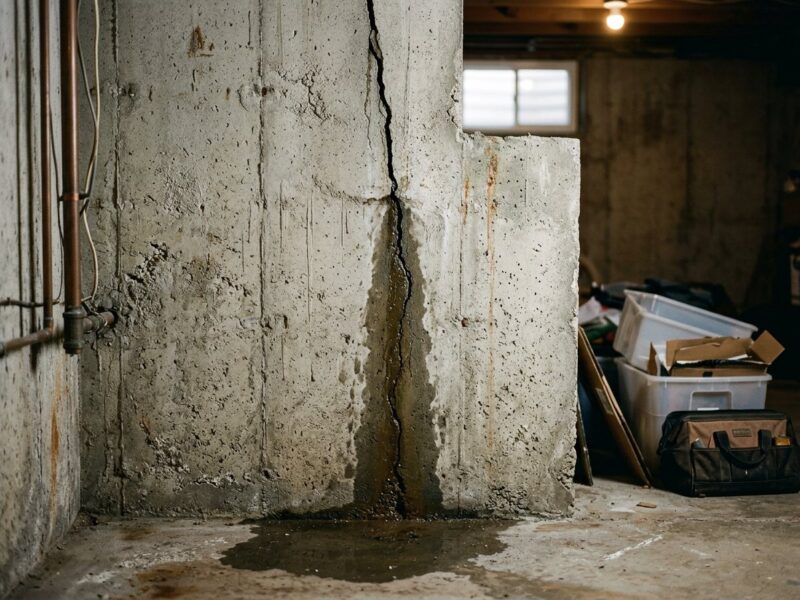
A poured-wall crack that runs in rain
Common in the 1990s and newer stock on the far sides. A stable shrinkage crack seals full-depth for $450 to $900 and the job takes a morning.

A yard that ponds for days
Graded farm clay sheds water slowly, and a settled swale parks it against your foundation. Regrading and burial of downspouts is the cheap fix that prevents the expensive one.
Same wet corner every time the Fox runs high? Tell us your street and which side of the river you sit on; the diagnosis usually starts there.
How does basement waterproofing work in Aurora?
An Aurora waterproofing job moves through four steps, and because we batch Fox Valley work into scheduled blocks, the calendar stays tight even at distance. Most full systems take two to four days on site.
Inspect and place the house
We identify your foundation era, trace the water's entry path, and check river-ward addresses against the Fox floodplain mapping, since floodplain water changes the honest advice. Free, within 48 hours.
Day 0Diagnose ground versus surface
Aurora's split personality makes this the decisive step: river-table groundwater gets a drainage system, subdivision surface water often gets $600 to $2,500 of yard work instead. The written plan says which and shows why.
Day 0, same visitInstall on a scheduled Aurora block
Trench, tile, gravel, sump with battery backup, fresh concrete, then a flood test you watch before we load the trucks. We arrive as a full crew with materials on board, so the distance never adds days.
Days 1 to 4Register the warranty
The lifetime, fully transferable warranty is recorded against the address and transfers to any future owner, useful paper in a city with this much housing turnover.
On completionInterior or exterior waterproofing: which works in Aurora?
Interior drain tile wins most Aurora comparisons because the city's two extremes both argue for it: pre-1900 river-ward lots are too tight and too saturated to excavate comfortably, and the newer far-side homes rarely have wall damage that would justify the dig.
| Interior drain tile | Exterior excavation | |
|---|---|---|
| Best for | High water tables and cove seepage, the standard Aurora complaint | Walls whose exterior face is genuinely failing |
| Near the Fox River | Handles a permanently high table by design | Digs collapse into saturated floodplain soil; dewatering adds cost |
| On mill-era stone walls | Installs inside with an off-footing trench and a light touch | Excavating beside a rubble wall risks the wall itself |
| Lot access | None needed; downtown and near-side lots with no side yard qualify | Requires machine access along every treated wall |
| Cost | $95 to $160 per linear foot | A multiple of interior cost, priced per wall after inspection |
| Season | Installs all winter; frozen ground is irrelevant indoors | Waits on weather and on the floodplain drying out |
Some walls do earn the excavation, and when yours does we will say so in writing with a price. The method should fit the wall, not the sales script.
When do Aurora basements flood?
The Fox River sets Aurora's water calendar, and each season gives homeowners a different smart move. Knowing which quarter you are in decides whether the fix costs hundreds or thousands.
Spring: the river's season
Snowmelt from the whole Fox Valley funnels past downtown, the table rises under the older wards, and cove joints start weeping citywide. Book early; this is when the 48 hours promise earns its keep.
March to MaySummer: the cloudburst test
Convective storms drop an inch in twenty minutes and sometimes the power with it. Far-side sumps drown on recycled roof water while primary-only pits sit dark. Battery backups are bought in July and wished for in June.
June to AugustFall: the outdoor window
Firm, dry ground makes fall the season for regrading, swale repair and downspout burials across the subdivision belt, the modest jobs that keep spring off your floor entirely.
September to NovemberWinter: the inside season
Interior drain tile is an indoor trade, so Aurora installs run all winter at full speed. Systems finished by February are proven before the valley thaws and the river tests them.
December to FebruaryHow much does basement waterproofing cost in Aurora?
Basement waterproofing in Aurora costs $95 to $160 per linear foot for interior drain tile, with a complete perimeter system including a sump and battery backup landing between $8,000 and $16,000 on most homes. There is no travel charge for Aurora and no Fox Valley markup; the published ranges hold on both sides of the river.
| Work | Range | What moves the number |
|---|---|---|
| Interior drain tileper linear foot | $95–$160 | Length of the run, slab thickness, what has to be moved off the walls |
| Sump pump with battery backupinstalled | $2,800–$4,500 | Pit condition, backup capacity, discharge routing |
| Exterior French drainper linear foot | $45–$90 | Trench depth, where the water can legally go |
| Downspout extensions and regradingtypical job | $600–$2,500 | Feet of grade to rebuild, soil hauling |
Every range lives on the pricing page, and your written Aurora quote lands inside it.
Where we waterproof in Aurora
Aurora calls sort neatly by geography across ZIPs 60502 through 60506. Downtown, Stolp Island's surroundings, the Near East Side and Near West Side send us weeping stone, high-table sump questions and floodplain homework. The middle rings send classic cove-joint seepage from post-war block and 1970s splits. The Eola Road area, the Orchard Road corridor, Blackberry Creek and the Farnsworth Avenue corridor send ponding yards, drowned window wells and sump pumps recycling their own roof water.
We will be straight about the map: Aurora is a forty-five minute to one hour drive from our base in the Joliet and New Lenox corridor, and we make it constantly. Fox Valley work is scheduled in blocks so crews arrive stocked and stay productive, inspections still land within 48 hours, standing water still gets a 24/7 response, and the drive is never billed to you.
 Four building eras, one city: the inspection starts by asking which one is yours.
Aurora basement waterproofing questions, answered straight
I live near the Fox in an older Aurora house. Is a sump pump enough by itself?
Close to the river a pump is necessary but rarely the whole answer. A pump only moves water that something collects for it, and pre-1900 Aurora foundations frequently have no footing drain at all, so the pit sits wet while the floor does too. The real project is building the drain line that feeds the pump; the pump is the easy part.
Do you really come out to Aurora?
Yes, on a regular schedule and with no travel charge. Aurora is a standing stop on our Fox Valley route, we group the area's visits into blocks so crews arrive fully stocked, and inspections are still free and still land within 48 hours. The distance is our logistics problem, not your line item.
Is my Aurora house in the floodplain?
If you are near the Fox, Indian Creek or Blackberry Creek, it is worth checking before spending anything, because downtown Aurora is literally built around islands in the river. A mapped floodplain address changes the honest sequence: flood coverage first, surface drainage second, and an interior system only for true groundwater.
My subdivision house past Eola Road gets water even though it is fairly new. Why?
Because new does not mean well-drained. Those neighborhoods sit on farm clay graded flat before construction, and after a decade or two the swales settle, downspouts stay short and the lot quietly tilts water at the foundation. The fix is frequently $600 to $2,500 of drainage and grading, not an interior system, and we will tell you which.
Can you waterproof a downtown Aurora house with no side-yard access?
Yes, and it is the standard situation on the near sides. Interior drain tile installs entirely from inside the basement, so lots where houses sit shoulder to shoulder qualify without touching a fence, a garden or a neighbor's driveway.
How much does basement waterproofing cost in Aurora?
Interior drain tile runs $95 to $160 per linear foot, a full perimeter system with sump and battery backup runs $8,000 to $16,000, an exterior French drain runs $45 to $90 per linear foot, and downspout or regrading work runs $600 to $2,500. Aurora pays the published sheet, nothing above it.
Will a finished Aurora basement survive the installation?
Yes. The work line takes the bottom drywall course along the treated walls and puts it back after the flood test; carpet, framing and everything beyond the perimeter stay protected and untouched. Losing a strip of drywall beats losing the basement every spring.
How should I choose among basement waterproofing companies in Aurora?
Ask whether the warranty transfers to a buyer without fees, whether prices are published before anyone visits, and whether the estimator can explain how a river-ward stone basement and an Orchard Road colonial call for different systems. In a city with four foundation eras, a one-system company is guessing three-quarters of the time.
Is the wet wall also cracked or leaning?
Aurora's saturated river-corridor clay pushes on walls with the same force it pushes water through them, and on century-old stone the first sign of both problems is often the same failing mortar joint. A horizontal crack, a stair-step line or a visible bow next to the damp means one inspection should cover both trades.
Foundation Repair in Aurora
Basement waterproofing near Aurora

Put the Fox Valley water problem behind you
A free inspection within 48 hours, a system matched to your side of the river, and a lifetime, fully transferable warranty registered to the address.
Or talk to a human right now
(630) 335-1128
Request your free estimate
Tell us what you're seeing. We'll call back fast and be out within 48 hours.