
Wall Seepage: Block Foundations vs. Poured Concrete
Two foundation materials, two completely separate leak patterns. Read the pattern correctly and the repair is obvious. Read it wrong and you buy a perimeter system for one crack, or a crack repair for a wall full of water.
- Free written diagnosis within 48 hours
- 20+ reading Chicago block and poured walls
- Published pricing on every repair line
 Injection repairs: 10-year warranty
The short answer
Concrete block seeps everywhere at once, because water passes the mortar joints and stands inside the hollow cores until it drains out along the bottom course. Poured concrete seeps at one defect: a shrinkage crack, a cold joint, a form tie hole. Block usually needs weep holes and drainage. Poured usually needs one injection.
A foundation wall is not one thing. Concrete block is an assembly, dozens of units stacked with mortar between them and open cores running up the middle, so it has hundreds of feet of joint line for water to use and a hollow interior for water to sit in. Poured concrete is monolithic. It has almost no joint line, which means it stays dry until something specific goes wrong at one place: the wall shrank as it cured, the truck came back late and left a cold joint, a form tie was never sealed.
That distinction decides the repair, and in this region it also tracks the calendar. Homes built here before the war sit on brick, limestone rubble or early block. The ranches and split-levels that filled the suburbs from the 1950s through the 1970s are almost entirely block, and they are the walls we open most often. Subdivisions from the 1980s onward are poured, which is why those calls are usually one wet line rather than a wet room. The basement waterproofing hub lays out the systems each of them ends up needing.
Why does a block foundation wall leak?
Block leaks because it fills up. Water gets past the mortar, collects inside the hollow cores, and then drains out wherever the wall lets it, which is almost always the bottom.
Follow one storm through a block wall and the whole pattern makes sense.
-
The clay holds the storm against the wall
Glacial clay drains slowly, so the backfill beside your foundation stays saturated for days after a heavy rain. That water presses on every square foot of the wall, and block offers it far more joint line per square foot than poured concrete ever does.
-
Mortar joints let it through first
Mortar is more porous than the block units it holds together, and it shrinks a little as it cures. Bed joints and head joints are the first path in. On a sixty-year-old ranch those joints have weathered as well, which widens the path every freeze.
-
The cores fill like a tank
Standard block is hollow. Water that gets past the joints drops into the cores and stands there, sometimes several courses deep, long after the rain has stopped. At that point the wall is holding water inside itself, and the storm is no longer the issue.
-
The bottom course gives it up
The lowest course carries the whole column of water in the cores plus the pressure outside. It weeps through the joints, through the face of the block, and out where the slab meets the wall. That is the puddle you keep pushing toward the floor drain.
-
Salt records the route
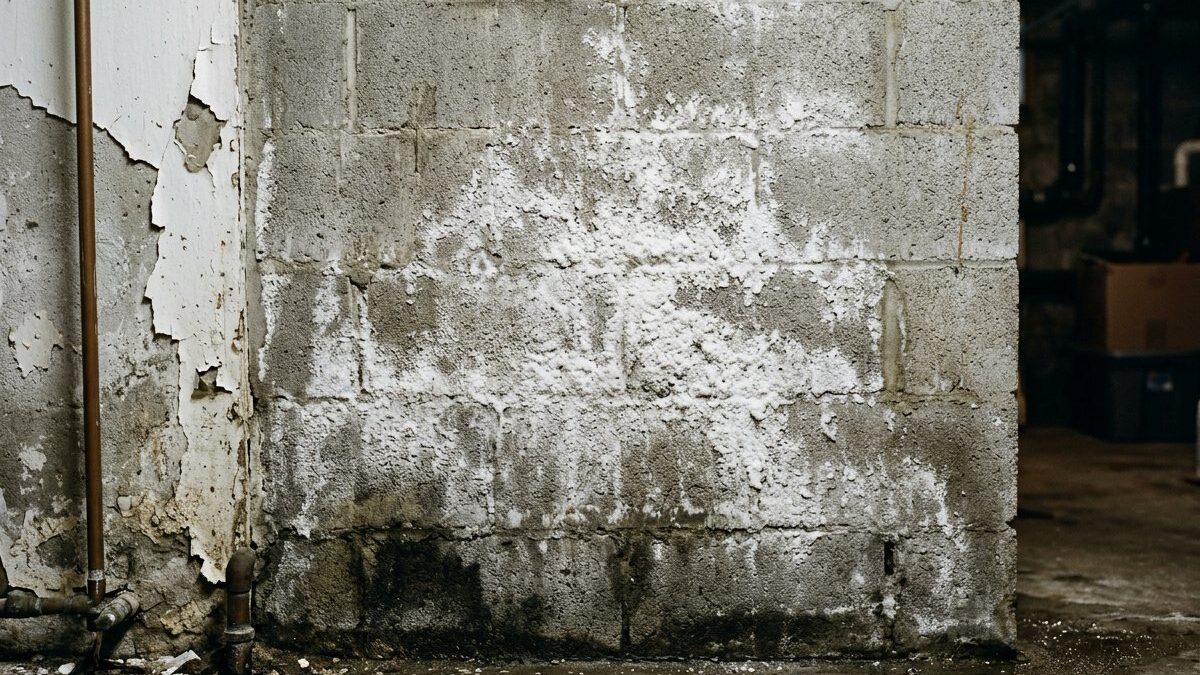
Water moving through masonry dissolves mineral salt and leaves it behind as it evaporates. The white chalky crust on the lower courses is a map of where the water traveled. It is evidence, not a cause, and scrubbing it off changes nothing.
Signs you are reading block seepage
- Damp shows as a band along the bottom two or three courses
- The wall gets wetter hours after the rain stops, not during it
- Chalky white deposits follow the mortar lines
- Paint or coating blisters off in sheets, low on the wall only
- More than one wall is damp at the same time
What will not fix it
- Coating the inside face, since the water is already inside the wall
- Troweling hydraulic cement into the cove and stopping there
- Regrading alone, once groundwater is standing at footing level
- A dry August, which proves the weather changed and nothing else
How is seepage repaired in each kind of wall?
The two materials get two different repairs. Point defects in poured concrete get injected. Block gets drained, because you cannot seal a wall that is already full.
Here is the order we work through on an inspection, whatever the wall turns out to be.
-
Read the entry point before naming a product
We map where water appears and when. A wall that darkens six hours after the rain ends behaves differently from one that runs during the storm. That timing separates joint seepage from a single defect long before anyone quotes a system.
-
A poured wall with one crack gets injected
A shrinkage crack or an unsealed form tie hole is a point repair. Urethane goes in through ports, expands through the full thickness of the wall and cures against wet concrete. Published at $450 to $900 per crack, and usually finished in an afternoon.
-
A block wall gets its cores drained
We drill weep holes into the bottom course so the water standing in the cores has an exit below the floor. Without that step the cores stay charged and keep feeding the cove joint every single time it rains, no matter what is on the face.
-
Drain tile takes the pressure off the footing
Perforated pipe bedded in washed stone at the slab edge gives that water somewhere to go before it can rise onto the floor. On block the weep holes and the pipe are one repair. Interior drain tile is published at $95 to $160 per linear foot.
-
Cut the water load outside
Neither wall type should be handling roof water. Moving downspouts away and rebuilding a settled grade takes thousands of gallons per storm out of the soil beside the wall, runs $600 to $2,500, and sometimes shrinks the system the house needs.
What each wall responds to
- Poured wall, one weeping crack: injection with a 10-year warranty
- Block wall, damp along the base: weep holes plus interior drain tile
- Either wall with groundwater at slab level: a sump with battery backup
- Both: roof and surface water dealt with before anything else is bought
Where crews get this wrong
- Injecting a block wall, which fills one core and moves the leak sideways
- Injecting a crack that is still opening, before the wall is stabilized
- Selling a full perimeter system for a single poured-wall crack
- Sealing the cove shut and describing that as waterproofing
Is my basement wall block or poured, and does it matter?
It matters more than almost anything else we look at, because the two materials fail on different schedules and respond to different repairs.
| Concrete block wall | Poured concrete wall | |
|---|---|---|
| How water gets in | Through mortar joints, then into the hollow cores | Through one defect: a crack, cold joint or tie hole |
| What you see inside | A damp band along the lowest courses and the cove | A single wet line or a single wet spot |
| Timing after a storm | Hours later, and it stays damp for days | During the rain, then it dries out |
| How to recognize it | Visible mortar grid, hollow sound when tapped | Flat face with form lines and small round tie holes |
| First repair we quote | Weep holes and interior drain tile | Urethane injection of the one defect |
| Published cost of that repair | $95 to $160 per linear foot | $450 to $900 per crack |
| Structural failure mode | Mortar shears, producing stair-step cracking and bowing | Cracks are usually shrinkage unless they run horizontal |
| Does a face coating help | No, the water is already inside the wall | No, nothing thin bridges a crack under pressure |
| Our warranty | A lifetime, fully transferable warranty on the system | A 10-year warranty on the injection |
Neither wall type is repaired by a product you roll on. We wrote a fair review of what masonry coatings do and do not do here: waterproofing paints and sealers.
Not sure what your wall is doing? We measure it, write the diagnosis down and quote from published ranges, free within 48 hours.
What kind of wall is under your house?
Build era predicts foundation material here with unusual reliability. These four cover most of what we find across the seven counties we serve.

Pre-war bungalows and two-flats
Brick, limestone rubble or early block below grade, with soft lime mortar that has been washing out of the joints for a century. Seepage arrives through the joint line across a whole wall rather than at any one point.
Joint seepage, drain it
Post-war block ranches
The purest version of the block problem. Cores charge with water during a storm, the bottom course weeps for days afterward, and the cove joint carries most of it onto the floor. Weep holes are not optional on these.
Textbook core seepage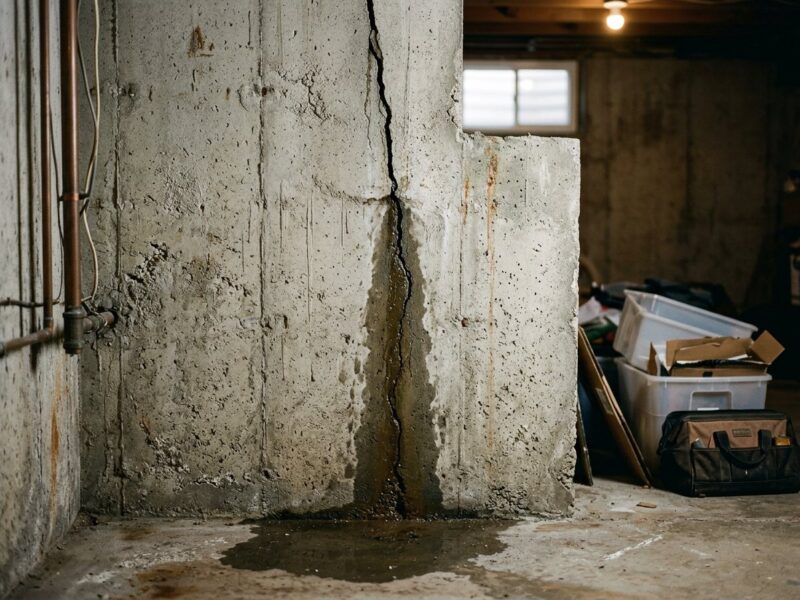
1980s and 90s poured walls
Monolithic walls that behave until one shrinkage crack opens, usually near a window corner or the middle of a long run. One line gets wet in April and the rest of the basement stays dry all year.
Usually one injection
Newer subdivision homes
Poured walls with form tie holes that were plugged quickly on a busy site. A pinhole weep at chest height on an otherwise perfect wall is almost always a tie hole, not a foundation problem.
Check the tie holes firstWhat does each kind of seepage cost to fix?
The gap between the two repairs is large and it is not a negotiating position. One poured-wall crack is $450 to $900 injected. A full perimeter system on a wet block basement lands between $8,000 and $16,000.
| Work | Range | What moves the number |
|---|---|---|
| Interior drain tileper linear foot | $95–$160 | Length of the run, slab thickness, what has to be moved off the walls |
| Sump pump with battery backupinstalled | $2,800–$4,500 | Pit condition, backup capacity, discharge routing |
| Downspout extensions and regradingtypical job | $600–$2,500 | Feet of grade to rebuild, soil hauling |
Most block basements do not need the full perimeter. We run drain tile only along the walls that are actually wet, which is why the linear foot number matters more than the whole-house number when you compare bids. Every published range sits on the pricing page.
When the wall is not the problem at all
Plenty of the damp walls we get called about are not leaking. Saying so out loud costs us work and saves you thousands.
The masonry is dry and the air is wet
Cool block in a humid July basement collects condensation that looks exactly like seepage. A $30 hygrometer settles it in a weekend: above roughly 60 percent relative humidity, you have an air problem. Start with the dehumidifier math.
Costs $30 to checkThe water is rising, not entering
Water surfacing at the floor drain during a storm while the walls stay dry is sewer backup. No wall repair touches it, and the fix runs through a licensed plumber and possibly a backflow valve. Here is how the two look different.
Call a plumberOne downspout is doing all the damage
A downspout dumping at the corner of the house puts hundreds of gallons into the backfill in a single storm, and the wall below it leaks while every other wall stays dry. A $12 elbow and a longer extension is worth trying before any of us quote you.
Try the cheap fixThe crack is still moving
Injecting a crack that is actively opening wastes the repair. Tape a $20 crack gauge across it and read it monthly through one full freeze and thaw. If the width is stable, injection holds. What the width itself tells you.
Wait a seasonQuestions homeowners ask about block and poured walls
Which leaks more, block or poured concrete?
Block leaks more often and across more of the wall, because it has hundreds of feet of mortar joint and a hollow interior that holds water. Poured concrete leaks less often but concentrates it, so when a poured wall goes wrong you get a stream at one line rather than a damp band. Neither material is waterproof on its own. Both are relying on drainage outside them.
Can you seal a block wall from the inside?
Not in any lasting way, because the water is already inside the wall by the time you see it. Sealing the interior face traps the water in the cores, which raises the pressure until it finds the cove joint, the next mortar joint up, or the seam behind your coating. Block gets drained, not sealed. Weep holes into a new drain tile line are what actually empties it.
Why is my block wall wet a day after the rain stopped?
Because the cores filled during the storm and are still emptying. Water needs hours to work through mortar joints, then it stands inside the block and drains slowly out the bottom course. That delay is one of the cleanest tells we have. A poured wall generally runs while it is raining and dries within a day, so a lagging wet band points at block behavior.
Does urethane injection work on a block wall?
Rarely, and we usually decline it. Injection is designed to fill a crack through a solid section of concrete. In block, the material follows the open cores instead, so it can fill a void, push out a joint somewhere else, and leave the wall leaking two feet away. On block the honest answer is weep holes and drainage, even though it is a bigger sale to explain.
Is a poured concrete foundation better than block?
For water resistance, yes, on average. Poured walls have almost no joint line and no cores to fill. That said, a poured wall with a neglected grade and a disconnected downspout will leak, and a block wall with proper drainage and a working sump stays dry for decades. The soil load and the drainage around the house matter more than the material.
How can I tell which wall type I have?
Look at the bare foundation in the utility area. Block shows a visible grid of mortar joints, usually eight inches by sixteen inches per unit, and sounds hollow when you tap it. Poured concrete is a flat continuous face, often with faint horizontal form lines and small round patches where the form ties were. Painted walls still show the grid through the paint.
What the repair looks like once the wall is diagnosed
Whichever material you have, the fix is a drainage decision rather than a product decision. This page walks through what a crew actually does inside a basement over two or three days, what gets opened, what gets closed back up, and what the finished system looks like when it is done.
How interior waterproofing works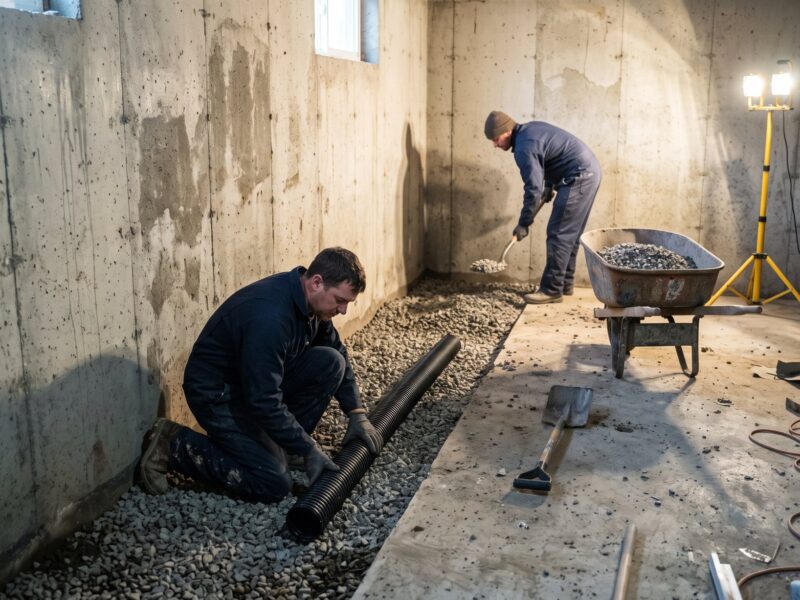

Have the wall read before you buy anything for it
Free written diagnosis within 48 hours, published pricing on every line, and 0% for 12 months if the repair is bigger than the month allows.
Or talk to a human right now
(630) 335-1128
Request your free estimate
Tell us what you're seeing. We'll call back fast and be out within 48 hours.