Poured Concrete Repair: Rod Holes, Cold Joints and Honeycombing
A poured wall rarely leaks across its face. It leaks at a handful of specific defects, nearly all of them created during the week the wall was poured, and each one has its own repair.
- Leak traced to the defect, in writing, free within 48 hours
- Published per-crack pricing, no commissioned salespeople
- 20+ of Chicago foundations, 1,500+ homes
 Injection carries a 10-year warranty
The short answer
A poured concrete wall leaks at defects, not through solid concrete. The common ones are shrinkage cracks, rod holes left by form ties, cold joints where two pours met, honeycombed pockets where the mix never consolidated, and unsealed pipe penetrations. Most are sealed from inside with urethane injection at $450 to $900 per crack.
Concrete shrinks as it cures. A poured wall loses volume in its first months, and because it is restrained by the footing below and the corners at each end, that shrinkage has to go somewhere. It goes into cracks that start at the weak points: a window opening, a step in the footing, the middle of a long run. Add the holes left by form ties, the seam where one pour stopped and the next began, and the pockets nobody vibrated the mix into, and you have a map of where the wall can leak.
What turns a defect into a wet basement here is the soil. Chicago clay holds storm water against the wall for days instead of draining it away, so a crack that would stay dry on sandy ground gets put under a head of water several times a year. Spring is when the phone rings, because the ground is thawing and saturated at the same time. Our foundation repair overview shows how these wall repairs sit alongside the settlement and stabilization work.
Where does a poured concrete wall actually leak?
There are five places water gets through a poured wall, and telling them apart takes a flashlight and a dry day rather than special equipment.
We work down this list on every poured wall, in the order the defects turn up in Chicago houses.
-
Shrinkage cracks
Usually vertical, often running down from a window corner or up from a footing step, and typically showing up in the first couple of years after the pour. They are dry most of the year and weep only when the soil outside is loaded with water.
-
Rod holes
The forms were held apart by ties, and pulling them leaves a round hole straight through the wall. Builders plug those with mortar or a cone. Plugs shrink and drop out, and thirty years later you get a pencil-width stream from a neat hole in an obvious grid.
-
Cold joints
Where one truckload set before the next arrived, the two pours never bonded. The result is a horizontal seam, sometimes visible as a faint color change, that leaks along its length rather than at a point. It is the defect most often mistaken for a structural crack.
-
Honeycombing
Where the mix was too stiff or never vibrated properly, the wall cures with open pockets of exposed stone, often low on the wall or tight to a corner. It looks like coarse gravel set in concrete, and water travels through it freely.
-
Penetrations
The water service, the sewer line and any conduit passing through the wall sit in a sleeve or a cored hole. If the annular space around them was never sealed, or the seal has aged out, that is a direct path in at exactly the depth the water sits.
How to tell which one you have
- A wet vertical line that runs from high on the wall: shrinkage crack
- A single round wet spot in a repeating grid: rod hole
- A horizontal wet band with no crack under it: cold joint
- Exposed stone and a dark patch near the floor: honeycombing
- Water at a pipe collar: penetration, sealed separately
Signs it is not a wall defect at all
- Water arriving at the seam where the floor meets the wall
- Water rising through a floor drain during heavy storms
- A wet patch only under a window well after rain
How does urethane injection seal a poured wall?
Injection fills the defect through the full thickness of the wall from the inside, which is what separates it from a surface patch that lasts one season.
Here is what a crew does on a typical injection visit, start to finish, in a couple of hours.
-
Set the ports
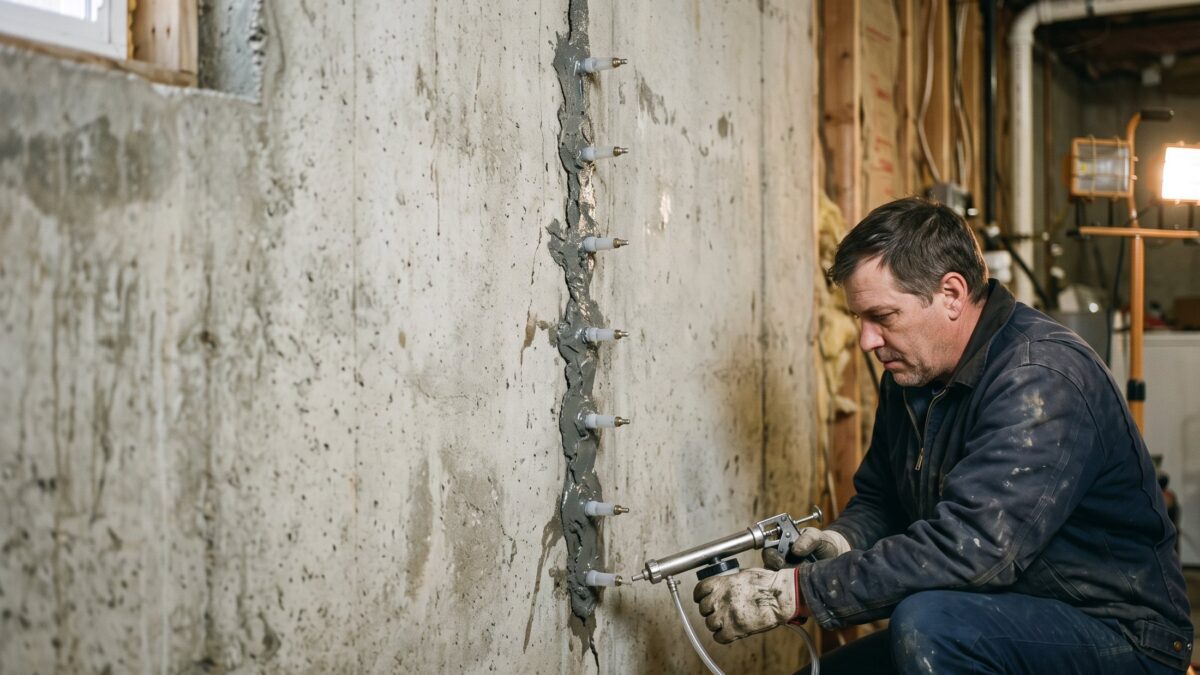
Injection ports are fixed along the crack at intervals, then the face between them is sealed with a surface paste so the material has nowhere to escape. On a rod hole the port goes straight into the hole, since the hole is already the delivery path.
-
Check what the crack is doing
Before anything is pumped, we confirm the crack is not actively moving and not carrying structural load. A crack that is still opening will tear a fresh seal apart, and that wall needs stabilizing before it needs filling.
-
Inject from the bottom up
Resin goes in at the lowest port until it appears at the next one, then the gun moves up. Working upward pushes air and water ahead of the material instead of trapping either one behind it, which is the whole reason the order matters.
-
Let the foam chase the water
Urethane reacts with water and expands into the void, following the crack out through the wall and into the wet soil at the back face. That is why it suits a leak that is actively running, where a rigid resin would struggle to bond to a wet surface.
-
Cure, trim and inspect
The material sets, the ports come off and the surface seal gets cut back flush. We check it against the next real rain rather than a hose, and injection work carries our 10-year warranty.
What injection is good at
- A single wet crack, sealed in hours with no excavation
- Rod holes and small honeycomb pockets in the wall face
- Published pricing at $450 to $900 per crack
- Working year round, since the crew never leaves the basement
When it will not hold
- A crack that is still moving, which needs stabilizing first
- A long cold joint, which is often a drainage job rather than a seal
- A wall that is bowing, where the crack is a symptom and not the problem
- Water arriving at the cove joint, which injection never touches
Inject the crack, or open the wall from outside?
Injection is the answer for most poured wall leaks in this region, and honest enough to say when it is not. Here is how the two approaches compare on a poured wall.
| Urethane injection from inside | Exterior excavation and membrane | |
|---|---|---|
| What it fixes | One defect at a time, through the full wall thickness | The whole wall face, defects and all |
| Published cost | $450 to $900 per crack | Priced by depth and access, quoted after we see the lot |
| Time on site | A couple of hours for most cracks | Days, plus backfill and restoration |
| Season | Any month of the year | Stops when the ground freezes |
| Access needed | Room to stand at the wall inside | Machine access and somewhere to put the spoil |
| Best on | Shrinkage cracks, rod holes, small honeycomb pockets | Failed wall face, long cold joints, multiple defects at once |
| Landscaping | Untouched | Excavated, then restored |
| What it does not solve | Cove joint seepage or a bowing wall | Groundwater rising to slab level |
| Our warranty | A 10-year warranty on injection | Written with the scope of the excavation |
A wall with several defects on the same run often costs less to open once than to inject four times, and exterior excavation waterproofing covers where that line falls.
Not sure whether it is a crack or a cold joint? We find the defect, name it in writing and quote from published ranges, free within 48 hours.
What poured walls do, era by era
Forming methods and concrete mixes changed decade by decade, and so did the defect you are most likely to be looking at.

Pre-war bungalows and two-flats
Poured walls exist from this era but are the exception, usually hand mixed, thick, and full of aggregate you can see. Where they leak it is honeycombing and old penetrations rather than the neat rod hole grid of a modern wall.
Rare, patched by hand
Post-war ranches
Mostly block below grade, with poured walls appearing on later builds and additions. Where a poured wall does show up it is often shallow and unreinforced, so a single shrinkage crack is the usual complaint.
Usually one crack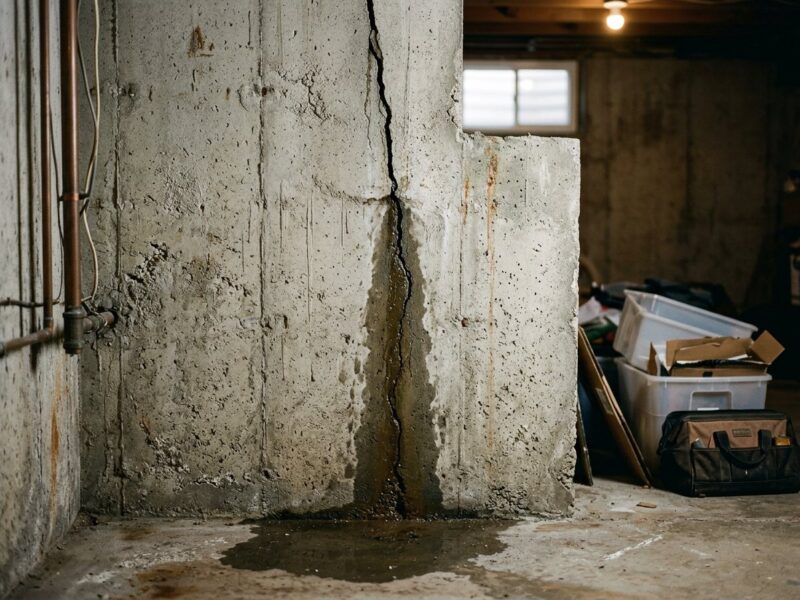
1980s and 90s poured walls
The core case. Formed with steel ties, so the rod holes are there in a grid, and shrinkage cracks run down from window corners. This is the wall injection was designed for, and where it performs best.
Injection, nearly always
Newer subdivision homes
Better mixes and rebar, but fast schedules mean cold joints between pours and backfill that went in early. Cracks in the first two years are common and often still under a builder warranty worth reading.
Check the warranty firstWhat does poured wall repair cost?
Injection is published at $450 to $900 per crack, so a wall with three separate leaking cracks lands between $1,350 and $2,700. Structural work on a poured wall is priced per strap or per beam.
| Work | Range | What moves the number |
|---|---|---|
| Urethane crack injectionper crack | $450–$900 | Crack length and width, access to the full height |
| Carbon fiber strapsper strap | $600–$1,000 | Wall height, spacing the deflection requires |
| Steel I-beam wall bracingper beam | $900–$1,500 | Ceiling height, footing condition at the base |
Digging the wall open from outside is the one scope with no published per-foot number, because depth and access move it too far; that gets quoted in writing after we walk the lot. Every published range lives on the pricing page.
When a crack in a poured wall is not a repair
Poured walls crack. Most of those cracks never leak and never move, and telling you so costs us a sale and buys you a season of watching instead.
A dry hairline that has never wept
Thin vertical cracks are normal in poured concrete and most of them stay dry for the life of the house. Mark each end with a pencil, note the date, and check after the next heavy spring rain. Dry and unchanged means there is nothing here to buy.
Watch a seasonThe water is coming in at the floor
A wet line where the slab meets the wall is water arriving under the slab edge, not through the wall, and injecting the wall will not touch it. That is a drainage repair. How cove joint leaks get sealed explains the difference.
Different fixIt only leaks under a window well
Wells fill with leaves, the drain packs solid and the well becomes a bucket sitting against your wall. Clearing it and fitting a cover is a homeowner Saturday and cheap parts. Window well drainage covers the whole sequence.
Try the cheap fixThe crack is horizontal and displaced
A horizontal crack in a poured wall with one side pushed in past the other is soil pressure, not shrinkage, and sealing it hides a structural problem. What horizontal cracks mean should be read before anyone quotes injection.
Structural firstQuestions homeowners ask about poured foundation walls
What is a rod hole and why is mine leaking now?
The forms that shaped your wall were held at the right spacing by steel ties passing through the concrete. When the forms came off, those ties were snapped or pulled, leaving a round hole through the wall that somebody plugged with mortar or a plastic cone. Plugs shrink, crack and eventually fall out. Yours is leaking now because the plug finally failed and the soil outside happens to be holding water this spring. It is one of the fastest repairs we do.
Is a cold joint a structural problem?
On its own, usually not. A cold joint is a bond failure between two pours, so it is a leak path rather than a crack caused by movement. It becomes a structural conversation only when the wall has also shifted along that seam, which shows up as one side sitting proud of the other. We check for displacement first. If the joint is flush and simply wet, the discussion is about how to seal a long horizontal seam, not about bracing the wall.
Can honeycombing be fixed from inside?
Small pockets can. If the honeycomb is shallow and confined, it gets cut back to sound concrete, packed and injected, and it holds. Extensive honeycombing running through the wall thickness is a different case, because there may not be enough sound material left for a patch to key into. That is one of the situations where we recommend opening the wall from outside instead, and we would rather say so at the inspection than after a failed repair.
How long does urethane injection last?
The material does not break down, so the life of the repair comes down to whether the crack stays still. On a stable wall an injected crack should stay sealed indefinitely, and ours carries a 10-year warranty. On a wall that is still moving, whether from settlement or soil pressure, any seal is temporary because the crack will open again. That is exactly why we check for movement before pumping anything, and why some walls get stabilized first.
Should I seal the crack myself with hydraulic cement?
Hydraulic cement stops an active drip long enough to get through a storm, which has real value at midnight. What it does not do is fill the crack through the wall, so water keeps arriving at the back face and works around the patch, often reappearing a few inches away. Treat it as first aid. If the same crack weeps again after the patch, the wall is telling you the leak path runs the full thickness and needs filling from the inside out.
Are poured walls better than block walls?
They are stronger against soil pressure, because the wall is continuous and usually reinforced, and they have no hollow cores holding water. They still crack, and a poured wall under heavy clay pressure can bow just as a block wall does. Different material, different failure. The comparison matters mostly when you are choosing a repair, since the methods are not interchangeable: read <a href="/foundation-repair/block-foundation-repair/">block foundation repair</a> if your wall is masonry units rather than solid concrete.
Epoxy or urethane for your crack?
Both fill a crack from the inside and they are not interchangeable. One is rigid and bonds the two sides back together, the other stays flexible and expands into wet voids. Which one belongs in your wall depends on whether the crack is structural, whether it is actively leaking, and whether the wall still moves with the seasons.
Compare epoxy and urethane

Find the defect first, then price the repair
Free written diagnosis within 48 hours, published per-crack pricing, 24/7 response when a wall is running water.
Or talk to a human right now
(630) 335-1128
Request your free estimate
Tell us what you're seeing. We'll call back fast and be out within 48 hours.