Waterproofing Paints and Sealers: What They Actually Do
Masonry coatings are a real product with a real job. The job is damp and vapor on a wall that is not under pressure. Ask one to hold back a saturated clay backfill and it will fail, on schedule, from the back.
- We will tell you when paint is genuinely enough
- Free written diagnosis within 48 hours
- Published pricing, no commissioned salespeople
 Drainage systems: lifetime, fully transferable warranty
The short answer
Masonry waterproofing coatings block vapor and slow minor damp on bare, sound masonry that is not under water pressure. They cannot resist hydrostatic pressure, bridge a crack, or empty a block wall, because they are bonded to the dry side and the water pushes from behind. Under real seepage they blister and peel.
A waterproofing coating is a thick cementitious or acrylic-modified product brushed into the pores of bare masonry, where it cures into a continuous film bonded to the surface. On a wall with no water behind it, that film does something useful: it stops the slow vapor drive that makes a basement smell like a basement, and it stops the fine damp that darkens block in August. That is a legitimate product doing a legitimate job. The trouble starts when the same film is asked to be a dam.
The physics of a Chicago basement are what break it. Dense glacial clay holds storm water against the wall for days, and a column of saturated soil pushes with real force at the footing. Our coating is on the inside face, which means the water arrives from behind and works to lift the film off the masonry rather than press it on. Add the mineral salt that comes through with the moisture and the bond gives up. The basement waterproofing hub covers what the same wall responds to instead.
What does waterproofing paint actually do?
It creates a bonded, vapor-resistant film on a masonry surface. Applied properly to the right wall, it works. Understanding which wall is the right wall is the whole question.
Take the product on its own terms and read what it is designed around.
-
It bonds into pores, so it needs bare masonry
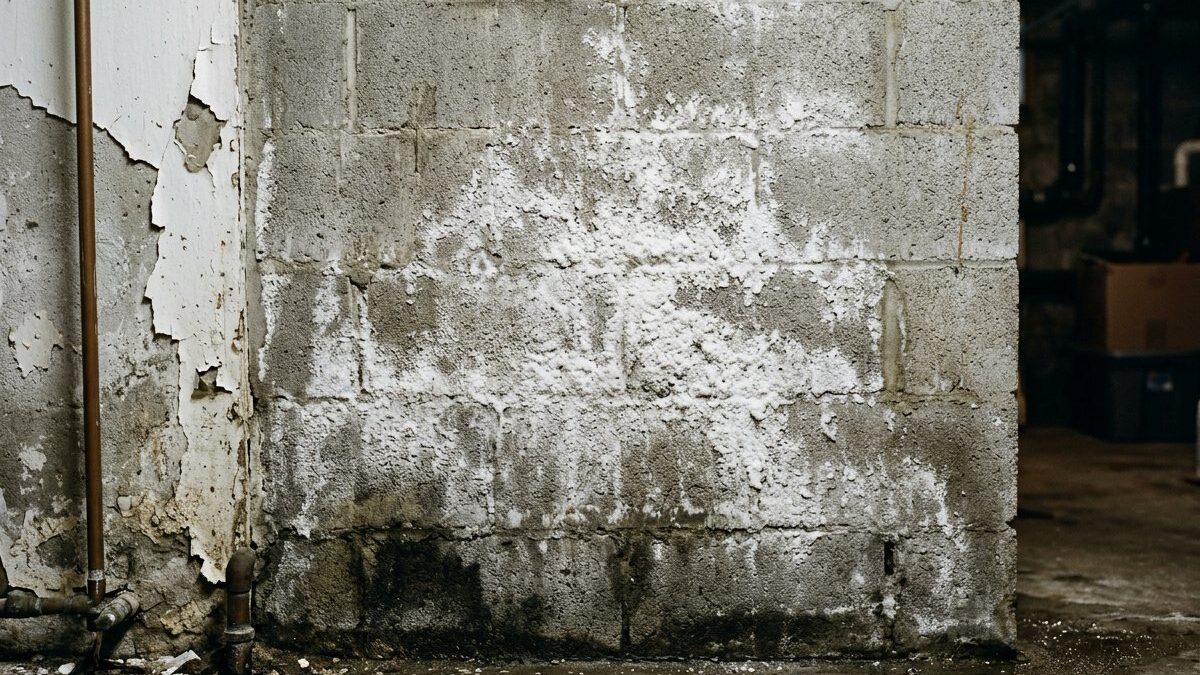
These coatings grip by penetrating the surface. Old paint, a previous sealer, form release residue or a dusty face all block that grip. Manufacturers are direct about this, and most of the failures we photograph in Chicago basements trace back to a coat applied over something else.
-
It is brushed in thick, not rolled thin
The instructions call for a stiff brush and a heavy film worked into the surface, then a second coat. Rolled on like wall paint it never reaches the thickness the product is rated at, and a thin film is what tears first when anything pushes on it.
-
Vapor and light damp are what it stops
On a sound wall with no active seepage, the coating slows moisture moving through the masonry as vapor. The room reads drier, the musty note fades, and stored boxes stop going soft. That is a real result and it is the result the product was formulated for.
-
It is working from the unfavorable side
Applied inside, the film sits on the dry face while water arrives from the wet face. Pressure works to lift it off the wall rather than push it against the wall. Every coating in this category is fighting the direction of the load when it is used this way.
-
The label states a pressure limit
Read the container and you will find how much head of water the product is meant to resist. It is a modest figure, and a few feet of saturated clay standing against a foundation after a spring storm sits well past it. That is not marketing failure, it is scope.
Where a coating genuinely earns its place
- A dry wall that reads cool and damp to the hand in midsummer
- Evening out patchy bare block in a utility or laundry area
- Vapor control on a basement with no history of standing water
- Above-grade or partially exposed masonry taking wind-driven rain
- A rental or a stopgap while a real repair is being budgeted
What it cannot do
- Hold water back once saturated clay is pressing on the wall
- Bridge a crack, a cold joint or the cove where slab meets wall
- Empty the hollow cores of a block wall that is already full
- Stay bonded over old paint, sealer or a bloom of efflorescence
Why does drainage work where a coating fails?
Drainage does not try to out-muscle the water. It removes the pressure that was pushing on the wall in the first place, and nothing has to stay stuck to anything for it to keep working.
The difference is one variable, and it is not the quality of the product.
-
Pressure is what decides the outcome
A wall does not leak because its surface is porous. It leaks because water has collected against it with nowhere to go and is looking for the path of least resistance. Change where that water can go and the surface stops mattering nearly as much.
-
A pipe at the footing gives it somewhere to go
Perforated pipe bedded in washed stone beside the footing accepts water below floor level and carries it to a single low point. The soil beside the wall drains instead of standing, and the head that was pressing on your masonry never builds.
-
Weep holes drain what is already inside
On a block wall the water sitting in the hollow cores has to come out somewhere. Holes drilled into the bottom course let those cores empty into the new pipe rather than into the cove joint, which is where a coated block wall usually gives way first.
-
A pump physically removes it from the building
A sump with a battery backup lifts collected water out and discharges it far enough from the house that it does not simply return. No coating removes a gallon of anything. This is the step that makes the difference permanent, and it runs $2,800 to $4,500.
-
Nothing depends on adhesion
A drainage system is pipe, stone and a pump. There is no bond to break, no film to blister, and no surface prep that can be got wrong three years ago and betray you now. It is also serviceable from inside, which a coating never is.
Signs you are past what a coating can do
- Water appears on the floor, not just damp on the wall
- A previous coat has blistered or peeled in sheets low on the wall
- White chalky salt keeps returning after every scrub
- The wall darkens hours after the rain, then stays dark for days
- It happens on more than one wall in the same storm
Fair points against drainage
- It costs many times what a few buckets of coating cost
- Flooring and low finishes come off the runs being treated
- The pump is a moving part that needs power and annual testing
- It manages water at the footing, it does not dry the wall face
Should I seal the wall or drain the water?
These are not competing solutions to the same problem. They are answers to two different problems that look similar from the top of the stairs.
| Masonry waterproofing coating | Interior drainage system | |
|---|---|---|
| What it addresses | Vapor and light damp through sound masonry | Water collecting against and under the foundation |
| Where it acts | On the inside face of the wall | At the footing, below the slab |
| Under real water pressure | Blisters, then peels from behind | Unaffected, because the pressure is relieved |
| Cracks and the cove joint | Cannot bridge either one | Cove and footing are exactly what it drains |
| Block wall cores | Seals them shut and traps the water | Weep holes empty them into the pipe |
| Surface preparation | Critical, and the usual reason it fails | Irrelevant, nothing is bonded to the wall |
| Cost | A weekend and a few buckets | $95 to $160 per linear foot |
| Who should do it | A homeowner with a free Saturday | A crew with a saw, a pump and a permit if the village asks |
| Our warranty | Not a warrantable repair, so we do not sell it | A lifetime, fully transferable warranty on the system |
Whether either one is right also depends on what your wall is made of, since block and poured concrete leak in different patterns: block vs. poured wall seepage.
Want to know whether paint would be enough? We will tell you straight, in writing, free within 48 hours, and we do not sell coatings either way.
How does your wall respond to a coating?
What the foundation is made of decides whether a film has any chance of staying on it. These four are the walls we meet across the seven counties.

Pre-war bungalows and two-flats
Brick, limestone rubble and soft lime mortar, usually carrying five decades of previous paint. There is nothing bare left for a coating to bond into, and stripping a century-old foundation back to sound masonry is not a weekend project.
Poor candidate
Post-war block ranches
Hollow cores charge with water during storms and empty at the bottom course. A film over that face traps the water inside the block, so it pushes out at the cove joint or lifts the coating a course higher.
Coating makes it worse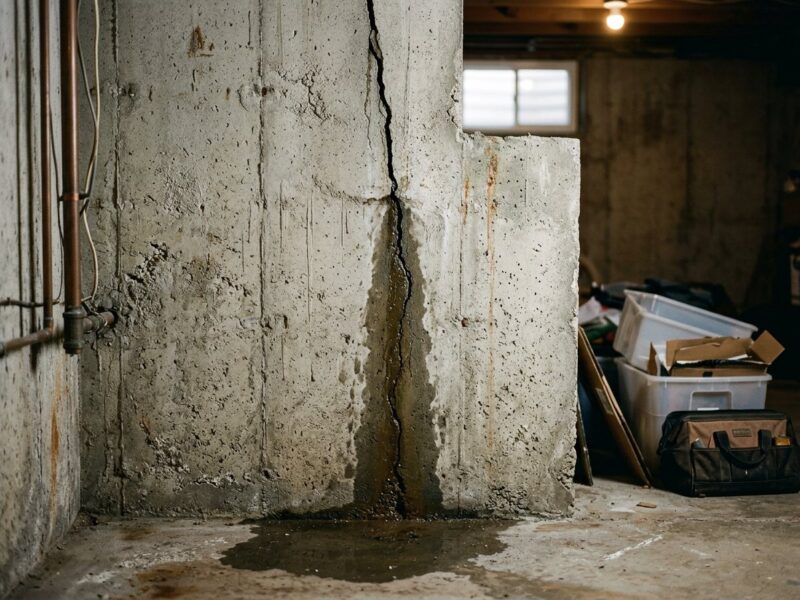
1980s and 90s poured walls
Sound, dense concrete that a coating actually bonds to well. It is also the wall type where the leak is usually one crack, and no film ever bridges a crack that is moving with the seasons.
Bonds fine, misses the leak
Newer subdivision homes
Poured walls that got a thin damp-proofing spray on the outside the day they were built, which was never a waterproofing membrane. A dry basement here usually means the grading and drainage are still doing their job.
Fix the grade firstWhat the real repair costs when paint is not enough
Coatings are the cheapest thing you can put on a basement wall, which is why they get tried first. The repairs that follow are published: interior drain tile is $95 to $160 per linear foot, and a single injected crack is $450 to $900.
| Work | Range | What moves the number |
|---|---|---|
| Interior drain tileper linear foot | $95–$160 | Length of the run, slab thickness, what has to be moved off the walls |
| Sump pump with battery backupinstalled | $2,800–$4,500 | Pit condition, backup capacity, discharge routing |
| Downspout extensions and regradingtypical job | $600–$2,500 | Feet of grade to rebuild, soil hauling |
Notice the order of magnitude between the last line and the first. Moving roof water away from the foundation is the cheapest real repair on this list and it is the one that most often makes the others unnecessary. Every range we quote from is on the pricing page.
When a coating is the right answer
We do not sell paint, so there is nothing in this for us. On plenty of the walls we look at, a bucket and a stiff brush is genuinely where it should end.
The wall is sound, dry and just looks rough
Bare block in a laundry room with no seepage history, no salt bloom and no stains at the cove is a cosmetic job. Prep it properly, brush two heavy coats into the pores, and spend the eight thousand dollars on something you will enjoy more.
Buy the paintWhat you are fighting is humid air
If the damp shows up on the coldest surfaces first, the ductwork and the cold water line as much as the wall, you are watching air give up its moisture rather than a foundation leak. Sealing the masonry does nothing for that. Run the numbers on a dehumidifier.
Wrong problem entirelyThe salt keeps coming back
White chalky bloom returning after every scrub means water is still traveling through the masonry, and nothing will bond over it for long. Deal with the water before the surface. What efflorescence is telling you.
Water first, film laterYou are painting it because the house is listing
A coat over a stained wall does not remove what happened there. Illinois sellers complete a residential disclosure covering known material defects, the details vary by situation, and it is a question for your attorney rather than for us or your agent.
Ask your attorneyQuestions homeowners ask about basement sealers
Does waterproofing paint actually work?
For what it is designed to do, yes. On bare, sound masonry with no water pressure behind it, a properly applied coating cuts vapor and light damp and makes a basement feel and smell better. It was never engineered to hold back groundwater. Applied to a wall that seeps after storms, it is a film waiting for the first heavy spring, and the wall wins.
Why did my basement paint peel off in sheets?
Because water reached the back of it. Moisture moving through masonry pushes against the bond from behind, and mineral salt crystallizing at that boundary pries the film off mechanically. It usually starts low, where the pressure is highest, and lifts upward. The peeling is not a defect in the product so much as evidence that the wall had a drainage problem the whole time.
Can I paint over efflorescence?
You can, and it will not hold. Efflorescence is mineral salt left behind by water evaporating out of masonry, so it is both a poor bonding surface and proof that water is still moving through the wall. Brushing it off and coating over it buys a season at best. The salt returning after you clean it is the useful signal, not the nuisance.
Will a sealer stop water at the cove joint?
No. The cove is the seam where the poured slab meets the wall, and it is where water under the floor arrives first. That is a gap with pressure behind it rather than a porous surface, and a brushed film cannot span it. Hydraulic cement troweled into the cove holds a little longer and then fails the same way, usually within a season or two.
Should I paint the wall before or after drain tile is installed?
After, if you want it to last. Once the system is in and the pressure at the footing is relieved, the wall dries out and a coating finally has the conditions it was formulated for. Give the new concrete and the wall a few weeks to dry, then prep and coat. Painting first just means doing the demolition through your own fresh work.
Is there any product that stops hydrostatic pressure from inside?
Not a coating. Point repairs work from the inside, urethane injection fills a crack through the full thickness of a poured wall and cures against wet concrete, backed by a 10-year warranty. But that is filling one defect, not resisting a wall of pressure. Pressure across a whole wall gets relieved by drainage, which is the only approach we warrant.
The two systems that actually resist water
Once a wall is past what a coating can do, there are two real routes: collect the water at the footing inside and pump it out, or open the wall from the yard and keep it off the face entirely. Your lot, your season and your finished space usually decide which.
Compare interior and exterior waterproofing

Get told the truth about your wall, free
A measured written diagnosis within 48 hours, published pricing if you need work, and a straight answer if a brush and two coats is all this ever was.
Or talk to a human right now
(630) 335-1128
Request your free estimate
Tell us what you're seeing. We'll call back fast and be out within 48 hours.