
Efflorescence: That White Chalky Residue on the Block
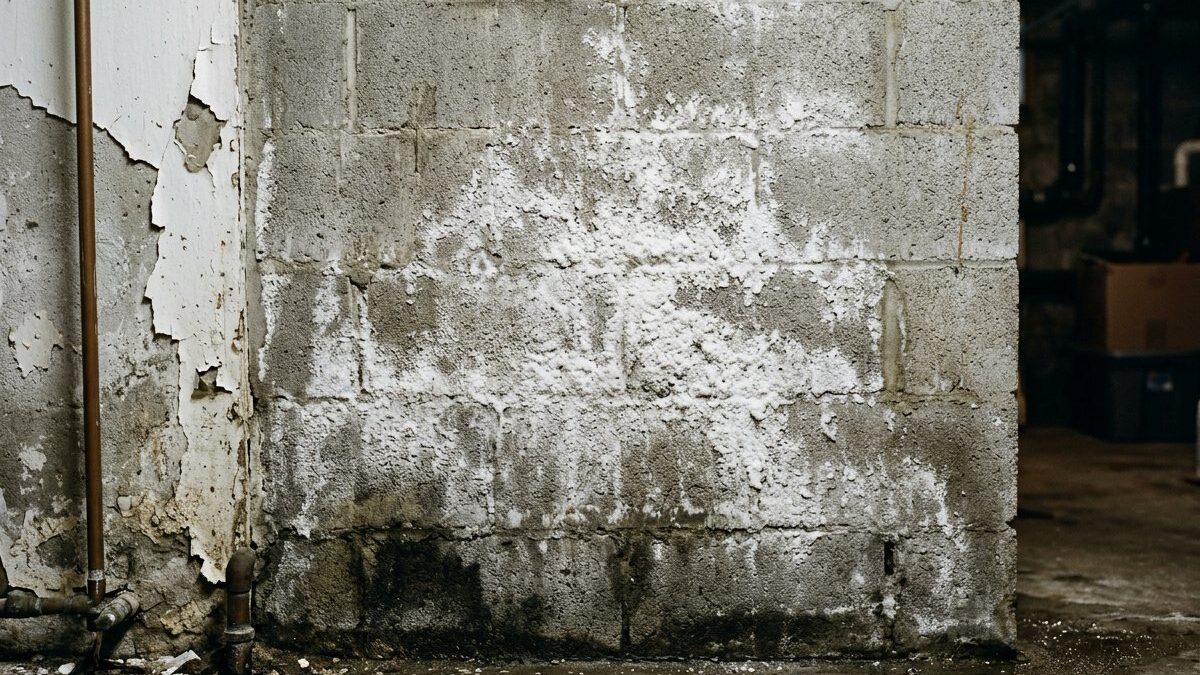
The white crust on your block is not mold and it is not the wall falling apart. It is a record of water that has already moved through the masonry, and it will tell you where that water came from if you read it properly.
- Written diagnosis whether you hire us or not
- 20+ reading Chicago basement walls, 1,500+ homes
- Published pricing, no commissioned salespeople
 Free wall diagnosis within 48 hours
The short answer
Efflorescence is a deposit of mineral salts left on masonry after water has passed through it and evaporated at the surface. The salts come from the block, mortar and soil, not from the air. It is harmless in itself, but it is proof that liquid water is moving through the wall, which is what actually needs attention.
Concrete block, mortar and the soil packed against them all contain soluble salts. When water works through the wall it dissolves those salts and carries them along. At the inside face the water evaporates into the room and the salts cannot follow it, so they are left behind as a white or grayish crust that brushes off like chalk. That is the entire mechanism. The deposit is not growing, it is not eating your foundation, and wiping it away accomplishes nothing except erasing evidence, because the water that made it is still arriving.
We see it on most block basements we walk in this region, and the reason is the soil. Glacial clay holds storm water against a foundation for days rather than letting it drain, which gives that water plenty of time to work through the mortar joints. Block walls make it worse, because the hollow cores fill and then unload slowly through the bottom courses. If you are still sorting out which symptom you have, the basement and foundation problem guide lines them up side by side.
What is the white powder on my basement walls?
Efflorescence is the visible end of a journey water made through the wall. Every stage of that journey is ordinary, which is why the deposit is so common here.
Trace it backward from the crust on the block and you get five steps.
-
Water reaches the outside face
Rain and snowmelt drain down through the backfill and sit against the wall while the clay behind it drains at a crawl. On most Chicago lots that wall face is damp for a good part of the wet season whether anyone notices or not.
-
It moves through the masonry
Mortar joints, block webs and hairline shrinkage cracks all take water by capillary action. It does not need pressure or a hole. Given contact and time, the material itself pulls moisture through toward the drier side.
-
Salts dissolve on the way
Moving water picks up soluble salts out of the mortar, the block and the surrounding soil. By the time it reaches your side of the wall it is carrying a load of dissolved mineral it cannot hold once the water is gone.
-
The water evaporates into the room
At the inside face the moisture leaves as vapor. The salts stay put on the surface and start to build. This is why the deposit is worst on walls with air moving past them and in stretches hidden behind stored boxes.
-
The crust accumulates and repeats
Each wet cycle adds another layer. A heavy, crumbly build-up means many cycles over a long time. A thin bloom that appeared this spring means the wall got wet recently, which is a much more useful piece of information.
What efflorescence proves
- Liquid water is moving through the wall, not just humid air
- The path is the masonry itself, so a coating on the face will not stop it
- Something outside is keeping that wall wet: grade, gutters or groundwater
- The deposit is cosmetic; the moisture behind it is not
What it does not prove
- That the wall is structurally compromised
- That you have a mold problem, which is a different organism entirely
- That the leak is active today, since old deposits stay for years
How do you tell efflorescence from mold?
The two look alike under a flashlight and mean completely different things. Three tests separate them in about a minute, and none of them costs anything.
Do these in order, and stop as soon as one gives you a clear answer.
-
Rub it between your fingers
Efflorescence is gritty and crystalline, and it crumbles to powder. Mold is soft and smears. Salt deposits also sit only on masonry, while mold will happily grow on wood, drywall paper, cardboard and carpet backing nearby.
-
Wet a small patch
Spray a bit of the deposit with plain water. Salts dissolve and largely disappear, then bloom back as the wall dries again. Mold changes color when wet but stays where it is, because it is attached to what it is feeding on.
-
Look at the color and the pattern
Efflorescence is white or pale gray and follows mortar joints, cracks and the bottom courses. Black, green or brown speckling in a random spread across a cool surface is biological growth, and a strong earthy smell points the same way.
-
Read the height of the deposit
Measure how far up the wall the crust reaches and note it. A band low along the bottom two courses says groundwater at the footing. A patch six feet up says surface water arriving from a downspout, a window well or a failed gutter above it.
-
Photograph it and check again after rain
Clean a one foot square, mark the date and look at it again after the next hard storm. If the bloom comes back, the wall is actively taking water and the source is worth chasing. If it stays clean for a season, you are looking at history.
What the pattern tells you
- Low band along the bottom courses: groundwater at the footing
- A vertical stripe: water tracking down a single crack or joint
- A high patch on one wall: roof or surface water at that spot
- Heavy build-up everywhere: years of it, and a system conversation
What to be careful with
- Wire brushing before you photograph destroys the map
- Acid washes and sealers hide the record without fixing anything
- Growth on wood or drywall is a remediation call, not a masonry one
Efflorescence or mold: which am I looking at?
Sorting these two out decides who you call. One is a water problem for a waterproofing contractor, the other is an air and remediation problem.
| Efflorescence | Mold or mildew | |
|---|---|---|
| What it is | Mineral salts left after water evaporated | A living growth feeding on damp organic material |
| Color | White to pale gray | Black, green, gray-green or brown |
| Texture | Gritty, crystalline, crumbles to powder | Soft, fuzzy or slimy, smears when rubbed |
| Where it appears | Block, brick, mortar and concrete only | Wood, drywall, paper, fabric and carpet as well |
| When sprayed with water | Dissolves, returns as the wall dries | Darkens but stays in place |
| Smell | None | Earthy or musty, often noticeable from the stairs |
| Health concern | Not a health issue in itself | Can affect breathing and allergies |
| Who fixes it | Us: stop the water reaching the wall | Remediation for the growth, then us for the moisture source |
| What it costs to identify | A flashlight and two minutes | A $30 hygrometer helps, testing if anyone is symptomatic |
The two often appear on the same wall, because the water that leaves salt behind also raises the humidity that growth needs. A musty basement smell alongside white crust usually means both are in play.
White crust coming back every spring? We read the wall, find where the water is entering and put it in writing, free within 48 hours.
What the deposit means by house era
The same white crust carries a different message depending on what the wall is made of and when it went up.

Pre-war bungalows and two-flats
Stone and early concrete walls with original clay tile drains that packed shut decades ago. Heavy, layered deposits low on the wall are normal here and usually mean the footing has been wet for a very long time.
Expect drainage work
Post-war block ranches
The classic case. Hollow cores fill during wet stretches and drain through the bottom courses, so the crust forms a band along the lowest two courses and returns every spring no matter how often it is brushed off.
Weep holes and drain tile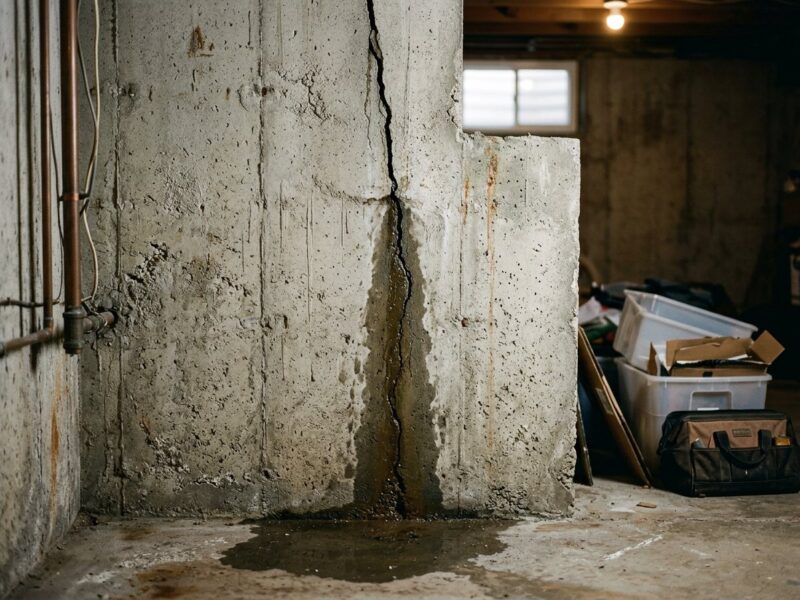
1980s and 90s poured walls
Poured concrete effloresces less, so a stripe of white down a wall is a strong hint at one specific shrinkage crack rather than a whole-wall problem. Follow the stripe up and you usually find it.
Often just injection
Newer subdivision homes
A fresh bloom on a young foundation is often construction moisture curing out of the concrete in the first year or two. If it is still returning in year five, the grade or the downspouts have settled.
Watch a season firstWhat does the underlying problem cost to fix?
Nobody pays us to remove efflorescence. What gets priced is the water behind it, and those ranges are published: interior drain tile runs $95 to $160 per linear foot, and a full perimeter system on a typical Chicago basement lands between $8,000 and $16,000.
| Work | Range | What moves the number |
|---|---|---|
| Downspout extensions and regradingtypical job | $600–$2,500 | Feet of grade to rebuild, soil hauling |
| Interior drain tileper linear foot | $95–$160 | Length of the run, slab thickness, what has to be moved off the walls |
| Sump pump with battery backupinstalled | $2,800–$4,500 | Pit condition, backup capacity, discharge routing |
A good share of these end at the top line of the table rather than the bottom. Correcting downspouts and grade for $600 to $2,500 dries out plenty of walls that were quietly wet for years. Every range is on the cost page.
When white on the wall is not worth spending on
Efflorescence is one of the most oversold symptoms in this trade. Here are four times we tell people to keep their money.
The foundation is new
Fresh concrete and new mortar carry a lot of water out with them as they cure, and a bloom in the first year or two on a house built recently is that process finishing. Clean it, note the date and look again next spring before anyone quotes you anything.
Wait a seasonIt is old and it has not changed
Deposits sit on a wall indefinitely once the water stops. If the crust is dull, undisturbed and no bigger than the photograph you took two winters ago, you are looking at a record of a problem that has already been solved.
History, not newsIt is really a humidity problem
Damp air, a musty smell and a clammy wall in July often come down to indoor humidity rather than seepage. A $30 hygrometer and a dehumidifier answer that for a fraction of any repair. Humidity and basement air covers the numbers to aim for.
Under $50 to testWhat you actually have is growth
If it smears, smells earthy or is spreading onto joists, drywall or stored boxes, the first call is a remediation contractor rather than a waterproofer. Get the growth handled, then deal with the moisture source so it does not come back.
Not our workQuestions homeowners ask about the white residue
Is efflorescence dangerous?
The deposit itself is not. It is mineral salt, chemically close to what is already in the concrete, and it is not a biological growth or a breathing hazard. What deserves attention is what it proves: liquid water is passing through your foundation wall. Left alone long enough that moisture feeds mold on nearby wood and stored belongings, and it will rust anything steel it keeps in contact with.
How do I remove it?
A stiff brush takes most of it off dry, and a masonry cleaner handles the rest. Do that after you have photographed and measured how high it reaches, because that pattern is the most useful diagnostic on the wall. And understand that removal is cosmetic. If the water keeps arriving, the crust comes back on the same schedule it always did.
Will waterproof paint stop it coming back?
Not for long. Coatings are applied to the face the water is pushing against, so moisture keeps arriving behind them and eventually lifts the film off along with the salt underneath. On block walls the paint often just moves the bloom to the next unpainted stretch. <a href="/basement-waterproofing/waterproofing-paint-vs-drainage/">What sealers actually do</a> goes through the limits honestly.
Why is it only on one wall?
Because one wall is getting more water than the others, and that is a genuinely useful clue. Go outside and stand at that wall in the rain. Nine times out of ten you find a downspout discharging beside it, a grade that has settled back toward the house, a window well holding water, or a neighbor's lot draining across the property line at that point.
Does efflorescence mean my block wall is failing?
No. Salt deposits say nothing about structure on their own, and a wall can bloom heavily for twenty years while staying perfectly sound. What we look for on the same wall is displacement: mortar joints stepping sideways, courses pushed in toward the room, or a horizontal crack partway up the height. Those are structural findings, and they get measured with a level and recorded rather than eyeballed from the stairs. <a href="/basement-foundation-problems/horizontal-foundation-crack/">Horizontal cracks</a> explains why that one carries the most weight.
Should I fix it before I sell the house?
Brushing it off the week before a showing is a bad plan, because a home inspector who finds fresh clean block with damp mortar reads it as a cover-up. Illinois sellers have disclosure obligations about known water conditions, and how those apply to your situation is a question for your attorney. Documented repair work with a transferable warranty is worth far more at closing than a clean-looking wall.
Block wall or poured wall?
Efflorescence behaves very differently depending on what your foundation is made of. Block wicks water through dozens of mortar joints and hollow cores, so it blooms across whole sections. Poured concrete leaks at specific defects, so it stains in stripes. Knowing which one you have narrows the repair before anyone quotes it.
Compare block and poured seepage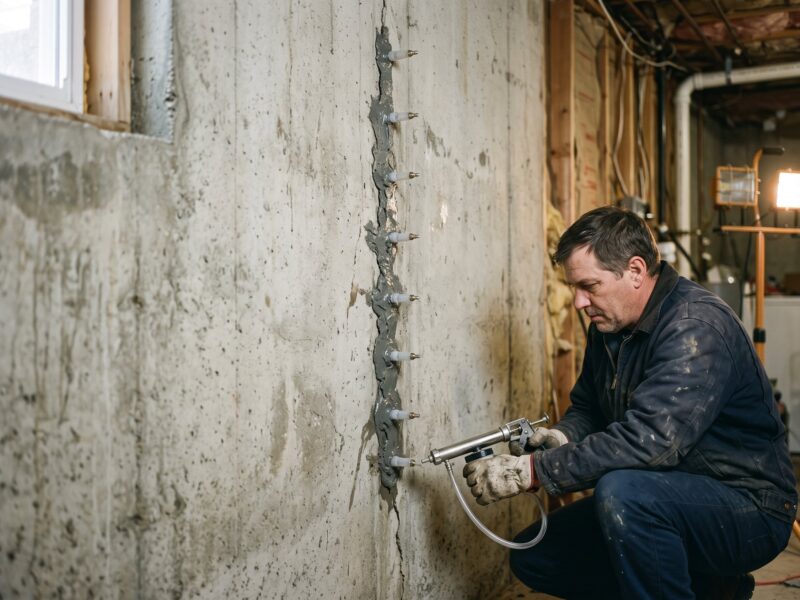

Find out what the white crust is telling you
Free written wall diagnosis within 48 hours, published pricing, and a lifetime, fully transferable warranty on any interior system we install.
Or talk to a human right now
(630) 335-1128
Request your free estimate
Tell us what you're seeing. We'll call back fast and be out within 48 hours.