
Humidity, Dehumidifiers and Basement Air
A basement can be thoroughly wet without a drop of water ever passing through the wall. Which kind of wet you have decides whether you are buying an appliance or a construction project.
- Free written diagnosis within 48 hours
- We say so when a dehumidifier is the whole answer
- 1,500+ homes across seven counties
 20+ of Chicago basements, straight answers
The short answer
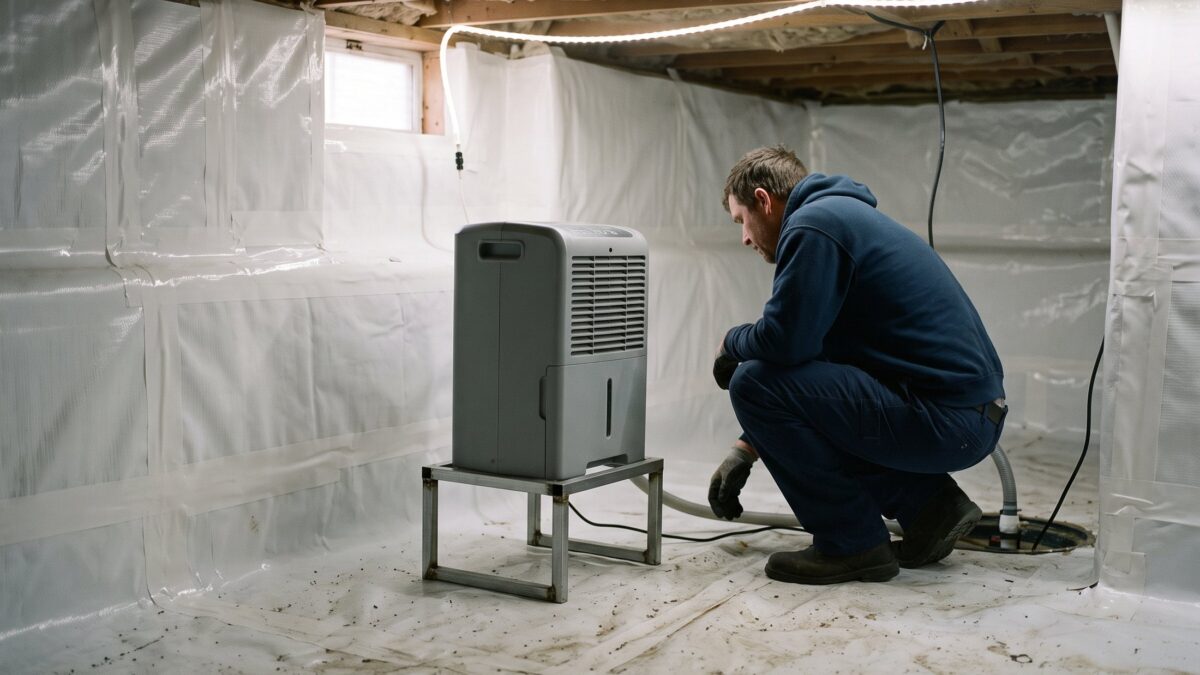
Basement humidity comes from warm outside air meeting cold below-grade surfaces, plus moisture wicking up through the slab and walls. A dehumidifier holding the room between forty and fifty percent relative humidity solves the air problem. It cannot stop seepage, so if water tracks across the floor after storms, drainage has to be fixed first.
Air carries water in proportion to its temperature. Warm June air arrives down the stairwell carrying a full load of moisture, reaches a basement where the slab and walls sit near fifty-five degrees all year, and cools past the point where it can hold what it brought. The excess lands on whatever is coldest: the outside of a water line, the bottom course of block, a metal duct, the inside of a window. That is condensation, and no wall repair anywhere will stop it.
Chicago summers turn that into a seasonal certainty rather than bad luck. Dew points here sit in the sixties for weeks at a time, and every basement in the region has cold masonry waiting for that air to find it. Add a glacial clay lot that keeps the soil damp and moisture is rising through the slab from underneath as well. The result is a room that smells wet in July and fine in January. If water also shows on the floor, the basement waterproofing overview covers the systems that stop it.
Why does my basement smell damp every summer?
Summer basement dampness is condensation, not a leak. It arrives with the weather and it leaves with the weather.
Here is the sequence, from the air outside your door to the smell on the stairs.
-
Warm wet air comes down
Humid outdoor air enters through an open window, a stairwell door or a gap around the dryer vent, then settles low because it grows heavier as it cools. Basements collect summer air the way a bowl collects rain.
-
Cold surfaces take the water out of it
A slab and below-grade walls stay in the fifties all year. When air at a sixty-five degree dew point touches them, moisture drops out onto the surface. It is the same physics as a glass of iced tea sweating on a table.
-
The slab adds its own
Concrete poured on damp clay wicks moisture upward continuously. Tape a two-foot square of plastic sheet to the floor for two days. Moisture trapped underneath it means the slab is contributing to what you are smelling.
-
Stored material absorbs it
Cardboard boxes, carpet pad, paper-faced drywall and stacked lumber soak up the surplus. The musty smell people describe comes from those materials breaking down, not from the concrete itself.
-
The cycle resets daily
Every warm humid day starts it over. That is why running a borrowed dehumidifier across a weekend seems to fix everything, and why the smell walks back in within a week of unplugging it.
A dehumidifier is the right tool when
- Cold pipes and window glass are sweating in summer
- The smell arrives in June and disappears by December
- The floor is dry the morning after heavy rain
- A hygrometer on the shelf reads above sixty percent
- Stored cardboard and fabric feel cool and soft
What it cannot fix
- Water tracking across the slab after a storm
- A wet stripe where the floor meets the wall
- A crack that weeps only while it is raining
- A sump pit that fills faster than the pump empties it
How do you tell condensation from seepage?
Two free tests settle it inside a weekend. A contractor who skips them is guessing, and guessing is how people end up owning systems they never needed.
Run these in order before you let anyone write you a quote.
-
Tape foil to the wall
Tape a foot-square piece of aluminum foil tight to the masonry on all four edges and leave it two days. Moisture on the room side means humid air is condensing. Moisture behind it means water is coming through the wall.
-
Match the damp days to the weather
Condensation tracks temperature and dew point, so it peaks on hot sticky days. Seepage tracks rainfall, appearing during a storm or the day after one. Keep a note on the calendar for a month and the pattern separates itself.
-
Read a hygrometer, not your nose
A thirty dollar hygrometer on a shelf in the middle of the room gives you the actual number. Above sixty percent is worth fixing no matter what else is happening. Below fifty and the smell has a different source.
-
Get down at the floor line
Take a light to the joint where the slab meets the wall and look along it. A darkened stripe, a crust of white mineral or a fine line of silt means liquid water has run out of that joint at some point.
-
Rule out the household sources
A sweating cold water line, a dryer venting into the room, a bathroom with no working fan and a crawl space with open dirt each add real gallons per day. Eliminate those before deciding the foundation is at fault.
Points to condensation
- Moisture on the room side of the foil
- Sweating pipes and fogged window glass
- Worst in July, gone by October
- A dry floor the morning after a storm
Points to seepage
- Moisture behind the foil, against the masonry
- A wet line at the floor joint or at one crack
- Timing that follows rainfall rather than heat
- White mineral crust building up on the block
Dehumidifier or drainage system?
They solve different problems, and buying the wrong one first is the most common expensive mistake made in a Chicago basement.
| Dehumidifier | Interior drainage system | |
|---|---|---|
| The problem it solves | Moisture already in the room air | Liquid water arriving at the footing and floor joint |
| What it costs | A few hundred dollars at a hardware store | Published at $95 to $160 per linear foot |
| How long it takes | Plug it in this afternoon | One to three days with a crew on site |
| What it does during a storm | Nothing useful | Carries the water out before it reaches the floor |
| What it does in July | Everything, holding the room near forty-five percent | Little, because room air was never its job |
| Running cost | Electricity all summer, every summer | A pump that runs only when water arrives |
| Effect on the smell | Ends it if humidity was the cause | Ends it if seepage was the cause |
| Our warranty | None, it is an appliance you bought retail | A lifetime, fully transferable warranty on the system |
Plenty of basements need both, and the order is not a coin flip: drainage first, then measure what humidity is left to remove. Our ranges are all published on the pricing page.
Not sure whether it is the air or the wall? We measure both and put the answer in writing, free within 48 hours, even when the answer costs you nothing.
Why is your house humid?
The era a house was built in decides where its moisture comes from and how much of it the air can hold onto. Four house types account for most of the damp air we meet across the seven counties.

Pre-war bungalows and two-flats
Low ceilings, stone or early concrete walls, and a thin slab poured straight onto clay. These basements wick from every direction at once and usually have no mechanical ventilation, so summer air simply parks down there.
Dehumidify, then drain
Post-war block ranches
Hollow block holds water in its cores and releases it into the room as vapor for weeks after a storm. White crusting on the wall means liquid water is arriving, so the air problem here usually has a drainage problem beneath it.
Check the block first
1980s and 90s poured walls
Denser walls, but many of these homes carry a crawl space section with open dirt evaporating into the whole house. The basement gets blamed for moisture that actually starts under an addition.
Look for open dirt
Newer subdivision homes
Tight construction and a conditioned basement, which works until a dryer vents into the room or the egress window sits open through August. Small sources make a big difference in a sealed house.
Usually a source, not the wallWhat does drying out a basement cost?
A dehumidifier is the cheapest thing on this page. When the problem is water rather than air, a full perimeter interior system on an average Chicago basement runs $8,000 to $16,000, and a sump pump with battery backup is published at $2,800 to $4,500.
| Work | Range | What moves the number |
|---|---|---|
| Interior drain tileper linear foot | $95–$160 | Length of the run, slab thickness, what has to be moved off the walls |
| Sump pump with battery backupinstalled | $2,800–$4,500 | Pit condition, backup capacity, discharge routing |
| Crawl space encapsulationper square foot | $7–$14 | Access height, standing water, whether drainage goes in first |
| Downspout extensions and regradingtypical job | $600–$2,500 | Feet of grade to rebuild, soil hauling |
Hygrometers and dehumidifiers are homeowner purchases and we do not sell either one, so nobody here has a reason to talk you out of the cheap answer. Everything we do quote sits on the pricing page.
When the answer is not a contractor
A good share of the humid basements we get called about need a screwdriver and a week of patience. Here is where to look before booking anyone.
Buy the hygrometer first
Thirty dollars settles arguments people spend thousands on. Put one on a shelf in the middle of the basement, read it morning and evening for a week, and you will know whether you have a humidity problem at all before anyone visits.
Costs nothing to checkYour dryer is venting indoors
A disconnected or crushed dryer duct pushes gallons of water vapor into the basement every week. Reconnecting it takes fifteen minutes and a screwdriver, and it changes the feel of the entire room within days.
Free to checkThe crawl space is doing it
Open dirt under part of the house evaporates moisture continuously, and that moisture travels through the whole building. Sealing the ground is a different job than waterproofing a basement wall. Start there instead.
Different jobWait one season before buying a system
If you have never watched the basement through a full spring, do that first and note every damp day against the weather. A pattern that follows heat is not a drainage problem, and we would rather tell you now than sell you a system. The rain pattern is here.
Wait and watchQuestions homeowners ask about basement humidity
What humidity should a basement be kept at?
Between forty and fifty percent relative humidity year round. Above sixty, mold has what it needs and stored cardboard and fabric begin to smell. Below thirty in winter is uncomfortable and hard on wood trim. Most Chicago basements drift toward seventy percent in July without any help from a leak, so a dehumidifier with a built-in humidistat set near forty-five is the practical target for a finished or storage basement.
Will a dehumidifier stop my basement from leaking?
No. A dehumidifier pulls water out of air at a rate measured in pints per day. Seepage arrives in gallons per hour during a storm, through the wall or the joint at the floor, no matter how dry the room air happens to be. Running one through an active leak means paying for electricity while the water keeps coming. Fix the drainage, then dehumidify whatever is left over.
Why is my basement humid but the floor is dry?
Because the moisture is arriving as vapor rather than as liquid. Warm humid air cooling against fifty-five degree masonry drops its water onto surfaces, and a damp slab sitting on clay adds more from below. Neither one produces a puddle. You see it instead on cold pipes, on window glass and in the smell of stored cardboard. That is the good version of this problem, because it is the cheap one.
Should I run a dehumidifier in winter?
Usually not. Cold outdoor air holds very little moisture, so once the heat is running a Chicago basement typically falls below forty percent on its own. Running a unit anyway wastes electricity, and most consumer models work poorly below sixty-five degrees. Check the hygrometer in January instead. If it still reads high in the cold, something inside the house is generating moisture and that is worth tracking down.
Does a dehumidifier get rid of the musty smell?
It does when humidity was feeding it. The smell comes from damp organic material rather than from concrete, so holding the room near forty-five percent and hauling out wet cardboard usually clears it within a couple of weeks. If the smell survives that, water is entering somewhere you have not found or something behind a wall has already gone soft. <a href="/basement-foundation-problems/musty-basement-smell/">The smell page</a> works through the rest.
Do I still need a dehumidifier after waterproofing?
Often yes, and it catches people off guard. An interior system stops liquid water reaching the floor, which is the large half of the problem, but summer air still condenses on cold masonry afterward. Most of our customers run a unit through the warm months and leave it off all winter. It is a cheap finishing touch on a system that already carries a lifetime, fully transferable warranty.
Still smelling it after the room dries out?
A smell that survives a dehumidifier is telling you something specific. Usually it is water arriving somewhere nobody has looked yet, or material behind a finished wall that has already gone soft and will not recover. We work through every common source, including the ones that have nothing to do with a foundation, before recommending any work at all.
Read about musty basement smell

Find out which kind of wet you actually have
Free written diagnosis within 48 hours, published pricing, and a straight answer even when the fix is an appliance from a hardware store.
Or talk to a human right now
(630) 335-1128
Request your free estimate
Tell us what you're seeing. We'll call back fast and be out within 48 hours.