
Stair-Step Cracks in Block and Brick
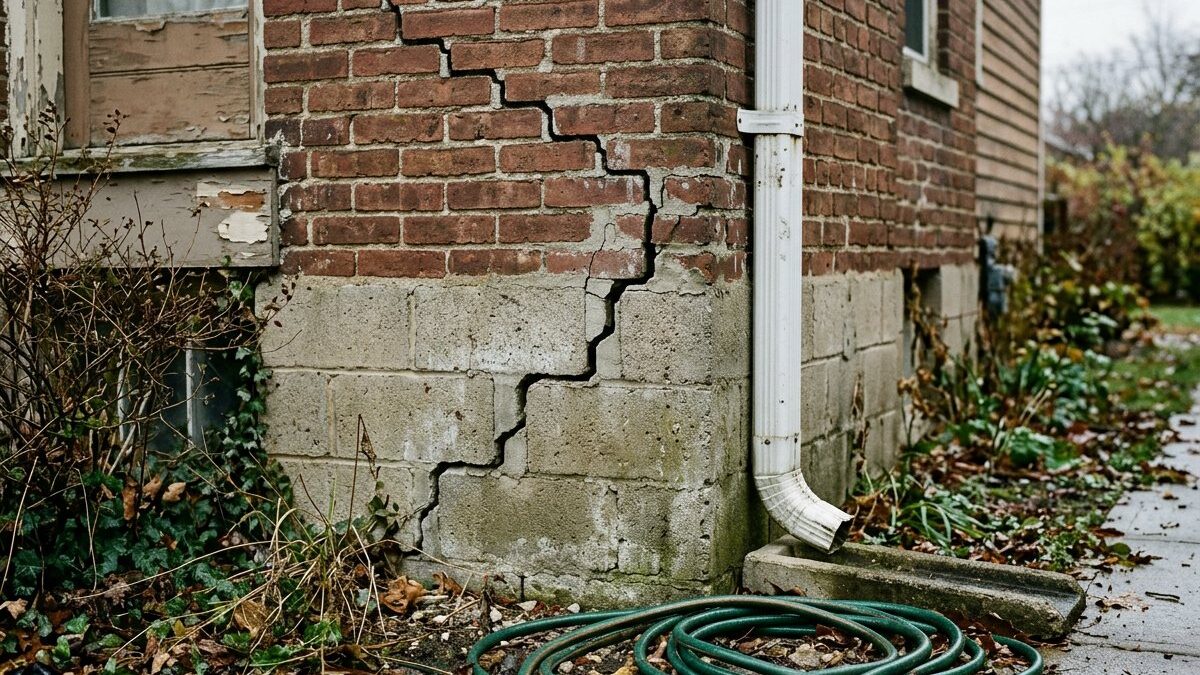
A crack that climbs the mortar joints in a staircase pattern is not random. It is the wall taking the easiest path around each block, and the direction it climbs tells you what moved.
- Crack width, offset and plumb measured free within 48 hours
- Published pricing on every strap, beam and pier
- $2,000,000 general liability in general liability, 20+ of Chicago masonry
 Wall stabilization: 25-year transferable warranty
The short answer
A stair-step crack climbs diagonally through the mortar joints because mortar is weaker than the block or brick it bonds. The pattern means one part of the wall moved relative to another, usually a settling corner or soil pressure. Wider at the top points to settlement below; wider at the bottom points to lateral load.
Mortar is the sacrificial part of any masonry wall. It is deliberately weaker than the block or brick beside it, so when a wall is pulled or pushed out of shape, the failure travels through the joints rather than splitting the units. Since joints run horizontally along each course and vertically between units, a crack looking for the easiest route has only one shape available: a diagonal staircase, up one head joint, across a bed joint, up the next. The staircase is not a separate defect. It is the shape masonry cracking takes.
Two things make this the most common crack we get called about across Cook, Will and DuPage counties. Almost every basement built here between the war and the early 1970s is hollow concrete block, and the region's clay soil both swells against those walls when wet and shrinks away from footings when dry. So a block wall in this area gets pushed from the side and dropped from below in the same decade. Where a stair-step fits in the larger symptom picture is laid out on our basement and foundation problems hub.
Why do cracks climb the mortar joints in a block wall?
The staircase pattern is a strength map. Every element in a masonry wall has a different breaking point, and the crack finds the cheapest route through them.
Five things about block and brick construction combine to produce that shape.
-
Mortar gives before the unit does
Bed and head joints are the weakest material in the assembly by design, so tension travels through them first. A crack passing straight through a block face instead is telling you the force involved was large enough to skip the easy route.
-
The joints only run two directions
Bed joints run level along each course and head joints run vertical between units, and they are offset course to course. Diagonal movement across that grid can only be expressed as a series of horizontal and vertical steps, which reads as a staircase.
-
Hollow block bends poorly
A concrete block wall is strong in compression and weak in bending. Once soil pressure or a dropping footing puts the wall into bending, it hinges along the joint line rather than flexing the way a poured wall can before it cracks.
-
Corners and openings concentrate stress
Cracks start where the wall changes shape. Window corners, beam pockets, the joint between an addition and the original wall, and the ends of a long run are where the staircase begins, then it climbs away from that point.
-
Water finishes what movement started
Once a joint opens, water gets into it, freezes and works the mortar loose. Old walls in this region often show a crack that started as a hairline decades ago and is now a raked-out joint you can push a screwdriver into.
Where these show up most
- The ends of a long back wall in a post-war block basement
- Above and below basement window openings
- The vertical joint where a rear addition meets the original house
- Brick veneer over a garage door header or a bay window
- Chimney masonry, which often moves on its own footing
What makes them worse
- A downspout discharging beside that corner every storm
- Mortar that was already soft and sandy before it cracked
- Repointing done over the crack without fixing the cause
- Freeze and thaw working an open joint through a Chicago winter
How do you read a stair-step crack?
A stair-step crack points at its own cause if you read three things: where it is widest, whether the two faces still line up, and whether the wall is still plumb.
This is the reading order we use on site, and you can do most of it with a tape and a level.
-
Find the wide end
Measure the gap at the top of the staircase and again at the bottom. Wider at the top usually means the far end of that wall dropped and the crack opened like a hinge. Wider at the bottom points at pressure or heave pushing the lower wall in.
-
Check whether the faces still align
Run a straightedge or your palm across the crack. If the two sides are still in the same plane, the wall has cracked but not displaced. If one side stands proud of the other, the wall has sheared and moved, which changes the conversation entirely.
-
Put a level on the wall
Hold a four-foot level vertically at the crack and at several points along the wall. A wall that is out of plumb and bulging toward the room is carrying soil load. A wall still plumb with a stair-step at one end is more likely reporting movement below the footing.
-
Follow it outside
Go out and look at the same wall above grade. A staircase in the brick or block outside that lines up with the interior crack means the whole wall assembly moved. Damage that exists only in the veneer often stops at the shelf angle or the lintel.
-
Mark it, date it, come back
Bridge the widest joint with a $20 crack gauge or a dated pencil line and read it again after the next wet spring or dry August. A crack that has not changed across a full seasonal swing is telling you the movement behind it has stopped.
Signs it is structural
- The two faces of the crack no longer sit in the same plane
- The wall is out of plumb along the same run
- The crack lines up with damage outside on the same wall
- It has widened measurably between two dated readings
- Soil or daylight is visible through an open joint
Signs it is cosmetic for now
- Hairline, in plane, and unchanged for years under old paint
- Confined to veneer brick with the wall behind it sound
- Around a single window with no other wall damage
- Soft old mortar crumbling with no crack line through it
Is the crack in the brick veneer or in the foundation wall?
Homeowners often find the crack outside in the brick and assume the foundation failed. They are two different walls with two different repairs, and telling them apart saves real money.
| Brick veneer above grade | Block foundation wall below grade | |
|---|---|---|
| What the wall does | Carries only itself, hung on the structure behind it | Holds the house up and holds the soil back |
| Where you see it | Outside, above grade, often near openings | Inside the basement, often behind stored boxes |
| Typical cause | Lintel rust, a failed shelf angle, or movement below | Soil pressure, a settled footing, or both |
| Does it leak | Rarely into living space | Often, straight into the basement at the joint |
| Who repairs it | A mason, once the cause underneath is settled | A foundation contractor, after the wall is measured |
| Typical fix | Rake and repoint, replace the lintel, rebuild a section | Straps, beams or anchors, sometimes piers below |
| Urgency | Low, unless brick is loose or bulging | Depends entirely on displacement and plumb |
| What we do about it | Tell you it is masonry work, not ours | Measure it and quote from published ranges |
A quarter inch at the widest joint, or any offset between the two faces, is our own trigger for measuring the whole wall rather than the crack. That is a field habit, not a code standard, and the number that applies to your particular wall is a structural engineer's call. Width alone is covered in the crack width guide.
Not sure if your crack has moved? We measure the width, the offset and the plumb of the wall and write it all down, free within 48 hours.
Which walls in this area crack this way?
Stair-step cracking needs joints, so it belongs to masonry construction. What decides the severity is what is behind the joints and how deep the footing went.

Pre-war bungalows and two-flats
Common brick above and stone, brick or early block below. Century-old lime mortar is soft, so cracks here often look alarming while the wall itself is stable. The wide-open joints are usually a repointing job.
Often mortar, not movement
Rubble stone and limestone walls
These do not step neatly because the units are irregular. Movement shows as bulges and washed-out joints instead, and the honest repair is holding the wall where it stands rather than chasing a straight line.
Read the bulge, not the line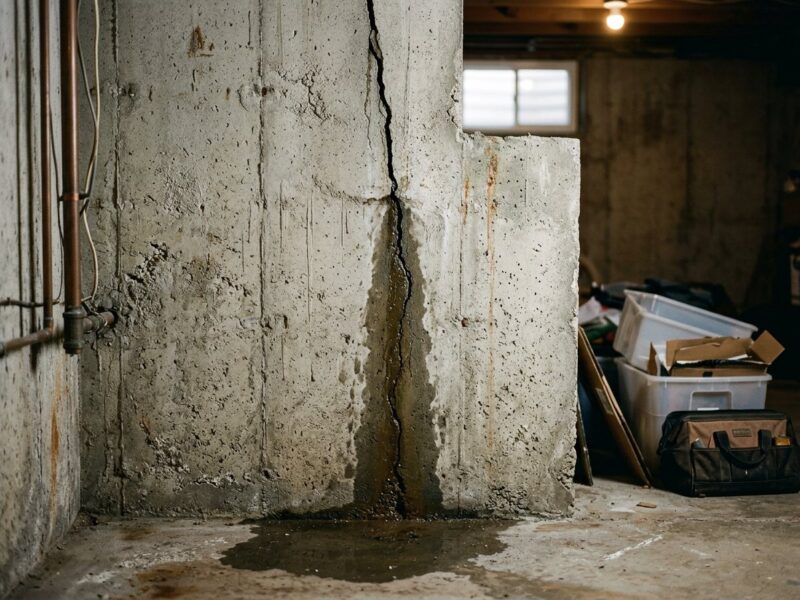
Post-war block ranches
The classic case. Hollow block backfilled with clay, no working footing drain, and stair-steps at both ends of the long back wall with a horizontal crack joining them across the middle.
Measure plumb first
Newer subdivision homes
Poured foundations below with brick or stone veneer above, so a staircase outside is usually a veneer or lintel issue rather than the foundation. Worth checking the stoop and garage, which move first.
Usually the veneerWhat does a stair-step crack cost to fix?
Price follows the cause, never the crack. A stable wall gets its joints repaired by a mason; a moving wall gets hardware, published at $600 to $1,000 per carbon fiber strap and $900 to $1,500 per steel beam.
| Work | Range | What moves the number |
|---|---|---|
| Carbon fiber strapsper strap | $600–$1,000 | Wall height, spacing the deflection requires |
| Steel I-beam wall bracingper beam | $900–$1,500 | Ceiling height, footing condition at the base |
| Push or helical piersper pier | $1,600–$3,000 | Depth to load-bearing strata, access for equipment |
A long block back wall commonly takes five or six straps, which puts that wall between $3,000 and $6,000 before any drainage work. Where the staircase is caused by a footing that dropped, the answer is piers at $1,600 to $3,000 each instead. Every range we quote from is on the pricing page.
When a stair-step crack is not structural
Plenty of the stair-steps we are called out to look at need a mason, a downspout or nothing at all. Saying so on the spot is cheaper for you than a proposal you did not need.
The mortar is simply old
Lime mortar in a pre-war Chicago wall was never as hard as modern mix, and a century of freeze and thaw crumbles it. If the joints are soft and sandy but the wall is plumb and in plane, that is maintenance repointing, and a mason handles it.
Masonry, not foundationIt stopped moving decades ago
A crack under two coats of old paint, with clean dust lines and no fresh edges, is a record of something that already finished. Mark it, date it, read it again after a wet spring. If nothing changes, you have your answer for the price of a pencil.
Measure, then waitThe downspout is doing it
One downspout dropping its water beside that corner soaks the clay against the wall every storm. Extensions and regrading run $600 to $2,500 and sometimes end the movement outright, which is a far better first purchase than steel. Watch it for a season afterward.
Cheapest real fixThe white powder is not the crack
Homeowners often find a stair-step because they were looking at chalky white residue nearby. That deposit is minerals left behind by evaporating moisture and it means water is moving through the wall, which is a drainage question. What efflorescence actually tells you.
Different problemQuestions homeowners ask about stair-step cracks
Are stair-step cracks always serious?
No. The pattern only tells you the wall is masonry and something moved; it says nothing by itself about how much. What matters is whether the two faces still line up, whether the wall is still plumb, and whether the crack has changed between two dated readings. A hairline staircase in soft old mortar that has sat unchanged for twenty years is a repointing job. Displacement and out-of-plumb are what change the answer.
What does it mean if the crack is wider at the top?
Usually that the far end of the wall dropped, so the wall hinged and the gap opened widest at the top of the staircase. That points downward at the footing and the soil under it, which is a settlement question. A crack widest at the bottom is more often lateral, meaning soil pushing the lower wall inward. Neither reading is a diagnosis on its own, but it decides which measurements we take first.
Can I just fill a stair-step crack with mortar?
You can, and if the wall has genuinely stopped moving that is exactly the right repair. What patching cannot do is stop movement, and mortar packed into an active crack cracks again within a season or two, usually along the same joints. The order matters: establish that the wall is stable with dated measurements, then repoint. Filling first only removes the evidence you were going to read.
Should a stair-step crack that leaks be injected?
Not in block. Urethane injection is a poured concrete repair, because it needs solid wall on both sides of the crack to fill against. Hollow block has open cores, so injected material simply travels into them. A leaking block wall is solved with drainage instead: weep holes drilled into the bottom course let the water standing inside the cores fall into a new interior drain line rather than sitting there feeding the cove joint. <a href="/basement-waterproofing/block-vs-poured-wall-seepage/">Block and poured walls leak differently</a>.
Does a stair-step crack mean my foundation is settling?
Sometimes, and it is only one of the signs. Settlement is a whole-house pattern, so if the footing dropped you should also find doors binding on that side, a floor sloping in that direction and probably damage outside on the same corner. A staircase with no other evidence anywhere in the house is more often a wall problem than a footing problem. <a href="/basement-foundation-problems/signs-of-foundation-settlement/">The full settlement checklist</a> is worth walking before you decide.
How fast do I need to act?
If the wall is plumb, the faces are in plane and nothing has changed on a dated mark, you have time to watch it for a season. If one side has shifted out of plane, the wall is leaning into the room, block has slid at a joint, or soil is visible through the crack, that gets looked at now rather than in the fall. We inspect free within 48 hours and run 24/7 when a wall has moved suddenly.
What actually gets done to a cracked block wall
Once the reading is done, the repair depends on how far the wall has traveled and what shape the mortar is in. Straps hold a modest bow, steel takes a larger one, and a wall with displaced courses and washed-out joints sometimes gets rebuilt instead. That page walks through each option on block specifically, including what it looks like when it is finished.
Block foundation repair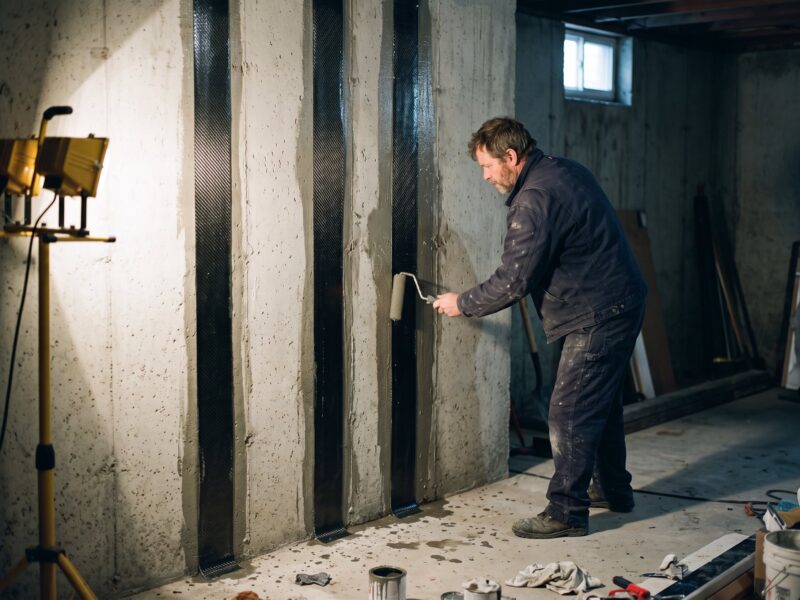

Get the wall read before anyone repoints or braces it
Free written diagnosis within 48 hours, width and plumb measured and dated, published pricing on every repair, and 0% for 12 months when the work is real.
Or talk to a human right now
(630) 335-1128
Request your free estimate
Tell us what you're seeing. We'll call back fast and be out within 48 hours.