
How Interior Drain Tile Works
Drain tile is not a barrier. It is a shortcut. Water that would otherwise climb into your basement gets offered an easier route, and physics takes the easier route every single time.
- Pitch checked with a level, not by eye
- Washed stone and filter fabric on every run
- 20+ of Chicago basements, 1,500+ homes
 Every line we lay carries a lifetime, fully transferable warranty
The short answer
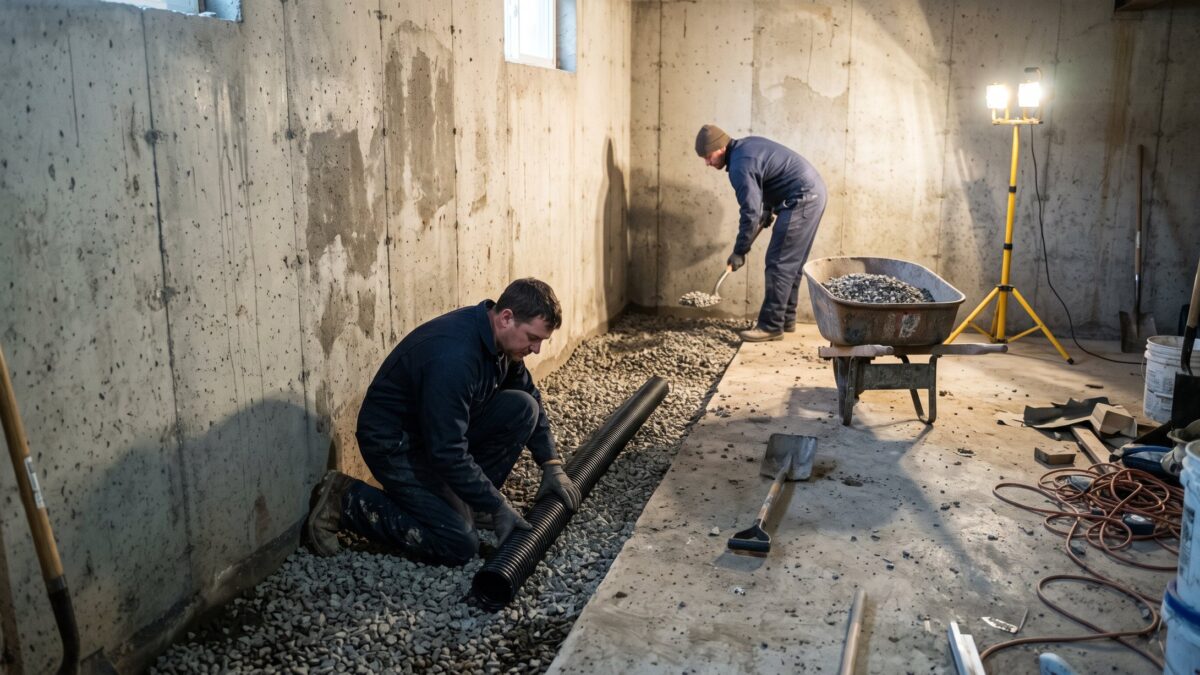
Interior drain tile is a slotted pipe bedded in washed stone beside the footing, under the edge of your basement slab. Groundwater pressing against the foundation drops into the stone, passes through the slots, and falls by gravity to a sump pit. A pump then lifts it out of the building and away from the house.
Water underground moves toward whatever offers the least resistance. Compacted clay resists it heavily, which is why saturated soil stacks up beside a foundation instead of draining away. Open stone resists almost nothing. Put a bed of washed stone beside the footing with a slotted pipe running through it and you have built the easiest path in the neighborhood, roughly a foot below the surface of your floor. The water goes there, drops out of the soil, and travels sideways to one collection point rather than upward through the slab.
That trick matters more here than in sandier parts of the country. Clay across Will, Cook and DuPage counties can hold storm water beside a wall for the better part of a week, so the load on a Chicago basement is long and steady rather than brief. A pipe running below slab level keeps drawing that load down the entire time, which no coating on a wall face can do. Our interior drain tile service page covers scope, scheduling and what a crew does to the room while the line goes in.
How does water get from the soil into the pipe?
Drain tile works by gravity and by contrast in permeability. Nothing pulls the water in; the stone simply makes going down easier than going up.
Follow a single storm from the yard to the discharge point and the mechanism explains itself.
-
Water stalls at the footing
Rain soaks through the loose backfill beside the wall and stops on the undisturbed clay beneath. Having nowhere left to sink, it spreads out along the top of the footing, which is the widest flat surface down there, and begins pressing on everything it touches.
-
The stone bed opens a void
Our trench beside the footing is filled with washed stone rather than the clay that came out of it. Roughly a third of that stone bed is open air, so arriving water falls straight through instead of soaking into the wall or lifting the slab edge.
-
The slots take it in
The pipe sits low in that stone with slots cut along its length. Water in the voids enters within seconds because there is nothing to squeeze through. Filter fabric over the stone keeps the clay fines out while letting the water pass.
-
Fall moves it sideways
The run is pitched so the invert drops steadily toward one corner of the basement. We set that fall with a level as the pipe goes down. Water inside the pipe then moves the same way water in a gutter moves, which is to say without any help.
-
The pit hands it to the pump
The line ends in a pit dug deeper than the pipe so the water falls into it rather than stalling at the opening. The pump lifts it up the discharge line and releases it far enough out that it is not simply queueing up to come back.
What the mechanism gives you
- Pressure drawn down below the slab, not just off the wall
- Steady relief through a week-long saturated spell
- A line reachable from inside in any weather
- No dependence on anything staying bonded to concrete
- A lifetime, fully transferable warranty on the system
What the mechanism cannot do
- It cannot catch water entering above footing level
- It cannot move water without electricity at the pump
- It cannot dry the outside face of the foundation wall
What makes one drain tile line outlast another?
Two lines can look identical the day the concrete is patched and be twenty years apart in service life. The difference is decided by material choices you never see again.
These are the five specifications worth reading on any quote, ours included.
-
Rigid pipe over flexible coil
Rigid pipe holds a straight invert and a consistent fall. Corrugated coil sags between supports and its ribbed interior grabs sediment as water slows over every ridge. The material costs a little more and buys years of drainage you never have to think about.
-
Washed stone, not trench spoil
Stone has to arrive clean. Pit-run gravel with clay dust in it packs into a crust the first wet spring, and pipe backfilled with the same soil it is meant to drain has no reservoir to draw from. This is the single most common corner cut.
-
Fabric where the silt is
Filter fabric laid over the stone separates the drainage layer from everything above it. Clay fines are what plugged the original tile under most older Chicago houses, and no amount of pipe quality helps once the voids around it are packed solid.
-
Depth relative to the footing
The pipe belongs beside the footing at its base, not perched partway up the wall. A line set high leaves a band of saturated soil under your slab that still has pressure in it, and that pressure surfaces at a floor crack instead of the cove.
-
Clean-outs and a serviceable pit
Accessible risers let a line be flushed and cameraed later without cutting concrete. A pit with a sealed lid, a check valve and room around the pump makes maintenance a ten minute job rather than a service call.
Specs worth having in writing
- Pipe type, stone size and fabric named on the quote
- Depth stated relative to the footing, not to the floor
- Clean-out locations marked before the concrete goes back
- Pitch verified and the pit set below the pipe invert
Red flags in a quote
- Materials described only as a drainage system
- No mention of fabric anywhere in the scope
- A pit reused because it was already there
- A price so far under $95 per linear foot that something is missing
Does the pipe have to go under the floor?
Some systems put a channel on top of the slab against the wall instead of a pipe below it. They are not the same product and they do not solve the same problem.
| Pipe below the slab | Channel on top of the slab | |
|---|---|---|
| Where it sits | Beside the footing, under the slab edge | On the finished floor, against the base of the wall |
| Water under the slab | Drawn down and carried away | Left where it is, still under pressure |
| Water at the cove joint | Intercepted below it | Caught after it has already arrived in the room |
| Block cores | Emptied through weep holes into the pipe | Only what escapes above the channel lip |
| Floor cracks away from the wall | Pressure relieved, so they usually stop | Untouched, since the channel only guards the edge |
| Concrete work | Slab edge opened and patched | None, which is the entire appeal |
| Published cost | $95 to $160 per linear foot | Cheaper, and priced case by case |
| Our position | What we install, under a lifetime, fully transferable warranty | We do not install it as a substitute for drainage |
A surface channel is a fair way to route water on a wall that leaks high up from a window well or a walkout door. It is not drainage, because nothing about it reaches the water sitting under your floor. See window well drainage if that is where yours starts.
Want to know where the water is entering yours? We measure the perimeter, read the cove on every wall and put it in writing, free within 48 hours.
How the pipe behaves in your house
The mechanism never changes. What changes is how much water arrives, and how the wall above the pipe lets it in.

Pre-war bungalows and two-flats
Stone or early block sitting on a wide footing, with sections of original clay tile outside that fill with silt rather than move water. A new line inside gets bedded in stone the old one never had.
Highest inflow we see
Post-war block ranches
Hollow cores act as a reservoir stacked above the pipe. Weep holes at the bottom course turn that reservoir into part of the drainage path instead of a wall that stays wet for days.
Drain the wall too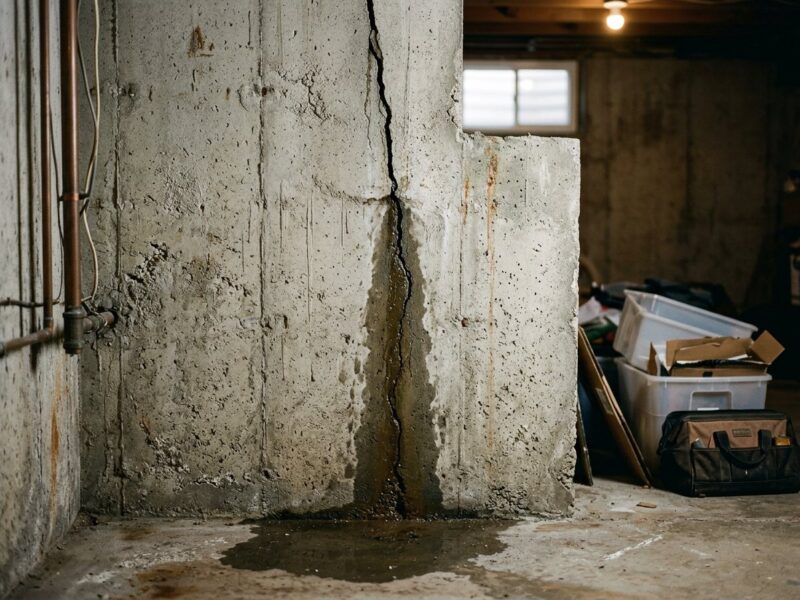
1980s and 90s poured walls
Solid walls, tight footings and modest inflow, so a line here rarely runs hard. When these basements wet, it is usually one crack passing water rather than a whole perimeter sitting under load, and the pipe would spend most of the year dry.
Confirm before tiling
Newer subdivision homes
A footing drain already exists outside and often still moves water fine. The weak point sits at the pit and pump end, where inflow from a large roof and a graded lot has outgrown a builder-grade unit in an undersized crock.
Check the pit firstWhat does interior drain tile cost?
Interior drain tile runs $95 to $160 per linear foot, and a full perimeter on an average Chicago basement lands between $8,000 and $16,000.
| Work | Range | What moves the number |
|---|---|---|
| Interior drain tileper linear foot | $95–$160 | Length of the run, slab thickness, what has to be moved off the walls |
| Sump pump with battery backupinstalled | $2,800–$4,500 | Pit condition, backup capacity, discharge routing |
| Downspout extensions and regradingtypical job | $600–$2,500 | Feet of grade to rebuild, soil hauling |
The materials that decide service life are a small share of that number; labor, concrete removal and disposal are most of it, which is why skimping on stone and fabric saves so little and costs so much later. Full breakdown on the drain tile cost page and the pricing page.
When a new line is not what you need
Drain tile only helps with water arriving at the footing. Four situations look identical from the top of the stairs and are not.
The pit stays dry while the wall runs
If water shows on the wall during a storm and the pit never fills, the water is entering above the pipe and drainage below the slab will never see it. Window wells, a walkout threshold and rim joists all do this, and all three are cheaper to solve than a perimeter.
Wrong elevationThe line you have may only be plugged
A silted pipe and a missing pipe behave the same way from inside. Flushing through a clean-out and running a camera settles it, and a line that comes back is worth far less than a new perimeter. Ask for that test before anyone quotes a replacement.
Test before replacingIt rises out of the floor drain
Water coming up rather than in during a downpour is the sanitary or combined sewer, not groundwater, and no drainage under your slab will hold it back. That is a licensed plumber and possibly a backflow valve. How to tell the two apart.
Call a plumberIt only happens during the thaw
A basement that is dry all summer and wet for two weeks in March is often reading frozen ground and drifted snow against the foundation rather than a high water table. Watch one full spring after fixing the grade. What the thaw does.
Wait a seasonQuestions homeowners ask about how drain tile works
How deep does interior drain tile sit?
Beside the footing, which on a full Chicago basement puts the pipe roughly a foot below the top of your slab. The exact depth is set by where your footing sits, not by a standard number, because the goal is to draw the water table down past the underside of the floor. A pipe set shallow leaves saturated soil under the slab, and that pressure will find a floor crack sooner or later.
Does the pipe go through the footing or beside it?
Beside it, always. The footing is what your wall stands on and nothing gets cut through it. The trench opens the slab edge on the inside face of the footing and the pipe is bedded there in stone. On older houses with unusually wide stepped footings we adjust the trench line rather than the footing, and we tell you if that changes the scope before the saw starts.
Does drain tile actually work in Chicago clay?
It works particularly well in clay, for the same reason clay causes the problem. Dense soil will not let water disperse, so it sits beside the foundation with pressure behind it, and a stone bed with a pipe in it is the only easy exit available. The one thing clay demands is filter fabric. Fines migrating into unwrapped stone is what ended the original tile under most older houses here.
How long does a drain tile line last before it silts up?
Properly bedded in washed stone under filter fabric, decades. The original clay tile around older Chicago homes failed because it had open joints, no fabric and often no stone, so every storm carried a little more soil into the line. Modern pipe with a clean drainage envelope does not have that intake. Where the ground carries iron ochre, plan on periodic flushing through the clean-outs.
Does interior drain tile need a sump pump?
In this region, almost always. Gravity drainage only works if there is somewhere lower than your footing for the water to reach, and lots across most of the Chicago area are flat enough that no such point exists on the property. A pump supplies the lift instead. Walkout and steeply sloped lots are the exception, and we check for that before pricing a pit. <a href="/sump-pump-installation/">Pump sizing and installation</a>.
Will drain tile stop water coming up through a crack in my floor?
Usually yes, because a slab crack that weeps is a pressure symptom rather than a defect in the concrete. Lowering the water table beneath the floor removes the force pushing water up through it. If the crack is also moving or lipped, that is a separate structural question and we look at it as one. <a href="/basement-waterproofing/basement-floor-cracks-water/">Floor cracks and slab water</a>.
The pipe is one piece of a bigger system
Drain tile handles collection. A finished interior system also has to relieve the wall, get the water to a pit sized for real inflow, keep the discharge open in January and survive a power cut during a summer storm. The full walkthrough covers every component and where each one tends to fail.
See the whole interior system

Find out what your footing is actually doing
A measured inspection and a written scope within 48 hours, published per-foot pricing, 0% for 12 months financing and 24/7 response when water is standing.
Or talk to a human right now
(630) 335-1128
Request your free estimate
Tell us what you're seeing. We'll call back fast and be out within 48 hours.