
Interior Drain Tile Cost per Linear Foot
Drain tile is sold by the foot, so the only two numbers that matter are the rate and how many feet you actually need. Both belong in writing before anyone starts talking about financing.
- $95 to $160 per linear foot, published
- Written scope and price within 48 hours
- 0% for 12 months financing available
 Published pricing, no commissioned salespeople
The short answer
Interior drain tile costs $95 to $160 per linear foot in the Chicago area. A full perimeter system on an average basement lands between $8,000 and $16,000, which includes cutting and hauling the slab edge, pipe, washed stone, filter fabric and fresh concrete. A sump pump with battery backup adds $2,800 to $4,500.
The per-foot rate is a labor number wearing a materials name. Pipe, stone and fabric are a modest share of any drain tile invoice. What you are buying is a crew cutting a band of reinforced concrete, digging beside a footing by hand in a room with a seven-foot ceiling, carrying the spoil up your stairs in buckets, then setting pitch, bedding the line and patching the floor behind them. Change any of those conditions and the number moves, which is the whole reason the published range is a range at all.
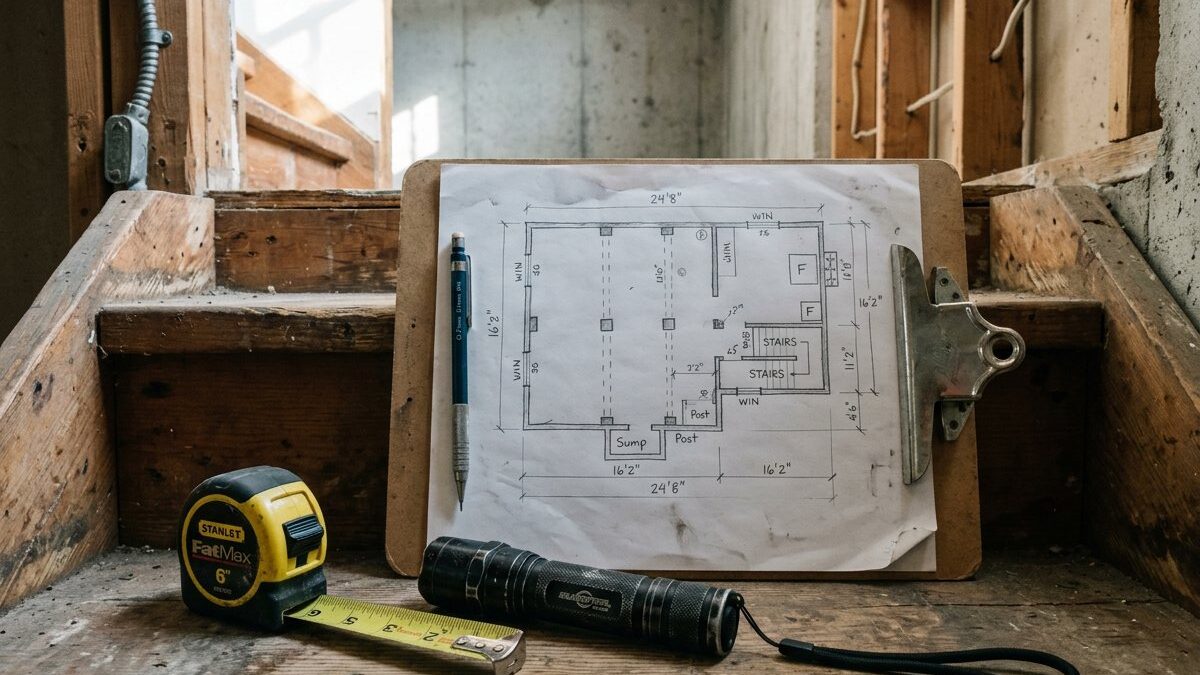
Feet come next, and that is where quotes diverge most. Two Chicago houses with identical basement footprints can need very different lengths of pipe depending on which walls actually take water and where the pit can go. We measure the inside perimeter, mark the runs that need tile, and price only those feet. The interior drain tile service page explains what the crew does with them, and every figure on this page comes from the same published sheet we quote from in all seven counties we serve.
What does the per-foot price include?
One rate covers five distinct pieces of work. A quote that leaves any of them out is quoting a shorter job than the one your basement needs.
Here is what those dollars buy along every foot of pipe we install.
-
Cutting and removing the slab
A saw opens a band of concrete along the inside perimeter and the broken slab comes out by hand. Older basements often hide slabs poured far thicker than anyone expected, and every bucket of that concrete leaves through the same door you use.
-
Excavation and spoil removal
The trench beside the footing gets dug out and the clay leaves the building. Nobody is running a machine in a basement, so this is shovels, buckets and stairs, and it is the largest single share of what you are paying for.
-
Pipe, stone and fabric
The drainage envelope itself: slotted pipe, washed stone bedding and filter fabric to keep clay fines out. Materials are the cheapest part of the line and the part that decides whether it still drains in twenty years, so we do not shave them.
-
Relieving the wall
On block walls the bottom course gets weep holes so water standing inside the cores drains into the new line rather than seeping out at the cove for days after a storm. On poured walls that step is unnecessary and does not appear on your price.
-
Concrete back and cleanup
Fresh concrete goes over the trench, the room gets cleaned, and the debris leaves with us. The patch band stays visible against the old floor for good, which is worth knowing before you plan a finished space over it.
Included in every foot we quote
- Saw cutting, demolition and hauling
- Slotted pipe bedded in washed stone under fabric
- Weep holes where the wall is hollow block
- Concrete patch and daily cleanup
- A lifetime, fully transferable warranty on the system
Priced as separate lines
- The sump pit, pump and battery backup
- Discharge line beyond the foundation wall
- Removing and rebuilding finished walls or flooring
- Crack injection on a poured wall that is also weeping
Why is my quote at the top of the range?
The spread between $95 and $160 is site conditions, not sales strategy. Five things move a basement up that scale, and all five are visible on an inspection.
If your number came in high, it is almost certainly one of these.
-
Footing depth and slab thickness
A deep footing means more clay out of the trench, and slabs in older houses can be double the thickness of a modern pour with wire mesh through them. Both add hours of cutting and carrying before a single foot of pipe is laid.
-
How the debris gets out
A walkout or a wide exterior stair keeps the haul short. Narrow interior stairs with a turn at the landing, or a bungalow where everything travels through the kitchen, add labor to every bucket for the length of the job.
-
Obstructions along the wall
Furnaces, water heaters, laundry, a finished bathroom, a chimney base or a workbench built into the corner all have to be worked around or temporarily moved. Each one slows the run and some require a trade we schedule around.
-
What is already down there
A failed original line, mud pumped in years ago, buried footings poured out of square, or an old cistern found mid-trench all change the scope. We would rather find those on the inspection than on day two, which is why we look before quoting.
-
Finished space in the way
Framing sitting tight to the wall, flooring that has to come up and drywall cut back to open the slab edge all add demolition. Restoration afterwards is a separate trade, and we say so in writing rather than burying it in a per-foot number.
What tends to land nearer $95
- Unfinished basement with clear walls
- A walkout or short haul to the outside
- Standard slab thickness with a shallow footing
- Poured walls, so no weep hole work
What tends to land nearer $160
- Finished rooms along the treated runs
- Thick or heavily reinforced old slab
- Long hand-carry through living space
- Utilities and stored contents crowding the perimeter
What decides where a basement lands in the range?
Same crew, same materials, same warranty at both ends of the scale. The difference is how hard the room is to work in.
| Toward $95 per foot | Toward $160 per foot | |
|---|---|---|
| Basement finish | Open and unfinished | Framed, drywalled and floored |
| Slab | Standard thickness, no mesh | Thick old pour, mesh or rebar through it |
| Footing depth | Shallow, typical for the era | Deep or stepped, more spoil per foot |
| Debris route | Walkout or exterior stair | Interior stairs through finished rooms |
| Wall type | Poured concrete, no weep holes needed | Hollow block needing the bottom course drilled |
| Obstructions | Clear perimeter | Mechanicals, bathroom, chimney base in the run |
| Surprises underfoot | Nothing buried | Old tile, buried structures, hard fill |
| Access for materials | Stone and concrete near the door | Everything wheeled the length of the house |
| Warranty | A lifetime, fully transferable warranty | The same warranty, unchanged |
None of this is guesswork on our side. We measure, note the conditions and hand you the number they produce, which is why our quote does not drop by a third if you say you are getting other bids. Read how to compare contractors before you line three of them up.
Want your actual number instead of a range? We measure the perimeter and price it from the published sheet, free within 48 hours, with 0% for 12 months available.
What it usually costs by house era
Perimeter length and working conditions track the era a house was built in more reliably than anything else, so the eras predict the money.

Pre-war bungalows and two-flats
Small footprints keep the foot count down, but thick old slabs, stone footings and a haul route through the kitchen push the rate up. Most of these sit in the upper half of the range on a shorter run.
High rate, fewer feet
Post-war block ranches
Long, wide footprints mean the most linear feet we tile of any era, and hollow block walls add weep hole work to every run. These frequently produce the largest total on the page even when the per-foot rate lands mid-range.
Most feet of the four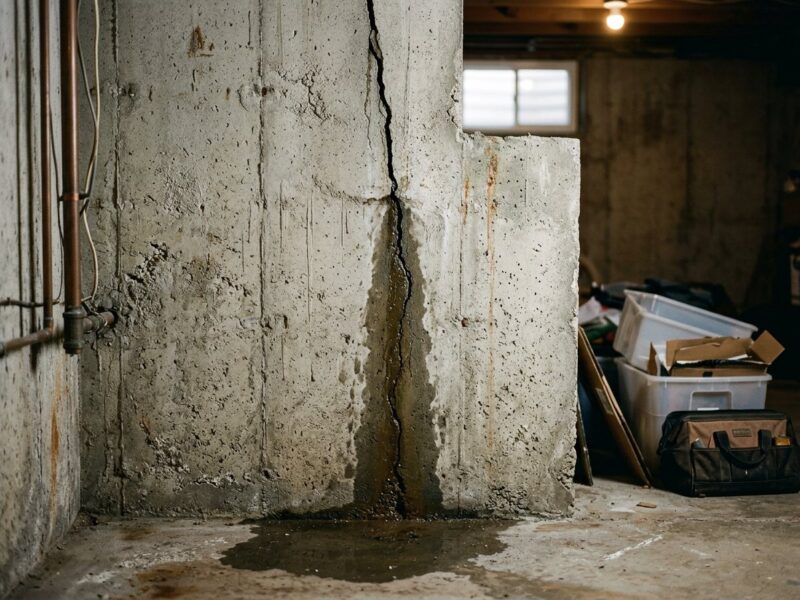
1980s and 90s poured walls
Poured walls skip the weep hole work and the slabs are predictable. Many of these houses need one wall rather than four, which is a very different invoice from a full perimeter.
Often a partial run
Newer subdivision homes
Usually a finished basement, so demolition and restoration carry real weight in the number, and usually an existing pit that may only want a better pump. On these houses the money often belongs at the pit end rather than in new pipe.
Price the pit firstThe published ranges we quote from
Interior drain tile is $95 to $160 per linear foot, so a 100 foot run is $9,500 at the bottom of the scale and $16,000 at the top. A full perimeter on an average Chicago basement lands between $8,000 and $16,000.
| Work | Range | What moves the number |
|---|---|---|
| Interior drain tileper linear foot | $95–$160 | Length of the run, slab thickness, what has to be moved off the walls |
| Sump pump with battery backupinstalled | $2,800–$4,500 | Pit condition, backup capacity, discharge routing |
| Exterior French drainper linear foot | $45–$90 | Trench depth, where the water can legally go |
| Downspout extensions and regradingtypical job | $600–$2,500 | Feet of grade to rebuild, soil hauling |
Every one of these ranges is published rather than negotiated, and they hold across Will, Cook, DuPage, Kane, Kendall, DeKalb and Lee counties. Exterior work taken to footing depth is the one item with no per-foot number, because depth and access swing it too far to quote from a table. The full sheet is on the pricing page.
Cheaper things to try before you spend this
A drain tile quote is a large number and it is not always the right purchase. Four ways homeowners spend far less and get a dry basement anyway.
Move the roof water yourself
A downspout dumping at the wall can be extended with a length of pipe from any hardware store for the price of lunch. Regrading a settled strip of soil is a weekend with a shovel. Our version costs $600 to $2,500; plenty of people never need to buy it. Getting the slope right.
A DIY afternoonOne crack is not a perimeter
A poured wall weeping through a single vertical crack is a $450 to $900 urethane injection with a 10-year warranty, done in a couple of hours with no concrete cut. Drain tile would also stop it, at fifteen times the price. Which injection your crack needs.
Injection insteadThe pit may be the whole problem
Plenty of subdivision basements have sound tile and a tired pump in an undersized crock. A pump with battery backup at $2,800 to $4,500 solves that without opening a foot of slab. When a pump is due for replacement.
Pit work onlyThe cheapest bid is cheap for a reason
When a quote comes in far below $95 per linear foot, something has been left out, and it is usually the stone, the fabric or the depth. Ask each bidder to name the pipe, the stone and the trench depth in writing, then compare the three quotes on the same scope.
Compare scopesQuestions homeowners ask about drain tile pricing
Is the price per foot of wall or per foot of pipe?
Per linear foot of pipe installed, which follows the inside perimeter of the walls being treated. If you tile two walls of a rectangular basement, you pay for those two runs and nothing else. We mark the runs on a sketch during the inspection so you can see exactly which feet you are buying, and the total on the quote is that measurement times the rate.
Does the price include the sump pump?
No. The pit, pump, check valve and battery backup are a separate line at $2,800 to $4,500 because not every job needs new ones. Houses with a sound pit and a recent pump often keep them and tie the new line in. We would rather show that as its own number than average it into a per-foot rate and charge everyone for it.
Will homeowners insurance pay for drain tile?
Standard policies exclude seepage and groundwater entry, so the installation itself is almost never covered. Sump failure and sewer backup are optional endorsements that some owners carry, and flood insurance is a separate policy altogether. Read your declarations page or call your agent before assuming anything, and ask specifically what is excluded rather than what is included. Where a failed pump caused damage to finished space, the endorsement may cover the cleanup even though it will not pay for the drainage work that prevents the next one.
Do you offer financing for a project this size?
Yes. We offer 0% for 12 months, and the application happens after you have the written quote rather than during a sales visit. Nobody at ProSeal earns commission, so there is no pressure to sign anything at the kitchen table. Take the written scope home, compare it against other bids line by line, and decide on your own schedule rather than ours. The quote does not expire at the end of the visit and the price does not change if you take a week over it.
Does drain tile increase what my house sells for?
It removes an objection more reliably than it adds a premium. Illinois sellers disclose known material defects about the property, and a documented, transferable warranty on a wet basement turns an unknown into a resolved item during negotiation. Buyers price uncertainty harshly. Ask your attorney or agent how disclosure applies to your sale. <a href="/basement-waterproofing/waterproofing-before-finishing-or-selling/">Waterproofing before you sell</a>.
Does the quote include putting my finished basement back?
Demolition is included where it is needed to reach the slab edge. Rebuilding framing, drywall, trim and flooring afterward is a separate trade and it is not in our number. We state that plainly on the quote and tell you roughly what scope a carpenter is picking up, because finding that out on the last day ruins an otherwise good week.
See how every other repair is priced
Drain tile is one line on a published sheet that also covers pumps, exterior drainage, crack injection, piers and wall bracing. If you are weighing a whole basement plan rather than a single job, the full pricing page is the faster read and no figure on it is a teaser.
See published pricing

Get the number for your basement, in writing
Measured inspection within 48 hours, published per-foot pricing, 0% for 12 months financing and $2,000,000 general liability carried on every job.
Or talk to a human right now
(630) 335-1128
Request your free estimate
Tell us what you're seeing. We'll call back fast and be out within 48 hours.