
Spring Thaw and Seasonal Basement Flooding in Illinois
A basement that only floods in March is not a mystery and not bad luck. Frozen soil turns your yard into a roof for a few weeks, and everything that lands on it has to go somewhere.
- Free written diagnosis within 48 hours
- 24/7 response during a thaw
- 20+ of Illinois springs, 1,500+ homes
 24/7 when water is standing
The short answer
Basements flood during the spring thaw because frozen ground cannot absorb snowmelt. Water runs across the frost layer, finds the looser backfill beside the foundation, and reaches the footing while the soil below is still saturated from winter. Add March rain on top and the water table sits at slab level for weeks.
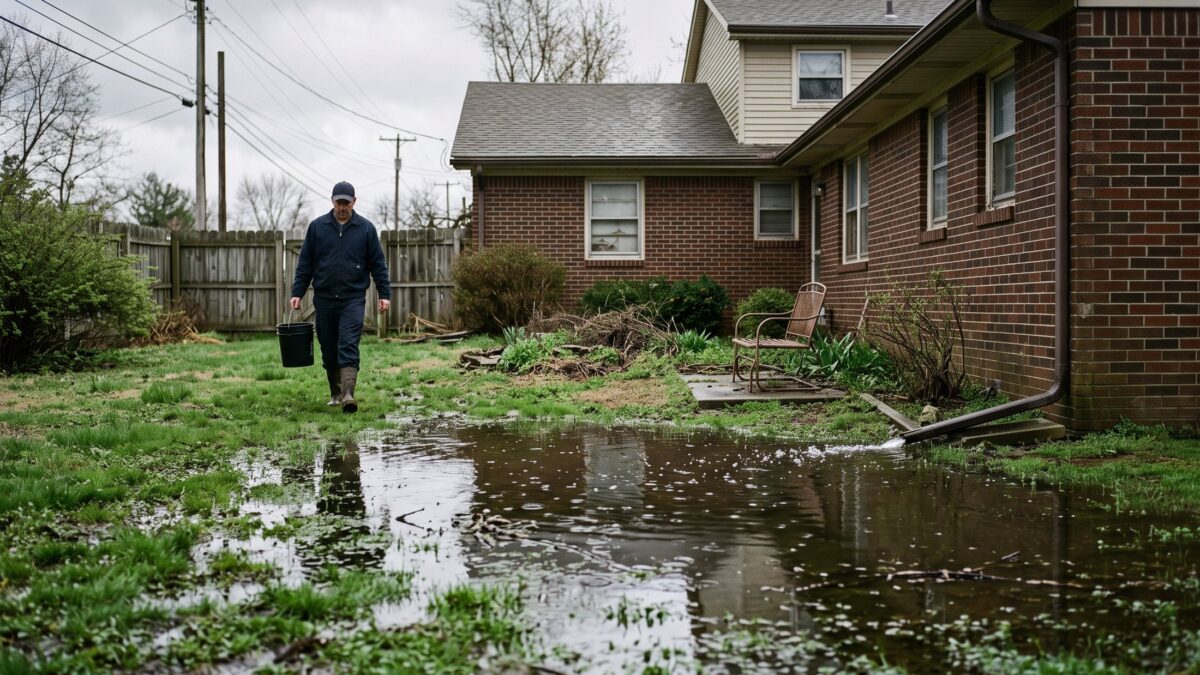
Winter loads the ground and spring unloads it all at once. Snow that fell over three months melts across a few warm days, and the top layer of soil is still frozen when it does. Frozen soil is close to waterproof, so the meltwater cannot soak straight down the way summer rain does. It travels sideways along the frost layer until it reaches something looser, and the backfill trench beside your foundation is the loosest ground on the property. From there it drops to the footing.
Illinois compounds it in a way milder states do not. Our frost line runs deep, our lots sit on dense glacial clay that drains slowly even when thawed, and the region reliably gets its heaviest rain in the same weeks the snowpack is going. Ground that is already saturated from winter has nowhere to put a March storm. That is why so many Chicago-area basements are dry from June to January and take on water three springs out of four. The basement and foundation problems hub sorts the rest of the symptoms.
Why does my basement flood every spring?
Spring flooding is a soil problem before it is a foundation problem. The ground stops accepting water for a few weeks, and your basement is downhill of everything that follows.
Here is the sequence, running from the first thaw to the water on your floor.
-
The ground freezes shut
Once the frost layer sets, the top foot or two of soil stops absorbing anything. Rain and melt that would have soaked in during July now sits on the surface or runs off, and it keeps doing that until the ground opens up.
-
The snowpack releases at once
A week in the forties turns months of accumulated snow into water in a few days. It is a volume no gutter, swale or yard grade was ever sized for, arriving faster than any of them can move it away from the house.
-
It runs to the loosest ground it can find
Meltwater travels along the top of the frost layer until it hits disturbed soil. The backfill trench beside your foundation was dug and refilled when the house was built, and it has been the easiest path down ever since.
-
The water table meets the footing
Below the frost, the clay is already carrying winter moisture. New water arriving from above has nowhere to drain, so the saturated zone rises to footing level and stays there, pressing on the bottom of the wall for weeks.
-
Spring rain lands on saturated ground
The heaviest rain of the year arrives while all of that is still true. A storm that a dry August lot would have swallowed becomes runoff instead, and it goes straight down the same trench the snowmelt used.
Points to thaw-driven flooding
- It happens in February, March or April and nowhere else
- The floor stays wet for days rather than hours
- Snow was piled against the house or over the window wells
- The sump runs almost continuously for a week or more
- The yard holds standing water long after the melt
Points to something else
- Water rising out of a floor drain instead of the walls
- Wet floors in July after a thunderstorm
- One wet spot at one crack, in every season
- Dampness with no water, worst in the warm months
What breaks in a Chicago basement in March?
Spring does not usually reveal a new leak. It finds the one component of your drainage that only fails in the cold.
These five account for most of the emergency calls we take between February and April.
-
The discharge line freezes
The pump works perfectly, pushes water into a line that is blocked with ice, and the water comes straight back into the pit. From inside the house it looks exactly like a dead pump, and homeowners replace a good one every spring.
-
The pump runs itself into the ground
A pump sized for storm-by-storm duty runs nearly continuously for two weeks during a thaw. Motors overheat, float switches wear out, and check valves start leaking back. Spring is when tired pumps go, not when new water appears.
-
The power goes out at the worst hour
Late-winter wind and ice storms take lines down while the pit is filling every few minutes. Without a battery backup, a basement that has been fine for years takes on several inches before anyone notices anything is wrong.
-
Gutters ice over and dump at the wall
An ice-dammed gutter overflows at the eave, which puts the entire roof plane onto four feet of ground next to the foundation. Buried downspout extensions freeze solid too, and then the downspout backs up and discharges at the elbow.
-
Snow and window wells do the rest
Snow shoveled from the drive against the house melts directly into the backfill. Window wells packed with snow become buckets, and if the well has no drain, the meltwater leaves through the window frame.
Worth checking before the first thaw
- Pour a bucket in the pit and confirm the pump cycles
- Walk the discharge line to its outlet and clear it
- Get shoveled snow away from the foundation walls
- Cover the window wells or dig the snow out of them
- Confirm the battery backup still holds a charge
Call us during the thaw when
- The pit overflows while the pump is running
- Water enters at the wall joint faster than a shop vac keeps up
- It floods in spring after years of a dry basement
- The pump is cycling every minute for days on end
Do you fix the outside first or install a system?
Almost every spring flooding call has both an outside answer and an inside answer. Which one you buy first depends on how the water is arriving, not on which is cheaper.
| Outside work first | Interior drainage system | |
|---|---|---|
| What it changes | How much water reaches the soil beside the wall | What happens once the water is already at the footing |
| Best evidence for it | Snow piled at the house, gutters overflowing, grade sloping in | Water at the floor joint with the yard already handled |
| Published cost | Downspouts and regrading at $600 to $2,500 | $95 to $160 per linear foot, $8,000 to $16,000 typical |
| Time on site | Usually one day | One to three days for most basements |
| Can it be done in February | No, the ground has to be workable | Yes, the work is all inside |
| Effect during a fast thaw | Reduces the volume arriving, does not remove groundwater | Removes water no matter how saturated the ground gets |
| What it does not solve | A water table that has risen to slab level | Roof water still being delivered to one spot |
| Our warranty | A 5-year warranty on drainage work | A lifetime, fully transferable warranty on the system |
| Honest first move | Almost always, if the outside has never been addressed | When the outside is right and it still floods |
Spring flooding and storm flooding are different patterns with different tells, and a basement can have both. If yours is also wet in June, read why a basement leaks only in heavy rain.
Water on the floor right now? We run 24/7 through the thaw, and the written diagnosis afterward is free within 48 hours.
How does your house handle a thaw?
The era a house was built in decides what it has to work with when the snow goes. These four cover most of what we see between February and April.

Pre-war bungalows and two-flats
Original clay tile drains that silted shut generations ago, gangways four feet wide where snow gets shoveled from both sides, and a flat city lot with nowhere for meltwater to run. These flood on schedule.
Interior system, usually
Post-war block ranches
Hollow block fills with water during a long thaw and releases it at the cove joint for weeks. Many of these houses have a single pump with no backup, installed by whoever owned the place in the eighties.
Pump and backup first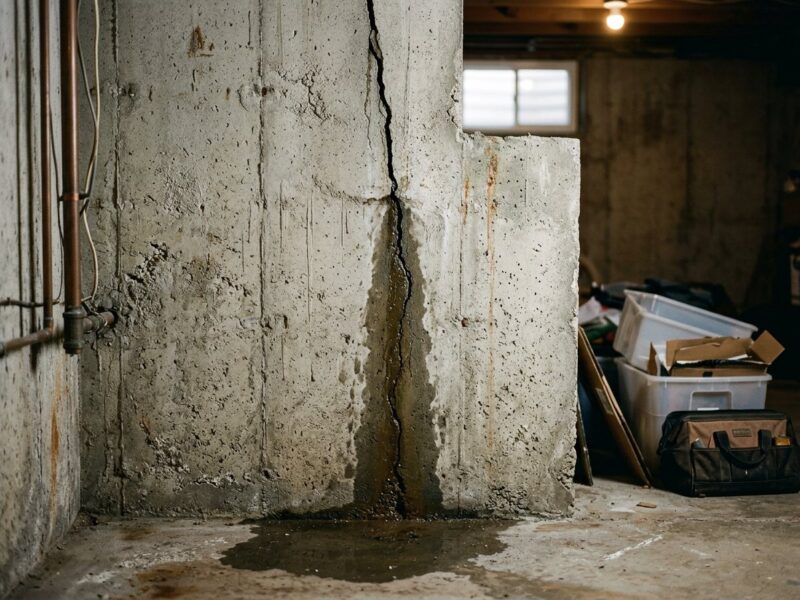
1980s and 90s poured walls
Usually one shrinkage crack that only weeps when the water table is high, which in this region means March. A crack that is dry all summer is still worth injecting before the next thaw.
Often just injection
Newer subdivision homes
Working perimeter drainage and a builder-grade pump, on ground where the grade has settled back toward the house and the downspout extensions were removed for mowing years ago.
Grading and downspoutsWhat does fixing seasonal flooding cost?
The outside answer is the cheap one: downspout extensions and regrading are published at $600 to $2,500. A sump pump with battery backup runs $2,800 to $4,500, and a full perimeter interior system on an average Chicago basement is $8,000 to $16,000.
| Work | Range | What moves the number |
|---|---|---|
| Downspout extensions and regradingtypical job | $600–$2,500 | Feet of grade to rebuild, soil hauling |
| Sump pump with battery backupinstalled | $2,800–$4,500 | Pit condition, backup capacity, discharge routing |
| Interior drain tileper linear foot | $95–$160 | Length of the run, slab thickness, what has to be moved off the walls |
| Exterior French drainper linear foot | $45–$90 | Trench depth, where the water can legally go |
We will quote the outside work on its own and tell you to live with it for a season before spending anything else, because for a lot of houses that is where this ends. Every range we use is on the pricing page.
Cheap things to do before you buy anything
A meaningful share of spring flooding gets solved with a shovel and an afternoon. None of these need a contractor and none of them cost much.
Move the snow, not the water
Snow shoveled from the drive and walk against the house melts straight into the backfill trench. Pile it out in the yard instead, at least a few feet off the wall, and keep the window wells dug out. This alone changes the March outcome for a lot of houses.
FreeCheck the discharge line, not the pump
A pump that hums but moves nothing is usually pushing against ice, not failing. Walk the line out to the yard and find the outlet before you buy a replacement pump you did not need. Frozen discharge lines are their own topic.
Check firstTest the pump in January
Pour five gallons into the pit, listen for the switch, watch the water leave, and unplug the backup to confirm it takes over. Twenty minutes in the cold beats finding out during the first warm week in March.
Twenty minutesLog one full spring before signing anything
Write down each wet day, how much snow was on the ground and what the weather did. A single bad thaw is not a pattern, and we would rather read your notes next April than sell you a system this March. Standing water in the yard is part of the same record.
Wait a seasonQuestions homeowners ask about spring flooding
Why does my basement flood in spring but stay dry all summer?
Because the ground behaves completely differently in March. Frozen surface soil will not absorb snowmelt, the clay underneath is still carrying winter water, and the heaviest rain of the year arrives on top of both. The result is a water table sitting at footing level for weeks. By June the same lot drains, the table drops well below the slab, and an identical storm never reaches your floor.
My sump has been running nonstop since the thaw. Is that normal?
Running often during a thaw is normal. Running continuously for days is a warning. Continuous duty is what kills pumps, and it usually means either the inflow has outgrown the pump or water is recirculating because the check valve is leaking back. Listen for it cycling every minute, and if it never gets a rest, have the pit and the pump sized rather than waiting for the motor to quit.
Can drain tile be installed while the ground is frozen?
An interior system can, and that is one of its practical advantages here. The work happens inside the basement, so a February install is no harder than a July one. Outside work is the opposite: excavation, regrading and exterior drainage all wait until the ground is workable. If you are flooding now and the yard is under snow, the interior route is the one that can actually start.
Does homeowners insurance cover spring basement flooding?
Standard policies exclude groundwater and seepage, which is what a thaw produces, so the usual answer is no. Coverage for sump pump failure and for sewer backup is generally sold as an optional endorsement, and flood insurance is a separate policy altogether. Read what you actually carry before the snow melts, and ask your agent directly rather than assuming. We are contractors, not advisors on your policy.
Should I wait until spring is over to have work done?
Not if it is actively flooding. Interior work runs year round, and a pump or a battery backup can go in the same week. What is worth waiting on is anything that depends on the yard: regrading, exterior drainage and downspout burial all need thawed, workable ground. We will happily split a job so the urgent half happens now and the outside half happens in May.
Will a battery backup actually help during a thaw?
It matters more in spring than in any other season. Late-winter ice and wind take power lines down exactly when the pit is filling every couple of minutes, and a pump with no power is a hole in your floor. A backup buys you hours of runtime and an alarm when it takes over. <a href="/sump-pump-installation/battery-backup-sump-pump/">The runtime numbers are here.</a>
The failure that costs people a pump every March
A frozen discharge line is the most misdiagnosed problem in an Illinois winter. The pump sounds healthy, the pit keeps filling, and the water has nowhere to go because there is ice sitting in the pipe out in the yard. It is worth understanding before the first thaw, because the fix is usually a change to the line rather than a new pump.
Frozen sump discharge lines

Get ahead of the next thaw instead of bailing through it
Free written diagnosis within 48 hours, published pricing, 24/7 while water is standing, and 0% for 12 months if you want to spread it out.
Or talk to a human right now
(630) 335-1128
Request your free estimate
Tell us what you're seeing. We'll call back fast and be out within 48 hours.