
Old Clay Tile Drains Under Chicago Bungalows
The drain under your bungalow was built to let water in through open joints, which is also how it filled with silt. Almost every one we dig up has been dead for decades, and the house has been quietly living without a footing drain.
- We open the floor and show you the old tile
- 20+ on pre-war Chicago foundations
- Free written diagnosis within 48 hours
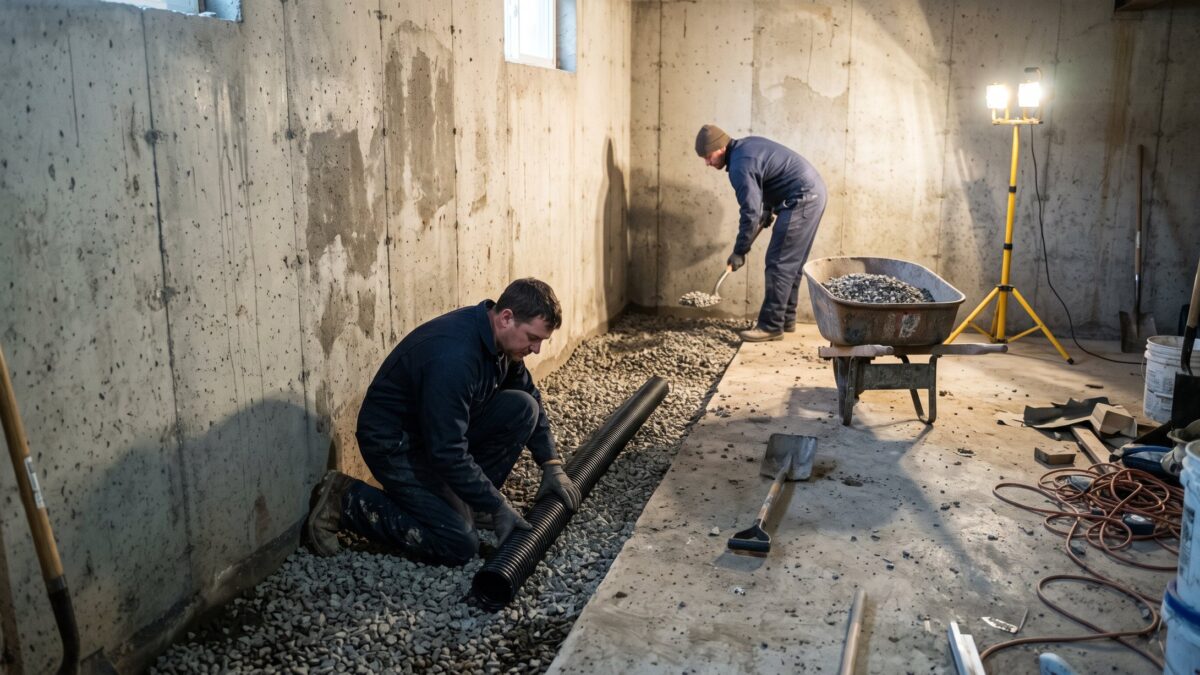 Replacement systems carry a lifetime, fully transferable warranty
The short answer
Clay tile drains are short lengths of unglazed pipe butted end to end at the footing, laid under most Chicago houses built before the 1950s. They took water in through the open joints, and silt and roots came in the same way. Most are packed solid today, and a packed clay tile cannot be cleaned back to new.
Nearly every Chicago basement poured before roughly 1950 got a footing drain made of foot-long clay tile. The pieces were butted together and left unsealed on purpose, because the gaps between them were the intake. Groundwater working down through the backfill dropped into the pipe and ran off by gravity. The weakness is written into the design: anything fine enough to travel with that water goes in through the same gaps, and nothing was ever put around the pipe to strain it out.
Give that arrangement a hundred years in our soil and the arithmetic stops working. Chicago clay sheds fine particles with every wet and dry cycle, elm and maple roots hunt for precisely that kind of open joint, and the gravity outlet many of these tiles ran to has since been abandoned or crushed. When we cut a slab edge on a bungalow in Berwyn, Portage Park or the older streets of Joliet, we lift out tile packed to the crown with grey silt. What replaces it is covered in the interior drain tile overview.
How did the original clay tile drain work?
A clay tile drain is a gravity system with no moving parts and no filter. It worked because the joints stayed open, and it failed for exactly the same reason.
This is what the original crew did, in the order they did it, a century ago.
-
Tile set dry on the footing
Unglazed clay pipe came in short lengths, roughly a foot each. The mason set them end to end along the outside edge of the footing with a deliberate gap at every joint. No mortar, no gasket, no fabric of any kind.
-
The joints did the collecting
Water saturating the backfill found the lowest easy path, which was the gap between two tiles, and dropped inside. A modern pipe is perforated for the same reason. The difference is that a slot can be sized and screened, and a butt joint cannot.
-
Gravity carried it off
The run was pitched toward an outlet. On these houses that was usually a gravity connection to the house drain or a brick catch basin in the yard, because there was no pump in the basement and often no power down there either.
-
Cinders or gravel over the top
A few inches of coarse fill went over the tile to keep the loose clay off it. Then the same heavy soil that came out of the trench went back in on top, which is the layer that later becomes the silt supply.
-
It bought the house fifty dry years
For the first few decades this worked, and it is why a 1924 basement was a usable room. The system had no way of telling anyone when it stopped, so most families found out through a wet floor rather than a warning.
What the design got right
- No pump, no power, nothing to fail in a storm outage
- Clay pipe itself is durable and often comes out intact
- Sat at the footing, which is the correct place to drain a wall
- Cost almost nothing to build into a house being dug anyway
What closed it
- Fine clay particles washing into every open joint, season after season
- Tree roots following moisture straight into the gaps and filling the bore
- Joints shifting apart as backfill settles, so the run loses its pitch
- The gravity outlet abandoned, rodded shut or capped during later sewer work
How do you tell if your clay tile is still doing anything?
You cannot see a footing drain from inside the basement, so the diagnosis is done by timing, staining and a few physical checks. None of it requires digging up the yard first.
Work through these five in order before anyone quotes you a system.
-
Read the stain line first
Look along the joint where the floor meets the wall. A tide mark that runs the length of a wall says water is arriving at the footing and rising, which is what a working footing drain is supposed to prevent.
-
Time it against the storm
Water on the floor within minutes of the rain starting points at the surface: a downspout, a window well, a settled grade. Water that shows up hours after the rain stops, or the next morning, is groundwater the old tile is no longer taking.
-
Hunt for the cleanout
Many pre-war basements have a trap, a catch basin lid or a plugged tap in the slab that ties back to the original drain. Finding it tells us where the tile ran and whether an outlet still exists to run to.
-
Camera the run if there is one to camera
Where a cleanout exists, a scope answers the question in ten minutes. On the bungalows we open, the camera usually stops within a few feet at a wall of silt, a root mass or a joint that has dropped out of line.
-
Confirm at the slab edge
The last check happens when the floor comes up. We show you the tile we pull out. If it is packed, you have been living without a footing drain, probably since before you bought the house.
Signs the old tile has quit
- Seepage at the floor and wall joint that tracks storm size
- Wet spots that appear a day late rather than during the rain
- A floor drain or old catch basin that no longer takes water away
- Efflorescence low on the block, well below the middle of the wall
- A neighbor two doors down with the same story on the same block
What a camera will not tell you
- Whether the outlet it drains to is still connected downstream
- How much of the run lost its pitch when the backfill settled
- Whether the wall itself is also taking water above the footing
Can old clay tile be cleaned out, or does it have to be replaced?
Rodding an old footing drain is a real service and occasionally it buys a season. Set it beside a new interior run and you can see what you are actually paying for in each case.
| Rodding the old clay tile | New interior drain tile | |
|---|---|---|
| What it changes | Clears part of what is sitting in the bore | Replaces the drainage path with a new one |
| Where the pipe lives | Outside the footing under eight feet of clay | Inside the footing, reachable from the basement |
| The joints | Still open butt joints, so silt returns | Wrapped perforated pipe bedded in washed stone |
| Roots | Regrow with the next warm season | Stone and fabric give them nothing to enter |
| Where the water goes | Depends on an old gravity outlet still being open | To a sump pit and a pump you can test |
| Published cost | Priced by the plumbing trade, not by us | $95 to $160 per linear foot |
| Service access later | Only where a cleanout was left behind | From inside, without touching the yard |
| How long it holds | Often a season or two before it silts again | Built to be serviced rather than replaced |
| Our warranty | Nothing we can warrant on century-old pipe | A lifetime, fully transferable warranty on the system |
If the old tile still has an outlet and the basement is only damp, rodding first is a reasonable order of operations. Before either one, get the roof water landing away from the wall: grading and slope around a foundation is where that starts.
Want to know what is under your floor? We look, we measure, and you get the findings in writing free within 48 hours.
What is under your house?
The decade a basement was dug decides what kind of footing drain it got, if it got one at all. These four cover almost everything we open across the seven counties.

Pre-war bungalows and two-flats
Foot-long clay tile at the footing, tied to a gravity outlet or a yard catch basin. A hundred years of silt later, the run is usually solid and the outlet is often gone as well.
Assume it is dead
Post-war block ranches
Some got clay tile, plenty got nothing but a gravel bed. Block walls hold water in the hollow cores, so the cove joint weeps whether or not a drain was ever installed out there.
Check before you assume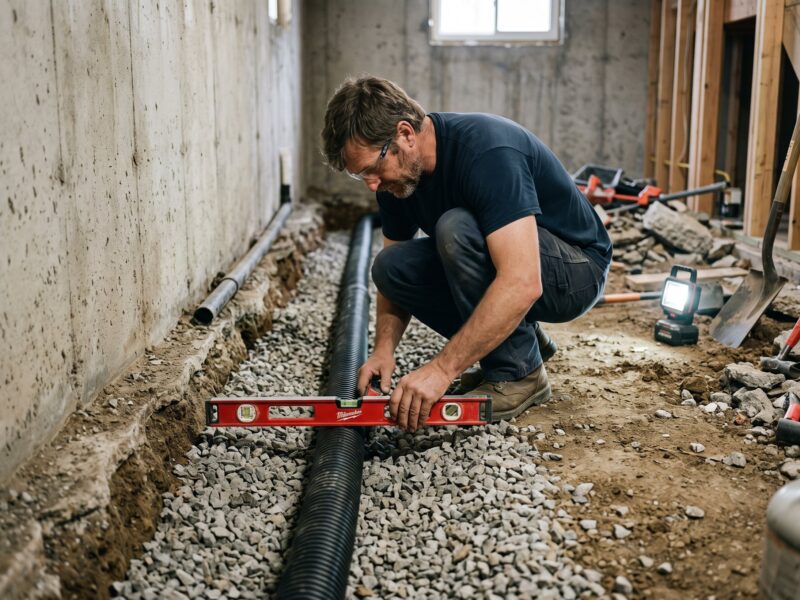
1980s and 90s poured walls
Rigid perforated PVC in stone, which does not silt the way clay does. When these leak it is usually a crack in the wall or a pump that never got maintained, not a dead footing drain.
Usually still draining
Newer subdivision homes
Proper perimeter pipe, filter fabric and a builder-grade pump, on ground that has settled since the sod went down. The pipe is fine. The grade above it often is not.
Fix the grade firstWhat does replacing a dead clay tile drain cost?
New interior drain tile runs $95 to $160 per linear foot, and a full perimeter system on a typical bungalow basement lands between $8,000 and $16,000. We quote from these published ranges, not from a number invented at your kitchen table.
| Work | Range | What moves the number |
|---|---|---|
| Interior drain tileper linear foot | $95–$160 | Length of the run, slab thickness, what has to be moved off the walls |
| Sump pump with battery backupinstalled | $2,800–$4,500 | Pit condition, backup capacity, discharge routing |
| Exterior French drainper linear foot | $45–$90 | Trench depth, where the water can legally go |
| Downspout extensions and regradingtypical job | $600–$2,500 | Feet of grade to rebuild, soil hauling |
Most bungalows do not need all four walls. We measure the runs that are actually wet and price only those, which is why a partial system on one wall is a real option rather than an upsell we talk you out of. Every range above lives on the pricing page.
When the old tile is not your problem
Plenty of dead clay tile sits under basements that are perfectly dry. A drain that no longer works is only worth replacing when water is actually getting in.
The basement has been dry for forty years
A packed footing drain is not an emergency by itself. If the grade sheds water, the downspouts run out into the yard and the floor has stayed dry through wet springs, there is nothing here to buy. Watch it through one bad season before you spend anything.
Do nothing yetIt is roof water reaching the wall
A single downspout dumping at the corner sends hundreds of gallons into the backfill in one storm, and no footing drain ever built was sized for that. Extensions and regrading run $600 to $2,500 and often end the problem outright.
Cheapest real fixWater rises out of the floor drain
If it comes up through a drain rather than in at the wall, that is the sanitary side of the house, not the footing drain. It goes to a licensed plumber and possibly a backflow device. Telling the two apart takes about five minutes.
Not our workThe block is damp but nothing is running
Cool walls in a humid July sweat, and old bungalow basements have almost no air movement. Before blaming the drain, run a hygrometer for a week. If the air is sitting above sixty percent, the first fix is a dehumidifier, not a drainage system.
Costs about $30 to checkQuestions Chicago homeowners ask about clay tile
Can clay tile drain be cleaned instead of replaced?
It can be rodded or jetted where a cleanout exists and the run is still intact. What that does not change is the design. The joints stay open, our clay soil keeps feeding fines into them, and roots return with the growing season. We have seen rodding buy a homeowner a quiet year. We have not seen it turn a hundred-year-old butt-jointed tile into a drain you can stop thinking about.
How do I know if my bungalow even has drain tile?
Not every pre-war house got one. Some were built with nothing but a gravel bed at the footing, particularly smaller cottages and workers cottages built quickly. Signs that a tile exists include a plugged tap or old trap in the slab, a brick catch basin in the yard, or a cleanout at the front of the basement. The certain answer arrives when the slab edge is opened.
Where did the old clay tile drain to?
Usually to a gravity outlet: the house drain, a yard catch basin, or in some neighborhoods a connection made when the street sewer went in. Many of those paths were cut, capped or crushed during later plumbing and sewer work, and nobody told the homeowner. A footing drain with no outlet is a pipe full of standing water sitting against your footing, which is worse than none.
Is the new pipe inside or outside the wall?
Inside, at the edge of the slab beside the footing, which is the practical answer on the narrow lots these houses sit on. It sits in washed stone, wrapped so silt cannot pack it the way the clay tile packed itself, and it can be serviced from the basement forever. The trade-offs against digging outside are laid out in <a href="/interior-drain-tile/interior-vs-exterior-drain-tile/">interior versus exterior drain tile</a>.
Do you have to remove the old clay tile?
No, and we normally leave it where it lies. It sits outside the footing under a great deal of soil, and digging it out would mean excavating the yard for no gain. The new run goes in on the inside face of the footing and takes over the job. Whatever the old tile still carries simply becomes surplus drainage nobody is depending on.
My neighbors all have wet basements too. Is that normal?
On a block of houses built the same year by the same builder, yes. They all got the same clay tile, the same backfill and the same fifty-year clock, so they tend to fail within a decade of each other. We see it street by street on the bungalow blocks, and it is a large part of what we do in the city. Our <a href="/basement-waterproofing-chicago-il/">Chicago waterproofing page</a> covers how we work those neighborhoods.
What actually replaces it
A modern interior run is not just newer pipe. It is stone, filter fabric, weep holes through the bottom course of block, a pitched run to a pit and a pump you can test in ten seconds. If you want to see how the replacement is built before deciding anything, start there and then call us.
See how interior drain tile is built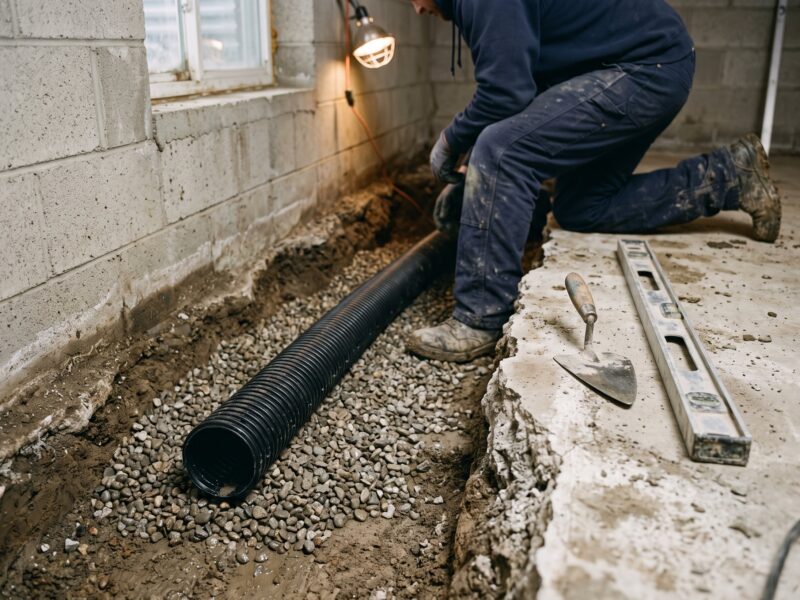

Find out what is really under your basement floor
Free written diagnosis within 48 hours, published per-foot pricing, 0% for 12 months if you need it, and 24/7 when the water will not wait.
Or talk to a human right now
(630) 335-1128
Request your free estimate
Tell us what you're seeing. We'll call back fast and be out within 48 hours.