
Exterior vs. Interior French Drains
Both are trenches full of stone and perforated pipe. They sit at different depths, catch water at different moments, and swapping one for the other is the most common drainage mistake we get called out to undo.
- Written diagnosis before any trench is priced
- Published per-foot pricing on both systems
- 20+ in Chicago clay, 1,500+ homes
 Drainage: 5-year warranty
The short answer
An exterior French drain is a stone-filled trench in the yard that catches water near the surface, and it runs $45 to $90 per linear foot. An interior French drain is drain tile at the footing under the slab, $95 to $160 per foot, and it removes groundwater that has already reached the wall.
Depth is the whole distinction. A yard drain works in the top few feet of soil, taking surface water and shallow saturation and moving it somewhere else before it can soak down alongside the foundation. A footing drain sits eight feet down at the base of the wall, inside the slab edge, catching water that has already made the trip and is now pressing at the one seam where your floor meets your wall. One works upstream of the problem. The other works at the point of entry.
That difference decides more than technique in this region. Chicago clay holds water instead of passing it along, so a shallow trench relieves a soggy lawn but never touches what is happening at the footing, and a footing drain never dries out a back yard. Frost depth adds a second split, because exterior digging stops for the winter while interior work does not. Our French drain installation page covers both builds in detail.
What does an exterior French drain actually do?
A yard drain intercepts water while it is still near the surface. It is a collection and transport system, and it only works if there is somewhere lower to send what it collects.
Here is the sequence on a typical suburban lot.
-
Find where the water sits
We walk the lot during or right after a storm when we can, because the wet spot tells us more than the topography does. The trench line follows the low path the water is already taking, not a straight line drawn on a plot map.
-
Cut a trench at yard depth
The trench goes deep enough to sit under the saturated zone and shallow enough to stay well above the footing. In clay the sides stand up cleanly, which is one of the few things this soil makes easier.
-
Wrap stone in filter fabric
Washed stone fills the trench and stores water during the peak of a storm. Fabric keeps clay fines out of the stone, because silt is what turns a working drain into a buried gravel bar three or four years later.
-
Set pipe on continuous fall
Perforated pipe runs the length of the trench, pitched toward the outlet without a single flat section. Every low spot in the pipe holds water, and in a Chicago winter water standing in shallow pipe is water that freezes.
-
End it somewhere legal and lower
Daylight on a slope, a pop-up emitter, or a catch basin tied to an approved line. Where that water is allowed to go varies by municipality in Illinois, so confirm it with your village before the trench is closed.
It solves
- Lawn that stays soft and squelching for days after rain
- Water sheeting toward the house from a neighboring high spot
- Saturated beds and window wells filling from the surface
- Roof water pooling once downspouts are already extended
- Backed by a 5-year warranty
It does not solve
- Seepage at the cove joint, which is below where this drain reaches
- A rising water table, since gravity drainage needs somewhere lower
- Anything at all between December and thaw, when the ground is frozen
- Cracks in a wall, which are a repair and not a drainage question
What does an interior French drain do differently?
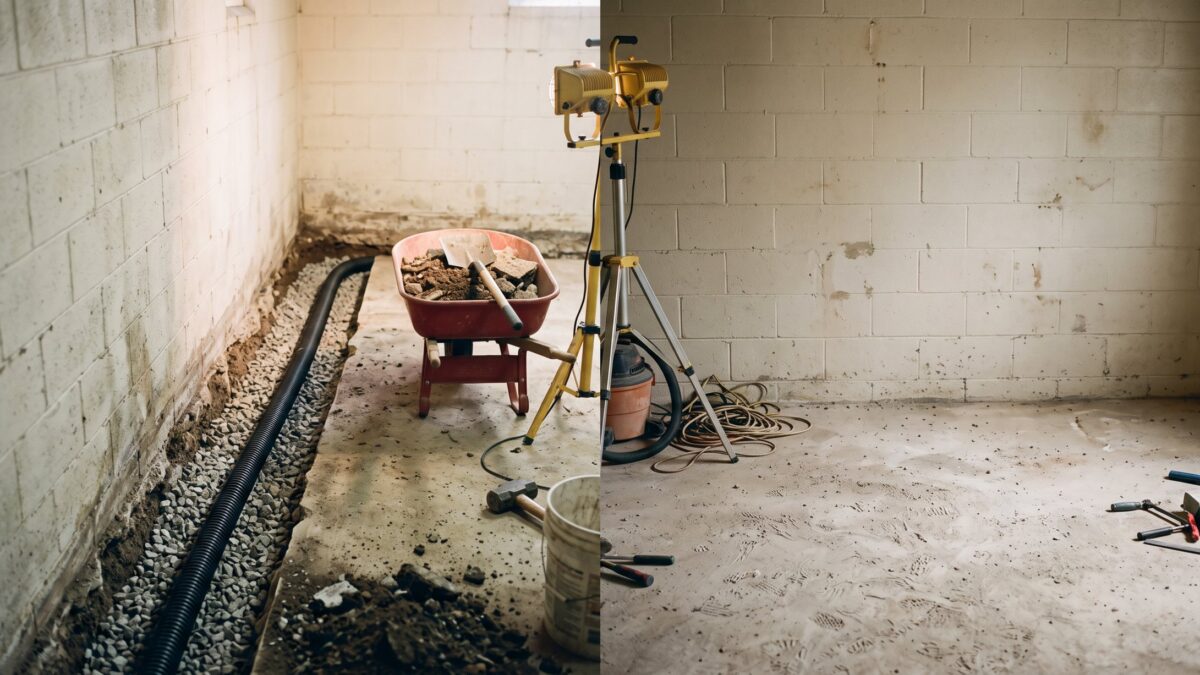
An interior drain, which the trade calls drain tile, is the same idea installed eight feet lower and inside the building. It assumes the water arrives and gives it a route out that does not cross your floor.
The build is short, loud and entirely indoors.
-
Open a channel at the slab edge
Concrete comes out in a strip around the inside perimeter, down beside the footing. Every bucket of clay and broken slab leaves through the same door the crew came in, which is a real part of why the per-foot price is higher.
-
Bed pipe against the footing
Perforated pipe goes into washed stone in that channel, wrapped so silt stays out, pitched around the perimeter toward one low corner. It is collecting water that has already traveled the full path down the outside of the wall.
-
Release the wall cavity
On block walls we drill weep holes into the bottom course so water standing inside the hollow cores drops into the new pipe. Without this the cores stay charged and the cove joint keeps weeping no matter what is in the floor.
-
Build the pit and pump
Gravity has run out at this depth, so a sump pit at the low corner and a pump sized to the inflow do the lifting. Battery backup matters, because the storm that fills the pit is also the storm that takes the power out.
-
Pour it closed
New concrete goes over the channel and cures. The system is now inside the building envelope, which means it can be inspected and serviced in February without anyone touching the yard.
It solves
- Water at the joint where the basement floor meets the wall
- Seepage through block cores and mortar joints
- A high water table pushing up under the slab
- Wet basements on lots with no room for a machine
- Carries a lifetime, fully transferable warranty on the system
It does not solve
- A yard that ponds, because this drain is below all of that
- Water entering high on a wall, above footing level
- Anything if the power is out and there is no backup battery
- The need for a discharge line run well away from the house
Which French drain does a Chicago house need?
Match the drain to where the water shows itself. The symptom you can see is a better guide than any general rule about which method is superior.
| Exterior yard drain | Interior drain tile | |
|---|---|---|
| Symptom it answers | Soft lawn, ponding, water running toward the house | Wet floor at the cove joint, damp block, water after storms |
| Working depth | Top few feet of soil | At the footing, below the slab |
| Published price | $45 to $90 per linear foot | $95 to $160 per linear foot |
| Moves water by | Gravity to a lower outlet | A pump, because nothing is lower |
| Needs machine access | Yes, plus room for the spoil | No, the work happens inside |
| Installed in February | No, frozen ground stops it | Yes |
| Ongoing attention | Keep the outlet clear | Test the pump, keep the backup charged |
| Our warranty | A 5-year warranty | A lifetime, fully transferable warranty |
Plenty of houses end up with both, because they are aimed at two different water sources. If the real question is how to waterproof the whole basement rather than which trench to dig, interior vs. exterior waterproofing takes that argument all the way through.
Not sure which water you have? We diagnose it in writing, free within 48 hours, and quote from published ranges either way.
Which one fits your house?
The era a house was built in usually settles the question before we get to preference. These four cover most of what we inspect across Will, Cook, DuPage, Kane, Kendall, DeKalb and Lee counties.

Pre-war bungalows and two-flats
Original clay tile at the footing gave up decades ago, and the gangway is too narrow for anything with tracks. The front yard is a strip of grass with the parkway beyond it, so there is little to drain and nowhere to send it.
Interior, almost always
Post-war block ranches
Water wicks through mortar joints and stands in the block cores, appearing at the cove joint on the floor. That is footing-level water. Yard work helps the lawn but leaves the seepage exactly where it was.
Interior, with weep holes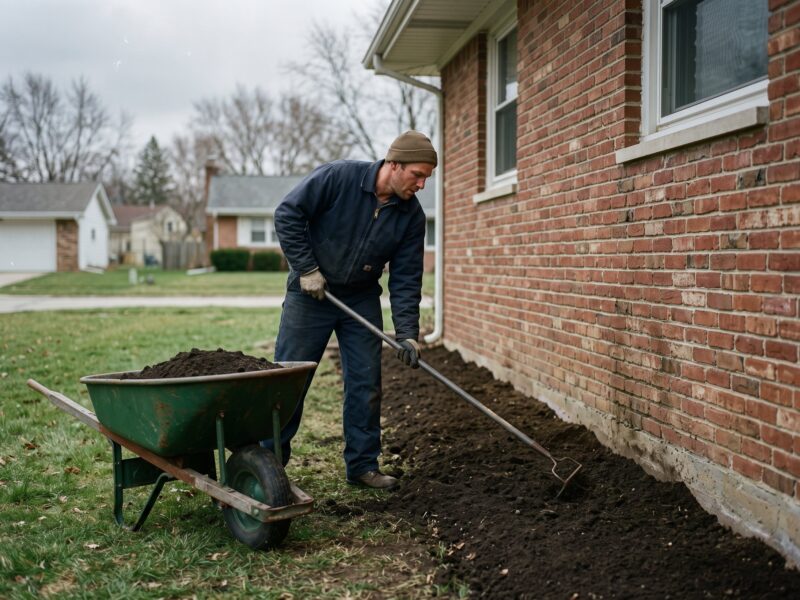
1980s and 90s subdivisions
Deep clay backfill, settled grade and downspout lines nobody has traced since the builder left. Surface water is usually the culprit here, and the yard drain often only needs to be short.
Exterior, after regrading
Newer subdivision homes
Working footing drainage and a builder-grade pump already in place, with ponding out in the lawn where the plan grade has flattened out. Open access makes exterior work straightforward.
Exterior, in the yardWhat the two systems cost
Exterior yard drains run $45 to $90 per linear foot and interior drain tile runs $95 to $160 per linear foot, with a full interior perimeter system landing between $8,000 and $16,000 on an average Chicago basement.
| Work | Range | What moves the number |
|---|---|---|
| Exterior French drainper linear foot | $45–$90 | Trench depth, where the water can legally go |
| Interior drain tileper linear foot | $95–$160 | Length of the run, slab thickness, what has to be moved off the walls |
| Sump pump with battery backupinstalled | $2,800–$4,500 | Pit condition, backup capacity, discharge routing |
Digging all the way down to the footing from outside is a different scope again, and we do not publish a per-foot price for it, because depth and access swing it too far to quote from a table; that one is priced in writing after we see the lot. Both published ranges above sit on the pricing page.
When the answer is neither trench
A fair number of the drainage calls we take end with us recommending something smaller, or nothing at all. Here are the four we see most.
The gutters are still doing the damage
No drain of either kind earns its price while a downspout is dumping at the wall. Extensions and a corrected grade run $600 to $2,500 and fix a surprising share of these houses on their own. Get the grade right first.
Cheapest real fixIt is one crack, not a drainage problem
A single vertical crack in a poured wall weeping during spring storms is a $450 to $900 urethane injection, done in a couple of hours with a 10-year warranty. Trenching for it spends thousands to fix something a two-hour repair handles. Here is how to tell.
Usually injectionThe water rises out of the floor drain
Water coming up through a floor drain during a heavy storm is coming from the sewer, not the soil, and neither trench will change that. It goes to a licensed plumber and possibly a backflow valve. Telling the two apart.
Not our workThe lawn is wet but the basement is dry
A soggy patch out in the yard is a lawn problem until it becomes a house problem. If the basement stays dry through a full spring, mark the wet area with stakes, watch it for a season and put the money somewhere it is needed now. What standing water actually means.
Wait a seasonQuestions homeowners ask about the two drains
Will an exterior French drain stop my basement from leaking?
Sometimes, when the water reaching the foundation is surface water and the drain catches it upstream. It will not touch a wet basement caused by groundwater already standing at the footing, which is most of the ones we see in this soil. Test it cheaply: if the leak follows heavy rain within an hour or two, surface water is likely; if it shows up a day later, the water table is involved.
Can I just dig an exterior drain instead of tearing up my basement floor?
You can, and on a subdivision lot with ponding water it is often the right call. On a narrow city lot it usually is not, because the trench cannot get near the wall and there is nowhere downhill for the outlet. The choice is made by where the water is entering and what the lot allows, not by which disruption sounds worse.
Do I need both?
A number of houses do, and there is no contradiction in it. The yard drain removes surface water before it soaks down, and the interior drain handles the groundwater that arrives anyway. We sequence them: the yard work and grading first, because it is cheaper and sometimes reduces the interior scope, then a season of watching before anyone opens the slab.
Which one lasts longer?
Both last as long as they stay clean, and that is a maintenance question rather than a design one. A fabric-wrapped exterior drain fails when its outlet plugs or a root finds it. An interior drain fails when the pump does, which is why we size the pump to the inflow and put a battery on it. The interior system is the one you can reach in January to check.
Is an exterior French drain the same as exterior waterproofing?
No, and the two get sold as if they were. A yard-depth French drain manages water out in the soil. Exterior waterproofing means excavating right down to the footing, sealing the wall face with a membrane and draining the footing itself. That is a much bigger scope with no published per-foot price, and we quote it in writing after seeing the lot.
Can either one be installed in winter?
Interior drain tile goes in any month, because the work happens inside a heated building and nothing depends on the ground being workable. Exterior trenching stops once frost sets in, since frozen clay cannot be cut cleanly or backfilled properly and the restoration will not take. If your basement is leaking in January, the interior route is the only one available.
Want the numbers before you decide?
Once you know which drain fits, the next question is what it costs at your actual footage. We publish per-foot pricing for both, explain what a foot includes and list what sits outside the number, so you can read any quote in the Chicago area against a real baseline instead of guessing.
See French drain cost per linear foot

Have the water diagnosed before you buy a trench
Free written diagnosis within 48 hours, published pricing on both systems, and 24/7 response when water is already standing.
Or talk to a human right now
(630) 335-1128
Request your free estimate
Tell us what you're seeing. We'll call back fast and be out within 48 hours.