
Exterior Excavation Waterproofing and Membranes
Digging a wall open to its footing is the most invasive thing we do to a house. When the wall face has genuinely failed it is also the only repair that addresses the cause, and this page is about telling those two situations apart.
- Free site assessment within 48 hours
- Access and spoil plan given before you sign
- $2,000,000 general liability carried on every excavation
 Priced in writing after we see the lot
The short answer
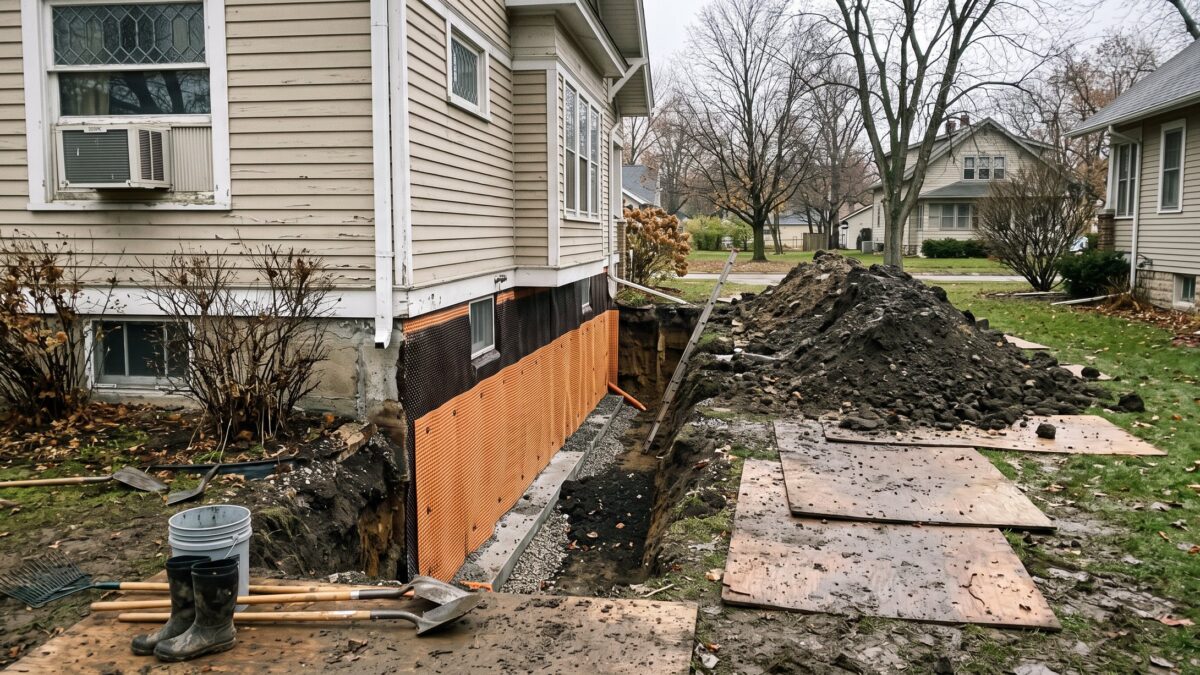
Exterior waterproofing excavates the foundation wall down to the footing, cleans and parges the face, applies a waterproofing membrane, covers it with dimpled drainage board, lays a new footing drain in washed stone under filter fabric, then backfills and rebuilds the grade. It stops water at the outside face rather than managing it once it arrives inside.
A below-grade wall is not waterproof on its own. Poured concrete carries shrinkage cracks and cold joints, block carries dozens of mortar joints, and the thin black damp-proofing sprayed on the day the house was built was never rated to hold back standing water. Exterior waterproofing replaces that spray with a real membrane and, just as importantly, gives arriving water somewhere to go before it stands against the seal. The membrane and the drainage plane are a pair. One without the other is half a system.
Whether a Chicago house can have this work is mostly decided before anyone prices it. A full basement here means a trench eight feet deep or more, cut into clay that holds its shape until it does not, and the excavated soil has to sit somewhere on your property while the wall dries. Ground frozen from December into March takes a third of the calendar off the table. The basement waterproofing hub sets this method against the alternatives, and the honest first step is a walk around the lot with a tape measure.
What actually goes on the wall in exterior waterproofing?
Exterior waterproofing is an assembly of layers, each with one job, built from the concrete outward. Removing any layer to save money removes the layer behind it from doing its job.
Working out from the wall face, this is what a finished exterior scope has on it.
-
A cleaned and repaired substrate
Old damp-proofing, loose parging and dirt come off, and voids get filled. Membranes bond to sound concrete and nothing else. Block walls usually take a fresh parge coat first so the membrane sits on a continuous surface instead of bridging every mortar joint.
-
The waterproofing membrane
This is the layer people picture. Whether it is a rubberized sheet or a fluid applied coat, it needs real thickness, full coverage down to and over the footing edge, and detailing at pipe penetrations. Thin, patchy or stopped short and water finds the gap.
-
A dimpled drainage board
Plastic sheet with molded dimples goes over the membrane, air gap facing the wall. Water arriving in the backfill runs down its channels to the footing instead of standing against the seal, and the board takes the abrasion when backfill goes back in.
-
Footing drain in stone and fabric
New perforated pipe sits beside the footing in washed stone, wrapped in filter fabric so clay fines cannot silt it shut. This is where every layer above sends its water, and it is the piece most often left out of a cheap quote.
-
Backfill and a rebuilt grade
The trench gets backfilled in lifts, and the finished soil is rebuilt to fall away from the house for the first several feet. Fresh backfill settles. If nobody comes back to top it up, you have built a funnel over your own new drain.
What the assembly buys you
- The outside face of the wall stops taking on water
- A leak entering above footing level gets addressed at its source
- Nothing inside the basement is opened or lost
- Deteriorated parging and open cold joints get repaired while exposed
Where it goes wrong
- Membrane stopped short of the footing leaves the wettest foot untreated
- Board installed backwards traps water against the seal
- Footing drain omitted, so the membrane stands in water
- Backfill never topped up as it settles over the first two years
What does the excavation involve on a Chicago lot?
The dig is the part that decides whether this job is possible and what it costs. On a city lot it is a logistics problem long before it is a waterproofing problem.
Here is what has to be true about your property before a machine turns up.
-
Locates and buried services
Gas, electric, water, cable and any old lawn irrigation all get located before a bucket moves. Utility marking is a free service in Illinois and it is not optional. Lines running along the wall can change the dig line or rule out a stretch entirely.
-
Access width and machine reach
A compact machine needs a gate opening and a clear run to the wall. Chicago gangways are often four feet or less, and where the machine cannot reach, the trench becomes hand digging, which changes the price and the schedule by more than most homeowners expect.
-
Somewhere for the spoil
An eight-foot trench along one wall produces a striking amount of clay. It sits on boards across the lawn, in a container on the drive, or it gets hauled, and hauling costs money. Where the pile goes is worth agreeing in writing before day one.
-
A safe trench
Deep trenches in wet clay do not simply stand open because they did yesterday. Sloping, benching or shoring is part of the job, along with keeping people and pets away from the edge. This is a large part of why the work is priced the way it is.
-
Restoration you can live with
Lawn, shrubs, a walkway, a fence line, a deck footing, sometimes a driveway edge come out and go back. Backfilled clay settles for a couple of seasons. Ask what is restored, what is replaced and what is simply gone before you sign anything.
Lots where this works well
- Open side yards on newer subdivision homes
- Corner lots with a genuine machine path to the wall
- Houses where the wet wall faces the widest side of the property
- Any project already digging for other reasons, like a new egress well
Lots where it usually does not
- City and older suburb lots with narrow gangways between houses
- Patios, drives or mature trees sitting tight against the wall
- Frozen ground, which takes roughly a third of the year off the calendar
- Anywhere the whole perimeter leaks, since digging four walls rarely pencils
Do I need the membrane, or just drainage outside?
Two different exterior jobs get sold under similar names. One rebuilds the wall face, one only adds a drain beside it, and they solve different problems.
| Full excavation and membrane | Exterior French drain only | |
|---|---|---|
| What it addresses | A failed or unsealed wall face, plus water at the footing | Water arriving through the soil, nothing about the wall itself |
| Depth of the dig | All the way to the footing, often eight feet or more | Shallower trench, set by where the water is being intercepted |
| Published cost | Quoted after seeing the lot, since depth and access swing it | $45 to $90 per linear foot |
| Wall repairs included | Parging, void filling and cold joint work while exposed | None, the wall is never uncovered |
| Right when | Parging is crumbling, block joints are open, leaks enter high on the wall | The wall is sound but the soil beside it stays saturated |
| Restoration scope | Significant, the full trench line comes back | Smaller, though still a trench across the yard |
| Season | Unfrozen ground only | Unfrozen ground only |
| Our warranty | Warranted in writing with the scope | A 5-year warranty on drainage work |
Both are outside work, and neither removes water that has already risen under your slab. If the water table is the problem rather than the wall, a pump is the only thing that lifts it out, which the interior and exterior comparison lays out in full.
Not sure whether your lot can even take a machine? We measure access, mark the spoil area and tell you plainly if the answer is no, free within 48 hours.
Can your house have exterior work done?
Access and wall type decide this, and both track closely with the decade the house went up. These four cover most of the seven counties we serve.

Pre-war bungalows and two-flats
Narrow lots, gangways often four feet wide, and neighbors close enough to shake hands from a window. Even where hand digging is possible, the economics rarely survive the labor once you price the whole wall.
Almost never practical
Post-war block ranches
Wider lots and better access, but block walls need parging before a membrane will bond, and mortar joints across the whole perimeter mean one wall is seldom the only wet one.
Possible, rarely the whole answer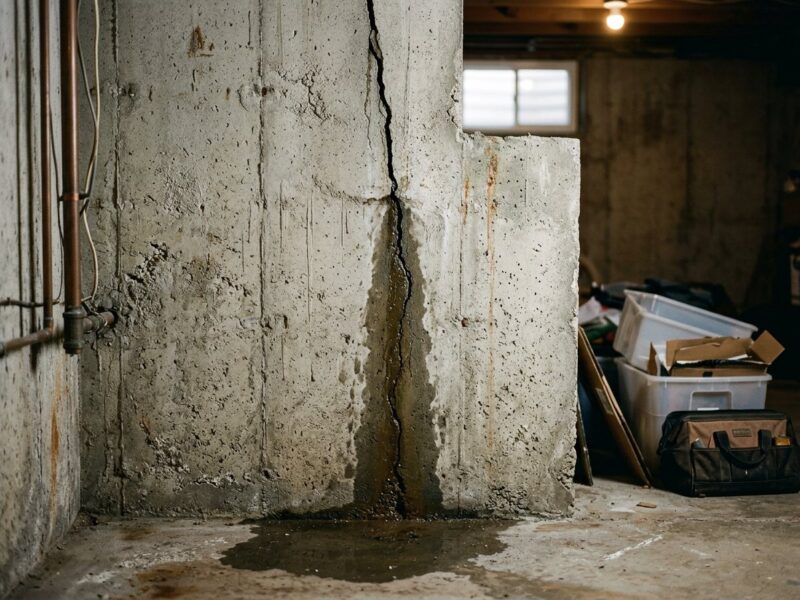
1980s and 90s poured walls
Solid walls with decent access. When the leak is one crack, injection from inside solves it for a fraction of the cost. Exterior work earns its keep here only when the outside face is genuinely failing.
Only if the face has failed
Newer subdivision homes
Open side yards, real machine access, and existing footing drainage that may have silted or been crushed during construction. This is the housing stock where exterior work is most often available and most often justified.
The strongest candidateWhat does exterior waterproofing cost?
Exterior excavation to footing depth is quoted in writing after we see the lot, because depth, access and restoration move the number too far to publish a per-foot rate honestly. An exterior French drain is published at $45 to $90 per linear foot.
| Work | Range | What moves the number |
|---|---|---|
| Exterior French drainper linear foot | $45–$90 | Trench depth, where the water can legally go |
| Downspout extensions and regradingtypical job | $600–$2,500 | Feet of grade to rebuild, soil hauling |
| Interior drain tileper linear foot | $95–$160 | Length of the run, slab thickness, what has to be moved off the walls |
The comparison worth running is the exterior quote against what interior drain tile costs on the same house at $95 to $160 per linear foot, plus what you would spend restoring the yard. Every published range sits on the pricing page.
When digging is the wrong call
Exterior work is the most oversold service in this trade, because the pitch is easy and the disruption is invisible on a brochure. Four cases where we tell people not to buy it.
The water is surface water
Before excavating a wall, follow the roof. A downspout emptying at the foundation or a grade that has settled back toward the house delivers more water in one storm than groundwater manages all season, and it costs $600 to $2,500 to correct. Get the grade right first.
Try this firstIt is one crack in a poured wall
A single vertical crack weeping in a spring storm is a $450 to $900 urethane injection done from inside in an afternoon, with a 10-year warranty. Excavating a wall to reach the outside of that crack is a very expensive way to reach it. Which injection your crack needs.
Injection winsThe water table is the real problem
When groundwater rises to slab level, sealing the wall face changes nothing, because the water is coming up as much as it is coming in. Something has to physically lift it out of the building, and that is a sump. How the interior system handles it.
Needs a pumpThe ground is frozen and you can wait
If the leak is seasonal and the calendar says January, waiting for thaw is a legitimate plan. Dry the space, run a dehumidifier, keep the pump tested and book the assessment for spring. Rushed winter excavation in Illinois clay is worse work at a higher price.
Wait a seasonQuestions homeowners ask about exterior excavation
How deep does the excavation have to go?
To the bottom of the footing, which on a full Chicago basement usually means eight feet or more from finished grade. Stopping short leaves the wettest band of wall untreated and gives the new drain nothing to catch. Depth is also the single biggest driver of price, since it sets the volume of spoil, the trench safety requirements and how long the wall stays open.
Can exterior waterproofing be done in winter?
Not once the ground is frozen. Frozen clay does not excavate cleanly, membranes and coatings have minimum application temperatures, and backfilling frozen chunks leaves voids that collapse in spring. In this region that takes roughly December through March off the table most years. If you have an active leak in January, we stabilize the situation inside and schedule the dig for thaw.
Will my landscaping survive?
Grass and small plantings along the trench line come out. Mature shrubs sitting against the wall rarely transplant well from that depth. Trees close to the foundation are a separate conversation, because cutting major roots has structural consequences of its own. Get the restoration scope in writing, including who replaces plantings and who tops up settled backfill in year two.
Does exterior waterproofing come with a transferable warranty?
Our interior systems carry a lifetime transferable warranty. Exterior scopes are warranted in writing with the specific job, because depth, wall condition and access vary so much from house to house, and drainage work carries a 5-year warranty. Ask any contractor what transfers, what it excludes and whether it requires inspections, then compare on our <a href="/warranty/">warranty page</a>.
Do I need a permit to excavate around my foundation?
Requirements vary by municipality across the Chicago area, and there is no single regional rule. Some villages want a permit for the excavation, some only for plumbing or discharge work, some for changes to grading and stormwater. Utility locates are separate and always required. We handle what your jurisdiction asks for, and your village building department can confirm the rule for your address.
Can you dig just one wall instead of the whole perimeter?
Yes, and that is how most exterior jobs in this region get scoped. If the seepage is documented on one elevation across several seasons, treating that wall is honest work. What we will not do is quote a single wall when the cove is wet on three sides, because water that finds no route on the treated wall will simply keep using the untreated ones.
What the inside alternative actually involves
On most of the lots we assess, the practical alternative to digging is an interior system that intercepts the same water below your slab and pumps it out. It installs in any season, costs a published per-foot rate and leaves the yard alone. Worth reading before you commit to opening the ground.
See how interior systems work

Find out whether digging is worth it on your lot
A free site assessment within 48 hours, a written scope with the access and restoration spelled out, and $2,000,000 general liability behind every crew that opens ground.
Or talk to a human right now
(630) 335-1128
Request your free estimate
Tell us what you're seeing. We'll call back fast and be out within 48 hours.