
Sump Discharge: Where That Water Should Actually Go
A pump can only move water from one place to another. If the other place is eight feet off the wall, you have bought a machine that lifts the same gallons twice a night.
- Free written diagnosis within 48 hours
- Published pricing on drainage and pump work
- 1,500+ homes across seven counties
 Drainage work: 5-year warranty
The short answer
Sump water should leave in a solid pipe, surface well clear of the foundation, and keep running downhill to a destination your village permits, normally your own lawn, a swale, or a storm system where the town allows the connection. Most Illinois municipalities prohibit discharging sump water into the sanitary sewer.
A sump pump does not remove water from your property. It lifts water out of a pit and sets it down somewhere else, and the only thing that makes the job worthwhile is that the somewhere else is far enough away and low enough that the water keeps going. Put the outlet close to the wall and the water soaks back down through the same loose backfill it came from, reaches the footing, enters the drain tile and arrives back in the pit. The pump then runs again on water it already handled once.
Where that outlet is allowed to end is a local question in Illinois, not a state one. The sanitary sewer is off the table in most municipalities here, since a working sump can send more water into a treatment system in an hour than a household sends in a week. Storm sewer connections, discharge to a curb or parkway, and how far the line may run all vary town by town across Will, Cook, DuPage and Kane counties, so we ask your village before we trench. The yard drainage hub covers where that water goes once it is out.
Where should sump pump water actually go?
There is a short list of legitimate destinations and a shorter list of places the water must never be sent. Everything else is a matter of distance and fall.
We work down this list in order on every job, and stop at the first option the lot and the village allow.
-
Your own lawn, well out from the wall
The simplest answer is open ground on your own lot that keeps falling away from the house. We treat ten feet as the floor and not the target, because on flat clay the water needs somewhere to go after it lands, not just distance from the foundation.
-
A swale or low route already on the lot
Most suburban lots were graded with a shallow swale between houses or along a rear line, designed to carry storm water off the block. Landing sump water in a swale that still functions puts it into a route the subdivision was built around.
-
A buried line to a distant outlet
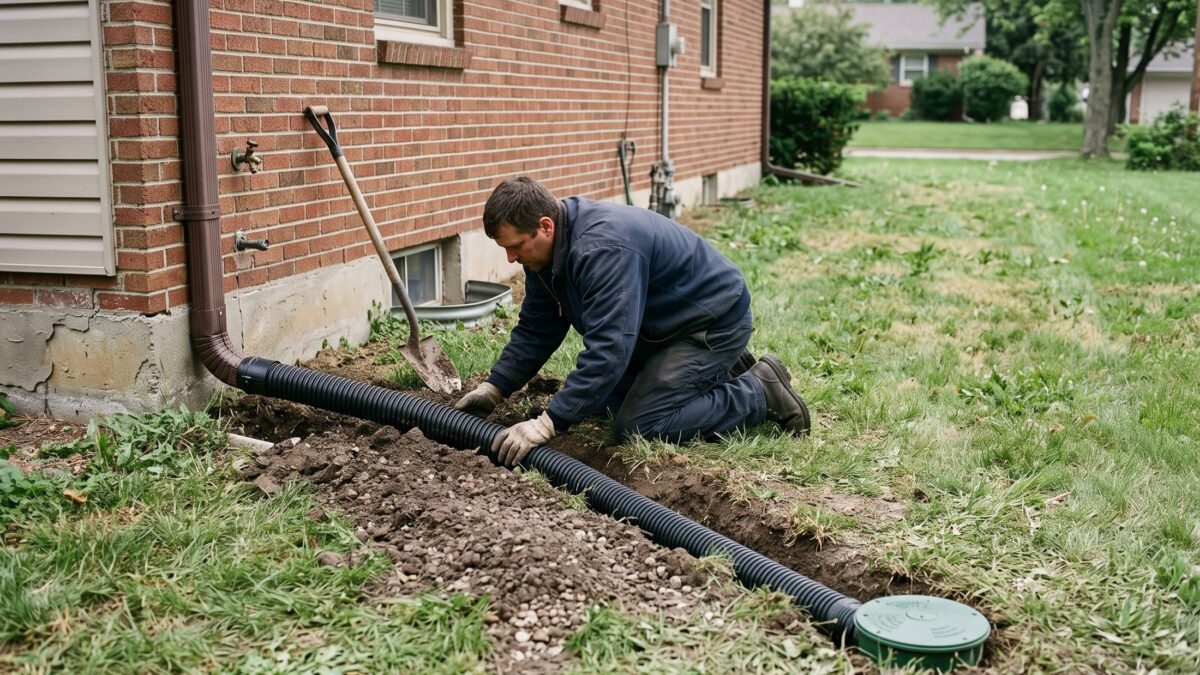
Where the lawn near the house has no fall, a solid wall pipe in a stone bed can carry the discharge to an emitter, a basin or a lower corner. It needs steady pitch the whole way and an escape near the house for when the far end plugs.
-
A storm system, if your town permits it
Some municipalities allow a sump line to tie into the storm sewer or to discharge at the curb, and others do not allow either. That is a phone call to your village before anyone opens the ground, and the answer changes across town lines.
-
Never the sanitary sewer or a floor drain
Most Illinois municipalities prohibit sending sump water into the sanitary system, which includes a laundry tub, a floor drain or a cleanout. If yours is plumbed that way, rerouting it is work for a licensed plumber and worth doing.
What a good outlet has
- Continuous fall from the wall all the way to the end
- Solid wall pipe rather than flexible corrugate that traps water
- A surfacing point clear of walks, drives and the snow plow line
- Ground below it that can carry water on, not just receive it
- A destination your village has actually confirmed is allowed
What to avoid
- Any connection to the sanitary side of the house
- An outlet aimed at the property line or a neighbor's low corner
- A run that ends in the one spot on the lot that already ponds
- Splash blocks doing the work a pipe is supposed to do
What happens when the water lands in the wrong place?
A badly placed outlet does not announce itself. It shows up as a pump that runs more than it should and a wet spot nobody can explain.
This is the loop we find on service calls, and it usually starts with a splash block.
-
The water lands near the wall
A stub pipe or a splash block puts the discharge two or three feet out. That ground is backfill, looser than the undisturbed clay around it, so the water goes straight down rather than running away across the surface.
-
It returns to the footing
Loose backfill against a foundation drains faster than anything nearby, which is why it is sometimes called the bathtub around a house. Water dropped into it reaches the footing in minutes and enters the drain tile it was just pumped out of.
-
The pump cycles on its own water
The pit refills, the float lifts and the pump runs again. During a wet week a good share of what it moves is water it has already moved, which is why some pumps sound like they never stop after a storm has passed.
-
The soil beside the wall stays saturated
Ground that never dries out holds pressure against the wall through every freeze and thaw. That is a foundation problem forming slowly, not just a pump working hard, and it shows up years later as movement rather than as a leak.
-
It becomes somebody else's water
Where the outlet points at the property line, the discharge ends up on the neighbor's ground. Illinois handles surface water between neighbors on a reasonable use standard, and disputes turn entirely on the specifics of the two lots.
Signs you have this
- The pump still cycling regularly two days after the rain stopped
- A permanently soft or mossy patch a few feet off the wall
- A mound of ice building at the outlet through January
- Mulch or stone washed out of one bed after every storm
What it costs you
- Pump hours and pump life spent on the same gallons twice
- Saturated soil pressing on the wall year round
- A neighbor conversation that could have been avoided
Onto your own ground, or into a village system?
Both are used across the Chicago area and neither is automatically right. What decides it is your lot's fall and what your municipality permits.
| Discharged onto your own lot | Connected to a village drainage system | |
|---|---|---|
| Where the water ends up | Your lawn, a swale or a low corner you own | A storm structure or a curb, where the town allows it |
| Who decides if it is allowed | You, within reasonable use toward neighbors | Your village, and the answer differs town to town |
| Needs approval first | Rarely, unless work crosses a drainage easement | Usually, and often a permit and an inspection |
| Works on a flat lot | Only if there is a real route away from the wall | Yes, since the system carries the water off site |
| Winter behavior | Freezes at the outlet where you can reach it | Freezes where it surfaces or at a plugged grate |
| Neighbor risk | Real, if the outlet points across a line | Low, because the water leaves the block |
| What we install | Pipe, pitch and an emitter or open outlet | The line to the connection point your village approves |
| Published cost | Priced with drainage work, $600 to $2,500 | Same range, plus whatever the village requires |
Rules on this genuinely are not uniform across the seven counties we serve, so ask your village before you commit to a route. Illinois sump discharge rules covers the general principle in more depth.
Pump running long after the rain stopped? We will trace where that water is going and put it in writing, free within 48 hours.
Where does the water go on a lot like yours?
Routing is a lot problem before it is a pump problem. These four cover most of what we work with around Chicago and the suburbs.

Pre-war bungalows and two-flats
A gangway a few feet wide with a neighbor's wall on the far side, so there is no downhill on the lot at all. The route is usually front to the parkway or back to the alley, whichever the village permits.
Ask the village first
Post-war block ranches
Deep yards with almost no drop, where a short outlet just makes a soft patch that never dries. The workable answer is normally a buried run reaching the rear swale or a low back corner.
Long run, steady pitch
1980s and 90s poured wall homes
A builder stub throwing water onto a splash block a yard off the wall, feeding the same backfill the drain tile sits in. Extending that line is often the cheapest improvement on the whole property.
Extend it and watch
Newer subdivision homes
Buried lines and pop-up emitters aimed at swales that were engineered for the block. The system works until a fence post, a shed pad or a new patio interrupts the route it was designed around.
Protect the swaleWhat does rerouting a sump discharge cost?
Most of this is drainage work rather than pump work. Downspout extensions and regrading run $600 to $2,500 on a typical lot, and a rerouted or buried sump line is quoted in that same band by distance and depth.
| Work | Range | What moves the number |
|---|---|---|
| Sump pump with battery backupinstalled | $2,800–$4,500 | Pit condition, backup capacity, discharge routing |
| Downspout extensions and regradingtypical job | $600–$2,500 | Feet of grade to rebuild, soil hauling |
| Exterior French drainper linear foot | $45–$90 | Trench depth, where the water can legally go |
If the pump itself is at the end of its life, a sump pump with battery backup runs $2,800 to $4,500 installed and the new discharge is set up correctly as part of that work. Every range we quote from is published on the pricing page, and drainage work carries a 5-year warranty.
When this is not a job for a contractor
Discharge routing is one of the few things in our trade a homeowner can genuinely improve in an afternoon. Here is where we would tell you to save the money.
The line just needs to be longer
A stub dumping three feet off the wall can be extended across the surface with hardware store pipe for the price of lunch. Run it through one heavy storm and see whether the pump still cycles afterward before anybody quotes a trench.
Twenty dollarsIt is plumbed into the sanitary side
A sump piped into a laundry tub, a floor drain or a cleanout needs rerouting, and that is a licensed plumber's work rather than ours. Most Illinois municipalities prohibit that connection, so ask your village what they want to see and have it done properly.
Call a plumberThe argument is with the neighbor
Where discharge routing has become a dispute over the line, Illinois applies a reasonable use standard and the outcome depends entirely on the particular lots and grades. Start with your municipality, and if that goes nowhere, speak with an attorney rather than with a contractor.
Not a contractor questionThe pump barely runs anyway
Some pits only work hard during the spring melt. If yours has been quiet through a wet summer, watch it through one thaw before spending anything, since that is when the routing gets its real test. Spring is the honest season for this.
Wait a seasonQuestions homeowners ask about sump discharge
Can a sump pump discharge into the sanitary sewer?
In most Illinois municipalities it is prohibited, and for a practical reason. Clean groundwater sent into a sanitary system takes up capacity meant for waste and can push the whole system past its limits during a storm. Older houses around here were sometimes plumbed that way before anyone objected. If yours still is, ask your village what they require and have a licensed plumber reroute it, because that is plumbing work and not drainage work.
How far from the house does sump water need to go?
Ten feet is where we start, and on flat clay it is nowhere near enough on its own. What matters more than raw distance is whether the ground keeps falling once the water lands. Water set down on a level lawn twelve feet out will find its way back through the backfill toward the footing within a day. We would rather run pipe another thirty feet to a spot with somewhere to go than argue about the minimum.
Can I discharge sump water at the curb or into the street?
That depends entirely on your municipality. Some towns around Chicago allow a discharge line to reach the parkway or the curb, some allow a storm sewer connection with a permit, and some allow neither and require the water to stay on your own ground. There is no single Illinois answer to give you. Call your village before any pipe goes in, because moving a buried line afterward costs far more than the phone call.
Can my sump discharge run onto my neighbor's yard?
Illinois takes a reasonable use approach to surface water moving between neighboring properties, which means the answer depends on the specifics rather than on a simple yes or no. Concentrating a pump discharge and aiming it over a property line is the version most likely to cause a problem, and we will not install it that way. If it has already become a dispute, your village is the first call and an attorney is the second.
Can I tie the sump line into my downspout drain?
Sometimes, and only if that buried line has the capacity and the fall to take both. A hard storm loads the roof drains and the sump at the same moment, so a line sized for gutters alone can back up and send water out of whichever inlet is lowest. We check the pipe size, the pitch and where the run ends before combining anything, and on a lot of houses the honest answer is to keep them separate.
Do I need a permit to move a sump discharge line?
Often yes, and it depends on the village and on what the work touches. Surface changes on your own lot are frequently treated differently from any connection to a public system or any trench crossing a drainage easement. We ask the municipality on every job rather than assuming. Our page on <a href="/interior-drain-tile/drain-tile-permit-illinois/">permits for drain tile and sump work in Illinois</a> covers how that varies here.
What do the discharge rules actually say?
Municipal rules around here cover more than the destination. How the line is built, where it may surface, what it may connect to and whether the work is inspected all sit with your village rather than with the state, and none of it is uniform across the counties we serve. Knowing what your town expects before the trench opens saves the redo.
Illinois sump discharge rules

Get the discharge routed once, properly
Free written diagnosis within 48 hours, published pricing, own crews, and a 5-year warranty on the drainage work.
Or talk to a human right now
(630) 335-1128
Request your free estimate
Tell us what you're seeing. We'll call back fast and be out within 48 hours.