
Standing Water in the Yard After Every Storm
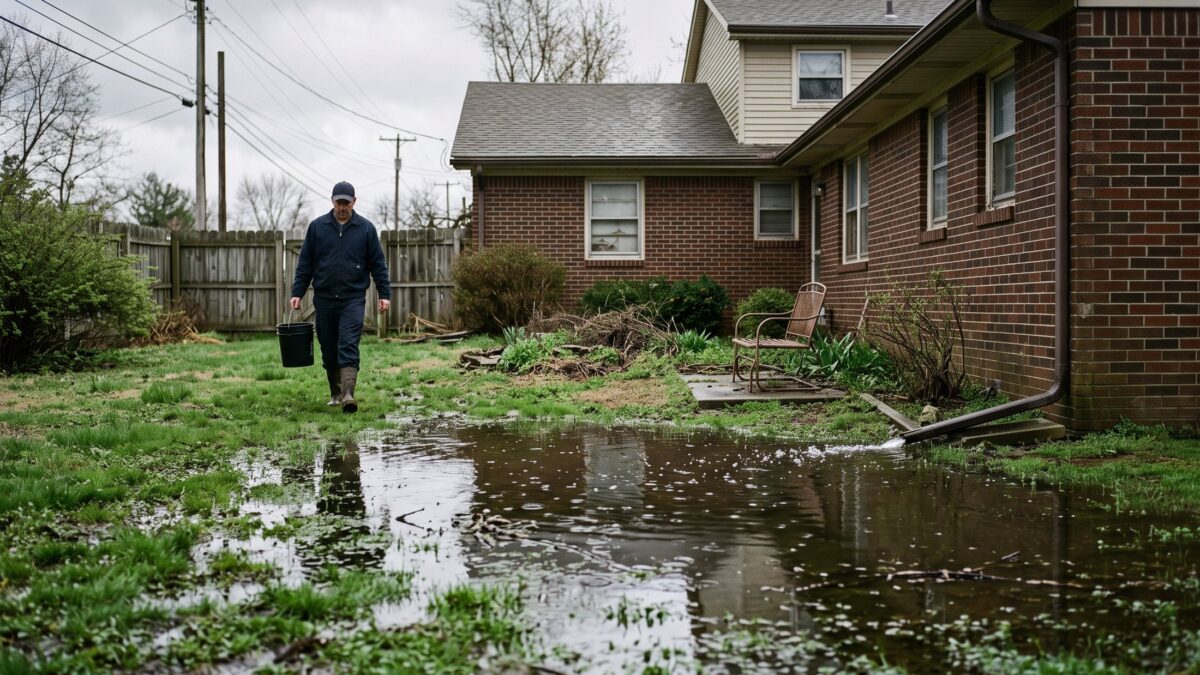
A puddle that outlives the storm by a day is telling you something specific about your soil, your grade and where the water has left to go. Whether it matters at all depends almost entirely on how close it sits to the house.
- Elevations shot across the lot, free within 48 hours
- We say when a wet corner can be left alone
- 20+ of Chicago clay, 1,500+ homes served
 Yard drainage: 5-year warranty
The short answer
Water standing more than a day after rain usually means three things at once: dense clay that absorbs slowly, soil compacted by construction, and a low spot with nowhere lower to drain. The fix always starts at the outlet. Catch basins and pipe, or an exterior French drain at $45 to $90 per linear foot.
A puddle that survives overnight is a soil problem, not a rain problem. Water leaves a yard three ways: it runs off the surface, it soaks in, or it evaporates. The clay under most of this region absorbs at a crawl once it is already wet, so a storm that drops an inch in twenty minutes has effectively one exit. When the ground where that water landed has nothing lower nearby to run toward, the puddle stays until the sun takes it back.
That is why ponding shows up in the same places on street after street here: the flat back third of a lot, the strip between two houses, the corner where a fence line stops the flow. Add subsoil compacted by construction traffic and a lawn built on a few inches of topsoil over glacial till, and the yard behaves like a shallow bowl. Where that bowl sits within ten feet of the foundation it stops being a lawn complaint. The yard drainage hub covers the full set of fixes.
Why does water sit in my yard for days after it rains?
Standing water is the visible end of a chain: soil that will not take it, ground that will not shed it, and no outlet within reach. Testing tells you which link is yours.
Five checks, none of which need a contractor, will usually name the cause before anyone quotes a number.
-
Dig a hole and time it
Dig down about a foot, fill the hole with water, let it drain, then fill it again and time the drop. Soil that moves less than an inch an hour is telling you it will never be the answer, whatever you spread on top of it.
-
Map where it stays, not where it lands
Walk the lot with a phone camera during the next storm and again twelve hours later. The water that matters is the water still there on the second walk, and it often collects somewhere other than where it first appeared.
-
Rule out the roof before anything else
Four or five downspouts unloading into one area will flood ground that drains perfectly well on its own. Move the roof water out, then judge the yard on the next storm. It is the cheapest variable to take off the board.
-
Look for a buried lid
Subsoil compacted by heavy equipment, an old driveway base, construction debris or a natural hardpan a foot down all create a layer water cannot pass. It perches on top of that layer and never reaches the deeper soil at all.
-
Note the season it happens in
Groundwater rides high through spring thaw and again after long autumn rains. A yard that ponds in March and stays firm through an August storm is pointing at the water table rather than at the surface.
What each result tends to mean
- Under an inch an hour in the test hole: heavy clay, plan on pipe
- Gone within six hours: a turf question, not a drainage job
- Ponding only below downspouts: roof water, fixed for far less
- A wet strip along a fence: something is blocking the flow path
- Wet only in early spring: a seasonally high water table
When it is worth calling someone
- Water standing within ten feet of the foundation
- A basement or crawl space that wets on the same storms
- A sump that keeps cycling for days after the sky clears
- Ground so soft in one area that the mower sinks in it
How do you drain a yard that will not drain?
Every yard drainage system is an outlet with pipe attached to it. Find the outlet first and the design writes itself. Skip that step and you have built an underground pond.
This is the order our crews work in, because it is the order the decisions actually have to be made in.
-
Establish the outlet first
We shoot elevations across the whole lot looking for the lowest usable point: a curb, an alley apron, a ditch, a shared swale, or a bank where pipe can daylight. Every other choice on the job gets designed backward from whatever that point is.
-
Set the inlets at the true low points
Eye level lies on a flat lawn. We find the bottom of each pond with an instrument and put the inlet there, because a basin set even two inches high leaves a ring of water behind after every storm and the homeowner never stops noticing it.
-
Trench with real pitch
Pipe needs steady fall the entire way, which on a flat lot means the trench gets deeper as it travels. Fall is the one thing on a drainage job that cannot be trimmed to save money without wrecking the result.
-
Collect or convey, on purpose
Perforated pipe in washed stone under filter fabric pulls water in along its length and belongs where the ground stays saturated. Solid pipe carries water past the parts of the yard that are already fine. Most lots need a run of each.
-
Handle a lot with no outlet
Where the ground is genuinely flat and nothing is lower, water goes to a dry well or a rain garden sized to the soil, which stores it and releases it slowly. Storage is a compromise rather than a cure, and we say that before we build one.
Best for
- Yards that pond in the same spots after every storm
- Lots with a curb, alley, ditch or bank within reach
- Soft ground within ten feet of a foundation wall
- Combining with downspout burial while a trench is already open
- Carries our 5-year warranty on the work
What it needs
- Somewhere lower to go, or storage built in instead
- Grates and basin sumps cleared out twice a year
- Unfrozen ground, so the work waits out a Chicago winter
- A restoration budget, because a trench leaves a scar
Catch basins or a French drain?
One takes water that is standing on the lawn, the other takes water held in the soil. Which you need depends on whether you can see the problem or only feel it underfoot.
| Catch basins and solid pipe | French drain in washed stone | |
|---|---|---|
| What it collects | Surface water already standing on the lawn | Water held in the soil along the trench line |
| Pipe used | Solid pipe, joints kept tight | Perforated pipe in stone under filter fabric |
| Published cost | Quoted with surface work, $600 to $2,500 | $45 to $90 per linear foot |
| Evidence it is right | A visible pond that fills fast and stays | Ground soft and soggy across a wide area |
| How it fails | Grate packs with clippings and leaves | Silts shut when stone or fabric was skipped |
| Maintenance | Lift the grate and pull the debris, twice a year | Almost none once it is built correctly |
| Effect on the lawn | Small boxes set at the low points | A trench line across the yard, then restored |
| On heavy clay | Works, since it never asks the soil to absorb | Works, but only with a genuine outlet |
| Where it usually sits | In the pond, piped onward to the outlet | Along the soggy strip or the uphill side |
Most yards we drain end up with both: a basin where water shows itself and a stone-bedded run where the ground stays soft. Out in the newer subdivisions around Plainfield, the whole job is frequently just reopening a swale that a fence post interrupted.
Wondering whether that puddle actually matters? We shoot the elevations, find the outlet if there is one, and tell you in writing when a wet corner can be left alone, free within 48 hours.
Which yards pond, and why
The era of the house sets the shape of the lot and the room you have to work with. These four cover most of what we walk across the seven counties.

Pre-war bungalows and two-flats
Narrow lots where the only open ground is a gangway and a small rear yard, ringed by a walk, a garage slab and an alley apron. There is very little permeable soil left for water to reach.
Pipe it to the alley
Post-war block ranches
Wide flat lawns on graded clay with a back half that drains toward nothing in particular. These are the yards where a pond can sit forty feet out and never once threaten the house.
Often safe to leave
1980s and 90s poured wall homes
Lots shaped with real fall originally, then landscaped hard for thirty years. Beds, steel edging and short retaining walls turn a working slope into a series of small dams.
Reopen the flow path
Newer subdivision homes
Engineered swales run between houses and were signed off at closing. A fence, a shed pad or a pool interrupts one, and the water backs onto whichever lot happens to sit lowest.
Restore the swaleWhat does draining a wet yard cost?
An exterior French drain runs $45 to $90 per linear foot across the counties we serve, and surface work with downspout extensions and regrading runs $600 to $2,500. Most yards need a measure of both.
| Work | Range | What moves the number |
|---|---|---|
| Downspout extensions and regradingtypical job | $600–$2,500 | Feet of grade to rebuild, soil hauling |
| Exterior French drainper linear foot | $45–$90 | Trench depth, where the water can legally go |
| Sump pump with battery backupinstalled | $2,800–$4,500 | Pit condition, backup capacity, discharge routing |
Dry wells and rain gardens are priced with the drainage run they serve, because their size depends on how much water the lot has to hold and how quickly that soil gives it back. Every published range we quote from is on the cost page.
When a wet yard needs nothing done to it
Not every puddle is a project. We turn down yard work regularly, and these are the four reasons why.
It is dry again by dinner
Water that clears within a few hours is a lawn doing what lawns do. If nothing inside the house is wet, this is a turf question. Core aeration and topdressing from a lawn service costs a fraction of any drainage job and often ends the complaint.
Call a lawn serviceThe pond is nowhere near the house
A wet corner sixty feet out, behind the garage, on ground nobody crosses, is not a foundation risk. We will say so at the inspection. Spend the money at the corner that touches the wall, or spend nothing at all.
Leave it aloneThe roof is filling it
Count the downspouts feeding that low spot before pricing a system. Redirecting roof water is the cheapest test available, and downspout extensions and buried drains frequently remove the pond from the yard altogether.
Try the cheap fixThe rules decide it, not you
Illinois municipalities differ on discharging to a street, a storm sewer or a detention area, and newer subdivisions often carry an approved grading plan you are not free to change. Ask your village first. Stormwater rules and rain gardens maps the landscape.
Ask the villageQuestions homeowners ask about a yard that holds water
How long should it take for water to drain out of a yard?
A working yard clears standing water within a day of the rain stopping. Twenty-four hours is the rough line we use on inspections. Past that, the soil, the grade or the outlet is the limiting factor, and the puddle will come back with every storm of that size. Water sitting for three or four days on ground next to the house is the version worth acting on quickly.
Does standing water in the yard mean my basement will leak?
Only if it stands close to the house. A pond within about ten feet of the wall keeps the backfill saturated and gives the next storm nowhere to drain, which is how yard water becomes basement water. The same pond out at the property line is a nuisance and nothing more. Distance from the foundation is the single most useful thing to measure.
Will adding sand or topsoil fix clay soil?
Not at the scale of a yard. Sand mixed into clay in small amounts can make drainage worse rather than better, and topsoil spread on the surface only creates a thin sponge sitting on the same impermeable layer. Soil amendment works in a planting bed you can dig completely. For a lawn over glacial till, the realistic answer is moving the water rather than changing the ground.
Do French drains actually work in clay soil?
They do, because a properly built French drain does not rely on the surrounding soil absorbing anything. Perforated pipe bedded in washed stone under filter fabric gives water a path with far less resistance than clay, and it carries that water to an outlet by gravity. The requirement is the outlet. Without somewhere lower to discharge, a French drain in clay is just a long stone trench holding water.
Can I run yard drains into my sump pit?
We do not do it. A sump is sized for groundwater arriving at the footing, not for the surface water off an entire lot, and feeding the yard into it means the pump runs constantly during the storms when you most need it in reserve. It also puts leaves and grit into the pit. Keep yard drainage on gravity to its own outlet wherever the elevations allow.
Is a dry well worth it on a Chicago lot?
It is storage, not drainage, so its value rests entirely on the soil around it. In clay a well fills during the storm and gives the water back over the following days, which copes with an ordinary rain and gets overwhelmed by a large one. On a lot with no outlet it can still be the right call. Where an outlet exists, piping to it wins. <a href="/yard-drainage/dry-wells-catch-basins/">Dry wells, catch basins and emitters</a> goes through the sizing.
Everything here comes back to the clay
The soil under most of this region is the reason a yard that drained fine for twenty years suddenly does not, and the reason sand and aeration rarely change much. If you want the ground itself explained before you decide what to build, that is the page to read next. It also covers what clay does to a foundation once it stays wet.
Read the clay soil guide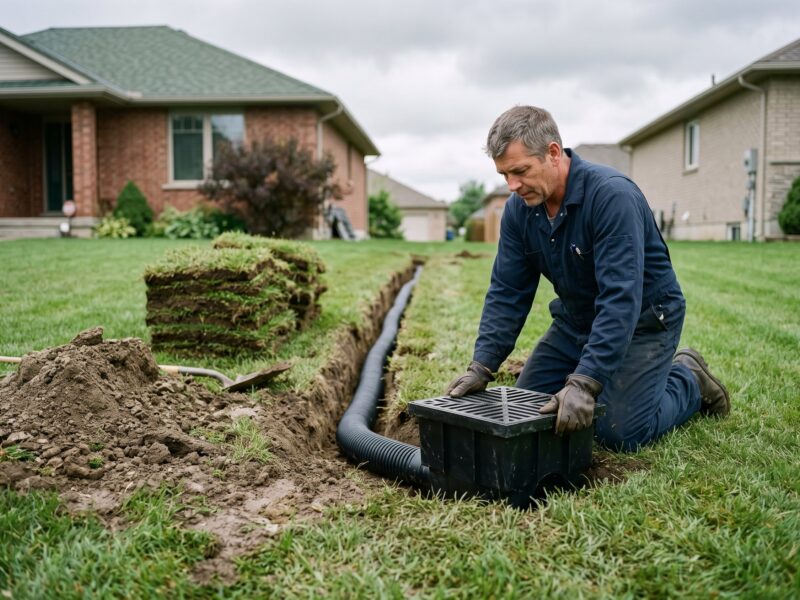

Find out whether that puddle is a problem or just a puddle
Free written diagnosis within 48 hours, published pricing on every drainage line, and a 5-year warranty on what we install.
Or talk to a human right now
(630) 335-1128
Request your free estimate
Tell us what you're seeing. We'll call back fast and be out within 48 hours.