
French Drain Cost per Linear Foot
A French drain is sold by the foot because that is how it is built. Knowing what one foot includes is the fastest way to read three quotes and see which one left something out.
- Published per-foot pricing, quoted in writing
- Free measured estimate within 48 hours
- Own crews, $2,000,000 general liability carried
 Drainage work: 5-year warranty
The short answer
An exterior French drain runs $45 to $90 per linear foot in the Chicago area. That foot covers a yard-depth trench, washed stone, filter fabric, perforated pipe and a working outlet. Interior drain tile at the footing is a different job at $95 to $160 per foot. Excavation to footing depth is quoted after we see the lot.
Length drives the price because length drives everything else. Every added foot is more trench, more stone, more spoil to move and more time on the machine, so the estimate scales cleanly with the run. The spread between $45 and $90 is not room to haggle. It is the honest distance between a shallow run across open lawn with a downhill outlet waiting for it, and a deeper one that has to cross a driveway, work around a gas line and end somewhere that is barely lower than where it started.
Chicago yards sit at the upper half of that range more often than not. Dense glacial clay does not let water soak away sideways, so a drain here has to be a real stone reservoir rather than a slot in loose soil, and the stone volume is a big part of what you are paying for. Much of Cook, Will and DuPage is also flat, which makes the outlet harder than the digging. The French drain installation page walks through how we build them.
What does $45 to $90 per linear foot actually pay for?
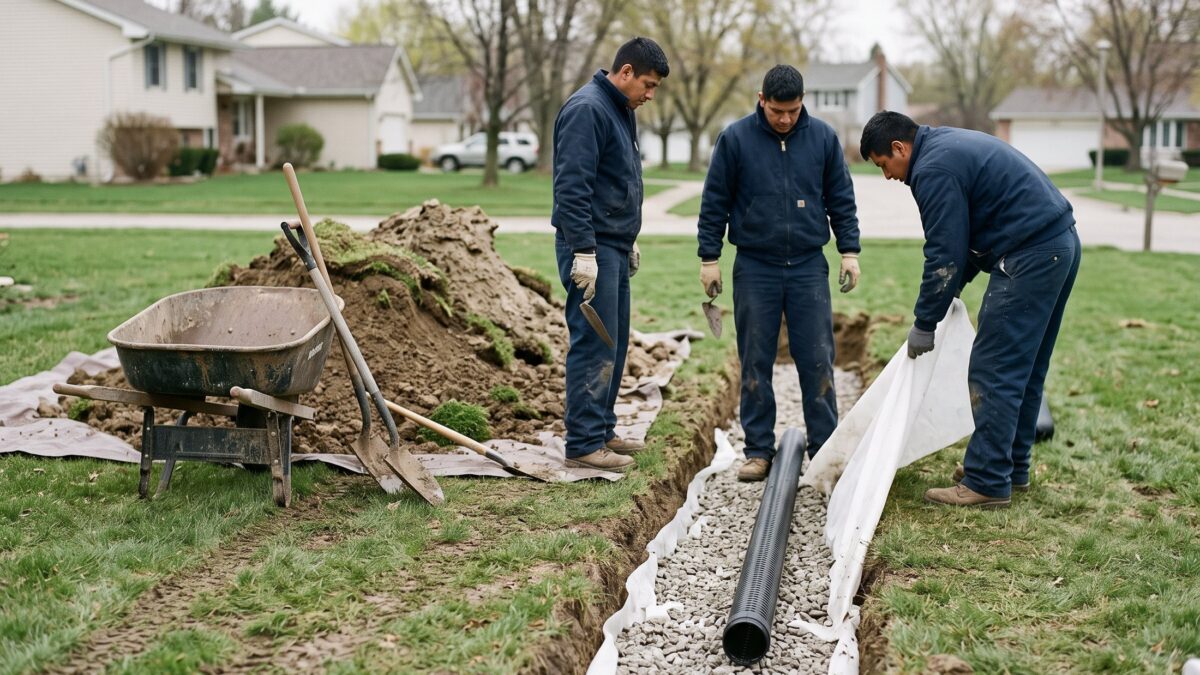
The per-foot number covers a finished, draining trench, not just a hole. Five things go into every foot of it, and a quote missing any of them is not cheaper, it is smaller.
This is the build, in the order the crew does it on a normal yard.
-
Measured trench feet, not yard feet
We measure the run the pipe will follow, which is almost never the length of the wall or the property line. Curves around beds and trees add feet. Getting this number right on paper is what keeps the final invoice matching the estimate.
-
Excavation to a working depth
A yard drain is cut deep enough to sit below the wet zone and still hold fall from one end to the other. In clay that usually means a narrow trench with clean walls, dug by machine where a machine can reach and by hand where it cannot.
-
Stone volume and filter fabric
Washed stone fills the trench around the pipe and does the actual storing during a downpour. Fabric wraps the stone so clay fines cannot migrate in and pack it solid, which is the failure that kills untreated gravel trenches in this soil.
-
Perforated pipe set to fall
Pipe goes in on grade, holes down, pitched toward the outlet the whole way. Fall is checked with a level or a laser rather than eyeballed, because a flat spot in a clay yard becomes a standing pool inside the drain within a season.
-
An outlet and the restoration
The run has to end somewhere legal and lower: daylight at a slope, a pop-up emitter, or a catch basin tied into an existing line. Then topsoil goes back, sod or seed follows, and the machine tracks get raked out.
What the number includes
- Excavation, stone, fabric, pipe and backfill for every measured foot
- Pitch set and verified along the whole run
- Basic yard restoration over the trench line
- Written scope before anyone starts digging
- A 5-year warranty on the drainage work
What sits outside it
- Catch basins, emitters and structures are priced as units, not by the foot
- Cutting and replacing driveway, patio or walkway sections
- Sod, new planting beds or irrigation heads that get taken out
- A pump, if the yard gives us nowhere downhill to send the water
Why do two quotes for the same yard differ by thousands?
Two contractors can look at one wet lawn and price two completely different drains. Almost all of the gap comes from five variables, and every one of them is visible before a shovel moves.
Read any quote against this list and the cheap one usually explains itself.
-
Depth is doing most of the work
Twice the depth is more than twice the dirt, because the trench has to widen as it goes down. A drain set shallow to hit a price will run dry above the water it was meant to catch, and it will still be there next spring doing nothing.
-
What is already buried on the line
Gas, electric, irrigation, invisible fence, old clay sewer laterals and maple roots all sit in the top few feet of a Chicago lot. Locates come first. Hand digging around what the locates find is slower work, and an honest quote says so up front.
-
Where the water is allowed to go
A gravity outlet to daylight is the cheapest ending a drain can have. A flat lot may need a catch basin, a longer solid line to the parkway, or a pump. Discharge rules vary by municipality in Illinois, so check with your village before the pipe is set.
-
Access, spoil and machine size
A trencher that fits through a gate prices differently from hand work down a four-foot gangway. The excavated clay also has to go somewhere: spread thin on site if the grade can take it, or hauled off, which is a real line item on a small lot.
-
Restoration nobody quoted
Sod, beds, a fence panel out and back, a section of walkway removed and replaced. If one quote is thousands lower, this is usually the section it is missing, and you will be paying for it either way once the trench is closed.
Signs of a quote you can trust
- Measured footage written down, not paced off
- Depth and stone size stated in the scope
- The outlet named specifically, with what happens if it needs a pump
- Restoration listed as its own line
Signs it will grow later
- A round lump-sum number with no footage behind it
- No mention of utility locates
- Gravel with no fabric, which silts up in clay
- A discount that expires if you do not sign today
Exterior French drain or interior drain tile: which costs less?
The exterior number is lower per foot, but the two are not buying the same result. Compare them on what moves the price and on what each one is capable of fixing.
| Exterior French drain | Interior drain tile | |
|---|---|---|
| Published price | $45 to $90 per linear foot | $95 to $160 per linear foot |
| Where it sits | Out in the yard, above foundation depth | Inside the slab edge, beside the footing |
| What moves the price | Depth, access, outlet, restoration | Wall length, wall type, slab thickness |
| Usual add-ons | Catch basins, emitters, downspout tie-ins | Sump pit and pump, weep holes, new concrete |
| Restoration bill | Lawn, beds and any hardscape on the line | Flooring and the base of finished walls |
| Working season | Stops once the ground freezes | Any month of the year |
| What it cannot fix | Groundwater already standing at the footing | A lawn that holds water after every storm |
| Warranty | A 5-year warranty on drainage work | A lifetime, fully transferable warranty on the system |
A per-foot number only means something next to a length. Ask for both, on both systems, before you compare totals: interior drain tile cost per foot breaks the other side down the same way.
Want the footage measured before you compare prices? We measure the run, name the outlet and put the number in writing, free within 48 hours.
What drives the number at your house?
Lot size, grade and what the builder left in the ground set the price more than the building does. These four cover most of the yards we price across the seven counties.

Pre-war bungalows and two-flats
Short front yards, a gangway measured in feet and a parkway at the end of it. Runs are short but almost everything is hand dug, and the spoil goes into a truck because there is nowhere on site to spread it.
Short run, high per foot
Post-war block ranches
Wide flat lots where the whole back yard holds water. Trenching is easy and the machine has room, but finding fall to an outlet across a hundred feet of level clay is the part that decides the price.
Cheap to dig, hard to end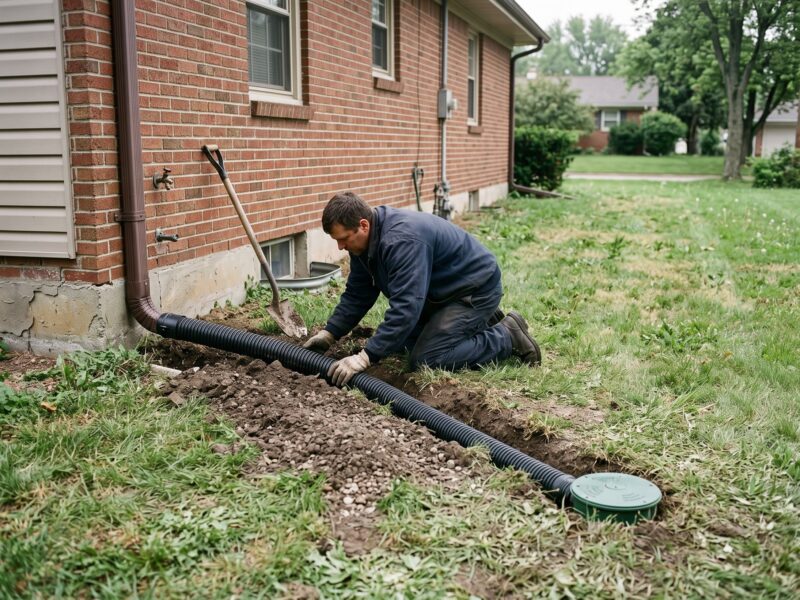
1980s and 90s subdivisions
Deep clay backfill and downspouts that were buried to a line nobody has seen since. Half these jobs start as a drain quote and finish as a downspout repair with a new emitter.
Check the buried lines first
Newer subdivision homes
Grading built to plan and then settled, with an approved storm structure usually available at the lot line. Machine access is genuinely good, which keeps the per-foot number near the bottom of the range.
Best case on pricePublished ranges for the work around a drain
Exterior French drain work is $45 to $90 per linear foot at yard depth, so a measured 60 foot run lands between $2,700 and $5,400 before any outlet structure is added.
| Work | Range | What moves the number |
|---|---|---|
| Exterior French drainper linear foot | $45–$90 | Trench depth, where the water can legally go |
| Interior drain tileper linear foot | $95–$160 | Length of the run, slab thickness, what has to be moved off the walls |
| Downspout extensions and regradingtypical job | $600–$2,500 | Feet of grade to rebuild, soil hauling |
| Sump pump with battery backupinstalled | $2,800–$4,500 | Pit condition, backup capacity, discharge routing |
Excavation down to footing depth is the one drainage line we will not publish a per-foot price for, because depth and access change it too much to put in a table honestly; that scope gets quoted in writing after we have walked the lot. Every other range on this page also lives on the pricing page.
When a French drain is the wrong thing to buy
A good share of the wet yards we price do not need one. We would rather say that here than sell a trench that changes nothing.
The roof water never gets away from the house
One buried downspout line crushed under a driveway can put hundreds of gallons in the same corner every storm. Fixing extensions and grade runs $600 to $2,500, and it is the first thing to rule out. Start with the downspout lines.
Cheapest real fixThe wet is inside, not out in the lawn
If the lawn dries out fine but water shows up at the joint where the basement floor meets the wall, a yard drain will not reach it. That water is already at the footing. Interior drain tile is what handles it.
Wrong toolThe water is arriving from someone else's lot
When runoff comes over a property line or a village storm structure is backing up, that is a drainage question before it is a construction one. Illinois drainage law is general, and how it is applied varies by municipality; talk to your village and, if it stays unresolved, an attorney.
Not a contractor callYou have only seen it once
One soggy week after a February thaw is not a pattern. Put a $20 rain gauge out, mark where the water stands and how long it takes to drain, and watch it through a spring. A drain priced off a year of notes is a drain built the right length.
Costs almost nothingQuestions homeowners ask about French drain pricing
How much does a French drain cost in the Chicago area?
Exterior work is $45 to $90 per linear foot. Run the arithmetic on the two lengths we install most: 40 feet works out to $1,800 to $3,600, and 80 feet to $3,600 to $7,200, before any outlet structure. Catch basins and emitters are priced separately as units. Turning the per-foot number into a real total takes a measured run and a named outlet, which is what the free estimate produces.
Why is interior drain tile more expensive per foot?
Interior work at $95 to $160 per foot includes cutting and removing concrete, digging beside a footing in a confined basement, drilling weep holes in block, hauling every bucket of spoil up the stairs and pouring fresh concrete over the finished channel. A yard trench is dug by machine in open air with the spoil sitting next to it. Different conditions, different labor, different number.
Does the quote include hauling the dirt away?
It depends on your lot, and it should say so in writing. On a wide lot the excavated clay can often be spread and graded on site at no extra cost, which is the cheapest outcome. On a narrow city lot with nowhere to put it, the spoil goes into a truck, and disposal is a line item. Ask which one your quote assumes before you sign it.
Can you give me a price over the phone?
We can give you the published per-foot range over the phone, and we will. What we cannot do is turn it into a total without seeing the fall of the yard and where the water is allowed to go, because those two things swing the price more than length does. The visit is free and happens within 48 hours, and the written number holds.
Is a longer drain cheaper per foot?
Slightly, and less than people expect. Mobilization, locates and the outlet get spread across more feet on a long run, which pulls the average down a little. Material and machine hours do not scale down at all. A 120 foot run costs close to double a 60 foot run, so the real saving comes from designing the shortest line that actually catches the water.
What makes the price change once digging starts?
Three things, mostly: a utility found where the locate marks did not put it, an old buried line that has to be crossed or replaced, and an outlet that turns out to be higher than the survey suggested. We price change orders in writing before doing the work, never after. A quote with no contingency language at all is the one to ask questions about.
Should the drain go in the yard or in the basement?
Price is the second question. The first is which drain catches the water you actually have, because a yard trench and a footing drain intercept it at completely different points. We lay both out side by side, with the symptoms that point to each, so you can rule one out before you start collecting numbers.
Compare exterior and interior French drains

Get the footage measured and the number in writing
Free measured estimate within 48 hours, published per-foot pricing, 0% for 12 months financing and 20+ of Chicago yards behind the number.
Or talk to a human right now
(630) 335-1128
Request your free estimate
Tell us what you're seeing. We'll call back fast and be out within 48 hours.