
A Leaking Foundation Crack: Seal It, or Fix the Wall?
A crack that weeps after every storm is usually a plumbing-grade repair, not a structural one. The trick is knowing which cracks belong in that group before you spend money sealing a wall that is still moving.
- Written crack diagnosis, free within 48 hours
- $450 to $900 per crack, published before we start
- 20+ in Chicago basements, 1,500+ homes
 Injected cracks: 10-year warranty
The short answer
Most leaking cracks in a poured Chicago foundation are shrinkage cracks, and urethane injection fills them through the full wall thickness for $450 to $900 per crack. The exceptions are horizontal cracks, cracks with one face pushed past the other, and cracks that keep widening. Those are movement, and sealing them without stabilizing the wall only buys dry months.
A crack leaks because it goes all the way through. Poured concrete gives up volume as it cures, and the shrinkage collects along the weakest line in the pour, usually beside a window buck, above a rod hole, or where the wall steps down. The opening is often hairline on the room side and noticeably wider against the soil, so wet ground finds it years before you notice a damp streak. No dramatic pressure is required either. Saturated backfill standing six feet deep supplies all the head the crack needs.
Around Chicago the soil does the work. Glacial clay holds a storm against the wall for days instead of draining it away in hours, so a crack that stayed bone dry through August starts running during the March thaw and again in the first hard June rain. That rhythm, quiet for months and then wet on a schedule the weather sets, is the signature of a seepage crack rather than a structural one. Where a crack sits at the other end of that scale, the foundation repair overview covers what stabilizing a wall actually involves.
How does urethane injection seal a leaking crack?
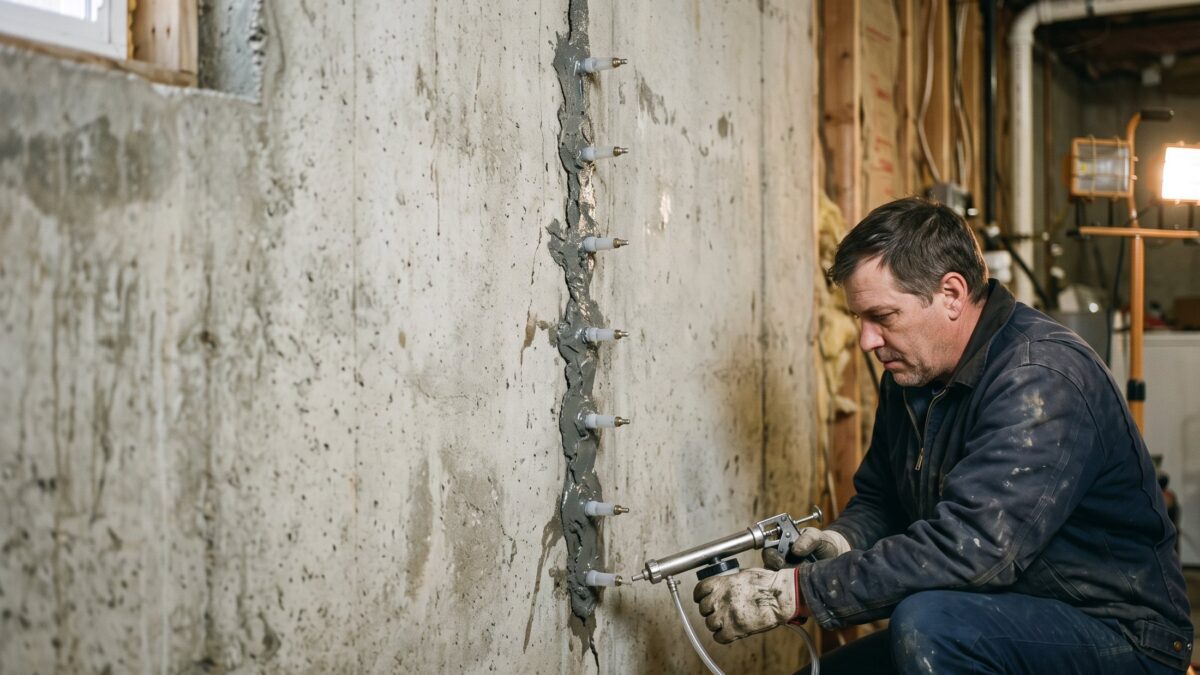
Urethane injection turns the crack itself into the gasket. Resin is pushed in under pressure, meets the moisture already in there, expands and cures against both faces of the concrete.
A single crack takes a couple of hours from setup to cleanup, and it runs in this order.
-
Read the crack before touching it
We measure the width at the top, middle and bottom, look for offset between the two faces, and check whether it continues into the floor slab. That reading decides whether injection is the right product at all, or whether we are looking at a wall problem wearing a leak as a symptom.
-
Set surface ports along the line
Injection ports are bonded to the face at intervals close enough that resin travelling inside the crack reaches the next one. Spacing follows wall thickness rather than a fixed rule, so a thick basement wall gets more ports than a thin garage foundation.
-
Cap the face
A paste seal goes over the crack between the ports. Without it the resin takes the easy route and runs back out into the room instead of travelling sideways and outward into the part of the crack you cannot see.
-
Inject from the bottom port up
Resin goes in at the lowest port until it appears at the one above, then that port is capped and the gun moves up. Working upward pushes water ahead of the resin instead of trapping it, and it keeps the fill continuous rather than leaving pockets.
-
Cure, trim and prove it in a storm
The urethane foams into the void, cures within minutes, and the ports come off once it has set. The real test is the next heavy rain. Every injection we do carries a 10-year warranty, so a crack that weeps again is our problem to come back for.
Best for
- Poured concrete walls with a vertical or diagonal crack that weeps
- Cracks under 1/8 inch with no offset between the faces
- Finished rooms, because nothing gets demolished to reach the crack
- Any season, including a January when nobody can dig outside
- Cracks around rod holes, window corners and cold joints
What it does not do
- It adds no strength, so it will not hold a wall that is bending
- Block walls swallow resin into the hollow cores, so injection rarely suits them
- It cannot fix water arriving over the top of the wall or through the cove
How do you know a crack is structural?
Structural cracks announce themselves through shape, direction and movement, not through how much water they let in. A dry crack can be far more serious than a wet one.
Five checks, all of which a homeowner can run with a flashlight and a tape measure.
-
Measure the width, not the length
Length tells you almost nothing. Width is the number that matters. Hairline to 1/16 inch is ordinary curing behaviour in a poured wall. Anything past a quarter inch, or a crack that is clearly wider at one end than the other, gets treated as movement until proven otherwise.
-
Look at the direction it runs
Vertical and near-vertical cracks in poured concrete are usually shrinkage. Diagonal cracks running off a corner point toward settlement below. A crack running horizontally along the wall is soil pressure pushing inward, and that one is never a candidate for injection alone.
-
Feel for offset across the faces
Run a finger across the crack. If one side sits proud of the other, or the two edges no longer line up as a matching pair, the wall has shifted rather than shrunk. Offset in any direction changes the conversation from waterproofing to stabilization.
-
Gauge it through a full season
A $20 crack gauge glued across the line, read once a month, settles most arguments. Illinois clay swells in spring and shrinks in a dry August, so a crack that opens and closes slightly with the seasons behaves differently from one that only ever gets wider.
-
Read the rest of the house
Walls do not move in isolation. Doors that bind in one corner of the house, a floor that has started to slope, and stair-step cracking in the brick above grade all say the same thing the crack is saying. One symptom is a maybe. Three is a pattern.
Signs it is only shrinkage
- Vertical, hairline at one end, no offset between faces
- Present since the first year the house stood, unchanged since
- Wet only during storms and spring thaw, dry the rest of the year
- No matching symptoms upstairs in doors, floors or brick
Signs the wall is moving
- A horizontal crack, usually partway up a block or poured wall
- One face pushed inward past the other
- Measurable widening across a season on a gauge
- Fresh debris or dust below the crack after a dry week
Seal the crack, or stabilize the wall?
These are two different trades solving two different problems. Set them next to each other and the leak in front of you usually sorts itself into one column.
| Urethane injection | Structural repair | |
|---|---|---|
| What the repair fixes | Water travelling through a crack that is not moving | A wall that is bending, leaning or dropping |
| Typical crack | Vertical or diagonal, hairline to 1/8 inch, faces aligned | Horizontal, offset, or measurably widening |
| Published cost | $450 to $900 per crack | Straps $600 to $1,000 each, steel beams $900 to $1,500 each |
| Time on site | Two hours for a typical crack | A day for most walls, longer if piers are involved |
| Disruption | A drop cloth and a stepladder | Wall face prepared, or beams anchored to slab and joists |
| Works on block walls | Rarely, resin escapes into the hollow cores | Yes, block is where bracing gets used most |
| Does it hold the wall | No, it is a waterproofing repair only | Yes, that is the entire purpose |
| Our warranty | A 10-year warranty | A 25-year transferable warranty |
| Cost of choosing wrong | A sealed crack that reopens as the wall keeps moving | Bracing bought for a wall that was only curing |
Product matters too. Urethane chases water and stays flexible, epoxy welds the concrete back together and needs a dry crack, and they are not interchangeable: epoxy vs. urethane injection covers which one your crack needs.
Want to know which kind of crack you have? We measure it, put the diagnosis in writing and quote from published numbers, free within 48 hours.
What kind of crack does your house get?
Wall material decides the crack pattern, and the era a house was built in decides the wall material. These four cover most of what we open the flashlight on across the seven counties.

Pre-war bungalows and two-flats
Rubble stone, clay brick or early concrete below grade. Water arrives through failed mortar joints and porous brick rather than a single clean crack, so there is often nothing to inject in the first place.
Rarely an injection candidate
Post-war block ranches
Block cracks along the mortar joints in a stair-step pattern, and the hollow cores hold water. Resin injected into a block wall disappears into those cores instead of filling a crack.
Diagnose the wall, not the line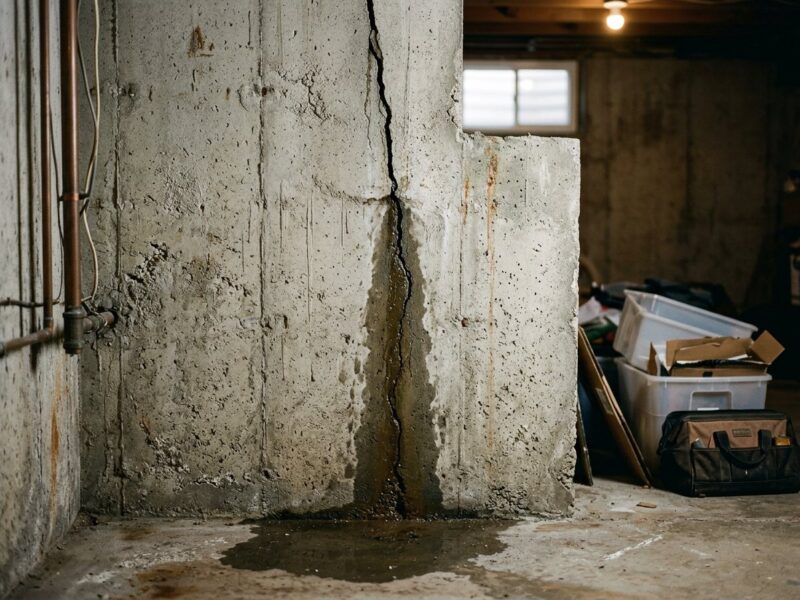
1980s and 90s poured walls
The classic case for this page. One or two vertical shrinkage cracks running from a window corner or a rod hole, dry most of the year, weeping during spring storms.
Textbook injection
Newer subdivision homes
Poured walls that are still young enough to be shrinking, on backfill that has settled into a bowl beside the house. The crack is real, but the water usually starts at the grade.
Inject, then fix the gradeWhat does a leaking crack cost to fix?
Urethane injection runs $450 to $900 per crack, quoted per crack rather than by the hour, so two cracks in the same wall land between $900 and $1,800 and you know that before we open a case.
| Work | Range | What moves the number |
|---|---|---|
| Urethane crack injectionper crack | $450–$900 | Crack length and width, access to the full height |
| Carbon fiber strapsper strap | $600–$1,000 | Wall height, spacing the deflection requires |
| Steel I-beam wall bracingper beam | $900–$1,500 | Ceiling height, footing condition at the base |
| Push or helical piersper pier | $1,600–$3,000 | Depth to load-bearing strata, access for equipment |
The three ranges below injection are there for scale, not because most leaking cracks need them. They apply when the diagnosis comes back as movement instead of seepage. Every number we quote from lives on the pricing page.
When the crack is not what is wrong
Plenty of the cracks we get called out to look at are not the source of the water, and a few are not a problem at all. Saying so on the visit costs us a sale and keeps our name clean.
The water is being delivered from the roof
A downspout dumping at the wall or a grade that has settled back toward the house drops hundreds of gallons into the backfill in one storm. Correcting that runs $600 to $2,500 and often dries the crack on its own. Start with the slope around the foundation.
Cheapest real fixIt is the cove joint, not the crack
Water pooling at the base of the wall may be arriving where the wall meets the slab rather than through the crack above it. The crack simply gets the blame because it is visible. The cove joint has its own tell, and it needs drainage, not resin.
Different repairIt has not changed since the Reagan administration
A hairline vertical crack that has been in a poured wall for decades, stays dry, and shows no offset does not need anything. Glue a $20 gauge across it, read it once a month, and call someone only if the number moves.
Costs $20 to checkThe water is on the wrong side of the wall for weather
A wet spot that shows up in dry weather, or a floor drain that backs up during storms, is a plumbing issue rather than a foundation one. That belongs with a licensed plumber. Sewer backup and seepage look nothing alike once you know the tells.
Not our workQuestions homeowners ask about leaking cracks
Can I seal a leaking foundation crack myself?
You can seal the inside face with a hydraulic cement patch, and it will stop the drip for a while. What it does not do is fill the crack out to the soil side, so water keeps standing in the wall and eventually finds the edge of your patch. The value of injection is that it fills the full thickness. If you patch first, tell whoever injects later, because a patch has to come off before ports go on.
Will the crack open again after injection?
Cured urethane stays flexible, so it tolerates the small seasonal movement every Illinois foundation goes through as the clay swells and shrinks. A properly injected shrinkage crack should not leak again, which is why ours carry a 10-year warranty. What injection cannot survive is real structural movement. If the wall keeps shifting, the resin will eventually be torn, and that is a sign the original diagnosis missed something.
Why does my crack only leak in spring?
Because spring is when the ground is fullest. Frozen soil thaws from the top down while the layer below is still locked, so meltwater has nowhere to go but sideways against your wall, and it arrives on top of ground that is already saturated. Add a rain on that and the head of water beside your foundation is at its annual peak. Summer storms drain faster because the clay has somewhere to put the water.
Do you have to dig outside to fix a leaking crack?
Almost never. Injection is done from inside the basement, which is one of the reasons it stays affordable and can be scheduled in February. Excavating to reach the outside face is reserved for walls where the concrete itself has deteriorated or where the crack is only part of a larger failure across the wall face. On an ordinary vertical shrinkage crack, digging costs many times more and buys nothing extra.
My crack is in a block wall. Can it be injected?
Usually not, and any contractor who says yes without looking is guessing. Block is hollow, so resin pumped into a joint travels into the cores and down instead of filling a defined void. Block walls leak through mortar joints and through water standing in those cores, which is a drainage problem. The honest answer for most block basements is a system that relieves the wall rather than a repair aimed at one line.
Do I have to disclose a repaired crack when I sell?
Illinois requires sellers to disclose material defects they know about, and a foundation repair generally falls into what buyers ask about directly. In practice a documented repair with a transferable warranty reads better to a buyer than an undocumented damp corner, so keep the paperwork. Rules and local practice vary, so run the specifics past your real estate attorney. <a href="/foundation-repair/foundation-repair-home-sale/">Repairs and home sales</a> covers what tends to come up.
How wide is too wide?
Width is the single measurement that separates a two-hour repair from a structural conversation, and most homeowners guess it high because a wet crack looks bigger than it is. Our crack width guide walks through what each range actually means in a poured wall and in block, with the offset check that matters more than width alone.
Read the crack width guide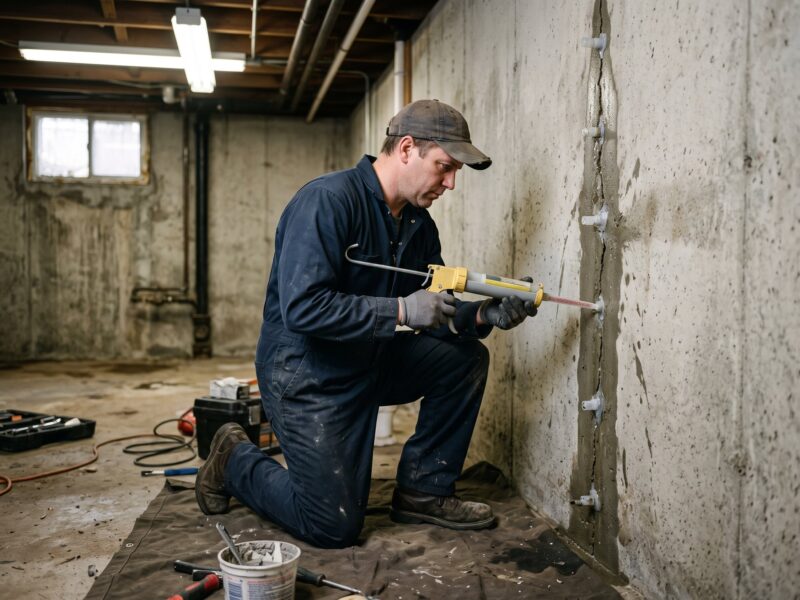

Get the crack measured before anyone quotes a repair
Free written diagnosis within 48 hours, published per-crack pricing, 0% for 12 months financing and 24/7 response when water is running.
Or talk to a human right now
(630) 335-1128
Request your free estimate
Tell us what you're seeing. We'll call back fast and be out within 48 hours.