
Horizontal Cracks and What They Mean
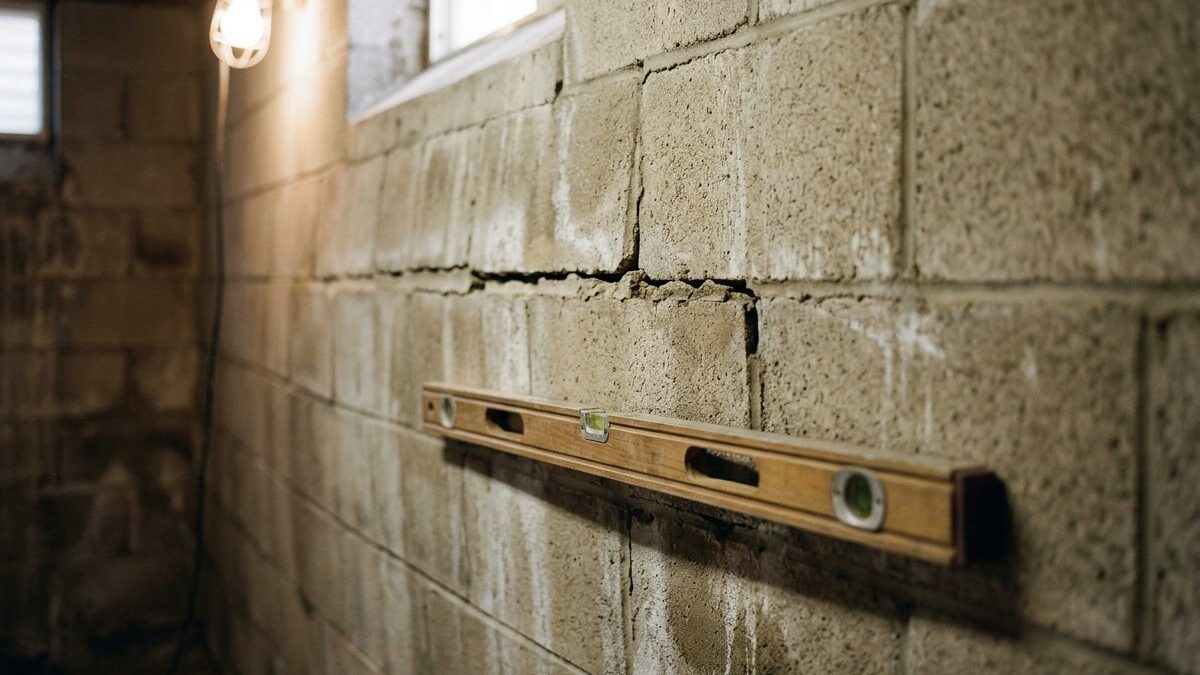
Of everything that can crack in a basement, a line running level across the wall is the one worth acting on. It means the wall is bending under load, and load does not go away by itself.
- Deflection and crack offset measured free within 48 hours
- 24/7 response when a wall has moved suddenly
- Published pricing on straps, beams and anchors, 20+ in business
 Wall stabilization: 25-year transferable warranty
The short answer
A horizontal crack means soil outside is pushing harder than the wall can resist, so the wall is bending inward and has failed along a level line. Unlike a vertical shrinkage crack, this pattern is structural. Measure how far the wall has moved off plumb, stop the water feeding the pressure, and brace it.
Foundation walls are built to hold back dirt, and dirt behaves like a liquid once it is saturated. That pressure acts sideways across the whole buried face. A wall carries it by working like a beam standing on end, spanning from the footing to the floor framing above. When the load passes what the wall can carry in bending, it breaks along a level line, usually near mid-height where the bending is greatest, and the wall hinges there from that day on. The crack runs horizontally because it follows the shape of the failure.
The soil around this region is unusually good at applying that load. Glacial clay swells as it takes on water and holds it for days after a storm rather than draining, so the pressure lingers instead of passing. Illinois frost reaches deep enough in a hard winter to push on the upper courses as well, and the backfill beside thousands of post-war basements is the same clay that came out of the hole. This crack sits at the urgent end of the symptom list on our basement and foundation problems hub.
What causes a horizontal crack in a basement wall?
Horizontal cracking is a bending failure, and bending needs a sideways load. Five sources supply that load in this region, and they stack on the same wall.
Each one leaves the crack in a slightly different place, which is the first thing we look at.
-
Saturated clay presses on the wall
Wet clay is both heavier and more mobile than the drained soil a wall was designed for. Days of pressure after every storm is the ordinary Chicago version of this load, and it is why the crack so often appears in a wet spring rather than during the storm itself.
-
Water stands in the backfill
With no working footing drain, the trench beside the wall fills and behaves like a standing column of water. The push is largest at the base, which is why some walls shear low and slide inward at the bottom course instead of cracking at mid-height.
-
Frost shoves from the top down
Wet soil freezing against the upper courses expands, pushes, then releases in the thaw. A crack up near the top of the wall with the top course displaced inward is usually a winter story, and it tends to repeat each year until the drainage changes.
-
Something heavy sits on the backfill
A driveway, patio slab, parked truck or loaded dumpster transfers weight into soil that is already pushing. Narrow side yards with concrete run right up to the house make this common, and the crack lines up with whatever is sitting outside.
-
The wall breaks at its weakest line
Block gives up along a bed joint, so the crack is dead level and follows the mortar. Poured concrete has no joint to follow, so it opens a long horizontal crack wherever the bending peaked, often running much further than the visible part suggests.
Where the crack tells you to look outside
- Directly above the crack, at grade and at the nearest downspout
- Any hardscape within a few feet of that wall
- The gangway between houses, where two roofs drain to one strip
- Window wells on that wall that fill and hold water
- The low corner of the lot, if the grade falls toward the house
What makes it move faster
- A saturated spring following a deep freeze
- Heavy equipment or fill piled against the wall outside
- Excavation on the neighboring lot
- A window well or footing drain that has silted shut
How urgent is a horizontal crack, and what should you check this week?
Urgency is set by displacement, not by crack width. A level crack with the wall still plumb is a different situation from the same crack with two inches of bow behind it.
Five checks, in this order, will tell you whether this is a phone call today or a measurement to repeat in the spring.
-
Sight down the wall
Put your eye at one corner and look along the face of the wall toward the far end. A bulge that is invisible standing in the middle of the room is obvious from that angle, and it is the single fastest way to know whether the wall has actually moved.
-
Drop a string from top to bottom
Tape a string at the top of the wall with a weight on the end and measure the gap at the crack. That number is the deflection, and it is the number every honest quote is built on. Write it down with the date and the location along the wall.
-
Check for shear at the crack
Feel across the crack with your hand. Block that has slid inward so the lower face stands proud of the upper one has sheared, not just cracked. Any daylight, soil or root visible through the opening moves this to the front of the queue immediately.
-
Look at the top of the wall
Go to where the wall meets the framing and look for a gap opening under the sill plate, or the top course pushed inward past the joists above it. A wall losing its bearing at the top is a genuinely urgent condition, whatever the crack width says.
-
Clear the outside load today
Move the vehicle, the fill pile or the stacked pavers off the backfill beside that wall, and get downspouts running well away from it. None of that repairs anything, but it stops adding to a load the wall has already told you it cannot carry.
Get it looked at now
- The wall is visibly bowed when you sight along it
- The two faces of the crack have shifted out of plane
- A gap has opened under the sill plate at the top
- The crack has grown since it was last marked
- Soil, roots or daylight are visible through the opening
Measure and re-read next season
- A hairline level line with the wall still plumb
- An old crack under two coats of paint with clean edges
- No change across a wet spring and a dry summer
- No damage anywhere else on that wall or the floor above
Horizontal crack or vertical crack: what actually changes?
Direction is the most useful single fact about a foundation crack. Two cracks of identical width mean entirely different things depending on which way they run.
| Horizontal crack | Vertical crack | |
|---|---|---|
| What it means | The wall is bending under sideways soil load | Concrete shrank as it cured, or the wall moved slightly |
| How common | Far less common, and rarely harmless | The most common crack in a poured basement wall |
| Structural | Yes, by definition | Usually not, unless it is displaced or widening |
| Typical location | Mid-height, or along one mortar bed joint | From the footing upward, often at a form tie or a window |
| First measurement | Deflection off plumb, in inches | Width, and whether it changes on a dated mark |
| Usual repair | Straps, steel beams or wall anchors, plus drainage | Urethane injection at $450 to $900 per crack |
| If it leaks | Sealing it alone leaves the load untouched | Injection normally ends it for good |
| Timing | Look at it now, not next season | Reasonable to mark it and watch a season |
| Our warranty | A 25-year transferable warranty on stabilization | A 10-year warranty on the injection |
Any measurable offset between the faces of a horizontal crack, or growth on a dated mark, is our own trigger for recommending an independent structural engineer. Those are field triggers we use to decide when to escalate, not a published standard, and the acceptable limit for one particular wall is the engineer's call. Widths across every crack type sit in the crack width guide.
Found a level crack across your wall? We measure the deflection, photograph the wall and give you the numbers in writing, free within 48 hours.
Which walls crack horizontally?
Wall construction decides where the crack lands and how much warning you get. These four cover almost every horizontal crack we are called to across the seven counties.

Pre-war stone and early block
Irregular units mean these bulge rather than crack in a clean line, so the warning sign is a belly in the wall and mortar washing out of the joints. They move slowly and they do not move back.
Hold it where it stands
Post-war block ranches
The most common case in this region by a wide margin. A dead-level crack along one mortar bed joint about halfway up the long back wall, usually with stair-stepping at both ends of the same run.
Measure plumb, then brace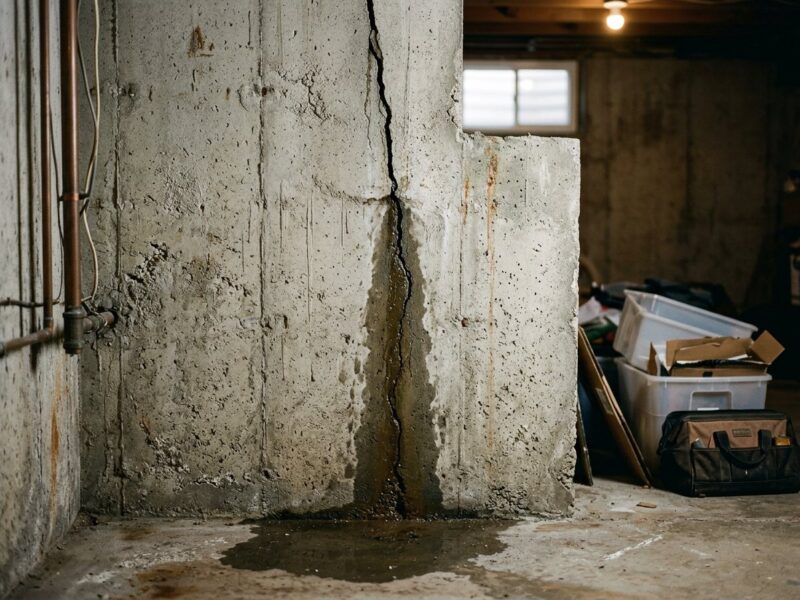
1980s and 90s poured walls
Poured concrete resists bending longer, so when it finally cracks the line runs a long way and often surprises people with how far it extends. Frequently traced to a driveway loading the backfill on one side.
Straps, once the load is off
Newer subdivision homes
Tight side yards, concrete close to the wall and backfill that never fully compacted. Movement here is usually early and small, and catching it at that stage is the least expensive version of this repair.
Fix drainage, then measureWhat does a horizontal crack cost to repair?
Hardware count drives the number, and we publish the pieces: carbon fiber straps at $600 to $1,000 each, steel I-beams at $900 to $1,500 each, and wall anchors at $1,000 to $1,800 each.
| Work | Range | What moves the number |
|---|---|---|
| Carbon fiber strapsper strap | $600–$1,000 | Wall height, spacing the deflection requires |
| Steel I-beam wall bracingper beam | $900–$1,500 | Ceiling height, footing condition at the base |
| Wall anchorsper anchor | $1,000–$1,800 | Yard access for the exterior plate, soil conditions |
| Urethane crack injectionper crack | $450–$900 | Crack length and width, access to the full height |
Spacing is set by the wall rather than by a quota, so a long back wall commonly takes five or six pieces. Six straps at $600 to $1,000 each lands that wall between $3,600 and $6,000 before drainage. Injection appears on this list only where a stabilized wall still needs sealing. Every range is on the pricing page.
When that level line is not what you think
Not every horizontal line across a basement wall is a crack, and not every crack is still moving. These four outcomes come up often enough to be worth checking before anyone quotes steel.
It is a cold joint, not a crack
Poured walls placed in two lifts leave a visible seam where the second pour met the first. Rod holes leave a level row of plugs. Both look like cracking and neither is. Cold joints and rod holes explains what those lines actually are.
Costs nothing to checkIt cracked decades ago and stopped
Some walls moved during one bad season in the 1970s, found equilibrium and have sat still since. Old paint carried across the crack, clean dust lines and no fresh edges all say so. Mark it, date it, read it again after the spring rain before spending anything.
Measure, then waitThe wall is plumb and only leaking
A level crack in a poured wall that is still plumb, still in plane and weeping in heavy rain is a sealing job rather than a structural one, at $450 to $900 per crack with a 10-year warranty. It still gets measured first, because plumb is the whole basis of that call.
Smaller repairYou want a spec no contractor wrote
Where the wall has moved appreciably, the most useful money you can spend is on an independent structural engineer who sells nothing. Their letter defines what your wall needs, and then every bidder including us has to price the same scope instead of their own.
Hire outside usQuestions homeowners ask about horizontal cracks
Is a horizontal crack in a foundation wall always serious?
Treat it as serious until measurement says otherwise. The direction alone tells you the wall bent under sideways load, which no vertical shrinkage crack does. What varies is how far it has gone. A hairline level line in a plumb wall may have been stable for thirty years, while the same crack with an inch of bow behind it needs work this season. Deflection off plumb is the number that decides it, not the width of the crack.
Can I just seal or inject a horizontal crack and be done?
Only if the wall is genuinely stable, and even then sealing addresses the leak rather than the load. Filling an active crack hides the evidence you were going to read and the wall keeps moving underneath it. In hollow block it does not work at all, because injected material runs into the open cores. The order is measure, relieve the water, stabilize the wall, then seal if sealing is still needed.
Why did the crack show up in the spring?
Because that is when the load peaks here. Frozen clay thaws and takes on melt water while the ground below is still tight, the backfill saturates, and the pressure against the wall runs high for weeks rather than hours. Walls that have been quietly bending for years often reach their limit in that window. It is also why a crack that appeared in April deserves a reading again in August, not just once.
Does a horizontal crack mean the wall has to be rebuilt?
Rarely. Most of these walls are stabilized where they stand with carbon fiber straps or steel beams tied into the framing above and the slab below, and that stops the movement permanently when the water load is also removed. Rebuilding is reserved for walls with badly displaced courses or mortar that has washed out over decades. Our stabilization work carries a 25-year transferable warranty that transfers with the house.
Will a home inspector flag this when I sell?
Almost certainly, because it is one of the patterns inspectors are trained to call out and photograph. Illinois sellers also have a disclosure obligation on known material defects, so an unrepaired horizontal crack tends to reappear as a price negotiation. A documented repair with a transferable warranty answers the question before it becomes leverage. <a href="/foundation-repair/foundation-repair-home-sale/">Repairs and home sales</a> covers how buyers and lenders treat it.
What should I do first, today?
Take the load off the outside. Move anything parked or piled on the backfill beside that wall, get every downspout discharging well away from the house, and clear window wells that are holding water. Then sight along the wall, drop a string line and write the deflection down with the date. That takes an hour, costs nothing and gives any contractor the one measurement they should be quoting from.
What happens once the wall has actually bowed
A horizontal crack is the first chapter; a bowed wall is the rest of it. That page covers how deflection is measured and recorded, how straps, steel beams and yard anchors differ in what they can do, and why bracing without fixing the drainage puts you back in the same basement in a few springs.
Bowing and leaning basement walls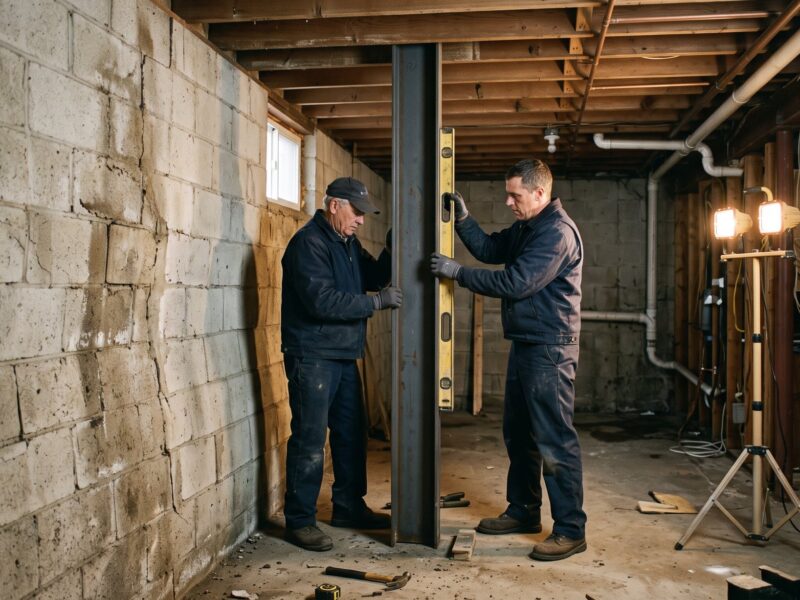

Get the deflection measured this week, not next spring
Free written measurement within 48 hours, published pricing on every strap, beam and anchor, and 24/7 if the wall has moved suddenly.
Or talk to a human right now
(630) 335-1128
Request your free estimate
Tell us what you're seeing. We'll call back fast and be out within 48 hours.