Musty Basement Smell and What's Causing It
Concrete has no smell. What you are smelling is damp material sitting in still air, and finding which material it is usually costs nothing but an afternoon and a flashlight.
- Free written diagnosis within 48 hours
- We say so when the fix costs you nothing
- 1,500+ homes across seven counties
 20+ of Chicago basements, straight answers
The short answer
A musty basement smell comes from damp organic material, usually cardboard, carpet pad, paper-faced drywall or framing lumber, supporting mold and mildew growth in still air. The odor is the byproduct of that growth. Remove the moisture, remove the material, or move the air, and the smell goes with it.
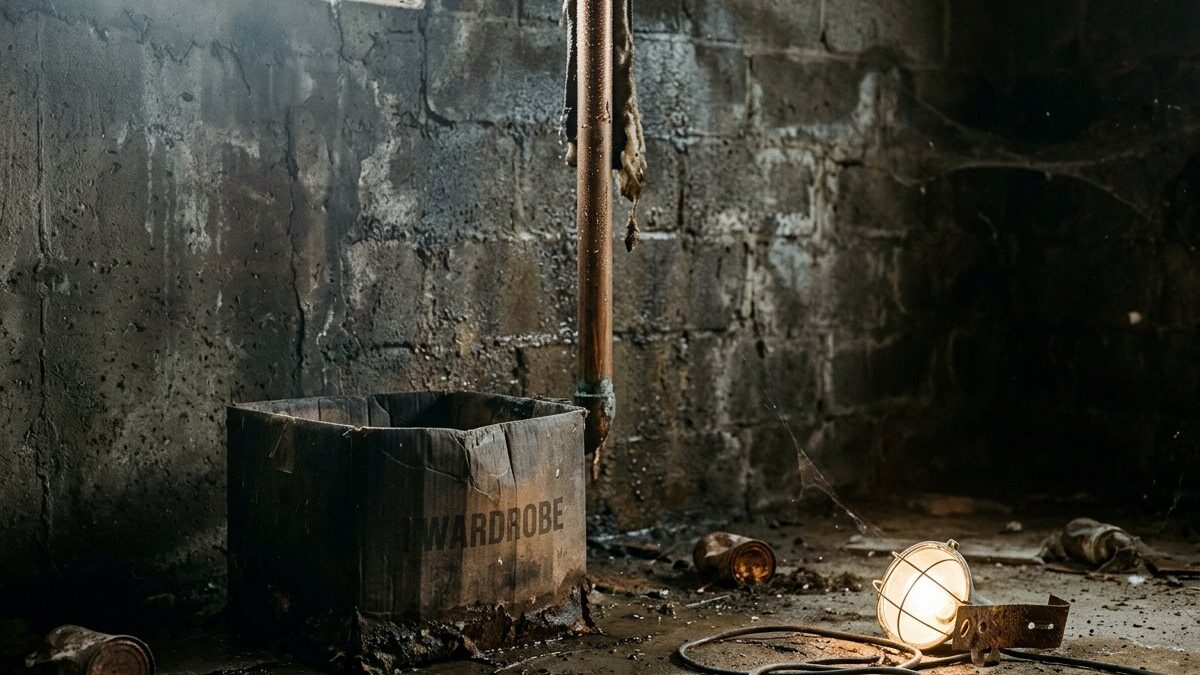
Three things have to line up before a basement smells. There has to be moisture, whether that is liquid water tracking in or simply air holding more than the room can carry. There has to be something organic for growth to feed on, which is why the smell clings to boxes, carpet, paper facing and wood rather than to bare block. And the air has to sit still long enough for the byproducts to build up instead of blowing away. Take away any one of the three and the odor fades.
A Chicago basement supplies all three by default. Below-grade walls stay near fifty-five degrees while July air arrives at a sixty-something dew point, our clay lots hold water against the foundation for days after a storm, and the average basement here has no mechanical ventilation at all. That is why the smell shows up in June, sharpens after every rain and quietly disappears once the furnace runs. If the odor arrives alongside actual water on the floor, the basement and foundation problems hub sorts out which symptom you are dealing with.
Why does my basement smell musty?
The smell is a byproduct, not a material. Something down there is damp and organic, and the odor is what growth on it gives off.
Here is the chain, from the weather outside to the smell on the stairs.
-
Moisture arrives, one way or another
It comes through the wall as seepage, up through the slab as vapor from damp clay, or down the stairwell as humid summer air. All three end with more water in the room than the room can hold onto.
-
It settles into whatever will hold it
Concrete sheds it, but cardboard, carpet pad, paper drywall facing, stored fabric and framing lumber absorb it and stay damp long after the air dries out. Those materials are the reservoir the smell lives in.
-
Growth starts on the damp material
Mold and mildew are ordinary, they are everywhere, and they need a damp surface with something to feed on. A finished basement gives them paper and wood; an unfinished one gives them your stored boxes.
-
The byproducts have nowhere to go
Growth releases gases as it works. In a room with no exhaust fan and one door at the top of a stairway, those gases accumulate instead of dispersing, which is why the smell hits you hardest on the bottom step.
-
The house circulates it upstairs
A furnace return in the basement pulls that air into the ductwork and delivers it through the whole house. People often describe the smell as coming from a bedroom vent long before they connect it to the basement.
Points to a humidity-fed smell
- It arrives in June and leaves once the furnace runs
- Cold pipes and window glass are sweating
- Cardboard on the floor feels cool and soft
- The slab is dry the morning after heavy rain
- The smell is general rather than strongest in one corner
Points to water getting in
- The odor sharpens for a few days after every storm
- One corner or one wall smells worse than the rest
- White mineral crust or dark staining low on the block
- Base trim, carpet edge or drywall bottom is soft to a fingernail
How do you find where a basement smell is coming from?
Odors are directional if you are patient. Work the room in a fixed order instead of standing in the middle guessing.
Take a flashlight and an hour, and check these five in this order.
-
The floor drain trap
A drain nobody uses loses its trap seal to evaporation, and then the pipe vents into your basement. Pour a gallon of water down every floor drain in the house. If the smell lifts within a day, that was it.
-
The sump pit
Lift the lid. A pit holding old standing water grows a film on the walls and on the float, and it smells. A bucket, a hose and twenty minutes of scrubbing usually resets it completely.
-
Stored material at floor level
Pull every box away from the walls and check the bottom flaps. Cardboard sitting on a slab wicks moisture continuously. In a lot of basements the smell walks out to the curb with the boxes.
-
The crawl space, if there is one
Open dirt under an addition evaporates moisture into the whole house and rots the wood above it. Get a light into it and look at the joists. That is a different job than waterproofing a basement wall.
-
Behind the finished walls
Framing set tight to masonry with paper-faced drywall and no drainage traps everything that comes through. If the smell is strongest along one finished wall, pull the base trim and look at the bottom inch of the board.
Free things to try first
- Refill every floor drain trap with water
- Clean the sump pit and the pump float
- Get cardboard and fabric off the slab
- Open a window on a dry, cool day and move air
When it needs more than housekeeping
- The smell returns within a week every time
- Framing, subfloor or joists feel soft or look discolored
- It is worst at one wall that also stains after rain
- There is standing water anywhere under the house
Musty smell or sewer smell?
Two odors get reported to us as the same complaint, and they lead to two different trades. Your nose can separate them in one visit to the bottom of the stairs.
| Musty and earthy | Sharp and sewery | |
|---|---|---|
| What it reads as | Damp, earthy, like an old closet or wet paper | Rotten eggs, ammonia or raw sewage |
| Where it is strongest | Near stored material, carpet or a finished wall | Right over a floor drain, a laundry sink or a basement toilet |
| When it is worst | Warm humid weather and the days after rain | Any time, and often after weeks with nobody down there |
| What you see with it | Damp boxes, staining low on the wall, soft trim | Nothing visible at all, or a dry drain grate |
| What makes it worse | Closing the basement up and running no air | Running a bathroom fan or dryer that pulls air backward |
| The free first move | Get cardboard off the slab and dry the room out | Pour a gallon of water into every floor drain |
| Who fixes the rest | A waterproofing contractor if water is the cause | A licensed plumber, always |
| What it usually costs | Nothing, or the price of stopping the water | Nothing, or a plumber's service call |
A sewer odor that survives refilling the traps means a vent or a drain line problem, and that is plumbing work we neither perform nor price. The same logic applies to water that comes up out of a floor drain.
Smell still there after the easy fixes? We find the water source and put it in writing, free within 48 hours, even when the answer is not a system.
Where does the smell hide in your house?
The era a house was built in decides which material is holding the moisture and where you should point the flashlight first. These four cover most of the basements we walk into.

Pre-war bungalows and two-flats
Stone or early concrete walls, a thin slab poured on clay, and often a back room or old coal bin with exposed dirt. Low ceilings and a single stairway door mean the air down there barely moves at all.
Ventilate, then dry
Post-war block ranches
Hollow block holds water in its cores and releases it as vapor for weeks after a storm. White crusting on the wall means liquid water is arriving, so the odor here usually has a drainage cause underneath it.
Read the wall first
1980s and 90s poured walls
Many were finished in the era of studs against masonry, paper-faced drywall and glued-down carpet. The smell hides behind that wall at the floor joint, and nothing you do to the room air reaches it.
Pull the base trim
Newer subdivision homes
Tight construction, a conditioned basement and usually a rough-in or full bathroom nobody uses. The commonest source in these houses is a trap that dried out, not a foundation that leaked.
Refill the traps firstWhat does it cost to fix the cause?
Most musty basements get better for nothing. When the cause is water arriving through the foundation, a full perimeter interior system on an average Chicago basement runs $8,000 to $16,000, and crawl space encapsulation is published at $7 to $14 per square foot.
| Work | Range | What moves the number |
|---|---|---|
| Interior drain tileper linear foot | $95–$160 | Length of the run, slab thickness, what has to be moved off the walls |
| Crawl space encapsulationper square foot | $7–$14 | Access height, standing water, whether drainage goes in first |
| Downspout extensions and regradingtypical job | $600–$2,500 | Feet of grade to rebuild, soil hauling |
We do not sell dehumidifiers, air testing or mold remediation, so nobody here has a reason to talk you past the free fixes. Everything we do quote is listed on the pricing page.
When the smell is not a foundation problem
Most of the smell calls we take never turn into work. Four of them come up again and again, and none of them need a contractor.
A floor drain that dried out
The U-shaped trap under an unused drain holds water to block sewer gas, and it evaporates in a few weeks. A gallon of water restores it. This is the single most common cause of a basement odor in a house that has no water problem at all.
Free to checkThe boxes are the problem
Cardboard, old carpet, paper and stored fabric hold moisture long after the air dries. Carry it out to the curb, keep whatever survives in sealed plastic bins up on shelves, and give the room a week before you judge the result.
Costs nothingThe crawl space is doing it
Open dirt under part of the house evaporates moisture into the whole building and the smell arrives in the basement from somewhere else entirely. Standing water under an addition is a different job with a different fix.
Different jobHealth questions belong with a doctor
Damp indoor spaces support mold growth, and some people are more sensitive to damp environments than others. That is as far as a waterproofing contractor should go. If anyone in the house has symptoms they are worried about, ask a physician. We do not test air, we do not remediate mold and we will not tell you what any of it means for your health.
Not our laneQuestions homeowners ask about basement odor
Does a musty smell always mean mold?
Not always, and not necessarily a problem worth panicking over. Mold and mildew are ordinary parts of the environment and they grow anywhere a surface stays damp with something organic on it. The smell tells you moisture is present; it does not tell you the scale, the type or what any of it means for anyone in the house. Deal with the moisture first, because that is the part you control.
Why does my basement smell worse after it rains?
Because rain adds water to the system on a delay. Groundwater climbs to footing level hours after the storm, the wall and slab take on moisture, and whatever organic material is nearby gets a fresh supply. A smell that reliably sharpens for two or three days after every rain and settles down between storms is describing seepage, whether or not you have ever seen a puddle on the floor.
How do I get rid of a musty basement smell for good?
Permanently means removing the water supply rather than covering the odor. Cut off liquid water first if there is any, get the room air down under fifty percent relative humidity through the warm months, take the organic material off the slab, and give the space some air movement. Scented plug-ins and ozone machines change what you smell without changing anything that caused it, so the odor comes back.
Do you test for mold or remove it?
No to both. We are a waterproofing and foundation contractor, and the work we do is stopping water from getting in. If you want testing, hire someone independent who does not also sell remediation, because a company that finds the problem and then sells you the cure has an obvious conflict. Anything to do with symptoms or exposure is a conversation for your doctor.
Will finishing the basement cover up the smell?
It reliably makes it worse. Framing, insulation, paper-faced drywall and carpet are exactly the material a damp basement needs to smell more, and once the wall is closed the moisture behind it is invisible until the drywall goes soft. If the room smells now, the water gets dealt with before anybody buys studs. <a href="/basement-waterproofing/waterproofing-before-finishing-or-selling/">Waterproofing before you finish</a> covers the order of operations.
Can the smell come back after waterproofing?
It can, because a drainage system stops liquid water and does not condition air. Once the floor stays dry through a wet spring, most houses need one more step through the summer: a dehumidifier holding the room in the forties and the damp material cleared out. Our interior systems carry a lifetime, fully transferable warranty on the water side. <a href="/basement-waterproofing/basement-humidity-dehumidifier/">The air side is here.</a>
When the smell is coming from under the house
A crawl space with open dirt feeds moisture into the whole building continuously, and the wood above it is the first thing to suffer. In plenty of houses the basement takes the blame for an odor that starts under an addition nobody has looked at in a decade. It is worth ruling out before anyone quotes you basement work.
Crawl space mold and wood rot

Find the water, and the smell goes with it
Free written diagnosis within 48 hours, published pricing, and an honest answer when the fix is a gallon of water down a drain.
Or talk to a human right now
(630) 335-1128
Request your free estimate
Tell us what you're seeing. We'll call back fast and be out within 48 hours.