
Why Your Basement Only Leaks in Heavy Rain
A basement that stays dry for months and then wets during one storm is telling you something specific. The rain did not change the foundation; it changed how much water arrived at once.
- Written diagnosis, not a guess, within 48 hours
- 1,500+ Chicago-area homes over 20+
- Published pricing before any crew is scheduled
 Storm leaks diagnosed free within 48 hours
The short answer
Basements that leak only in heavy rain have a volume problem rather than a broken wall. Ordinary rain soaks into the yard. A fast, heavy storm saturates the loose backfill against the foundation quicker than the soil can drain, water stacks up along the wall, and pressure pushes it through the weakest seam it can find.
The dirt touching your foundation is not the same dirt as the rest of your yard. It was dug out when the house was built, broken up, and shoveled back around the new wall, so it stays looser and takes water faster than the packed clay beyond it. That loose ring behaves like a bathtub with your basement sitting in the middle of it. A slow half inch of rain never fills it. An inch falling in forty minutes does, and once the water level in that ring climbs above your slab, it has to go somewhere.
Storms here arrive in exactly the shape that causes trouble. Summer thunderstorms over Cook, Will and DuPage counties dump hard and fast onto ground that has already been sealed off by driveways, patios and roofs, and the glacial clay underneath moves water at a crawl. That is why the same basement can sit dry through a gray drizzly week and then take on water in a single August evening. If you are still working out which symptom you are looking at, start at the basement and foundation problem guide and match what you actually see.
Why does it only leak when the rain is heavy?
Every foundation has a threshold: the rate of rainfall above which water arrives faster than the ground can carry it away. Below that line you stay dry, above it you do not.
Here is the sequence a hard storm runs through, from the first drop to the puddle on your floor.
-
Light rain never gets deep enough
A slow rain wets the top few inches of soil and mostly evaporates or feeds the lawn. It never builds a column of water tall enough to press on anything. This is why a homeowner can go three seasons believing the basement is fine.
-
The backfill ring fills up
A hard storm runs off the roof and the hard surfaces and lands in the loosest soil on the property, which happens to be the ring hugging your wall. That ring fills long before the undisturbed clay around it accepts a drop.
-
Pressure builds at the footing
Standing water in that ring pushes sideways on the wall and down at the footing. It is not dramatic force, but it is constant and it works on every joint, pore and hairline at once for as long as the water sits there.
-
Water picks the weakest seam
It comes through wherever the assembly is thinnest: the cove joint where the slab meets the wall, a shrinkage crack in a poured wall, a mortar joint in block, or a rod hole left from the original forms. Same water, different doorway.
-
It stops almost as fast as it started
Once the storm passes, the ring drains, pressure drops and the seepage quits. The basement dries, the homeowner decides it was a freak event, and nothing gets fixed until the next storm of the same size arrives.
What this pattern points to
- A drainage volume problem, not a structural failure
- A fix that is often measured in downspouts before it is measured in concrete
- Seepage that will repeat every time rainfall rate crosses the same line
- A wall that is usually sound: check width before assuming otherwise
What it does not tell you
- Where the water enters, since the puddle can travel across a sloped slab
- Whether the source is roof water, groundwater or a failed line
- How bad the next storm will be, because rate matters more than total inches
How do you find where the water is actually coming in?
Finding the entry point is the whole job, and it is done by observation and controlled testing rather than by looking at a dry floor and guessing.
This is the order we work in, and most of it you can do yourself before we ever ring the bell.
-
Photograph the evidence before you mop
The wet line on the wall, the direction the water ran and the mineral trail it left behind are the best data anyone will get. Take pictures during the storm and again the next morning, and note the time each one was taken.
-
Follow the roof water first
Walk outside while it is raining and watch each downspout. Water spilling at the base of the wall, or an extension that quit two feet from the house, delivers hundreds of gallons to one spot. That is the cheapest thing to rule out.
-
Run a hose, one zone at a time
On a dry day, flood a ten foot stretch of grade for twenty minutes while somebody watches inside with a light. Move to the next stretch. Testing one zone at a time is the difference between an answer and a wet basement with no explanation.
-
Watch the sump and the floor drain
A sump that cycles every ninety seconds for two days says groundwater. Water welling up out of the floor drain while the walls stay dry says something else entirely, and that route goes to a plumber, not to us.
-
Measure the wall, not just the puddle
We record crack widths, check the block courses for displacement and note where efflorescence sits on the wall. Height of the staining tells you how high the water rose outside, which is information a mop bucket destroys.
What a good test gives you
- A named entry point instead of a general area
- A source: roof water, surface grade, groundwater or a failed line
- A repair scoped to the wet section rather than the whole perimeter
- A baseline photo set to compare against after the work is done
Where a hose test misleads
- Flooding several zones at once proves nothing
- Twenty minutes will not reproduce a saturated spring water table
- Frozen or already soaked ground gives a false result
Is it roof water or groundwater?
Nearly every storm-only leak sorts into one of two sources, and they call for very different money. The timing and the shape of the wet spot separate them.
| Surface and roof water | Groundwater at the footing | |
|---|---|---|
| When it shows up | Minutes into a hard storm | Hours in, or the morning after |
| Where it shows up | One spot, often near a downspout or window well | Along the cove joint in more than one place |
| How long it runs | Stops shortly after the rain does | Keeps weeping while the ground drains |
| What the sump does | Runs hard, then goes quiet | Cycles steadily for a day or two |
| Snowmelt behavior | Usually quiet unless a gutter is iced | Wet again during a fast thaw |
| What confirms it | A hose on that one zone reproduces it | Wet with no hose running, after saturated ground |
| First repair | Downspout extensions and regrading, $600 to $2,500 | Interior drain tile, $95 to $160 per linear foot |
| Time on site | Often one day outside | One to three days inside |
| Warranty we put on it | A 5-year warranty on drainage work | A lifetime, fully transferable warranty on the system |
Plenty of houses have both, and the order matters: outside water gets corrected first, because a perimeter system installed under a downspout that still dumps at the wall is being asked to bail out a hose. Slope is where we start, and grading around a foundation explains what good slope looks like.
Wet again after the last storm? We measure the wall, trace the source and put the diagnosis in writing, free within 48 hours.
What storm leaks look like by house era
The same storm produces a different leak depending on when the foundation went in. These four cover most of what we open up across the seven counties we serve.

Pre-war bungalows and two-flats
The original clay tile ring around the footing silted shut generations ago, so heavy rain has nowhere to drain. Water shows along the base of a stone or early concrete wall, often on the gangway side where two roofs drain into one narrow strip.
Interior system, usually
Post-war block ranches
Block cores fill during a storm and unload at the bottom course, so the water appears at the floor line rather than partway up. It arrives late in the storm and keeps seeping after the rain quits.
Weep holes and drain tile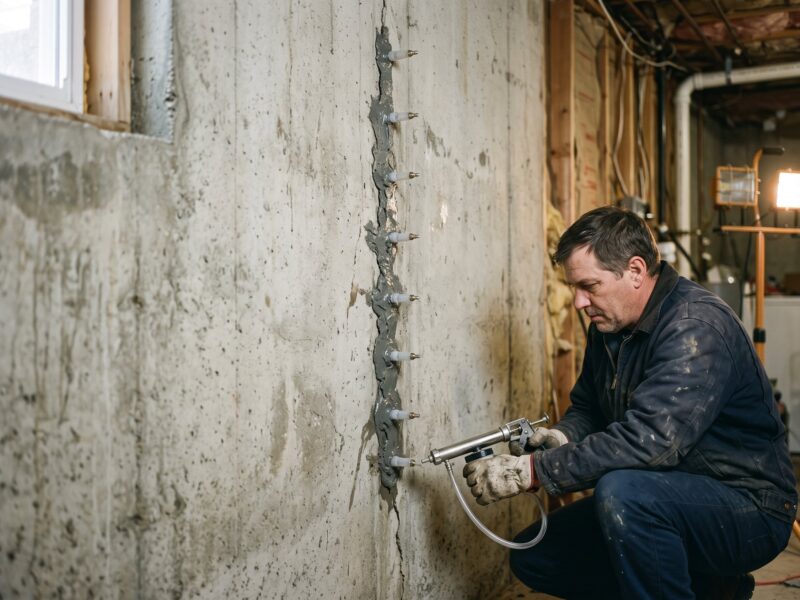
1980s and 90s poured walls
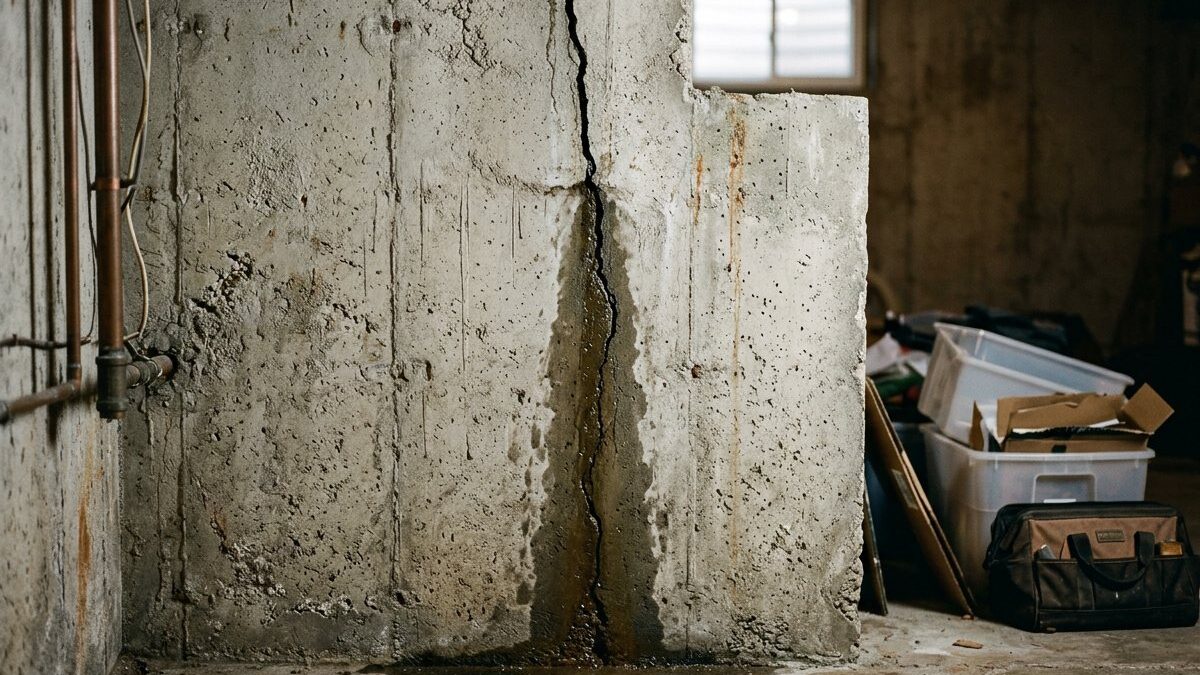
Typically one vertical shrinkage crack that only weeps when the outside water rises above it. Dry for months, then a wet stripe down the wall and a puddle under it during a hard rain.
Often injection alone
Newer subdivision homes
The perimeter drain works, but the backfill has settled into a saucer around the house and the downspouts discharge into it. Storm water gets aimed at the foundation by the grade itself.
Regrade first, then reassessWhat does fixing a storm leak cost?
These are our published ranges, quoted the same way in every county we serve. Correcting downspouts and grade runs $600 to $2,500; a full perimeter interior system on a typical Chicago basement lands between $8,000 and $16,000.
| Work | Range | What moves the number |
|---|---|---|
| Downspout extensions and regradingtypical job | $600–$2,500 | Feet of grade to rebuild, soil hauling |
| Interior drain tileper linear foot | $95–$160 | Length of the run, slab thickness, what has to be moved off the walls |
| Sump pump with battery backupinstalled | $2,800–$4,500 | Pit condition, backup capacity, discharge routing |
Most storm-only leaks land at the cheap end of this table, not the expensive end, and we would rather sell you the four-figure answer that works than the five-figure one that also works. Every range we quote from is published on the cost page.
When a storm leak is not a waterproofing job
A real share of the storm calls we take do not end with us selling anything. These are the four we send elsewhere most often.
The downspout is the entire story
One roof plane can deliver well over a thousand gallons in a heavy storm, and if it lands beside the wall it will get in. Extend the discharge properly, watch it through a season, and a lot of basements simply stop leaking. How far the extensions need to run.
Cheapest real fixIt comes up out of the floor drain
Water rising from the floor drain or a laundry standpipe during a storm is a sanitary or combined sewer that has surcharged. No wall system stops it, and the work belongs to a licensed plumber and possibly a backflow device. Telling backup from seepage.
Not our workThe window well filled and overflowed
A well packed with leaves and a clogged drain becomes a bucket sitting against the glass. Clearing the well and restoring its drain is an afternoon and a bag of stone, not a perimeter system. Window well drainage in detail.
Under $200 to testIt only happened in a record storm
When the rate of rainfall breaks local records, water shows up in basements that are otherwise sound, including ours. If it has happened once in a decade, fix the grade, note the date and watch the next two seasons before buying a system.
Wait and watchQuestions homeowners ask about storm-only leaks
Why is my basement dry all week and wet in one storm?
Because rainfall rate matters more than rainfall total. Two inches spread across three days soaks in and drains away. Two inches in an hour arrives faster than clay can move it, so it pools in the loose backfill against your wall and presses through the weakest joint. The foundation did not change between those two events; the amount of water hitting it at once did.
Will it get worse if I ignore it?
Usually yes, slowly. Water moving through a mortar joint or a crack carries fines out with it, so the path widens a little each storm and the threshold that triggers a leak drops. Repeated wetting also rusts anything steel in the wall and feeds mold in stored belongings. It rarely becomes an emergency overnight, but the cheap window to fix it does close.
Can I just seal the crack from the inside myself?
A hardware store patch on the face of a wall is holding back water that is pushing from behind, and it typically lets go within a season or two. Urethane injection is different: it is pumped through the full thickness of the wall so the repair fills the crack rather than covering it. On a poured wall that runs $450 to $900 per crack with a 10-year warranty.
Does a sump pump fix a storm leak?
Only if the water is reaching a pit. A sump lifts water that drain tile has already collected, so a pump on its own does nothing for water entering through a crack six feet up a wall or spilling out of a window well. When groundwater is genuinely the source, a pump with battery backup is essential, because the storms that overload a basement are the same storms that drop the power.
What about the first warm week of spring?
A fast thaw behaves like a heavy storm with the ground frozen shut underneath. Meltwater cannot soak in, so it runs along the frost layer and collects in the backfill just the same. If your basement wets in March as well as in July, you are almost certainly dealing with groundwater rather than roof water. <a href="/basement-foundation-problems/spring-thaw-basement-flooding/">Spring thaw flooding</a> covers that pattern.
Is a storm leak covered by homeowners insurance?
Standard policies exclude seepage and groundwater entering below grade, which is what a storm-only leak almost always is. Sump pump failure and sewer backup are usually optional endorsements you have to add on purpose, and true flood coverage is a separate policy altogether. Read your declarations page before you assume anything, ask your agent in writing which of those three you actually carry, and take photographs of the damage the day it happens either way.
Is it seepage, or is it the sewer?
This is the fork that changes who you should be calling. Water pushing through a wall or the cove joint is ours to fix. Water rising out of the floor drain during the same storm is a surcharged sewer line and belongs to a licensed plumber. The tells are easy to read once somebody shows you where to look.
Read the comparison

Find out what the next storm is going to do
Free written diagnosis within 48 hours, published pricing, 0% for 12 months financing and 24/7 response when water is standing.
Or talk to a human right now
(630) 335-1128
Request your free estimate
Tell us what you're seeing. We'll call back fast and be out within 48 hours.