
Signs of Foundation Settlement
Settlement never shows up in one place. It shows up as a set of small complaints spread across a house, and reading them together is the difference between a repair and a guess.
- Floor elevations shot and written down, free within 48 hours
- Own crews, published per-pier pricing, no commissioned salespeople
- 20+ in business, 1,500+ homes across seven counties
 Piers and stabilization: 25-year transferable warranty
The short answer
Foundation settlement is a house moving down rather than sideways, and the signs arrive as a set. Look for diagonal cracks running off door and window corners, doors and windows that bind, floors sloping toward one wall, gaps opening under baseboards, and stair-step cracking outside on that same corner. One sign alone rarely proves anything.
A footing rarely fails because the concrete gave out. It fails because the soil under one stretch of it stopped carrying the weight it used to carry, so the house follows that soil down. The drop is never even. One corner loses a fraction of an inch, then a little more the next wet season, and the frame above has to absorb the difference somewhere. Every complaint a homeowner notices, the door that binds in July, the sloping floor, the crack over a window, is the frame reporting what the footing did.
This region gives soil plenty of reasons to change. Our glacial clay swells when it takes on water and shrinks back in a dry stretch, so support under a footing moves with the calendar instead of staying put. Shallow footings under pre-war porches and additions sit above the depth that stays stable, subdivision backfill from the 1990s is still compressing, and a mature silver maple can pull a remarkable amount of water out of the clay in a dry August. Settlement is one branch of the wider symptom map on our basement and foundation problems page.
Why do houses settle on Chicago clay?
Settlement is a soil story with five common plots. Knowing which one is running under your house decides whether the fix is a downspout, a tree decision or a pier.
These are the causes we actually find behind settled corners across the seven counties we work in.
-
The clay changes volume
Clay soil expands as it wets and contracts as it dries, and it does that under the footing as readily as it does in your garden bed. Every cycle leaves a little less contact between soil and concrete than the builder counted on.
-
Trees drink from the same soil
A large deciduous tree close to the house pulls water out of the clay through a dry summer, and the clay shrinks away from the footing above its roots. It is the one cause of settlement that arrives with no water damage at all to point at.
-
Backfill keeps compressing
Soil that went back into the hole around a foundation was never as dense as the ground it was dug from. Additions, porches, stoops and garage slabs founded partly on that backfill keep sinking into it for years after the house is finished.
-
Water carries the fines away
A downspout dumping at one corner, a cracked service line, or a footing drain that gave up decades ago moves fine particles out from under the footing a little at a time. That corner drops while the rest of the house sits still.
-
Shallow footings move first
Older porches, room additions and enclosed rear stairs in this area were often built on footings nowhere near the depth of the main house. They ride the frost and moisture layer, which is why the addition pulls away from the original wall.
Where we look first
- The outside corner nearest the downspout that has never had an extension
- The joint where an addition or enclosed porch meets the original house
- Any wall with a tree canopy overhanging it
- The garage slab and the stoop, which move before the house does
- Whatever direction the floors already slope toward
What speeds it up
- A long dry summer following a very wet spring
- Excavation or new construction on the neighboring lot
- A slow supply or sewer leak nobody has found yet
- A gutter system that has been overflowing for a season
How do you check your own house for settlement?
You can do a useful first pass in an hour with a tape, a level and a pencil. What you are collecting is a pattern and a date, not a verdict.
Work in this order, because each step narrows what the next one has to explain.
-
Walk the outside first
Circle the house and look at the mortar joints, the brick coursing above windows, and the line where the siding meets grade. Cracking that runs diagonally toward a low corner is the clearest exterior evidence, and it tells you which corner to study inside.
-
Work every door and window
Open and close everything on the affected side of the house. Doors that rub the jamb on the latch side, windows that bind halfway, and gaps that taper along the top of a door frame all describe a frame that has been pulled out of square.
-
Measure the floor, do not eyeball it
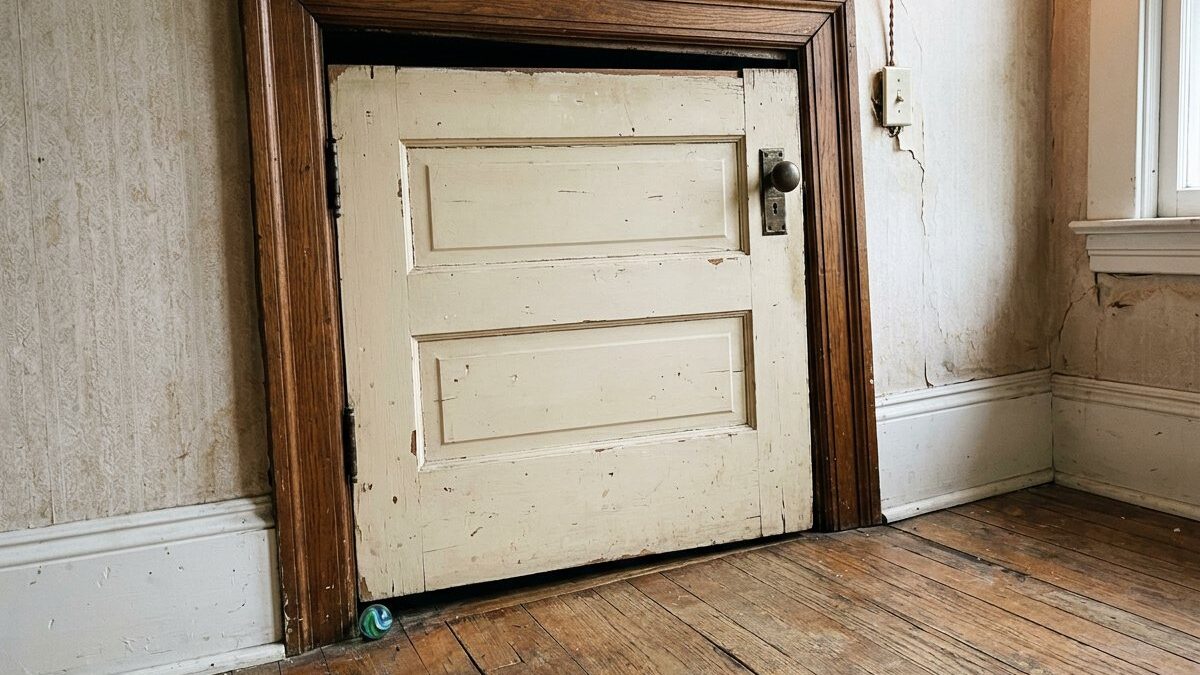
A marble tells you a floor slopes. A four-foot level walked across the room, or a laser line on the wall, tells you how much and in which direction. Write the number down with the room and the date rather than trusting a memory of it.
-
Mark and date every crack
Draw a pencil line across each crack, note the width beside it and write the date. A $20 crack gauge glued over the worst one gives you a readable number instead of an impression. Photograph each mark with something in frame for scale.
-
Re-read after a season swing
Come back after the next big change in weather, a wet spring or a dry August, and read the same marks. Movement between two dated readings is the fact that matters. A crack that has not budged in a year is a very different problem.
What a real settlement pattern looks like
- Several signs clustering on one corner or one wall, not scattered
- Cracks running diagonally away from door and window corners
- Floors falling consistently in one direction across the room
- An exterior crack lining up with the interior damage on the same wall
What is usually not settlement
- Fine drywall cracks at seams throughout a newer house
- Doors that stick every August and free up in October
- A single vertical crack in a poured wall, which is normally shrinkage
- Nail pops and ceiling seam lines, which are drywall behavior
Which signs mean call someone, and which mean watch it?
Most of what homeowners find in this category is worth recording rather than repairing. A short list of findings genuinely changes that, and they are the ones worth knowing by heart.
| Record it and re-check | Get eyes on it now | |
|---|---|---|
| Crack direction | Vertical and hairline in a poured wall | Diagonal off an opening, or stepping down a block wall |
| Crack width | Under an eighth of an inch and unchanged | Wide enough to slip a nickel in, or widening on your marks |
| Change over time | Nothing new between two dated readings | Fresh edges, fallen dust, a mark that no longer lines up |
| Doors and windows | One door that binds only in humid weather | Several doors on one side of the house, year round |
| Floors | A slight slope in an old house with no other signs | Slope you can feel, growing, in one direction |
| Where it shows | Cosmetic drywall cracks in scattered rooms | Interior and exterior damage lining up on the same corner |
| Water in the picture | Dry crack, no seepage | Water entering the crack, or soil visible through it |
| What we do about it | Tell you to watch it and re-measure next season | Shoot floor elevations and put a diagnosis in writing |
A floor out of level by more than roughly an inch across ten feet is our own field trigger for bringing out the laser, not a code standard and not a repair threshold. What is acceptable for one specific house is a structural engineer's call. Widths on their own are covered in the crack width guide.
Found three of these on one corner? We shoot the floor elevations, photograph the pattern and hand you the numbers in writing, free within 48 hours.
How settlement shows up by house era
Footing depth, the soil the house was set on and what got added later all track with the decade it was built, and so does the way settlement announces itself.

Pre-war bungalows and two-flats
The main house on these usually sits deep and stays put. The movement turns up at the rear addition, the enclosed back porch or the front stoop, built later on footings that never reached the same depth.
Check the additions first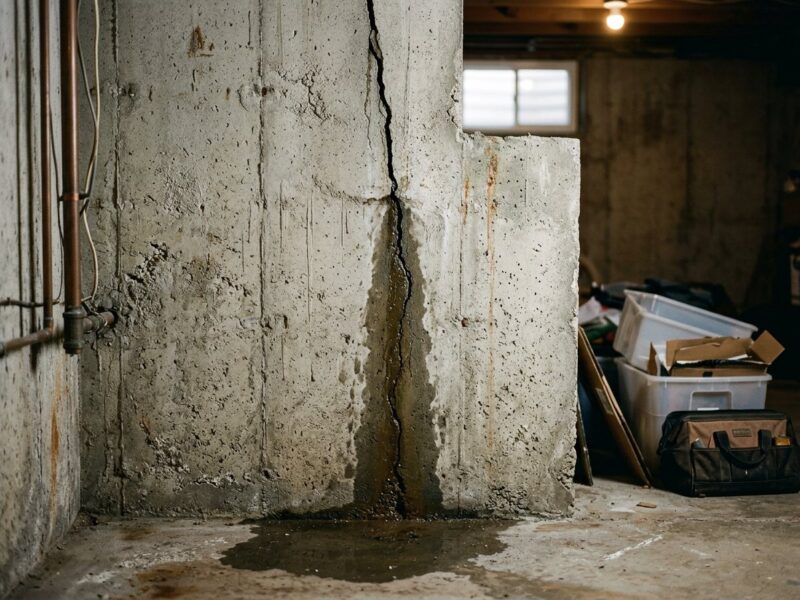
Post-war block ranches
Long shallow footprints on graded clay lots, often with the garage slab and the driveway pulling away from the house. Interior signs show as doors binding at one end of a long hallway.
Watch the low corner
1980s and 90s poured walls
Deeper footings and better soil work, so true settlement here is less common than homeowners fear. When it appears it is usually a corner fed by a downspout that has run short for fifteen years.
Usually a drainage story
Newer subdivision homes
Backfill and regraded fill are still compressing under stoops, garage aprons and the corners of bump-outs. Drywall cracks in the first few years are common and mostly mean the house is drying, not dropping.
Separate settling from settlementWhat does fixing settlement cost?
When settlement is real and still moving, the repair is piers, published at $1,600 to $3,000 each. A single settled corner is commonly three to five of them, so $4,800 to $15,000 depending on depth and load.
| Work | Range | What moves the number |
|---|---|---|
| Push or helical piersper pier | $1,600–$3,000 | Depth to load-bearing strata, access for equipment |
| Urethane crack injectionper crack | $450–$900 | Crack length and width, access to the full height |
Not every settled house needs the whole list. A dropped interior column under a main beam is a $1,500 to $3,200 repair on its own, and a settlement crack that is leaking but no longer moving is often just injection at $450 to $900. All of it is on the pricing page.
When the signs are not settlement at all
A good share of the houses we get called to for settlement are not settling. Four explanations account for most of them, and none of them ends with us writing a proposal.
The house is drying out, not dropping
New framing lumber gives up moisture for the first two or three heating seasons, and drywall cracks at seams and corners while it does. If the cracks are thin, scattered across rooms and no floor slopes, that is a house shrinking. Patch it after the second winter.
Costs nothing to waitThe door is the problem
A single door that sticks in humid weather and works fine in January is swelling wood or a loose hinge screw, not a footing. A carpenter or a longer hinge screw fixes it for the price of an hour. Doors across a whole side of the house are a different story.
Not our workWater is leaking under the slab
A supply line or sewer lateral leaking beneath a floor can wash out soil and mimic settlement exactly. That is a licensed plumber with a camera before it is a foundation contractor, because piering a house over an unrepaired leak buys you the same problem twice.
Call a plumber firstThe wall is being pushed, not dropped
Sideways movement is a different failure with different hardware, and mixing the two up is the most expensive mistake on this page. A horizontal crack, a bulge you can sight along, or a wall shifted at the base means load, not settlement. Start with horizontal cracks.
Wrong diagnosisQuestions homeowners ask about settlement
How do I know if my foundation is settling or just settling in?
Time and pattern separate them. New construction gives up moisture and shows thin drywall cracks in the first couple of years, spread around the house, with the floors staying level. Real settlement clusters: several signs on one corner, cracks running diagonally off openings, floors falling in one direction, and marks that keep changing between dated readings. If nothing moves across two seasons, you are watching a house that already stopped.
What size crack is a problem?
Width matters less than direction and change. A hairline vertical crack in a poured wall is normal shrinkage. A diagonal crack running off a window corner, or a crack that has widened on a dated pencil mark, is worth a look at any width. We treat about a quarter inch as our own trigger for measuring more carefully, which is a field habit rather than a published standard. For a specific wall, an engineer sets the number.
Can a tree really cause foundation settlement?
Yes, and it is one of the few causes with no water damage anywhere to point at. A mature deciduous tree pulls water out of clay soil through a dry summer, the clay shrinks, and support drops away under the nearest stretch of footing. Removing the tree is not automatically the answer either, because the soil can then swell back and move things a second time. <a href="/basement-foundation-problems/trees-and-foundation-damage/">Trees and clay shrinkage</a> covers the trade-off.
Does homeowners insurance cover foundation settlement?
Standard policies exclude earth movement, settling and groundwater, so settlement repair is normally the homeowner's expense. Sump failure and sewer backup are optional endorsements and flood coverage is a separate policy, and none of them address soil that stopped carrying a footing. A sudden accidental water leak under the slab is sometimes treated differently, which is a question for your own agent and your own policy language rather than for us.
Do I need a structural engineer or a contractor first?
If the movement is small and you mostly want to know what you are looking at, a free measured inspection is a reasonable first step and it costs nothing. If the house has moved noticeably, or you want a scope that every bidder has to price against, hire an independent structural engineer who sells no repairs. Their letter sets the standard for your house and we are happy to bid against it.
Will settlement stop on its own?
Plenty of houses settle, find soil that holds them and never move again, which is why dated measurements matter more than any single reading. What does not stop on its own is settlement driven by something still active: a leaking line, a downspout emptying at one corner, or a tree drawing down the clay every summer. Deal with the driver and many houses stabilize without hardware. <a href="/basement-foundation-problems/sticking-doors-sloping-floors/">Doors and floors</a> is the fastest way to track it.
When settlement needs piers under the footing
If the measurements say a corner is still moving, the repair is not patching what cracked. It is getting the load onto soil that will hold it, which means steel piers driven or screwed down beside the footing and a bracket taking the weight. That page explains how the two pier types differ, how many a settled corner usually needs, and what each one costs.
Foundation settlement and underpinning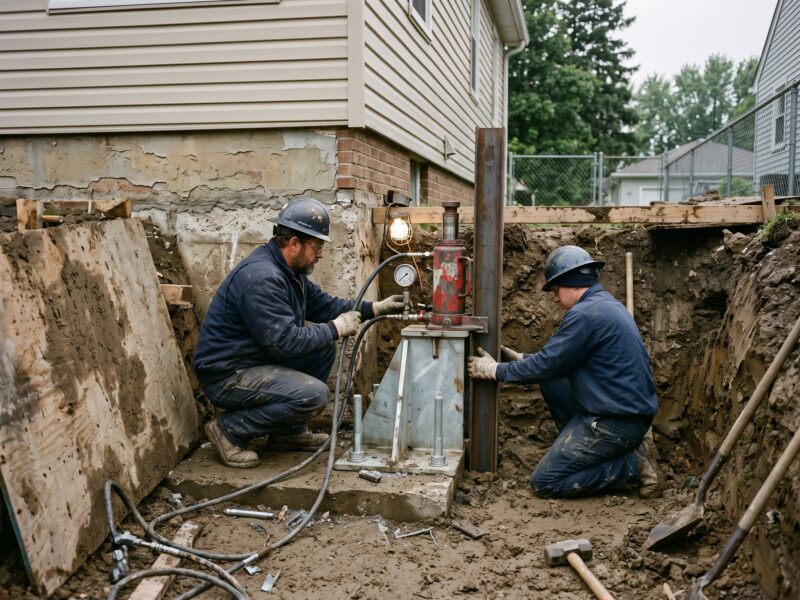

Get the movement measured before anyone talks repair
Free written diagnosis with floor elevations within 48 hours, published per-pier pricing, and 0% for 12 months if the work turns out to be real.
Or talk to a human right now
(630) 335-1128
Request your free estimate
Tell us what you're seeing. We'll call back fast and be out within 48 hours.