
Trees, Drought and Clay Shrinkage Near Foundations
The story homeowners are told is that roots push walls apart. The real mechanism is quieter and more expensive: a big tree drinks one side of your lot dry in August, the clay shrinks, and the footing goes down with it.
- Floor elevations and crack marks recorded free within 48 hours
- We say no to pier work when the tree can be managed instead
- 20+ on Chicago clay, 1,500+ homes served
 Piers carry a 25-year transferable warranty
The short answer
Tree roots almost never crack a sound foundation wall by pushing on it. What a mature tree does in Chicago clay is draw water out of the soil through a dry summer, shrinking the ground under one stretch of footing until it drops. Roots do invade cracks, failed mortar joints and old clay tile drains that had already opened.
Two completely different mechanisms get filed under tree damage, and they call for opposite responses. The first is mechanical: a root thickens as it grows and widens whatever gap it is already sitting in. That one is real but limited, and it does very little to sound concrete. The second is hydraulic: a large deciduous tree pulls water continuously out of the ground it is standing in, and clay that loses water loses volume. Nothing pushes on anything. The soil simply occupies less space than it did in May.
That second mechanism is the one that matters here, because the glacial clay under most of this region shrinks and swells more than the sandier soils a national article was probably written about. Silver maples, elms and honey locusts sit close to the house on narrow older lots across Cook and Will counties, and a hot rainless August reliably produces a run of calls about a new diagonal crack and a bedroom door that will not latch. The rest of the basement and foundation symptom guide covers the other patterns these houses show.
Can tree roots actually crack a foundation?
Roots rarely break a sound foundation wall. They exploit openings that already exist, and they wreck thin flatwork and old drain lines with real enthusiasm.
Here is what a root does and does not do when it reaches your house.
-
A root follows the easy path
Roots grow where water, air and space already are. A backfilled trench beside a foundation is loose, damp and easy, so roots run along the wall rather than into it. Solid concrete offers nothing a root wants, and it gets bypassed.
-
It widens what is already open
Where a crack, an open mortar joint or a failed parge coat already exists, a root can find that gap, take hold in it and thicken season after season. The wall failed first and the root moved in afterward, which is the opposite of the usual telling.
-
Thin flatwork is the real casualty
Sidewalks, driveway aprons, patios, stoops and garage slabs are a few inches thick, unreinforced and sitting directly in the root zone. Those lift and break constantly, and it is genuine root pressure doing it. None of it is your foundation.
-
Old clay tile drains fill with root
The original bell and spigot clay tile under most pre-war Chicago basements has an open joint every couple of feet. Roots find the moisture, get in and pack the line solid. The pipe stops draining long before anybody upstairs connects the two events.
-
So do sewer laterals and buried downspout lines
Same story, same joints. A rooted lateral backs up into the floor drain and a rooted downspout line surfaces water beside the house. Both are worth ruling out early, and neither one is a foundation repair.
What roots genuinely damage
- Sidewalks, driveways, patios and garage aprons
- Front stoops and porch slabs on shallow footings
- Original clay tile drains, at every open joint
- Sewer laterals and buried downspout runs
- Cracks and mortar joints that had already opened
What roots almost never do
- Split a sound eight inch poured concrete wall
- Push an intact block wall inward on their own
- Lift a full basement foundation off its footing
- Cause damage on the far side of the house from the tree
How does a tree dry the clay under a footing?
A tree is a pump running all summer. It moves ground water up and out through its leaves, and the soil it takes that water from is the soil your footing is bearing on.
The sequence takes one dry season to start and years to finish.
-
The tree draws down its root zone
Through a hot, rainless stretch a mature deciduous tree keeps pulling moisture out of the ground continuously, and it does not stop because the lawn browned out. The soil in that zone reaches a dryness it would never reach on its own.
-
The root zone is bigger than the canopy
Roots commonly reach well past the drip line, often out to a distance comparable to the height of the tree. That is why a maple that looks a comfortable distance from the house can still be drinking from directly under a corner of it.
-
Dry clay physically shrinks
Chicago clay changes volume with moisture. Take the water out and the particles pack closer together, so the ground surface drops and cracks open across the lawn. The same contraction is happening below, at footing depth, where nobody can see it.
-
One part of the footing loses support
Because the drying is concentrated on the tree side, that stretch of footing settles while the rest of the house stays put. Differential movement is what breaks things. Uniform movement of an entire foundation would go unnoticed for decades.
-
Spring brings back only part of it
Rain rehydrates the clay and the ground swells again, so cracks partly close and doors partly free up. Recovery is rarely complete, and each drought cycle can leave the house a little lower than the last one. That ratchet is what turns a symptom into a repair.
Signs the tree is the cause
- The damage appeared or worsened late in a dry summer
- It is on the side of the house the tree is on
- Cracks partly close again after a wet spring
- Shrinkage cracks are open across the lawn nearby
- A large deciduous tree stands within roughly its own height of the wall
Reasons to doubt the tree
- The damage is on the opposite side of the house
- It started during a wet spring or a thaw instead
- A downspout or a settled grade dumps at that same corner
- The tree is young, small or was planted after the cracks appeared
Root pressure or clay shrinkage: which one do you have?
Both get called tree damage and they behave nothing alike. Where the damage sits and what month it appeared usually separate them in one visit.
| Root pressure | Clay shrinkage from the tree | |
|---|---|---|
| What is moving | A root thickening inside a gap that already existed | The soil itself losing volume as it dries out |
| Where it shows up | Walks, driveway, patio, stoop, garage slab | The house: a wall crack, a dropped corner, doors that bind |
| Season it appears | Slowly, across growing seasons, year over year | Late in a dry summer, easing back after a wet spring |
| Distance from the trunk | Close, right along a visible surface root | Anywhere in the root zone, often past the drip line |
| Typical wall damage | An existing crack or mortar joint pried wider | A new diagonal crack, wider at the top, at one end |
| How often it causes real foundation damage | Rare in our experience | Common, and it clusters in drought years |
| What actually resolves it | Root pruning, replacing the flatwork, a root barrier | Water management first, piers if the footing has truly dropped |
| What removing the tree does | Ends it | Can cause years of heave as the clay takes water back |
| Published cost if repair is needed | Usually not our scope | $1,600 to $3,000 per pier, under a 25-year transferable warranty |
The two do overlap in one place worth knowing about. Roots invading an old clay tile drain stop the line from working, the backfill stays saturated, and then that same wall leaks for a reason nobody connects to the tree. Old clay tile drains under Chicago bungalows explains that failure.
Cracks that showed up during a dry summer? We measure the movement, mark it and tell you whether it is the tree or something else, free within 48 hours.
Which houses the trees get to
Lot width, parkway planting and footing depth all changed by decade, and together they decide how much a big tree can do to a given house.

Pre-war bungalows and two-flats
Deep, wide footings that resist shrinkage well, paired with parkway elms and maples planted close to the walk. The tree usually takes the sidewalk, the stoop and the clay tile line long before it touches the house.
Flatwork and drain tile
Post-war block ranches
The most vulnerable era we see. Shallow footings, a long footprint and silver maples planted in the 1950s that are now enormous. One corner drops in a drought year and stair-steps the block above it.
Watch the tree side
1980s and 90s poured walls
Better footings and younger trees, so shrinkage settlement is less common. When it happens it is usually one mature specimen left standing from the original farmstead or woodlot the subdivision was carved out of.
Usually one big tree
Newer subdivision homes
Small trees, but graded fill and irrigation systems that keep some of the lot wet and leave the rest dry. Uneven soil moisture around the perimeter does its own version of the same damage.
Even out the wateringCheaper things to try before anyone talks about piers
A tree driven settlement problem is one of the few foundation issues where a homeowner can genuinely change the outcome themselves. Try these first.
Water the tree side through a dry August
A soaker hose run slowly along that side of the house during a rainless stretch keeps the clay from reaching the dryness that causes the drop. It costs almost nothing, it helps the tree, and it treats the actual mechanism instead of the symptom.
Try the cheap fix firstDo not cut the tree down as a reflex
Removing a large tree stops the drying, and then the clay takes water back for years and pushes upward. Heave can crack a house that was only ever settling gently. Talk to an arborist about pruning, root management and timing before anyone starts a saw.
Call an arboristRule out the sewer lateral
If water rises from the floor drain rather than seeping at a wall, roots in the lateral are the likely culprit and that is a licensed plumber's job, not ours. How to tell backup from seepage shows the difference in about a minute.
Not our workCheck whether the crack predates the tree
Plenty of the cracks blamed on a big maple were photographed in a 1990s listing. Measure the width, mark and date both ends, and read it again after the opposite season before spending anything. How to measure a crack properly.
Watch a seasonQuestions homeowners ask about trees and foundations
How close can a tree be to a foundation?
The rule of thumb we use is to keep large deciduous species at least their mature height away from the house, and to treat anything closer than that as worth monitoring rather than worth removing. On a Chicago bungalow lot that distance is often impossible, which is why watering and drainage management matter more here than planting distance. Species matters too: thirsty, fast growing trees like silver maples do the most.
Will removing the tree fix my foundation?
It stops the drying, but it can start a slower problem going the other way. Clay that a tree kept dry for thirty years absorbs water again once the tree is gone, swells, and can push a foundation up over several seasons. Heave is harder to correct than settlement. If a tree really has to come out, expect to monitor elevations for years afterward rather than assuming it is over.
Do tree roots grow through concrete walls?
Not through sound concrete. Roots need an existing void to enter, so what we find is a root sitting inside a crack, an open mortar joint or a gap where parging failed, thickening there and widening it over time. The wall opened first. Repairing that opening and dealing with the root is a small job compared to what people usually fear when they see one.
Why did my foundation crack during a drought year?
Because dry clay shrinks. A rainless summer pulls moisture out of the soil across the whole lot, and a large tree accelerates that on one side, so the ground under part of the footing contracts and the footing follows it down. Differential movement cracks walls. That is why we get a wave of these calls in September of a dry year and far fewer in a wet one.
Can roots in my drain tile cause a wet basement?
Yes, and it is one of the more common causes we find under older houses. Original clay tile has an open joint every few feet, roots find the moisture and pack the pipe until it carries nothing. The backfill beside your wall then stays saturated after every storm. The fix is a modern interior system rather than trying to clean out a line that will simply refill.
Is a root barrier worth installing?
Sometimes, and it is far cheaper than structural work. A barrier trenched between the tree and the house redirects roots downward and away, which can slow the drying on that side. It is not a guarantee, it is best installed by someone who works with trees, and it is worth trying while you document elevations rather than as a substitute for measuring anything.
When the footing really has dropped
Watering and root management stop the cause, but they do not lift a footing that already went down and stayed down. Once elevations across two seasons show real, one-way movement, the repair is underpinning: steel taken past the seasonal zone to soil that does not care what the weather did. That page covers the sequence and the per-pier numbers.
See how underpinning works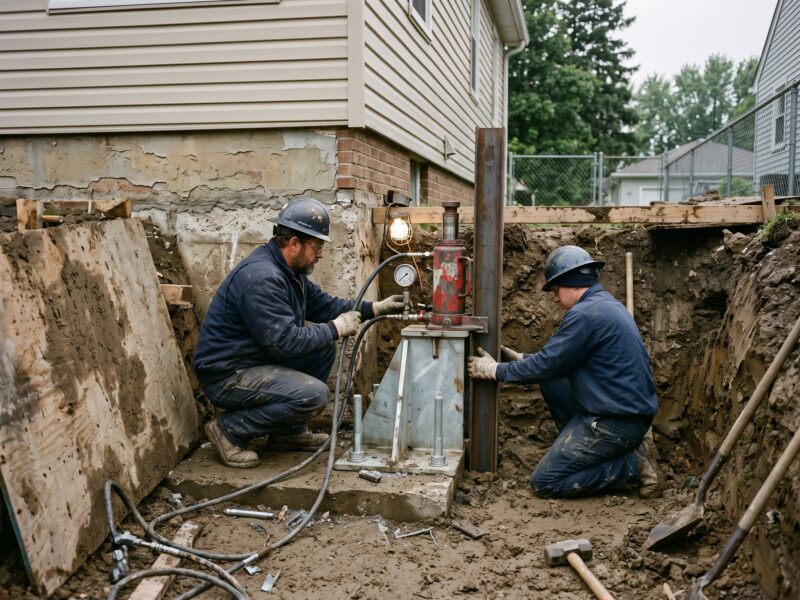

Find out whether the tree is really doing it
Measured elevations, dated crack marks and an honest answer about what to try first, free within 48 hours from crews who have worked 1,500+ homes on this clay.
Or talk to a human right now
(630) 335-1128
Request your free estimate
Tell us what you're seeing. We'll call back fast and be out within 48 hours.