Carbon Fiber Straps for Foundation Walls
A strap is thinner than a coat of drywall mud and it will not rust, but it only works if both ends are tied into something solid and the water outside has been dealt with first.
- Deflection measured in writing, free within 48 hours
- $600 to $1,000 per strap, published before we quote
- 20+ of Chicago foundations, 1,500+ homes served
 Wall stabilization: 25-year transferable warranty
The short answer
Carbon fiber straps are fabric strips bonded to the inside face of a foundation wall with epoxy. They work in tension across a horizontal crack and stop the wall bending any further. They add no thickness, need no excavation, and suit walls with modest, stable deflection at $600 to $1,000 per strap.
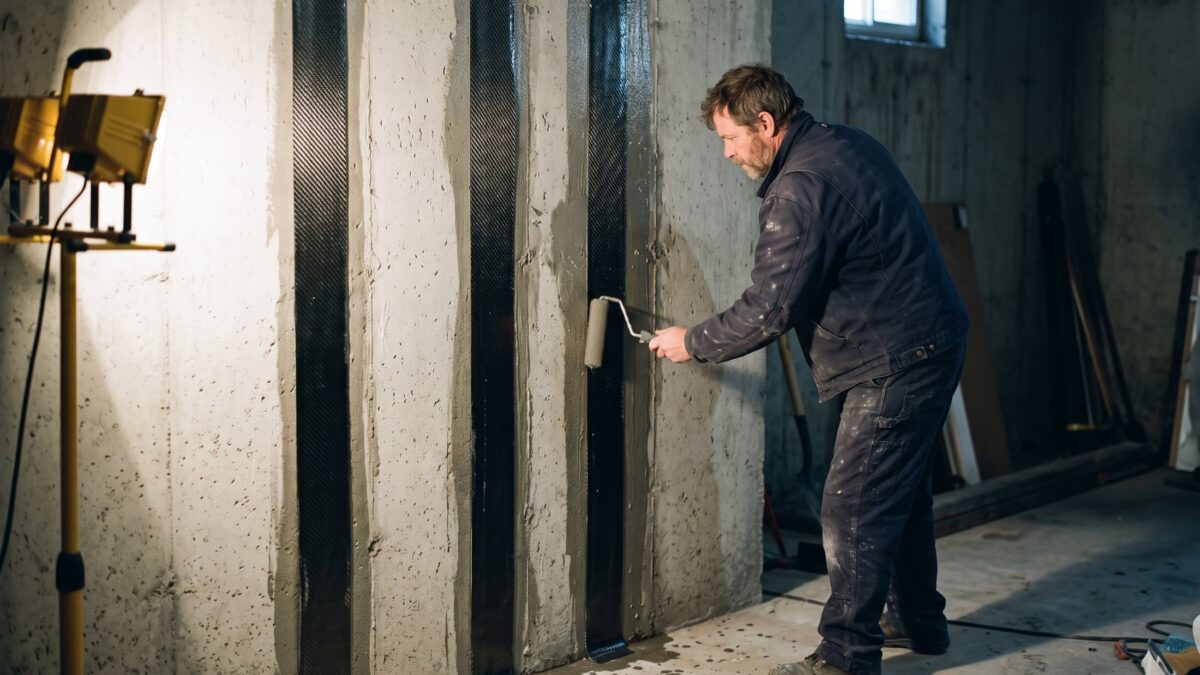
Concrete and block are excellent in compression and poor in tension, which is why a wall being pushed inward opens on the inside face. A carbon fiber strap addresses that directly. The fabric is bonded flat to the wall with a structural epoxy that soaks through it, and once cured, the strap and the wall behave as one element. Any further bending would have to stretch the fabric, and carbon fiber does not stretch. The wall keeps its job of holding back soil; the strap takes the tension the concrete could not.
The reason this method took over so much of the wall repair work in the suburbs is practical rather than technical. Chicago basements are usually finished or about to be, they are usually short on headroom, and their owners do not want steel posts standing in the room. A strap disappears under drywall. It is one of several ways to stabilize a moving wall, and the full comparison of methods lives on the foundation repair page, where piers, anchors and beams sit alongside it.
How do carbon fiber straps hold a foundation wall?
The strap does nothing until the wall tries to move, then it refuses to lengthen. Everything about the installation is about making that refusal reach both ends of the wall.
Here is the whole install, which on a typical wall runs one day with a return trip to check the cure.
-
Grind back to sound concrete
Paint, parging, efflorescence and loose mortar all come off in a band the width of the strap, floor to ceiling. Epoxy bonds to the wall, not to whatever is on the wall, and skipping this step is why some strap jobs peel.
-
Deal with the crack first
If the horizontal crack leaks, it gets injected before anything is bonded over it. Trapping active water behind a strap gives you a stabilized wall that still puts water on your floor every spring.
-
Saturate and bond the fabric
Structural epoxy goes on the wall, the fabric is laid into it and rolled until it is fully wetted through, then more epoxy over the top. Done right the strap ends up almost flush, no thicker than a taped drywall seam.
-
Anchor the top end
The top has to deliver load into the floor framing. Depending on joist direction that means a bracket at the sill plate or blocking installed between joists. A strap that stops short of the framing has nowhere to send the force it collects.
-
Anchor the bottom end
The bottom terminates at the slab or into the footing so the base cannot kick inward. On walls that have already slipped at the base, this end does more work than the field of the strap does.
Best for
- Modest, measured deflection that is not increasing
- Horizontal cracking in block or poured walls
- Finished or soon to be finished basements
- Low headroom, where a steel beam is awkward
- Backed by a 25-year transferable warranty that transfers
What the strap is not
- Not a way to push a bowed wall back toward plumb
- Not a water repair: it seals nothing on its own
- Not a fix for a wall that is settling downward
When are carbon fiber straps not enough?
Straps have a working range. Past it they are still doing their job and the wall still moves, which is the worst outcome to pay for.
These are the five conditions that send us to steel, anchors or an engineer instead.
-
The wall has moved too far
Fabric bonded to a wall holds it where it is. It cannot recover lost position, so a wall that has already come in a substantial distance is usually a candidate for anchors or beams that can take up movement over time.
-
The base is sliding, not bending
When a block wall shears at a low joint and the bottom slides in across the footing, the failure is horizontal displacement rather than bending. That is a different repair and it needs the base positively restrained, not just reinforced.
-
The top has nothing to push against
A strap loads the floor framing above. Rotted sill plates, joists running parallel with no blocking, or an open stairwell at the top of the wall all mean that end has to be built before the strap is worth installing.
-
The wall is going down as well as in
Settlement and lateral movement look similar from the basement and are opposite problems. Diagonal cracks over doors, sloping floors upstairs and a wall dropping at one end point at footings and piers, and no amount of fabric addresses that.
-
The water load never got removed
This is the quiet one. Straps stop the bend; they do nothing about the saturated clay pressing on the outside. Without drainage the pressure keeps cycling, and it will look for the next weak line in the wall.
Signals to check first
- Deflection measured at several points, with dates
- Whether the crack line is fresh or painted over years ago
- Joist direction above the wall you plan to strap
- Condition of the sill plate and rim
- Where roof water lands outside that wall
Go elsewhere when
- An engineer has specified steel, in which case buy steel
- The wall has moved noticeably in a single season
- The wall is stone rubble rather than block or poured
- The house is settling and the wall is only the symptom
Carbon fiber or steel: which does my wall need?
Both stop a wall from bending further. They differ in how much movement they can handle, what they leave in the room, and what they cost per piece.
| Carbon fiber straps | Steel I-beam bracing | |
|---|---|---|
| How it resists | Bonded to the wall, works in tension | Stands against the wall, works in bending |
| Room it takes | Nearly flush, drywall goes over it | A steel section standing off the wall |
| Movement it suits | Modest and stable deflection | Larger deflection, or ongoing movement |
| Install time | Usually one day for a wall | Longer, with cutting and floor work |
| Headroom needed | None beyond wall height | Enough to set and tie a full-height beam |
| Published cost | $600 to $1,000 per strap | $900 to $1,500 per beam |
| Corrosion | Nothing to rust | Coated steel, worth inspecting over time |
| Excavation | None | None inside, unless soil load is being relieved |
| Our warranty | A 25-year transferable warranty | A 25-year transferable warranty |
Plenty of walls get both, straps across the field and a beam where the deflection peaks. If the wall is bowed rather than simply cracked, read bowing and leaning walls before choosing hardware.
Wondering whether straps will hold your wall? We measure the bow, check the framing above it and put the recommendation in writing, free within 48 hours.
Which houses get strapped?
Straps go on walls, not on house styles, but the wall you have came with the house you bought. This is what we see by era.

Pre-war bungalows and two-flats
Rubble stone and early masonry walls have no flat, continuous face to bond to and their movement is rarely uniform. Bonding fabric to irregular stone is not a repair, so these walls take other methods.
Almost never straps
Post-war block ranches
The main market for this repair. A long clay-backfilled block wall with one horizontal crack, flat enough to bond to and moved just far enough to matter. Straps across the wall plus drainage outside is the standard answer.
The usual candidate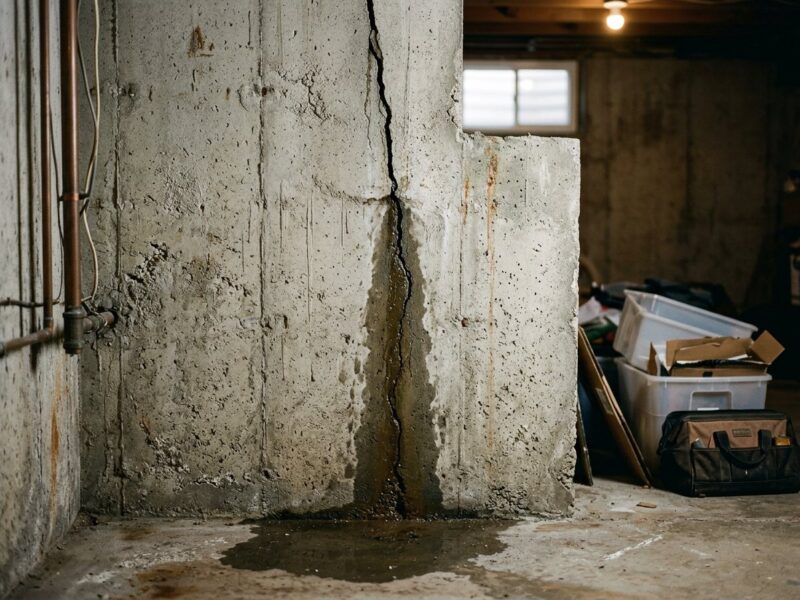
1980s and 90s poured walls
Poured concrete gives the best bonding surface of any wall we work on. Movement here is usually early and small, often on the side loaded by a driveway, and a few straps hold it for good.
Excellent fit
Newer subdivision homes
Loose backfill in a tight side yard produces small deflections that show up within the first fifteen years. Caught early, this is the least expensive structural repair in the whole trade.
Catch it earlyWhat do carbon fiber straps cost?
We publish $600 to $1,000 per strap, installed, and the number of straps is set by the length of the wall and where the crack runs.
| Work | Range | What moves the number |
|---|---|---|
| Carbon fiber strapsper strap | $600–$1,000 | Wall height, spacing the deflection requires |
| Steel I-beam wall bracingper beam | $900–$1,500 | Ceiling height, footing condition at the base |
| Urethane crack injectionper crack | $450–$900 | Crack length and width, access to the full height |
A long back wall in a block ranch typically takes five or six straps, which puts that wall between $3,000 and $6,000. If the crack leaks it gets injected first at $450 to $900, and that line is quoted separately so you can see what you are paying for. All ranges are on the pricing page.
When you should not buy straps
We install a lot of this hardware and we still turn some of it down. These four situations come up most often.
The crack is vertical and only leaks
A vertical crack in a poured wall is a water problem, not a bending problem, and reinforcing it accomplishes nothing you can measure. Injection at $450 to $900 handles it in an afternoon. Seal it, or fix the wall walks through the difference.
Wrong repairNothing has moved in twenty years
A painted-over crack with clean edges, no fresh debris beneath it and no change on a straight edge is a wall that found its balance long ago. Mark it, date it, look again after a wet spring. Stability over time is worth more than any product.
Watch it insteadThe gutters are the real cause
When one wall is cracking and the downspout beside it discharges at the foundation, the cheap work goes first. Extensions and regrading run $600 to $2,500 and take the load off. Move the roof water first.
Cheaper first stepAn engineer should be writing the spec
Where the wall has moved substantially or moved recently, hire an independent structural engineer who does not sell repairs. You get a scope written for your house, and every contractor bids the same thing. We will follow their spec whether or not it names our preferred method.
Hire outside usQuestions homeowners ask about carbon fiber straps
Do carbon fiber straps really work on a bowing wall?
On a wall with modest, stable deflection, yes, and the mechanism is straightforward: the strap will not stretch, so the wall cannot bend further where the strap crosses it. What decides the outcome is the preparation. Ground to sound concrete, fully wetted fabric and both ends tied into the framing and the slab, and it holds. Bonded over paint with a loose top end, it is decoration.
Can I drywall or panel over carbon fiber straps?
Yes, and that is a large part of why homeowners choose them. A finished strap sits nearly flush with the wall, so framing goes in front of it the same as anywhere else and nothing telegraphs through the drywall. Photograph the wall before you cover it and keep the invoice, because a buyer's inspector will eventually ask what is behind that wall.
How many straps does my wall need?
Spacing depends on the wall height, the wall type and how far it has moved, so the count comes out of the measurement rather than a standard package. A long block wall in a ranch commonly takes five or six. Be wary of any quote where the strap count arrives before anyone has measured the deflection, because that number is coming from a price sheet, not your basement.
Do carbon fiber straps stop water from coming in?
No. They are structural reinforcement and they seal nothing. If your horizontal crack leaks, it needs injection before the strap is bonded over it, and if the wall sweats or the cove joint seeps, that is drainage work. We quote those as separate lines so nobody assumes a structural repair bought them a dry basement.
Do straps need to be tightened or maintained?
They do not. There is nothing to torque, nothing to grease and nothing to rust, which is a genuine advantage over hardware with threads in it. What you should do is look at the wall once a year with a straight edge or a string line and confirm nothing has changed. If a reading moves after a repair of ours, that is what the 25-year transferable warranty is for.
Will I need a permit for wall reinforcement?
Structural work often does require a permit in Illinois, and the rules are set municipality by municipality rather than statewide, so a village next door can handle it differently. Ask your local building department before work starts, or ask us to and we will tell you what they said. Any contractor who waves the question off is telling you something about the rest of their work.
Is your wall actually bowing?
Straps answer a question that comes second. First you need to know how far the wall has moved, whether it is still moving, and what is pushing on it, because those three readings decide whether fabric, steel or anchors belong on that wall. That page covers the causes, the measurement and every repair option side by side.
Bowing and leaning walls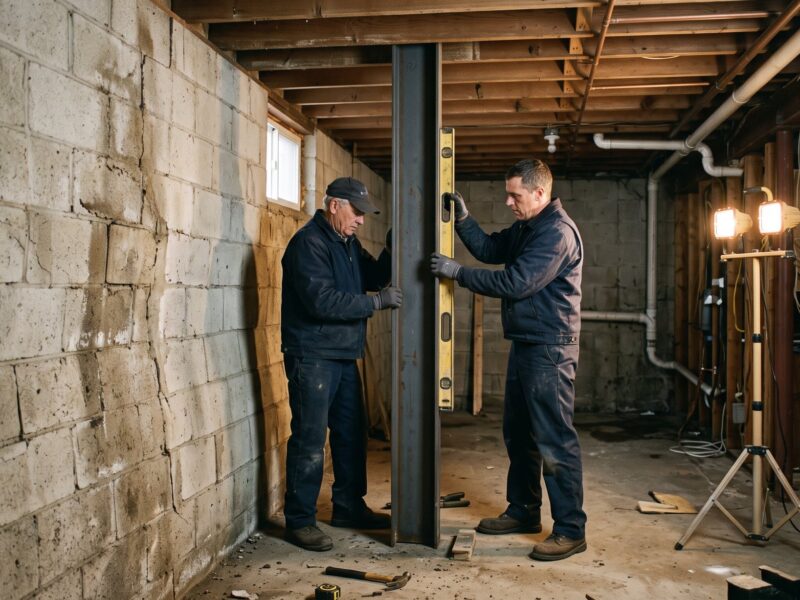

Get the wall measured before you buy hardware
Free written measurement within 48 hours, $600 to $1,000 per strap published up front, and a 25-year transferable warranty that stays with the house.
Or talk to a human right now
(630) 335-1128
Request your free estimate
Tell us what you're seeing. We'll call back fast and be out within 48 hours.