Bowing and Leaning Basement Walls
A wall does not bow because the concrete got weak. It bows because the dirt outside it got heavy, and until that load is understood, nothing bolted to the inside face is worth buying.
- Deflection measured and written down, free within 48 hours
- Own crews, published pricing, no commissioned salespeople
- $2,000,000 general liability in general liability, 20+ in business
 Wall stabilization: 25-year transferable warranty
The short answer
A basement wall bows inward when soil outside pushes harder than the wall can resist, usually saturated clay, frost, or a driveway loading the backfill. Block walls crack along a mortar joint near mid-height; poured walls open a horizontal crack. Repair means bracing the wall with straps, beams or anchors and removing the water load.
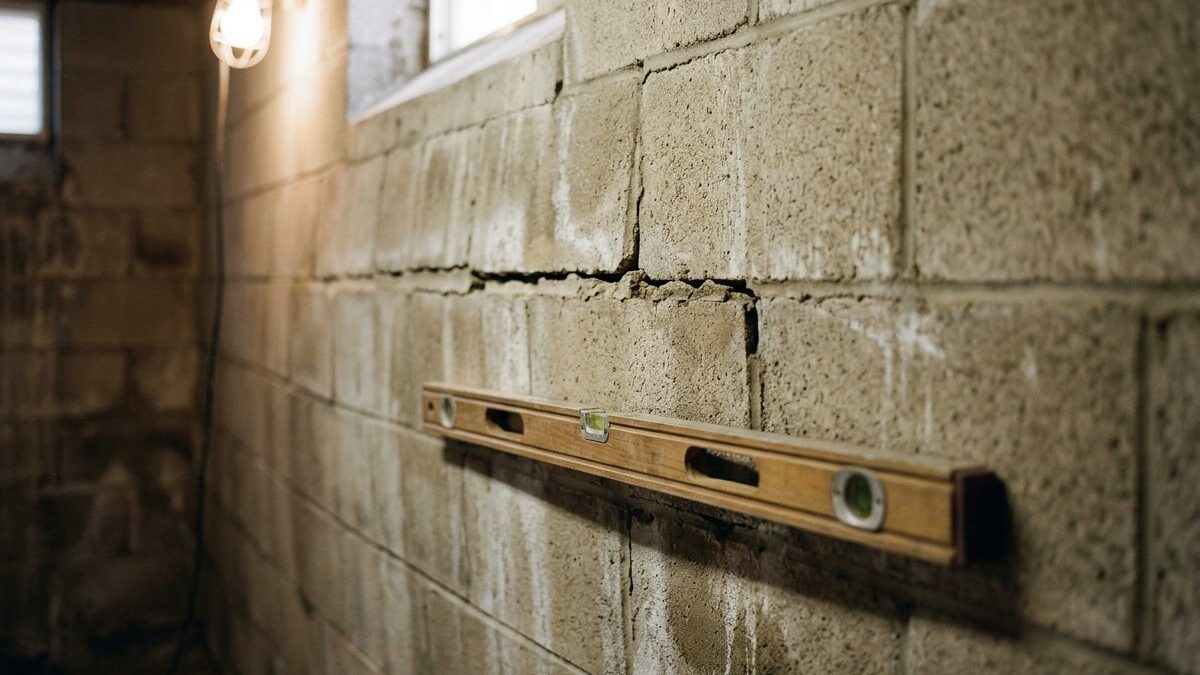
Every below-grade wall is holding back dirt, and dirt gets heavier when it is wet. A basement wall is designed for the ordinary push of drained soil, not for the pressure that builds when water fills the backfill and has nowhere to drain. When that pressure exceeds what the wall can carry in bending, the wall gives at its weakest line. In block that is a mortar joint somewhere near the middle of the height. In poured concrete it is a horizontal crack that runs a surprising distance before anyone notices it.
Chicago hands walls a hard version of this. Our glacial clay swells when saturated and holds that water for days, the frost line runs deep enough to push on the upper courses each winter, and thousands of postwar block basements were backfilled with the same heavy clay dug out of the hole. Add a driveway or a patio sitting on that backfill and the load goes up again. Wall movement is one branch of the larger picture on our foundation repair page, and it is the branch that gets ignored longest.
Why do basement walls bow inward?
A bow is a load problem, not a material problem. Five forces act on the outside of a Chicago basement wall, and they stack.
Understanding which of these is driving your wall changes the repair, so we work down the list on every inspection.
-
Clay swells against the wall
The clay across this region expands as it takes on water and contracts in a dry stretch. That cycle presses the wall each wet season and gives ground back each dry one, and walls remember only the movement in one direction.
-
Water raises the pressure at the base
Saturated backfill with no working footing drain behaves like a column of water standing against your wall. The push is greatest at the bottom, which is why block walls often shear at a joint low on the wall and slide inward at the base.
-
Frost pushes from the top down
Illinois frost reaches several feet in a hard winter. Wet soil freezing against the upper courses expands and shoves, then thaws and lets go, and a wall that leans in only at the top is usually telling you about winter rather than groundwater.
-
Surcharge adds weight nobody counted
A driveway, a patio slab, a parked truck or a full dumpster on the backfill transfers load down into soil that is already pushing. Newer subdivision lots with tight side yards and concrete right up to the house see this constantly.
-
The wall finds its weakest line
Block cracks horizontally through a mortar joint or in a stair-step at the corners. Poured concrete opens a long horizontal crack, usually around mid-height. Once that line opens, the wall hinges there and every following season moves it further.
What tells you it is moving
- A horizontal crack in the wall at roughly mid-height
- A visible bulge when you sight along the wall with your eye at the corner
- Stair-step cracking at both ends of a long block wall
- The top course pushed in, leaving a gap under the sill plate
- Fresh dust or debris under a crack you have already looked at once
What it usually is not
- A vertical shrinkage crack: common, and a different problem
- Bumpy or wavy block from a rough original build
- Cosmetic parging cracks on the inside face
How does a bowing wall get stabilized?
Stabilizing a wall means giving it something stiff to lean against and taking away the water that is pushing it. Skip the second half and you have bought a stronger wall with the same problem.
This is the order we work in, and the measuring comes before anybody prices hardware.
-
Measure the deflection
A string line from top to bottom of the wall, or a plumb bob and a tape, gives the inward movement in inches. We record it at several points with the date. That single number drives which system the wall gets.
-
Find and stop the water
Downspouts dumping at the wall, a grade that has settled back toward the house, or a footing drain that silted shut decades ago all keep the load on. Fixing the water is not an upsell here; it is what stops the wall from moving again.
-
Match the system to the movement
Small, stable deflection takes carbon fiber straps bonded to the inside face. Larger movement takes steel I-beams tied to the joists and the slab. Where the yard has room, wall anchors reach out into stable soil and can pull as well as hold.
-
Tie the top and the bottom
Any brace is only as good as its two ends. The top has to transfer load into the floor framing above and the bottom into the slab or footing. A beam standing loose against a joist is decoration, and it is the failure we find most often on other people's work.
-
Document and re-measure
We photograph the wall, note the deflection on the invoice and tell you what to look for. A braced wall should not move. If a year later the number has changed, that is a warranty conversation and it is covered for 25-year transferable.
What a good repair includes
- Deflection measured in inches and written down before and after
- The water source found and fixed, not just the wall braced
- Positive connections at the joists and at the floor
- A structural engineer's letter where the movement is significant
- A 25-year transferable warranty that transfers with the house
Red flags
- A price given without anyone measuring the bow
- Straps or beams sold with no mention of drainage
- A promise to make a bowed wall perfectly straight again
- Same-day pressure pricing from a commissioned salesperson
Should the wall be braced or straightened?
Bracing stops the wall where it is today. Straightening tries to recover some of the movement, and it costs access, excavation and time.
| Brace it in place | Straighten it back | |
|---|---|---|
| What you get | Movement stops at the current deflection | Some of the bow recovered, then held |
| Typical methods | Carbon fiber straps, steel I-beams | Wall anchors, or excavation with beams tightened over time |
| Excavation | None, all work from inside | Yes, outside access to place anchors or relieve soil |
| Season | Any month, including winter | Stops when the ground freezes |
| Yard impact | Nothing outside is touched | Anchor plates in the lawn, landscaping disturbed |
| Published cost | Straps $600 to $1,000 each, beams $900 to $1,500 each | Anchors $1,000 to $1,800 each |
| Finished basement | Straps stay flat enough to drywall over | Anchors show as plates on the inside face |
| Best when | The bow is modest and the wall is stable | The bow is significant and the lot has room |
| Our warranty | A 25-year transferable warranty | A 25-year transferable warranty |
Neither column is finished work on its own. A braced wall with saturated clay still standing against it is a wall waiting for next spring, which is why most of these jobs include drainage. See yard drainage for the outside half.
Not sure how far your wall has moved? We measure the deflection, photograph it and hand you the numbers in writing, free within 48 hours.
Which walls bow, and why
Wall type and backfill decide the failure. These four cover nearly every bowing wall we are called to across the seven counties we serve.

Pre-war stone and early block
Rubble stone and limestone walls bulge rather than crack cleanly, often where mortar has washed out over a century. They move slowly and they rarely move back, so the repair is holding what is there.
Brace, do not chase plumb
Post-war block ranches
The most common bowing wall in this region. Hollow block backfilled with clay, no working footing drain, and a horizontal crack through a mortar joint about halfway up the long back wall.
Straps or beams, plus drainage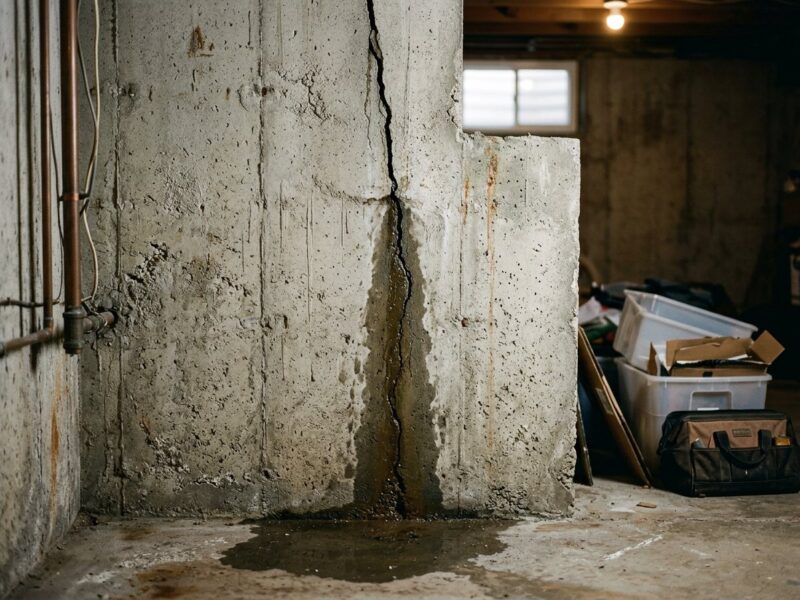
1980s and 90s poured walls
Poured concrete resists bending better, so when it does move it shows one long horizontal crack rather than a bulge. Often traced to a driveway or patio surcharging the backfill on one side.
Usually straps
Newer subdivision homes
Tight side yards, concrete close to the house and backfill that was never fully compacted. Movement here is early and modest, and catching it at that stage is the cheapest version of this repair.
Fix drainage, then braceWhat does bowing wall repair cost?
We publish carbon fiber straps at $600 to $1,000 each, steel I-beams at $900 to $1,500 each and wall anchors at $1,000 to $1,800 each, and the count of them is set by the wall, not by a quota.
| Work | Range | What moves the number |
|---|---|---|
| Carbon fiber strapsper strap | $600–$1,000 | Wall height, spacing the deflection requires |
| Steel I-beam wall bracingper beam | $900–$1,500 | Ceiling height, footing condition at the base |
| Wall anchorsper anchor | $1,000–$1,800 | Yard access for the exterior plate, soil conditions |
Spacing depends on the wall, so a long back wall in a block ranch commonly takes five or six pieces of hardware. Six straps at $600 to $1,000 each puts that wall between $3,600 and $6,000 before any drainage work. Every published range sits on the pricing page.
When a bowed wall does not need repair yet
Not every bow is an emergency, and a few of these calls end with us telling a homeowner to wait and watch. That is a real outcome, not a soft close.
An old bow that has stopped moving
Some walls bowed in the 1970s, found their equilibrium and have not shifted since. Painted-over cracks with no fresh edges and clean dust lines are evidence of that. Measure it, date the measurement, and check again next spring before spending anything.
Measure, then waitThe real problem is a downspout
One disconnected downspout can put hundreds of gallons into the backfill against a single wall in one storm. Extensions and regrading run $600 to $2,500 and sometimes stop the movement outright. Grading and slope come first.
Cheapest real fixIt is settlement, not soil pressure
A wall that is dropping rather than leaning is a different repair with a different fix. Doors sticking, sloping floors and diagonal cracks over openings point downward, not sideways. Read the settlement signs first.
Wrong diagnosisThe movement is significant and you need your own expert
Past a couple of inches of deflection, or with any wall that has moved recently, hire an independent structural engineer who sells no repairs. Their letter tells you what the wall needs and gives you a spec every bidder has to price against, including us.
Hire outside usQuestions homeowners ask about bowing walls
How much bowing is too much in a basement wall?
There is no single number that applies to every wall, which is why we measure and date it rather than eyeball it. A slight bow that has not changed in years is a different situation from a smaller bow that grew over one wet spring. Movement over time matters more than the total. Past a couple of inches, or with any recent change, get an independent structural engineer to set the standard.
Can a bowing basement wall collapse?
It is uncommon and it does happen, usually where a wall was already badly bowed and something changed fast: heavy equipment on the backfill, a saturated spring after a frozen winter, or excavation next to the house. Warning signs are movement you can see between seasons, block shifting sideways at a joint, and a gap opening under the sill plate. Those get looked at now, not in the fall.
Can carbon fiber straighten a bowed wall?
No, and anyone who tells you otherwise is selling. Straps hold the wall where it stands and stop further movement, which is what most walls need. Recovering a bow takes excavation to relieve the soil load, or wall anchors set out in the yard and tightened over seasons. Straightening is a bigger job with real yard impact, and plenty of walls never need it.
Does homeowners insurance cover a bowing basement wall?
Standard policies exclude damage from earth pressure, seepage and groundwater, which is exactly what causes a bow, so this is usually a homeowner expense. Sump failure and sewer backup are separate optional endorsements and flood coverage is its own policy, and none of them address soil load. Read your own policy or ask your agent rather than take a contractor's word on coverage.
Can I sell a house with a repaired bowing wall?
Yes, and a documented repair usually helps more than an unmentioned crack. Illinois sellers have a disclosure obligation on known material defects, and a written repair with a transferable warranty answers the question a buyer's inspector will raise anyway. Our wall stabilization carries a 25-year transferable warranty that transfers to the buyer. <a href="/foundation-repair/foundation-repair-home-sale/">Repairs and home sales</a> covers the rest.
Will fixing my drainage stop the wall from moving?
Sometimes, and it is always part of the answer. Removing the water load takes the pressure off a wall that is bending under it, and on early movement that alone can be enough. What drainage cannot do is restore a wall that has already cracked through and hinged. In that case you need both: the brace to hold the wall and the drainage so it never gets pushed again.
Beams, anchors and how they are chosen
Once a wall has moved past what straps can hold, the conversation turns to steel. Which hardware a wall gets depends on deflection, headroom, joist direction and whether the yard has room for anchor plates. That page walks through both systems, what they look like on a finished wall and what each one costs.
Wall anchors and steel bracing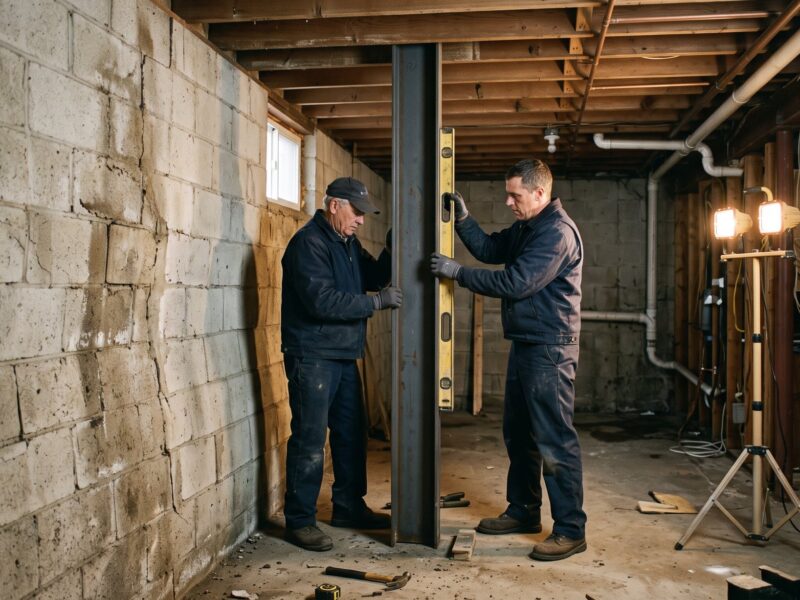

Get the bow measured before anyone quotes hardware
Free written measurement within 48 hours, published pricing on every strap, beam and anchor, and 24/7 if the wall has moved suddenly.
Or talk to a human right now
(630) 335-1128
Request your free estimate
Tell us what you're seeing. We'll call back fast and be out within 48 hours.