
How to Choose a Basement Waterproofing Contractor in Chicago
A wet basement is one of the few home repairs sold at the kitchen table by someone paid on the sale. Here is how to judge any company that comes to your door, us included, using paperwork instead of instinct.
- Written diagnosis, free within 48 hours
- $2,000,000 general liability, in-house crews only
- 20+ in the Chicago area, 1,500+ homes
 Published pricing, no commissioned reps
The short answer
Judge a waterproofing contractor on paper, not on personality. Ask for the perimeter measured in linear feet, the method named, and prices you can check against published ranges. Confirm the warranty transfers with the house and read what it excludes. Ask whether the crew is employed or subcontracted. Decline any price that expires today.
Basement waterproofing is unusual among home repairs. The homeowner cannot see the failure, cannot easily verify the fix, and is often deciding while water is still on the floor. That combination is why the industry grew up around in-home sales appointments, tiered good better best presentations and discounts that vanish when the representative leaves the driveway. None of that is illegal and some of those companies do fine work. It just means the quality of the paperwork tells you more than the quality of the conversation.
The Chicago area makes this sharper. Dense clay, deep frost and a housing stock ranging from century-old brick to subdivisions built in the last twenty years mean the correct scope varies house to house, so an estimate that never mentions your specific wall, low point or discharge route was not built around your house. Everything below applies to us as much as anyone. If you are still working out what system you need before you shortlist anyone, start with the basement waterproofing overview.
What should a basement waterproofing quote include?
A real proposal describes a specific job on a specific house. If you could hand it to three crews and get three different installations, it is not a scope, it is a number.
Read every estimate you receive against these five things, and ask for whatever is missing in writing.
-
The perimeter measured in linear feet
The proposal should state how many feet of wall get treated and which walls they are. Per-foot pricing only means something against a measured length, and a measured length is the one number that lets you compare two companies honestly.
-
The method described in plain terms
What gets cut, what pipe goes in, what it sits in, whether the block gets weep holes, and how the line is pitched. Trademarked product names are fine on top of that description. They are not a substitute for it.
-
Pump, pit and backup specified
Pit depth, pump size, whether a battery backup is included and what it is rated to do. A system that moves water to a pit and then relies on a pump nobody sized is a system with one unexamined weak point in it.
-
Where the discharge actually ends
The line has to leave the water somewhere it will not walk back. Ask how far from the house it runs, how it is protected in winter, and whether the destination satisfies your municipality, since discharge rules differ from village to village.
-
What is excluded, in writing
Flooring, framing, drywall, painting, moving a gas line, restoring landscape. Exclusions are normal. Exclusions discovered on day two are not. Ask for the list before you sign, then ask who does that work and what it adds.
Green flags
- Linear feet and wall runs written on the page
- A price you can check against published ranges
- Named exclusions and a named restoration plan
- A certificate of general liability insurance offered without being asked
- The same price if you call back in three weeks
Red flags
- One lump sum for the whole basement with no measurements
- A price that only becomes reasonable after a discount
- A warranty described out loud but not shown in writing
- Nobody can tell you where the water will be discharged
How do you tell a diagnosis from a sales pitch?
A diagnosis explains where water enters and why. A pitch explains why the product is good. You can usually tell them apart within ten minutes of the visit starting.
Watch what actually happens during the appointment, not what gets said at the end of it.
-
Did anyone measure anything?
Tape, level, moisture reading, a look at the pit. An inspection that produces a price without producing a measurement produced a guess. You are entitled to ask what the numbers were and to see them written down before you decide anything.
-
Did they walk the outside of the house?
Most basement water starts at the roof and the grade. Anyone who never left the basement skipped the cheapest half of the problem. Gutters, downspout discharge, the slope of the first ten feet and the window wells all belong in the report.
-
Can they say where the water enters?
Cove joint, a crack, a rod hole, a window well, the floor drain. Each one has a different repair and a different price. A company that cannot name the entry point is selling one system to every house it visits, which means someone is being oversold.
-
Did anyone price the smaller fix?
If a $600 downspout correction might solve it, that should be on the table alongside the full system. A contractor willing to name the cheap option in front of you is a contractor whose expensive option you can trust.
-
What happens when you say not today?
This is the real test. An honest price is the same price next month. If the number moves the moment you hesitate, or a manager gets called from the driveway, the original figure was never the price. Take the night. Every time.
Questions worth asking out loud
- Are the installers your employees or subcontractors?
- Is the person quoting me paid a commission on this sale?
- Does the warranty transfer to a buyer, and at what cost?
- What would make this warranty void?
- What is the smallest thing that might fix this?
Answers that should slow you down
- The discount ends when I leave today
- We do not put the diagnosis in writing until you sign
- Everything is covered, without a document listing exclusions
- A crew we work with will handle it, name to follow
What separates a verifiable quote from a pitch?
Put two proposals side by side on these eight lines. The differences show up fast, and none of them require you to know anything about drainage.
| A quote you can verify | A quote to slow down | |
|---|---|---|
| Scope | Linear feet and specific walls named | One lump sum for the basement |
| Diagnosis | Written, naming the entry point and cause | Delivered verbally at the end of the visit |
| Price | Checks out against published ranges | Only makes sense after a discount |
| Validity | Holds for weeks | Expires when the rep drives away |
| Crew | Employees of the company doing the work | A subcontractor you meet on install day |
| Warranty | In writing, transferable, exclusions listed | Described as lifetime, document later |
| Insurance | Certificate offered up front | Assurance that they are fully insured |
| Payment | Modest deposit, balance at completion | Most of the money before anyone digs |
| Alternatives | Smaller fixes named even when cheaper | One system, every house, every time |
Price-checking is the fastest of these. Interior drain tile runs $95 to $160 per linear foot and a full perimeter system $8,000 to $16,000 in this market, and every range we quote from is public on the pricing page.
Holding a quote you cannot read? Send us the scope and we will price the same work from published ranges, free within 48 hours, hire us or not.
What a good contractor should say about your house
The era a house was built in narrows the likely cause before anyone opens a catalog. If the answers you are getting ignore that, the diagnosis is generic.

Pre-war bungalows and two-flats
Expect questions about the original clay tile at the footing, the gangway, and whether the downspouts still run underground. Anyone proposing exterior excavation on a four-foot side yard owes you a serious explanation of the access.
Ask about the tile line
Post-war block ranches
Expect the estimator to name the cove joint and to ask whether the block cores are holding water. If weep holes are not mentioned anywhere in the scope on a block wall, ask directly why not.
Ask about weep holes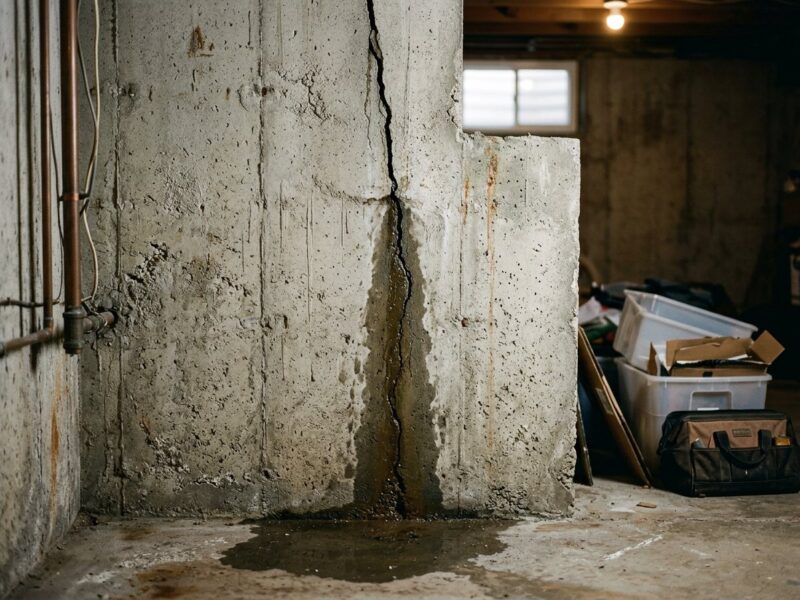
1980s and 90s poured walls
One weeping crack usually needs one repair. If the only proposal on the table for a single vertical crack is a full perimeter system, get a second opinion before you sign anything.
Ask why not injection
Newer subdivision homes
These houses already have perimeter drainage and a pump. The right first questions are about grading that has settled, downspout runs and whether the existing pump is simply undersized or worn out.
Ask about the grade firstWhat should the work cost?
These are the ranges we publish and quote from across the Chicago area, and they are the numbers to hold any estimate against. A quote landing far outside them deserves an explanation you find convincing.
| Work | Range | What moves the number |
|---|---|---|
| Interior drain tileper linear foot | $95–$160 | Length of the run, slab thickness, what has to be moved off the walls |
| Sump pump with battery backupinstalled | $2,800–$4,500 | Pit condition, backup capacity, discharge routing |
| Exterior French drainper linear foot | $45–$90 | Trench depth, where the water can legally go |
| Downspout extensions and regradingtypical job | $600–$2,500 | Feet of grade to rebuild, soil hauling |
One caution when you compare: digging to footing depth from outside has no honest per-foot number, since a six-foot dig on an open lot and a nine-foot dig beside a driveway are different jobs. Anyone quoting it sight unseen is guessing. Our ranges sit on the pricing page so you can read them before anyone knocks.
When you should not hire a waterproofing contractor
Some wet basements are not a waterproofing job at all. Knowing which is which saves you the appointment as well as the money.
Nobody has ruled out the gutters yet
An inch of rain on an average roof is thousands of gallons, and all of it is aimed by four or five downspouts. Move that discharge away from the house, correct the first ten feet of grade for $600 to $2,500, then give it a season of storms before signing anything larger.
Try this firstThe drain in your floor runs backwards in a storm
That is the municipal system pushing water into the house, and it is outside what any waterproofing company can warranty. A licensed plumber handles it, sometimes with a backflow valve or an overhead sewer. Confirming which one you have is free.
Call a plumberThe wall has moved and you want an independent read
If a wall is bowing, a licensed structural engineer with no repair to sell can give you a written opinion before you talk to any contractor. We are glad to work from one. What movement actually means.
Independent opinionThe floor is dry and the air is not
Warm July air meeting cold masonry produces smell, sweating pipes and clammy boxes without a drop of seepage. Leave a $30 hygrometer down there for a week before you buy anything, because a dehumidifier solves this and a drainage contract does not. The test takes a week.
Costs almost nothingQuestions homeowners ask before hiring anyone
How many quotes should I get for a wet basement?
Three is a reasonable number, and the value is in comparing scopes rather than prices. Ask each company for linear feet, method and exclusions, then line them up. When two proposals cover ninety feet and one covers forty, you have learned something real about the diagnosis. When all three describe the same work at wildly different prices, you have learned something about the pricing. Either way the measurements do the work, not your gut.
Is a lifetime warranty on waterproofing real?
It can be, and the wording decides. Ask three things: does it transfer to a buyer without a fee, what specifically voids it, and does it require paid annual inspections to stay active. A transferable warranty backed by a company that has been installing in the same counties for years means more than the word lifetime on a brochure. Ours is a lifetime, fully transferable warranty on interior systems, and the terms are published on our <a href="/warranty/">warranty page</a>.
Does a basement waterproofing contractor need a license in Illinois?
Illinois does not license waterproofing statewide the way it licenses plumbers, and requirements are set locally, so what applies in the city may differ from your village. Registration, bonding and permit rules vary. Ask the contractor which permits the job needs and who pulls them, and confirm with your own building department. Separately, always ask for a current certificate of general liability insurance before work starts. We carry $2,000,000 general liability.
Should I ever accept a same-day discount?
No, and the reason is simple: a price that only exists today was never a price, it was a lever. Legitimate seasonal pricing survives you sleeping on it. This is a repair that will be in your house for as long as you own it, and no honest company loses money by giving you a week. If a number drops sharply the moment you hesitate, ask yourself what the first figure was based on.
Does it matter if the crew is subcontracted?
It matters for accountability. When the installers are employees, the company that sold you the job is the company standing in your basement, and a warranty claim goes to one place. Subcontracting is not automatically bad, but you should know before signing who is doing the work, whether they carry their own insurance, and who answers the phone in three years. Our crews are our own, and we do not use commissioned salespeople.
What if I already paid someone and the basement still leaks?
Start with the paperwork. Pull the original scope and warranty and check what was actually installed against what was promised, because the gap between those two is where most of these disputes live. Then have someone measure again and put a fresh diagnosis in writing. We do that assessment free within 48 hours even when the first system was not ours, and sometimes the honest finding is that the existing work only needs finishing.
What our own inspection actually looks like
Every standard on this page is one we expect to be held to. The visit includes measuring the perimeter, walking the outside, checking the pit and the discharge, and leaving you a written diagnosis with numbers on it, priced from ranges you can read before we arrive. It is free within 48 hours whether you hire us or not.
See our inspection process

Hold us to everything on this page
Measured scope in writing, pricing you can read in advance, $2,000,000 general liability carried, and a diagnosis free within 48 hours. Call (630) 335-1128 and compare us line by line.
Or talk to a human right now
(630) 335-1128
Request your free estimate
Tell us what you're seeing. We'll call back fast and be out within 48 hours.