
Downspout Extensions and Underground Downspout Drains
A roof is a rain collector, and every gallon it catches lands somewhere. Getting that water past the first ten feet is the cheapest real repair on our price list, and on a fair share of the houses we inspect it is the only one that needs doing.
- Free written diagnosis within 48 hours
- Own crews, published prices, no sales commission
- 20+ in Chicago basements and yards, 1,500+ homes
 Drainage work: 5-year warranty
The short answer
Downspout extensions carry roof water past the loose backfill around the foundation, and six to ten feet out is the working minimum on a Chicago lot. Underground drains do the same job in solid pipe below the lawn, ending at a pop-up emitter or a lower spot. Both sit inside a $600 to $2,500 range.
An inch of rain falling on 1,000 square feet of roof is roughly 620 gallons, which is straight volume arithmetic rather than a study finding. All of it leaves through four or five downspouts. Release it at the wall and it soaks into the backfill ring, the disturbed soil that was shoveled back around the foundation the week the house went up and has never packed as tight as the ground beside it. That ring is the fastest route to your footing.
Chicago clay makes the arithmetic worse. Water that lands in that ring cannot spread sideways through dense till, so it stacks against the wall and stays for days after the sky clears. Add the bungalow blocks, where two roofs drain into one gangway barely four feet wide, and a single August storm puts a startling amount of water on one strip of dirt shared with the house next door. The wider picture sits on our yard drainage page.
How far from the house should a downspout discharge?
An extension is not decoration. It is a length of pipe with one job: get roof water past the loose soil ring that surrounds every foundation.
Five things decide whether an extension actually works, and the price of the pipe is not one of them.
-
Find where the backfill ends
The disturbed ring usually runs three to six feet out from the wall, about the width of the original excavation. Water released inside it goes down rather than away. Every question about length traces back to clearing that ring.
-
Go six to ten feet, not two
A splash block moves water roughly a foot and a half, which is still inside the ring on nearly every house we look at. Six feet is our working minimum, ten is better, and on a lot that falls back toward the house, farther still.
-
Keep fall in the pipe
An extension lying dead flat holds water, collects sediment and freezes solid in January. Give it steady drop from the elbow to the open end so it empties itself after each storm and dries out between them.
-
Land it on ground that keeps falling
The open end has to sit where the yard continues to slope away. Discharging into a flat planting bed, a mulch ring or the low corner of the lot relocates the puddle a few feet and buys you nothing at the wall.
-
Watch it during a real storm
Stand outside in the next heavy rain with a flashlight and follow each downspout. Ten minutes in the weather tells you more about where your water goes than any dry-day walkthrough, ours included.
Best for
- Testing whether roof water is the whole problem before buying anything
- Bungalows and two-flats with no room beside the house to dig
- Renters, and anyone who wants something done this weekend
- Any downspout currently ending on a splash block
- Reversible: if it changes nothing, you are out very little
What it costs you
- Something to mow around, trip over and rake against
- Roll-out sleeves silt up and stay collapsed once they do
- Ice at the open end backs water up the pipe in a thaw
- Nobody warranties a length of pipe lying on a lawn
How does a buried downspout drain work?
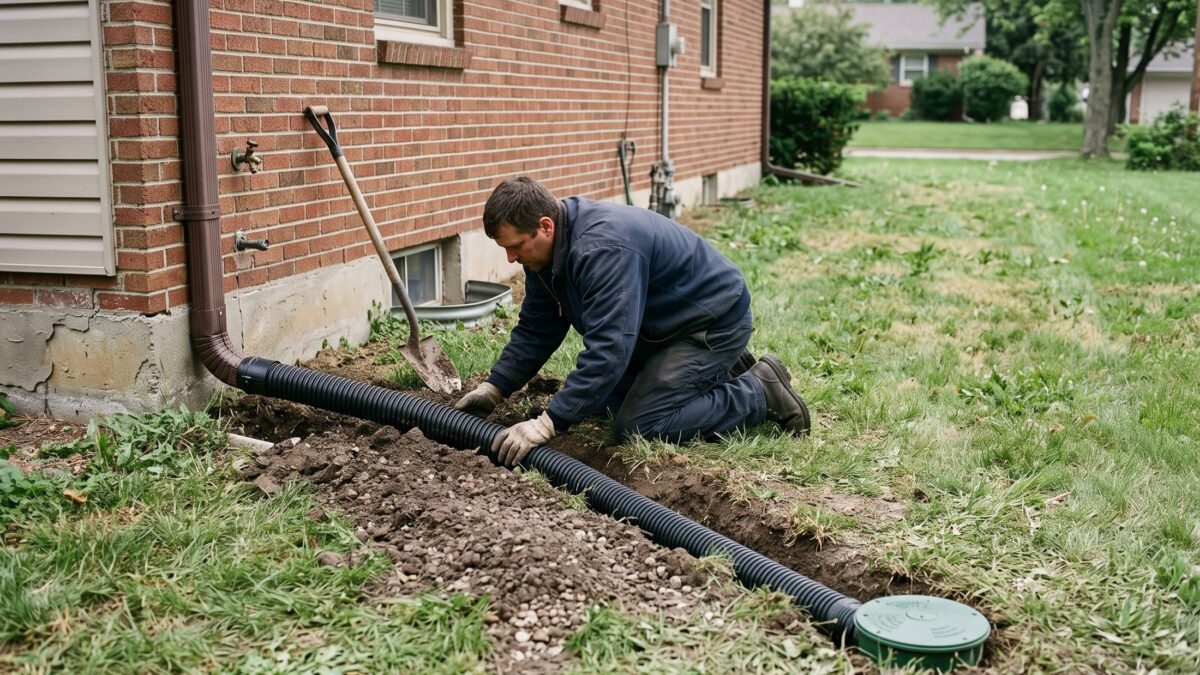
A buried downspout drain is a closed pipe, not a drain field. It carries the same water an extension carries, underground, so the lawn stays a lawn.
Order matters on this one, because the outlet decides everything upstream of it.
-
Find the outlet before you dig
Water leaves by gravity or it does not leave. We shoot elevations from the downspout elbow to the lowest usable point on the property, and when there is no fall to work with we say so instead of selling pipe.
-
Solid pipe, never perforated
Perforated pipe wrapped in stone belongs in a French drain, where the point is to collect. A downspout line exists to convey. Perforated pipe on this run quietly injects hundreds of gallons back into the soil near the house.
-
Pitch it and give it cleanouts
The line wants steady fall for its whole length, with a cleanout at the elbow and at any hard bend. Shingle grit, maple seeds and roof moss all end up in there, and a line nobody can rod is a line that gets abandoned.
-
End it where water can leave
Daylight on a bank or into a swale is the best ending. On a flat lot, a pop-up emitter set in a small stone pocket lets the line discharge at the surface, then closes flush so a mower passes over it.
-
Keep it off the foundation drain
Roof water never gets tied into a footing drain or a sump line. One plugged outlet then backfeeds thousands of gallons to the exact spot the whole job was meant to protect.
Best for
- Lots with genuine fall, or a swale, ditch or curb to reach
- Front elevations where a surface pipe looks wrong
- Homeowners tired of mowing around a sleeve every week
- Pairing with regrading while the ground is open anyway
- Carries our 5-year warranty on the work
What it needs
- Somewhere lower to go: no fall, no buried line
- Cleanouts, or it becomes pipe nobody can service
- Unfrozen ground, so winter installs wait for spring
- Village rules on where roof water may be discharged
Should you bury the downspouts or just extend them?
Both put roof water in the same place. What separates them is what you give up to get it there, and how long the fix survives a lawn mower.
| Above-ground extensions | Buried downspout drain | |
|---|---|---|
| What it is | Pipe or sleeve on the surface from the elbow outward | Solid pipe under the lawn to an emitter or daylight |
| Published cost | The low end of $600 to $2,500 with regrading | The upper end of that same published range |
| Time on site | An afternoon | A day, sometimes two once the lawn is restored |
| Season | Any month of the year | Stops once the ground freezes |
| How it fails | Kicked loose, crushed by a mower, iced shut | Silts up or crushes when there are no cleanouts |
| Lawn and looks | Visible, and something to mow around | Invisible apart from the emitter lid |
| Serviceability | You can pick it up and look inside it | Needs a rod run through a cleanout |
| Our warranty | Not a warrantied install on its own | A 5-year warranty on the work |
| Honest use | Prove roof water is the problem | Make a proven fix permanent and invisible |
Neither one matters if the gutter above it is packed with shingle grit. Clear the gutters and check their pitch first, then judge what the downspouts are doing. If the yard still holds water once roof water is moved, that is a separate job: see standing water in the yard.
Not sure the roof water is your problem? We trace every downspout, measure the grade at each corner and put the finding in writing, free within 48 hours.
What roof water does to each kind of Chicago house
Downspouts fail differently depending on when the house was built and how much room there is beside it. These four cover most of what we walk up to.

Pre-war bungalows and two-flats
Two roofs draining into one gangway barely four feet wide, with the downspout usually ending on a cracked splash block against a shared walk. There is often nowhere to send the water except the front sidewalk or the alley.
Run it to the front
Post-war block ranches
Wide shallow roofs, generous lots and a grade that has flattened out over sixty years. The downspouts have room to run here, and this is the era where extensions alone dry out the most basements.
Cheapest fix wins
1980s and 90s poured wall homes
Many already have buried lines the builder installed without a single cleanout. They silt shut quietly, and the first symptom is water surfacing at the elbow instead of at the emitter forty feet out.
Rod it before replacing it
Newer subdivision homes
Buried lines to pop-up emitters, shallow swales between lots, grading that was correct on closing day. Settlement and later landscaping beds are what break the path years afterward.
Reset the path, not the pipeWhat does it cost to move roof water away from the house?
Downspout extensions and regrading run $600 to $2,500 on the homes we work on. It is the least expensive real repair we sell, and the one we recommend first more often than any other line on the list.
| Work | Range | What moves the number |
|---|---|---|
| Downspout extensions and regradingtypical job | $600–$2,500 | Feet of grade to rebuild, soil hauling |
| Exterior French drainper linear foot | $45–$90 | Trench depth, where the water can legally go |
| Interior drain tileper linear foot | $95–$160 | Length of the run, slab thickness, what has to be moved off the walls |
Buried downspout lines are priced inside that same downspout and regrading range, because the number moves with run length and how much lawn has to be opened. Every range we quote from is published on the cost page, and you get the same numbers at your kitchen table.
When downspout work is not the answer
Roof water is the first thing we check and often the whole story. These are the cases where it is not, and where more pipe would just be money spent politely.
The gutters themselves are failing
A gutter packed with shingle grit, back-pitched by an old ice dam or undersized for the roof overflows at the fascia no matter what happens downstream. That is a gutter contractor's work and it costs a small fraction of any drainage job.
Call a gutter companyWater pushes up through the floor
Wet slab cracks and a damp floor out in the middle of the room mean groundwater under the slab rather than roof water at the wall. Surface work does not touch it. Water coming up through the slab runs on a different mechanism.
Not a surface fixIt comes out of the floor drain
Water rising out of a floor drain or a laundry standpipe during a storm is sewer backup. Roof drainage changes nothing about it, and the next call is a licensed plumber. Telling backup from seepage takes about five minutes.
Not our workYou can test the whole theory for $30
Buy a roll-out sleeve, run every downspout ten feet out, pencil a line around the wet spot on the wall and watch it through one wet spring. If the wall stays dry you have your answer, and you spent almost nothing getting it.
Wait a seasonQuestions homeowners ask about downspouts and buried drains
How far should a downspout drain from the foundation?
Six feet is the minimum we work to and ten is better, because the loose backfill ring around most foundations reaches three to six feet out from the wall. Water released inside that ring takes the easy path down to the footing. Length is not the only variable either: the pipe needs fall along its whole run, and it has to end on ground that keeps sloping away, or you have only relocated the puddle.
Can I bury my own downspout lines?
Plenty of homeowners do, and the digging itself is not complicated. What people miss is the elevation check. Buried lines move water by gravity, so if the outlet is not genuinely lower than the elbow, the pipe holds water permanently and freezes in winter. The other common miss is perforated pipe, which soaks the water back into the soil near the house. Solid pipe, real fall, cleanouts at every bend.
Do underground downspout drains freeze in an Illinois winter?
They can, and the failure point is almost always the outlet rather than the buried run. A pop-up emitter sitting in a shallow stone pocket ices over during a thaw and refreezes overnight, and then a January rain has nowhere to go. We set emitters where snowmelt drains off them and pitch the line so it empties after every storm. Expect to clear an outlet once or twice a winter.
Can the downspouts and the sump pump share one buried line?
We keep them separate. The sump has to be able to discharge at any moment, including while a storm is filling the roof line, and one shared pipe means a single clog stops both. Sump discharge also carries its own rules in many Illinois villages, and those rules do not always match the ones for roof water. <a href="/yard-drainage/where-sump-water-should-go/">Where sump water should go</a> covers the discharge side.
Will fixing my downspouts really dry out my basement?
Sometimes it is the entire repair, and we say so on the first visit when the evidence supports it. If the wall wets only during heavy rain, the damp patch sits under a downspout and the grade at that corner has settled, roof water is the leading suspect. If the basement wets during a slow three-day soaker with no downpour at all, the water is arriving from the water table and the roof is not your issue.
Where am I allowed to send roof water?
The general Illinois principle is that you may not concentrate water and direct it onto a neighboring property. Past that, the rules are local: some villages permit a storm sewer connection, some prohibit it, some regulate where a line may daylight. Ask your village before anyone digs. If a property line dispute is already running, that conversation belongs with an attorney rather than with a drainage contractor.
Is the ground itself sending water back at the house?
Downspouts and grade are two halves of one repair, and doing either alone is why so many people fix their gutters and stay wet. The soil in the first ten feet has to fall away from the wall before the extension you just installed can do anything useful with the water it delivers. That is the next page to read.
Read the grading guide

Start with the cheapest fix that could possibly work
Free written diagnosis within 48 hours, published pricing on every line, and a 5-year warranty on the drainage we install.
Or talk to a human right now
(630) 335-1128
Request your free estimate
Tell us what you're seeing. We'll call back fast and be out within 48 hours.