
Basement Slab Cracks, Heaving and Uneven Floors
A heaved basement floor is not a structural failure of the concrete. It is clay under the slab taking on water and expanding, and it stops when the water stops arriving.
- Elevations across the floor, free within 48 hours
- We name the cause before anyone prices a repair
- 20+ of Chicago basements, 1,500+ homes
 Drainage systems: lifetime, fully transferable warranty
The short answer
A basement floor heaves when clay beneath the slab absorbs water and swells. Expanding soil lifts the concrete, and because a basement floor is thin and unreinforced, it cracks along its weakest line and one side ends up higher than the other. The fix is moisture control and drainage that keeps water away from the soil under the slab.
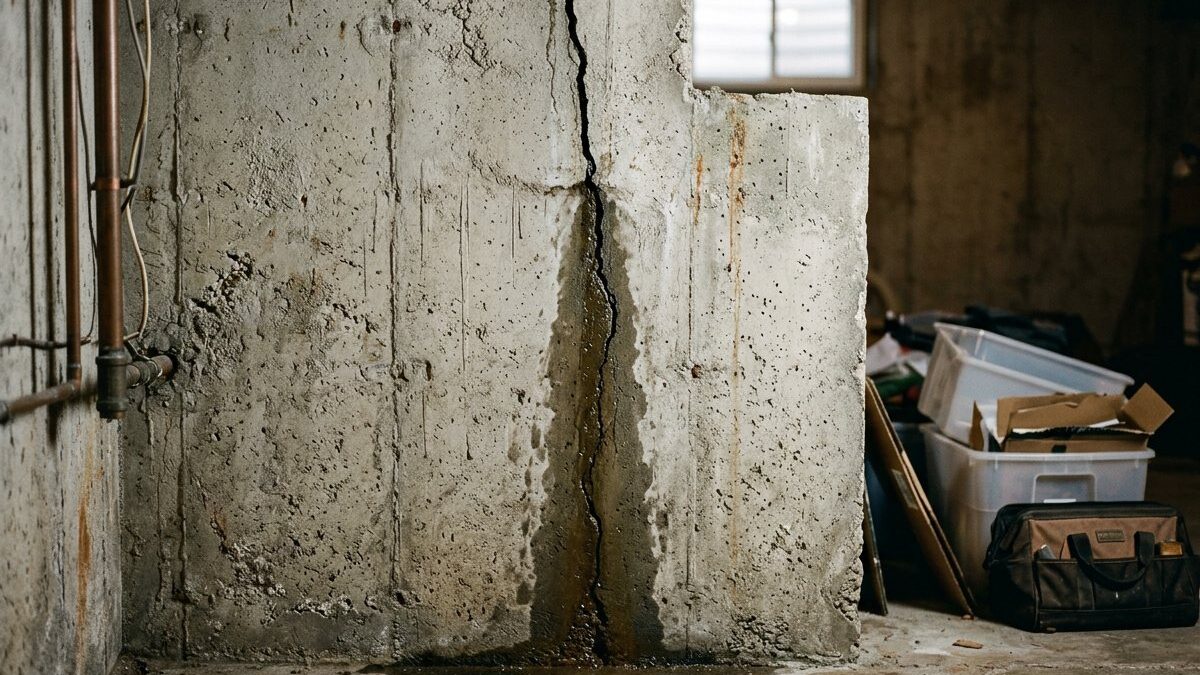
Heaving is upward movement, and that single word separates it from almost everything else people worry about in a basement. Clay is made of plate-shaped particles that hold water between them, and when they take water on, the whole mass expands with real force behind it. A basement floor is typically four inches of unreinforced concrete carrying nothing but your furniture, so it is the weakest thing standing in the way. It lifts, it breaks, and the break shows up as a crack with a lip you can feel through a sock.
Local geology makes this a familiar call. Glacial clay across Cook, Will and Kendall counties swells and shrinks noticeably with its moisture content, and it drains slowly enough that a wet spring keeps the soil saturated for weeks. Floors that were poured straight onto that clay with no stone bed, which describes a great many pre-war basements here, feel it most. The foundation leveling overview covers where floor movement fits alongside the structural work.
Why is my basement floor cracking and lifting?
Expanding clay is the usual answer, and it is a moisture story from beginning to end. The concrete did not fail; the ground it was resting on grew.
Here is the sequence that produces a heaved floor, and where it can be interrupted.
-
Water reaches the soil under the slab
It arrives from a downspout emptying at the wall, a settled grade tipping toward the house, a leaking service line, or simply a water table climbing after a long rain. Clay under a basement floor is not sealed off from any of that.
-
The clay swells
Wet clay occupies more space than dry clay. The expansion is slow and it does not need much distance, because it is pushing against a slab that has nothing holding it down. A quarter inch across a room is enough to break concrete and to be obvious underfoot.
-
The slab breaks where it is weakest
Pressure finds a control joint, an old shrinkage crack or a spot where the pour was thin, and the floor separates there. The tell is a vertical lip between the two sides. Settlement cracks pull apart; heaving cracks step up.
-
Everything sitting on the floor reports it
Vinyl plank buckles at a seam, tile grout crushes into powder, and a basement door that closed all winter starts scraping the floor in May. Finished basements notice heaving long before anybody looks at the concrete itself.
-
It cycles with the seasons
Then a dry August pulls the moisture back out, the clay contracts and the floor drops part of the way back. Movement that reverses on a yearly rhythm is the signature of soil moisture, and it is the reason people describe cracks that seem to open and close.
Signs it is heaving
- A crack with one side sitting higher than the other
- A dome or ridge you can feel walking across the floor
- A basement door that binds in spring and clears in fall
- Buckled flooring or crushed grout along one line
- Movement that is worst after a wet spring
Signs it is something else
- A crack that is level across, with no step: normal shrinkage
- A floor sloping down toward the middle: a beam or column
- Cracks in the wall above tracking with the floor: settlement
What stops a basement floor from heaving?
Controlling the water is the repair. Nothing placed on top of a slab resists swelling clay, so the work happens in the soil and the drainage around it.
A real scope on a heaving floor runs in this order, and the first three steps are the cheap ones.
-
Measure the floor and record it
Elevations are shot on a grid so the high area has a shape and a number instead of a description. That reading is repeated after a season, which is how we prove whether the floor is still moving or has already found its equilibrium.
-
Cut off the water at the surface
Downspouts get extended well past the foundation and the grade is rebuilt so it falls away from the wall. At $600 to $2,500 this is the least expensive line on the page and, on a good number of these floors, the only one that turns out to be needed.
-
Manage the humidity inside the room
A basement that stays near sixty percent relative humidity keeps the slab and everything on it stable, and a $30 hygrometer tells you where you actually stand. This does not stop heaving on its own, but it keeps flooring and stored goods from taking damage while the soil settles down.
-
Relieve the groundwater under the slab
Where the water table itself is the source, interior drain tile at $95 to $160 per linear foot intercepts water at the footing and a sump lifts it out, which lowers the water sitting under the floor. The system carries a lifetime, fully transferable warranty.
-
Replace the broken section, last
Once movement has stopped, a floor section that has genuinely broken up can be saw cut out, the base recompacted and new concrete poured to match. That work has no published per-foot price, so we measure the area and quote it after seeing what is under the slab.
What this approach delivers
- The moisture cycle under the floor interrupted at the source
- Movement that slows and then stops, documented by repeat readings
- Drainage work that also ends the seepage most of these basements have
- A repair sequence where the cheap steps come first
What will not work
- Sealers, coatings or floor paint applied over a moving slab
- Patching the crack while the clay under it is still swelling
- New flooring installed before the movement is proven finished
- Anything that treats the concrete instead of the water
Is my floor heaving or settling?
They are opposite movements with opposite repairs, and homeowners describe both as an uneven floor. The direction, the season and the crack profile sort them out quickly.
| Heaving, the floor moved up | Settling, the floor moved down | |
|---|---|---|
| Direction | Up, usually in the middle of a room | Down, usually toward a wall or a corner |
| Crack profile | A step you can feel, one side higher | A gap that has pulled apart with little or no step |
| Cause | Clay under the slab swelling with moisture | Fill under the slab compressing or washing out |
| Season it peaks | Late spring, after weeks of saturated ground | Late summer in drought years |
| What the walls do | Usually nothing, the slab moves alone | May crack too, if the footing went with it |
| Does it reverse | Yes, partly, as the soil dries out | No, settlement does not come back on its own |
| First repair | Drainage and moisture control around the house | Assessment of whether the footing is involved |
| Published cost of that first step | $600 to $2,500 for extensions and regrading | Free elevation survey, then priced by what moved |
| When concrete work is warranted | After movement stops, quoted by measured area | After the structure is stabilized, if at all |
Both readings can appear in one basement, since a floor can heave in the middle while a corner of the house settles. The structural half of that is a different scope: foundation leveling and underpinning explains what happens at the footing.
Is the floor still moving, or is it finished? We shoot elevations, put the readings in writing and tell you what the cheap first step is, free within 48 hours.
Which basement floors do this
What is under the concrete decides how a floor behaves, and that changed considerably over a century of building in this region.

Pre-war bungalows and two-flats
Thin slabs poured directly on clay with no stone bed and no vapor barrier under them. Nothing separates the concrete from soil that swells, so these are the floors we see heave most often across the older city blocks.
Highest risk
Post-war block ranches
Slightly better pours, still usually straight onto graded clay. Movement here often shows near an outside wall where a downspout has been dumping at the same corner for forty years.
Fix the water first
1980s and 90s poured walls
Real stone base under the slab and often a vapor barrier, which breaks the connection between clay and concrete. Cracks in these floors are far more likely to be plain shrinkage than movement.
Usually cosmetic
Newer subdivision homes
Stone bed, barrier and a working perimeter drain, on lots where the fill was placed and compacted recently. Heaving is uncommon; when it appears it usually points at a specific water source outside.
Look for the sourceWhat does it cost to deal with a heaving floor?
The first step is drainage at $600 to $2,500 for extensions and regrading. Where groundwater under the slab is driving it, interior drain tile is published at $95 to $160 per linear foot and a full perimeter system runs $8,000 to $16,000.
| Work | Range | What moves the number |
|---|---|---|
| Downspout extensions and regradingtypical job | $600–$2,500 | Feet of grade to rebuild, soil hauling |
| Interior drain tileper linear foot | $95–$160 | Length of the run, slab thickness, what has to be moved off the walls |
| Sump pump with battery backupinstalled | $2,800–$4,500 | Pit condition, backup capacity, discharge routing |
| Exterior French drainper linear foot | $45–$90 | Trench depth, where the water can legally go |
Saw cutting out and replacing a broken section of floor is quoted by measured area rather than from a list, because the base under the concrete is unknown until it is open and it has to be corrected before anything is poured back. The ranges above, and everything else we quote from, sit on the pricing page for you to read before we visit.
When an uneven floor is not worth repairing
Most cracked basement floors we look at need photographs and a season of patience, not concrete work. Four of these come through every month.
It is a shrinkage crack from the original cure
Concrete shrinks as it dries and cracks in its first year. If the two sides are flush, the crack wanders rather than running straight, and it has never changed, that is a floor doing what floors do. Photograph it with a coin for scale and forget about it.
CosmeticA line under the slab is leaking
A warm or persistently damp patch, running water audible with the house quiet, or a water bill climbing for no reason points at a supply or drain line under the concrete. That is a licensed plumber's work, and it changes the whole diagnosis before anyone talks about soil.
Call a plumberThe air is the problem, not the floor
Cupped flooring, a musty smell and condensation on the slab in July come from humid summer air meeting cold concrete. A $30 hygrometer and a dehumidifier settle it for a fraction of any concrete work. Basement humidity and dehumidifiers covers the whole test.
Costs almost nothingThe tree is running the moisture cycle
A large tree close to the house pulls the soil dry each August and lets it rehydrate every spring, which is the exact rhythm that heaves and drops a floor. Watering that side through drought and monitoring beats any repair. Trees, drought and clay shrinkage explains it.
Manage the causeQuestions about heaving basement floors
Is a heaving basement floor a structural problem?
Usually not, because the slab is not holding your house up. The walls sit on footings, and the floor is a separate slab poured inside them, so it can lift and crack while the structure above is completely unaffected. It becomes a structural conversation only when the walls or the footing move with it, which shows as cracking in the foundation wall or doors sticking upstairs at the same time.
How much movement is too much in a basement floor?
There is no single number, so we look at the trend rather than the total. A quarter inch of step at a crack that has been the same for fifteen years is a nuisance. The same quarter inch that appeared over two springs is telling you something is actively feeding water to the clay. Record elevations, date your photographs, and reread them after a wet spring and again after a dry August.
Can a heaved floor be put back to level?
The realistic path is to stop the movement first and then decide about the concrete. Once repeat elevation readings show the floor has settled into a stable position, a broken section can be saw cut out and replaced on a properly prepared base, and that work is quoted by measured area. Doing concrete work while the clay underneath is still swelling simply buys the same crack again.
Why is my basement floor worse in the spring?
Because that is when the soil holds the most water. Snowmelt runs off ground that is still frozen below the surface, ponds against the house and soaks in as soon as the ground opens, and March and April rain lands on soil that is already saturated. Clay under the slab reaches its wettest and most expanded state in that window, so heaving peaks then and eases through the summer.
Should I install flooring over a cracked basement slab?
Not until the movement has been documented as finished. Anything rigid installed over a slab that still lifts seasonally will telegraph the crack within a year or two, and tile is the least forgiving of all. Prove the floor is stable across a full wet and dry cycle first, correct the drainage that was feeding it, then choose flooring. Doing it in the other order is expensive twice.
Does water on the floor mean the same thing as heaving?
No, they are separate problems that often share a cause. Heaving is the concrete being pushed up by expanding clay. Water arriving through a crack is groundwater under pressure finding an opening. Both trace back to saturated soil around and beneath the house, which is why the same drainage work usually addresses the two of them together and why we quote them as one scope. <a href="/basement-waterproofing/basement-floor-cracks-water/">Water coming up through the slab</a> covers the seepage side in full.
If water is coming through the crack too
Plenty of these floors do both: they lift in the spring and they weep during a long storm. The second half of that is hydrostatic pressure, groundwater pushing up through the first opening it can reach, and it has its own diagnosis and its own repair. Reading both pages together gives you the full picture of what the soil under your basement is doing.
Water coming up through the slab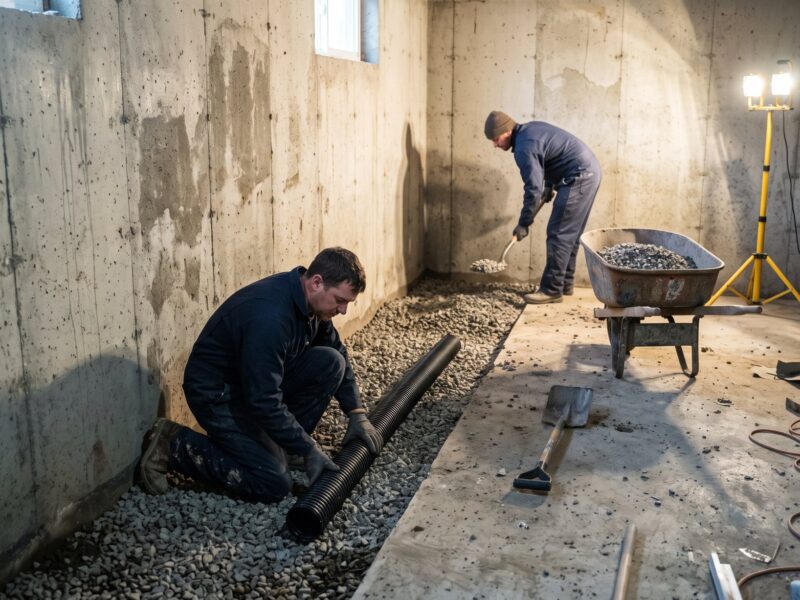

Find out what the floor is actually doing
Elevation readings, a written diagnosis and the cheapest honest first step, free within 48 hours, with 24/7 response when water is involved.
Or talk to a human right now
(630) 335-1128
Request your free estimate
Tell us what you're seeing. We'll call back fast and be out within 48 hours.