
Basement Floor Cracks and Water Coming Up Through the Slab
A basement floor is four inches of concrete resting on wet ground. It was never a boat hull. When the water table climbs above the underside of that slab, the floor leaks along its weakest line.
- Written diagnosis, free within 48 hours
- We say so when the right answer is a plumber
- 1,500+ Chicago-area homes in 20+
 Interior systems carry a lifetime, fully transferable warranty
The short answer
Water comes up through a basement floor crack when the water table rises above the underside of the slab and hydrostatic pressure pushes it through the weakest opening. It is groundwater, not plumbing. The repair is not the crack itself. It is drainage below the slab that lowers the water and takes the pressure off.
Concrete does not hold back water on its own. A basement slab is poured over stone or over graded clay, it shrinks as it cures, and it cracks somewhere in the first year of its life. Those cracks sit dry for decades while the ground beneath them is merely damp. Raise the water table until saturated soil presses against the bottom of that slab and the water is under a head of pressure. Pressure finds the crack, and the crack becomes a spring in your floor.
The Chicago area gives that water table plenty of reasons to climb. Dense glacial clay drains at a crawl, so a two-inch rain sits in the soil for days rather than moving through it. Spring thaw over still-frozen ground does the same thing on a larger scale, which is why so many of these calls land in March. Low-lying blocks in Will and DuPage counties see it worst. If you are still sorting out which of your basement problems is which, start with our basement waterproofing page.
Why is water coming up through my basement floor?
This is hydrostatic pressure, and it is the one basement problem that gets worse the harder it rains. Water trapped under a slab has nowhere left to go but up.
The sequence runs the same way on nearly every house we inspect.
-
The ground saturates
Clay around a Chicago foundation holds rain instead of passing it along. After a long storm or a rapid thaw the voids in the soil fill, and the whole volume around and beneath the house behaves like a wet sponge that cannot drain sideways.
-
The water table reaches slab level
Once the soil is full, the free water surface climbs. When it passes the underside of your floor, the slab is no longer sitting on damp ground. It is holding back standing water with four inches of unreinforced concrete.
-
Pressure looks for an opening
Water under a head pushes upward on everything above it. The floor is thinner than the walls and carries no structural load, so the first place it gives is a shrinkage crack, a control joint, or the seam where the slab meets the footing.
-
Water arrives at the crack, not from it
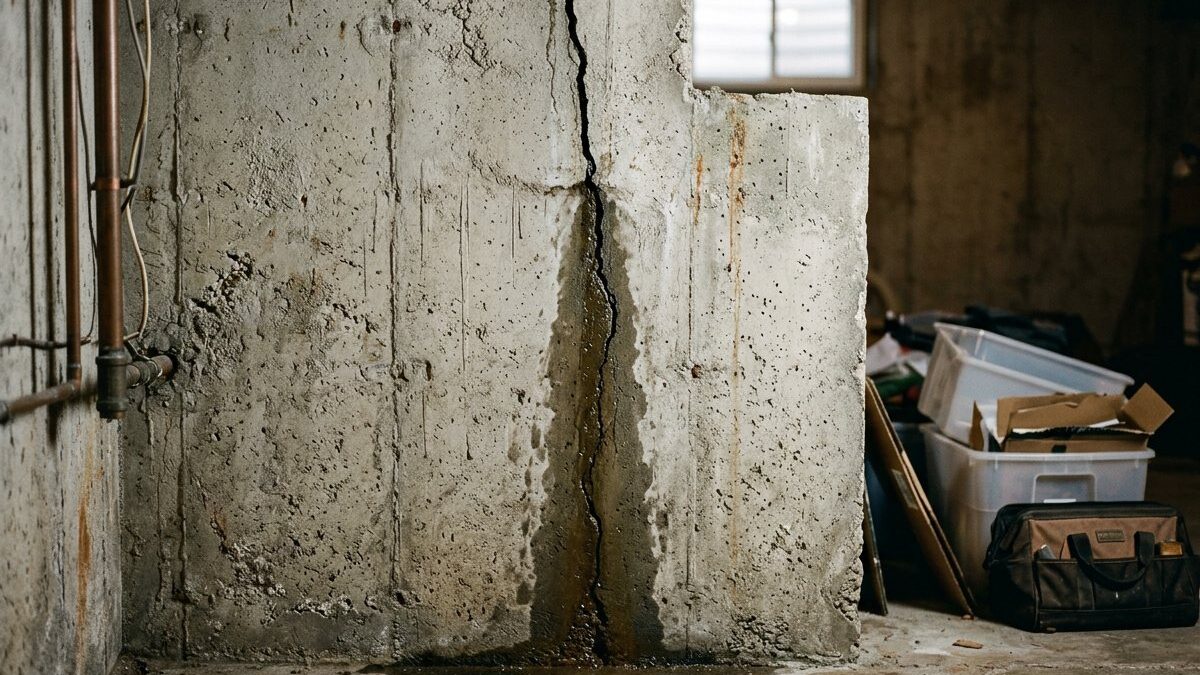
What you see is a wet line spreading across the floor while it rains and drying a day after it stops. Nothing inside the crack is broken. The crack is simply the lowest-resistance path through a floor being loaded from below.
-
The perimeter usually goes with it
The same pressure relieves itself where the slab edge meets the wall. Finding water in the middle of the floor and along the base of the walls in one storm is a single problem showing up in two places, not two separate failures to price separately.
Signs it really is pressure from below
- The wet patch spreads outward from a crack, not down a wall
- It appears hours into a storm and lingers a day after
- The water is clear and carries no smell
- The perimeter and the floor crack go wet in the same rain
- A dry stretch of weather makes it vanish completely
What it is not
- Not a plumbing leak, because those run in dry weather too
- Not a structural failure of the slab itself
- Not something a floor coating or a patch will hold back
What actually stops water coming through the slab?
Nothing applied to the top of a slab will hold back a rising water table. The durable answer is giving that water a lower place to go than your floor.
That means drainage below the slab and a pump, installed in this order.
-
Find the true low point
We shoot levels across the floor and note where water shows first. A slab is rarely flat after fifty years, and the pit belongs at the actual low corner rather than wherever a previous pit happens to sit.
-
Open the slab edge
A channel is cut through the concrete around the perimeter beside the footing. That is where the pressure relieves and where water can be caught below floor level, which is why the trench follows the wall rather than chasing the crack.
-
Bed pipe in washed stone
Perforated pipe goes into the channel in clean washed stone and is wrapped so clay fines cannot pack it. The stone bed matters as much as the pipe, because it is the reservoir that lets water move sideways under the slab toward the line.
-
Pump it out and send it away
A pit at the low point collects the water and a pump lifts it out, with a battery backup, because the storms that raise a water table are the storms that drop the power. The discharge has to end far enough out that it does not walk back.
-
Patch the crack last, if at all
Once the pressure is relieved, the floor crack is cosmetic and gets closed when the slab is finished. Sealing it first, with the water table untouched, only moves the leak to the next weak line a few feet away.
What this buys you
- The water level under the slab drops below the concrete
- The floor stays dry during the storm, not just after it
- Perimeter seepage stops at the same time, from the same work
- The system carries a lifetime, fully transferable warranty
What to plan for
- Two or three loud days and concrete dust in the house
- Flooring off the perimeter runs that have to be opened
- A pump is a moving part, so test it twice a year
- Power matters here, so budget the backup with the pump
Is it seepage through the slab or backup from the floor drain?
These two look identical on a wet floor and share nothing else. One is groundwater and our work. The other is your sewer and a licensed plumber's work.
| Up through a slab crack | Up out of the floor drain | |
|---|---|---|
| Where it shows first | At cracks, control joints and the slab edge | At the drain grate, then spreading outward from it |
| What the water looks like | Clear groundwater with no odor | Often grey or dark, with a distinct sewer smell |
| When it happens | Hours into a long rain, or during thaw | At the peak of a downpour, sometimes minutes in |
| How it ends | Recedes as the ground drains over a day | Drops fast once the sewer main catches up |
| Other fixtures | Unaffected | Basement toilet or laundry standpipe may gurgle or overflow |
| The actual cause | Water table above the underside of the slab | A surcharged sewer or a blocked lateral |
| Who repairs it | Us: drainage below the slab and a sump | A licensed plumber: backwater valve or overhead sewer |
| Insurance | Standard policies exclude seepage and groundwater | Sewer backup coverage is a separate optional endorsement |
| What will not help | Patching the crack while the pressure stays | Any amount of waterproofing on the walls or floor |
If both happen in one storm you have both problems, which is more common than people expect on older combined-sewer blocks. Sewer backup versus seepage walks through the full test.
Water on the floor and no idea why? We tell you which of the two it is in writing, free within 48 hours, even when the answer is to call a plumber instead.
Which floors do this, and why
Slab construction changed a great deal over a century of Chicago building, and the era tells us what is under the concrete before we cut into it.

Pre-war bungalows and two-flats
Thin slabs poured straight onto clay with no stone bed and no vapor barrier, often over an original tile line that silted shut generations ago. Water travels freely under these floors and surfaces wherever the concrete happens to be thinnest.
Perimeter system, nearly always
Post-war block ranches
Slabs poured tight against a block wall, so the floor and the slab edge leak in the same storm. Hollow block holds water too, which is why relieving the wall and the floor together is the only version that holds up.
Relieve the wall and the floor
1980s and 90s poured walls
Better slabs on real stone, but often one long control joint that has opened. If the perimeter stays dry and only that joint weeps, the water table is barely clearing the slab and the yard may be the cheaper correction.
Check the grade first
Newer subdivision homes
Stone bed, vapor barrier, working perimeter drain and a builder pump undersized for a real storm. Water at a floor crack here usually means the pump is losing the race, not that the system is missing.
Often just the pumpWhat does it cost to stop water coming up through the floor?
The work that relieves pressure under a slab is interior drain tile, published at $95 to $160 per linear foot, and a full perimeter system on an average Chicago basement lands between $8,000 and $16,000.
| Work | Range | What moves the number |
|---|---|---|
| Interior drain tileper linear foot | $95–$160 | Length of the run, slab thickness, what has to be moved off the walls |
| Sump pump with battery backupinstalled | $2,800–$4,500 | Pit condition, backup capacity, discharge routing |
| Downspout extensions and regradingtypical job | $600–$2,500 | Feet of grade to rebuild, soil hauling |
| Exterior French drainper linear foot | $45–$90 | Trench depth, where the water can legally go |
Not every one of these floors needs the whole perimeter. Where pressure only shows on one wall we quote that run and say why. Every range above is published on the cost page, and we price from it whether the job is forty feet or a hundred and forty.
When this is not our job
A wet floor gets blamed on groundwater more often than it deserves. Four of these come through every month, and none of them are waterproofing.
It rises out of the floor drain
Water coming up a floor drain is sewer backup. Your lateral or the municipal main is surcharging, and no drainage system under your slab will stop it. That is a licensed plumber, and the usual answers are a backwater valve or an overhead sewer conversion.
Call a plumberA tank or a supply line is leaking
A water heater weeping at the base, a softener discharge or a failing supply line will wet a floor during a dry week in August. Groundwater does not do that. If the floor is wet after ten days without rain, look at plumbing before anything else.
Not groundwaterIt is condensation on a cold slab
Warm humid July air meeting a slab still holding winter temperature beads up and reads as a leak, usually in open floor rather than at a crack. Tape a square of plastic down for two days and see which side is wet. A dehumidifier handles that.
Costs nothing to testThe gutters are doing it
One downspout dumping at a corner can raise the water table right under that quarter of the slab. Extensions and a corrected grade run $600 to $2,500, and we would rather you spend that and watch a season than buy a system you may not need.
Try the cheap fixQuestions about water coming through a basement floor
Can I just seal the crack in my basement floor?
You can, and on a floor under pressure it rarely holds. Sealing one crack does nothing to the water table, so the same head of water finds the next joint, the slab edge, or a spot where the concrete is thin. Patching earns its place as the last step, after drainage is in and the pressure is gone. Doing it first usually just relocates the wet spot by a few feet.
Does a crack in my basement floor mean a foundation problem?
Usually not by itself. Most slab cracks are shrinkage from the cure and carry no structural meaning, because a basement floor is not holding the house up. What matters is whether the two sides have moved relative to each other. A crack you can feel a lip across, or one that keeps widening, belongs in a settlement conversation instead. <a href="/foundation-leveling/basement-slab-cracks-heaving/">Slab cracks and heaving</a> covers that side of it.
Why does my floor only leak in spring?
Because frozen ground works like a lid. Snowmelt and March rain cannot soak into soil that is still frozen a foot down, so it runs across the surface, ponds against the house, and shoves the water table up quickly once the ground finally opens. That is the annual peak in this region, and a basement that stays perfectly dry all summer can still take water every March.
Will a dehumidifier stop water coming up through the floor?
No. A dehumidifier pulls moisture out of air and does nothing about liquid water under pressure. It has a real job after the drainage is in, keeping the room from smelling and keeping stored goods dry, but running one against an active leak only fills the bucket faster. Deal with the water first, then manage the air in the room.
Is water coming up through the slab covered by insurance?
Standard homeowner policies in Illinois exclude seepage and groundwater, which is exactly what this is. Sump pump failure coverage and sewer backup coverage are optional endorsements you have to add on purpose, and flood insurance is a separate policy entirely. Read your declarations page before you assume anything, and ask your agent which of the three you actually carry today.
How long does the repair take?
A perimeter interior system in an average Chicago basement runs one to three days on site with our own crews, plus curing time on the fresh concrete before anything goes back on the floor. A single wall run is often a day. You get the schedule in writing with the quote, and the system carries a lifetime, fully transferable warranty that transfers when you sell the house.
Not sure whether it is the sewer?
The most useful thing you can do before calling anyone is work out whether that water arrived from the ground or from the sewer. The tests are simple, they cost nothing, and they decide whether you need a waterproofing contractor or a licensed plumber. We wrote the whole comparison out because we would rather you reach the right trade the first time.
Compare sewer backup and seepage

Find out what is under your floor before anyone cuts it
Free written diagnosis within 48 hours, published pricing per linear foot, and 24/7 while the water is still rising.
Or talk to a human right now
(630) 335-1128
Request your free estimate
Tell us what you're seeing. We'll call back fast and be out within 48 hours.