
Discharge Lines and Illinois Sump Discharge Rules
A sump pump does not solve anything until the water is genuinely gone. Where that pipe ends decides whether you moved the problem or just gave it a lap around the house.
- We trace the whole run, pit to outlet
- Published pricing on drainage work
- No-charge visit booked inside 48 hours
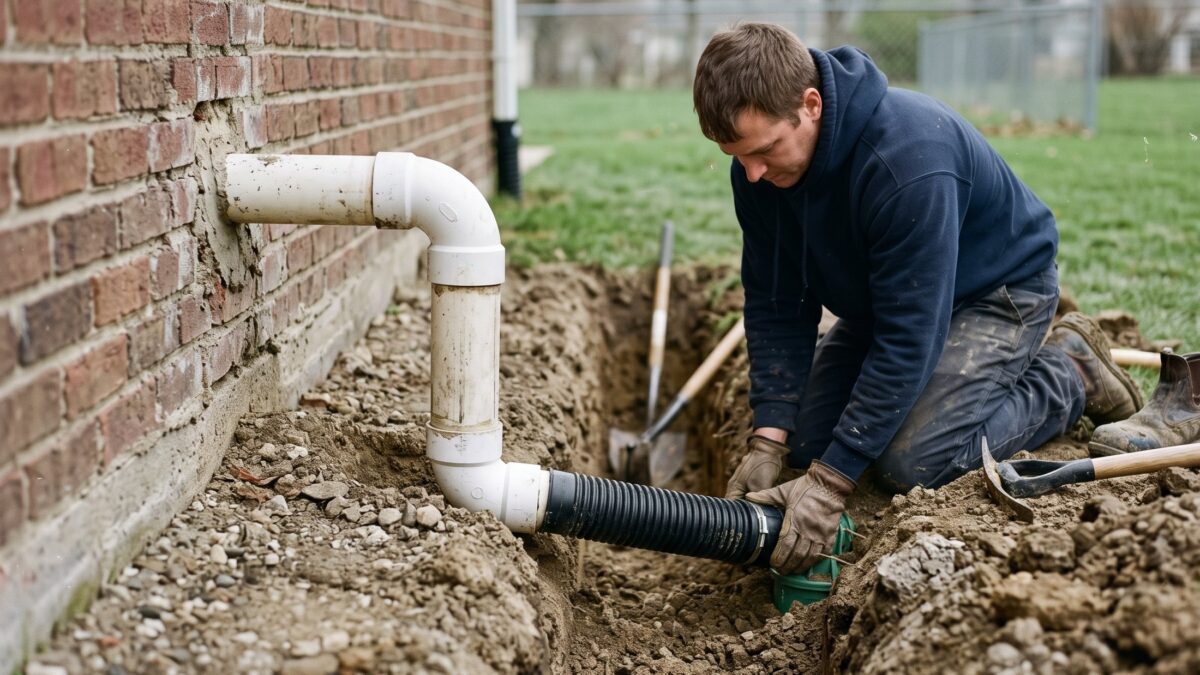 Drainage work carries a 5-year warranty
The short answer
Most Illinois municipalities prohibit connecting a sump discharge to the sanitary sewer, because clean groundwater overwhelms treatment plants during storms. Where the water may go instead, a storm sewer, a curb, or your own ground surface, varies town by town. Check your village code or building department before anyone trenches a line.
A discharge line is the last stage of a system that has already done the hard part. Drain tile intercepts water at the footing, the pit collects it, the pump lifts it, and then a pipe carries it somewhere. That last leg is the one nobody inspects, and it is where a working system quietly fails. Water released too close to the wall soaks back into the same loose backfill it just came out of, arrives at the footing again, and the pump moves the same gallons for the rest of the storm.
Chicago area towns are strict about this for a reason that has nothing to do with your basement. Sanitary sewers here were sized for waste, not for thousands of sump pumps running at once through a spring storm, and clean groundwater sent down that pipe becomes somebody else's backup a few blocks over. Storm sewers, curb outlets and surface discharge each have their own local rules, and they genuinely differ between neighboring villages. The sump pump installation page covers the pit end of the same system.
Where is a sump pump allowed to discharge in Illinois?
There is one near-universal prohibition and then a set of local choices. The prohibition is the sanitary sewer; everything after that depends on which village you live in.
Work down the list in this order, because the first item rules out an option that many older houses still use.
-
Not into the sanitary sewer
Most Illinois municipalities prohibit tying a sump discharge into the sanitary line, including a floor drain or a laundry tub that leads there. Clean groundwater has no business in a treatment plant, and during storms it is what pushes sewage into basements downstream.
-
A storm sewer only where your town allows it
Some communities permit a direct connection to the storm system, some allow it only with a permit and an inspection, and some do not allow it at all. This is a question for your building department, not for a contractor's assumption.
-
Onto your own ground, well away from the wall
The common answer is a run that releases the water onto your own lot, far enough out that it drains away rather than soaking back toward the footing. How far is a question of grade, soil and lot size.
-
Not onto the neighbor or the sidewalk
Rules on discharging toward a neighboring lot, across a public walk or into a street differ by town, and in winter water crossing a sidewalk becomes a liability question as well as a code one. Ask before you point a pipe that way.
-
Confirm it in writing before trenching
Call your village and ask what is permitted for a sump discharge at your address, and whether a permit or inspection is required. It is a short call, and it is the difference between a line that stays and one you rebuild.
What we ask your village about
- Whether a storm sewer connection is permitted at all
- Whether a permit or inspection applies to the line
- Any rule on discharge toward a lot line or public way
- Whether an existing sanitary connection has to be disconnected
- What the town expects at the outlet itself
Where old houses hide a problem
- A discharge pipe disappearing into the floor near the sanitary stack
- A pump discharging into a laundry tub or a floor drain
- A capped mystery line in the crawl or the utility room
- Nothing about the arrangement documented at the last sale
How far from the house should a sump line discharge?
Far enough that the water is past the disturbed backfill around your foundation and moving downhill. A pipe that quits at the wall just recirculates the storm.
Five things decide whether a discharge run keeps working, and only one of them is the length.
-
Clear the backfill zone
The soil replaced against your foundation when the house was built is looser than the clay around it and drains faster. Water dropped inside that zone runs straight back down to the footing, so the outlet has to be well beyond it.
-
Follow the grade, not the shortest path
The line has to end somewhere lower than where it starts and somewhere the water can keep moving. Running a pipe efficiently to a flat spot or a low corner just relocates the puddle to a place you now own.
-
Bury it or accept the mower
A surface hose gets kinked, run over and disconnected. A buried line to a pop-up emitter survives the yard, stays out of the way, and puts the water out at the point you actually chose rather than wherever the hose ended up.
-
Plan for a February freeze
Any buried run in this climate can ice at the outlet, and a blocked line stops the pump dead. The usual answer is a relief fitting near the house so the pump can still push water out if the far end is frozen shut.
-
Keep it findable
Mark the emitter, note the route, and walk it every fall and spring. Lines nobody can locate are the ones that stay clogged for a season, which you discover during the storm rather than before it.
Signs the discharge is the weak link
- A permanently wet or spongy patch near the outlet
- The pump cycling again within seconds of shutting off
- Ice building at the outlet through the winter
- A hose lying disconnected in the grass
- Water surfacing between your house and the neighbor's
What we correct most often
- A pipe ending three feet from the foundation wall
- A buried run with a belly in it holding water
- An emitter buried under mulch or sod and never found again
- A shared line where two pumps fight each other
Surface hose or buried line to a pop-up emitter?
Both get the water away from the wall. They differ on what happens the rest of the year, when nobody is thinking about the sump at all.
| Surface hose or splash extension | Buried line to a pop-up emitter | |
|---|---|---|
| Install cost | Low, often a homeowner afternoon | Priced with the drainage work, quoted in writing |
| Survives the lawn mower | Rarely | Yes, the pipe is under the sod |
| Stays where you put it | Gets moved, kicked and disconnected | Fixed route and a fixed outlet |
| Winter behavior | Freezes at the outlet, easy to spot and clear | Can freeze at the emitter, needs a relief fitting |
| Where the water lands | Wherever the hose happens to be pointing | The spot you chose from the grade |
| Appearance | Visible pipe across the yard | Invisible until it pops open |
| Maintenance | Reconnect it constantly | Walk the route twice a year |
| Our warranty | Not a system we warrant | A 5-year warranty on the drainage work |
Neither one helps if the yard itself holds water. Where the low ground is the real problem, the discharge has to tie into a wider plan: see yard drainage.
Not sure where your discharge line ends? We follow it from the pit to the outlet and put what we find in writing. The visit costs nothing and happens inside 48 hours.
Where does the water go at your house?
Lot width, fall and the age of the plumbing decide what your options actually are. Here is how that tends to play out by house type.

Pre-war bungalows and two-flats
Narrow lots with a four-foot gangway and very little fall in any direction. These are also the houses most likely to have an old discharge quietly tied into the sanitary line, which is worth finding before a sale.
Check the old connection
Post-war block ranches
Wider lots with room to run a line properly, but grades that have settled flat over sixty years. The pipe usually exists; it just ends too close to the wall to accomplish anything.
Extend and re-slope
1980s and 90s subdivision colonials
Pumps that run only in spring, with a hose someone rolls out each March and forgets by June. Half the ones we see are disconnected at the time we look at them.
Bury it and be done
Newer subdivision homes
Engineered lot grading and swales designed to carry stormwater to a specific place, sometimes with rules attached to the subdivision. Tying a sump line in without checking can undo the design.
Ask the village firstWhat does the discharge side cost?
Discharge and grading work is published: downspout extensions and regrading run $600 to $2,500, and a buried sump line is priced with that same work.
| Work | Range | What moves the number |
|---|---|---|
| Downspout extensions and regradingtypical job | $600–$2,500 | Feet of grade to rebuild, soil hauling |
| Sump pump with battery backupinstalled | $2,800–$4,500 | Pit condition, backup capacity, discharge routing |
| Exterior French drainper linear foot | $45–$90 | Trench depth, where the water can legally go |
The line length, whether it is buried, and where the grade lets it end are what move the number inside that range. The rest of our published numbers, and how drainage sits against full system work, are on the pricing page.
When you do not need us for this
The discharge end of a sump system is the part a homeowner can genuinely handle, and we would rather say so than sell a trench nobody needs.
The pipe just needs to be longer
If the grade already falls away from the house and the pipe simply stops too soon, a solid extension to a lower spot is an afternoon and the cost of pipe. Watch it through one full storm before deciding anything larger is warranted.
Cheapest real fixYou found a sanitary connection
If your discharge disappears into a floor drain or a stack, that is a plumbing question. A licensed plumber disconnects it and your village tells you what to replace it with. Ask the building department first, then hire the trade that does the work.
Not our workThe neighbor and the property line
Where discharge water is crossing between lots, Illinois drainage principles apply and local rules vary, so start with a conversation and your village, and with an attorney if it escalates. Pointing the pipe a different direction is often the whole resolution.
Talk before you digThe pit is dry anyway
A pump that has not run in two seasons is not a discharge problem. Keep the roof water moving away from the house and check the line each spring. Where sump water should actually go covers the rest.
Wait a seasonQuestions homeowners ask about sump discharge
Can a sump pump discharge into the sanitary sewer in Illinois?
In most Illinois municipalities, no. Sanitary systems were sized to carry waste, and thousands of sump pumps adding clean groundwater during a storm is what pushes sewage back into basements elsewhere in the neighborhood. Many towns actively look for these connections and require them removed. Because enforcement and the exact requirement differ by community, call your village or building department about your specific address before you assume anything.
How far from the foundation should the discharge end?
Far enough to clear the loose backfill placed against your foundation when the house was built, and onto ground that keeps falling away. There is no single number that fits every lot, because a steep side yard and a flat corner lot behave completely differently. What we do is walk the grade with you and find the point where released water actually leaves rather than soaking back down to the footing.
Can I run the sump line into my downspout drain?
Sometimes, and it depends on where that drain goes and what your town permits. If the downspout line runs to a proper outlet with capacity to spare, combining them can work. If it runs to a dry well already at its limit, or into a system the village restricts, you have created a new problem during the exact storm both lines are busiest. Confirm the destination first.
What happens if my discharge line freezes?
The pump keeps running, cannot push water anywhere, heats up and eventually fails, and the pit backs up while it does. This is a real Illinois winter failure, not a theoretical one. The usual protection is a relief fitting near the house that lets the pump discharge at grade if the buried section is blocked, plus a check of the outlet each fall. See <a href="/sump-pump-installation/frozen-sump-discharge-line/">frozen discharge lines</a> for the detail.
Do I need a permit to install a sump discharge line?
It varies by municipality. Some towns treat it as part of the plumbing work and require a permit and inspection, some regulate only a connection to the public storm system, and some ask for nothing on a surface line across your own lot. Ask your building department what applies at your address before work starts. We handle the question with you rather than guessing on your behalf.
Can I discharge onto my neighbor's property?
You should assume not, and check. Illinois drainage law addresses how water moves between properties, local ordinances add their own requirements, and a pipe pointed at a lot line is one of the fastest ways to turn a wet basement into a dispute. In practice there is nearly always another direction with fall available. Your village can tell you what is permitted, and an attorney handles anything genuinely contested.
Getting the water out is only half the question
Rules tell you where a discharge may legally go. Grade, soil and where your lot actually drains tell you where it should go, and those two answers are not always the same address. Our yard drainage page works through the destination side: swales, emitters, low corners, and what to do when the honest answer is that there is nowhere downhill left.
See where sump water should go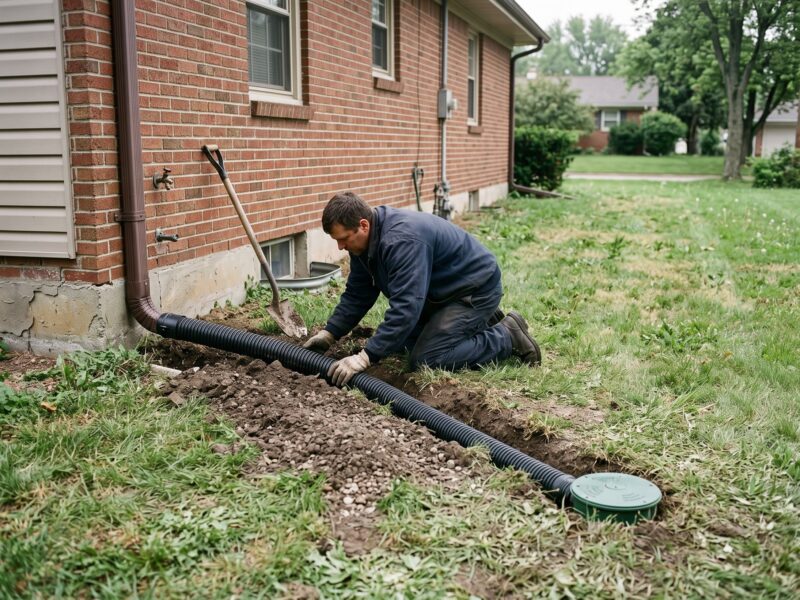

Have the whole line checked, pit to outlet
No charge for the visit, 48 hours to get it on the calendar, published drainage pricing, and 24/7 when a line has stopped moving water.
Or talk to a human right now
(630) 335-1128
Request your free estimate
Tell us what you're seeing. We'll call back fast and be out within 48 hours.