
Battery Backup Sump Pumps
The storm that fills your pit is the same storm that knocks out your block. A backup pump is the only part of a waterproofing system that assumes the power is already gone.
- Inspection booked inside 48 hours, at no charge
- Published pricing on pumps and backup systems
- Own crews, $2,000,000 general liability in liability cover
 Backed by 24/7 emergency response
The short answer
A battery backup sump pump is a second pump in the same pit with its own float switch, wired to a deep-cycle battery and a charger rather than to your house circuit. When the grid drops or the primary pump quits, the backup float rises and the battery runs the pump until power returns or the charge is spent.
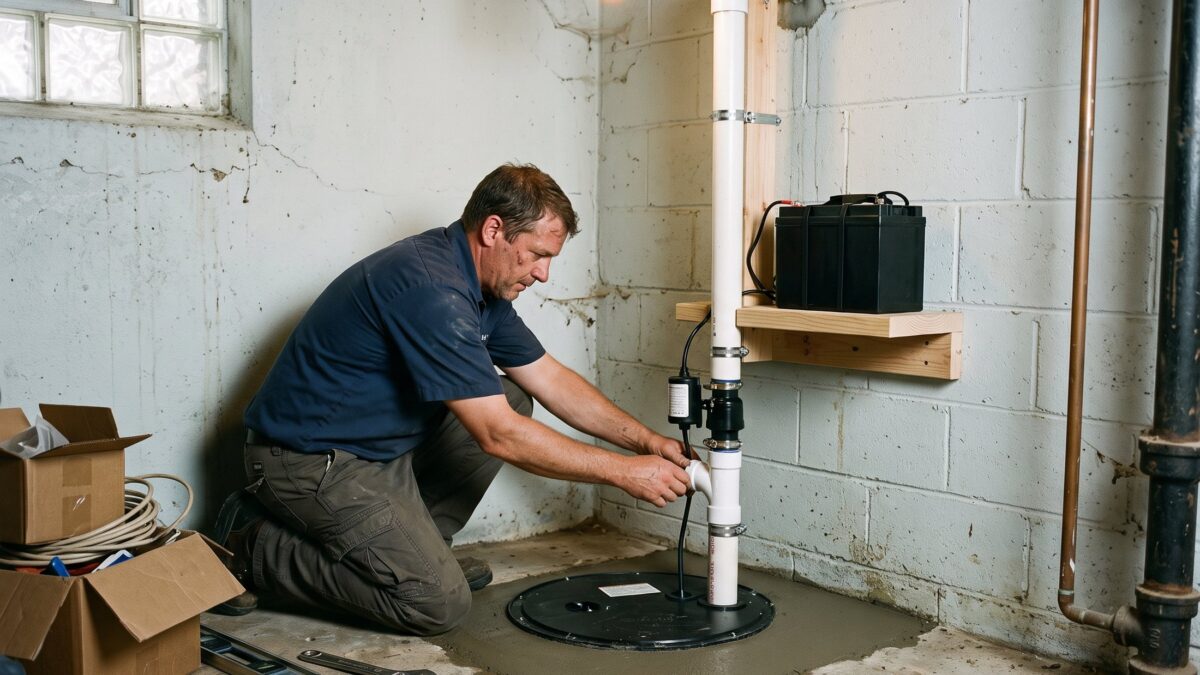
The primary pump in your pit is a plug-in appliance. Pull its power and it is a lump of iron sitting in rising water, which is the whole problem, because the weather that overwhelms a pit is the weather that takes lines down. A backup system fixes that by stacking a second pump above the first with its own float, its own switch and a battery that has been trickle charged since the day it was set. Nothing on that path passes through your breaker panel.
Around Chicago the failure has a season. Late spring storms roll through with wind ahead of the rain, transformers go down across the suburbs, and saturated clay keeps pushing water at the footing for hours after the sky clears. That is the gap a backup covers. It also covers the quieter failure, a primary pump that has simply worn out mid-storm with nobody home to notice. Both are why we quote backup capacity as part of the system rather than as an upsell, and why the sump pump installation page treats the pit as one assembly instead of a single pump.
How does a battery backup sump pump work?
A backup system is a parallel pump with a parallel power source. Everything about it is designed to work when the rest of the basement has no electricity.
Here is the assembly, from the bottom of the pit up to the wall it hangs on.
-
A second pump in the same pit
The backup pump mounts above the primary, high enough that it never runs during normal weather. If the water gets to it, something has already gone wrong, and that is exactly the point of where it sits.
-
Its own float, set higher
The backup float sits a few inches above the primary switch. That stagger means the primary handles every ordinary cycle and the backup stays dry and unworn until a real event lifts water past the level the main pump should have cleared.
-
A deep-cycle battery in a box
The battery lives in a sealed box off the floor, because a battery sitting in the puddle it was bought to prevent is not much of a plan. Deep-cycle chemistry matters here: it is built to be drained and refilled repeatedly.
-
A charger and controller on the wall
The controller keeps the battery topped up, watches its voltage, and switches the pump over the instant house power disappears. Most units carry an audible alarm and a fault light, which is the only warning you will ever get.
-
A shared or separate discharge
The backup either ties into the primary discharge behind its own check valve or runs its own line out. Either way the outlet has to stay clear, because a frozen or crushed line stops a backup pump exactly the way it stops a primary.
Worth it when
- Your block loses power in summer storms, which is most of the region
- The basement is finished, or holds a furnace, panel or anything stored
- Nobody is home during the workday to hear a pit running hard
- The pit runs often enough that a single pump is doing real work
- Installed as part of a system covered by our lifetime, fully transferable warranty
What it does not do
- It does not run forever: runtime depends on the battery and the inflow
- It does not fix a discharge line that is frozen, clogged or crushed
- It does not replace a primary pump that is already on its way out
Why do backup pumps fail during an outage?
Almost every dead backup we pull out failed quietly, months before the storm. The battery is the part that ages, and nothing about it is visible from the top of the stairs.
These are the five ways we actually find them dead, in rough order of how often.
-
The battery aged out in silence
Deep-cycle batteries lose capacity every year whether or not the pump ever runs. A unit that held a long night of pumping when it was new may only hold a fraction of that by the time it is called on, with no outward sign at all.
-
Nobody ever tested it
Unplugging the primary and pouring water in the pit takes five minutes and is the only proof a backup works. Systems installed and never touched again are the ones that fail, and the alarm they were counting on had a flat battery too.
-
The wrong battery went in
A car starting battery is built for one huge burst, not for being drained slowly and recharged over and over. Swapped in as a cheap replacement, it will run a pump for a while and then die far sooner than the owner expects.
-
The outage outlasted the charge
Backups are sized in hours of pumping, not days. A long regional outage with steady inflow will empty any battery. Two batteries, or a generator, is the honest answer for a house that has to ride out that scenario.
-
The discharge was the real problem
A pump that cannot push water anywhere runs, heats and gets nowhere. An iced outlet in February or a line crushed by a mower does this. See frozen discharge lines for the winter version.
What we check on a service visit
- Battery age, terminals and the charger reading
- Both floats lifted by hand and by water
- A live test with the primary unplugged
- The full discharge run out to the outlet
- That the alarm actually sounds
Do this yourself twice a year
- Pour a bucket into the pit and watch both pumps cycle
- Write the battery install date on the box in marker
- Walk the discharge line to its outlet in fall and again in spring
- Replace the battery on age, not on whether it looks fine
Battery backup or water-powered backup?
There are two real backup technologies and they fail in opposite directions. One needs a charged battery, the other needs municipal water pressure.
| Battery backup | Water-powered backup | |
|---|---|---|
| What powers it | A deep-cycle battery kept charged on the wall | Pressure from the municipal water main |
| Works during a power outage | Yes, that is the entire purpose | Yes, as long as water pressure holds |
| Works on a private well | Yes | No, a well pump needs the same electricity |
| Runtime limit | Hours, set by battery capacity and inflow | Effectively unlimited while the main is pressurized |
| Ongoing consumable | A battery replaced on a schedule | Metered water every minute it runs |
| Plumbing involved | None beyond the discharge | A potable supply connection with backflow protection |
| Municipal rules | Straightforward in most towns | Cross-connection rules vary, check your village |
| Ongoing attention | Test it and replace the battery | Test it and confirm the backflow device |
| Best fit | Most Chicago area houses on city or well water | City water houses with strong pressure and long outages |
A backup only buys time if the primary side of the system is sound. If the pit is undersized or the pump is mismatched to the inflow, start with sizing the pump before adding a second one above it.
Not sure your backup would actually start? We test both pumps, the battery and the full discharge run, free within 48 hours.
Which houses really need a backup?
How hard the pit works, and what a failed pump costs you, both change with the era the house was built in. Four patterns account for nearly every basement we look at.

Pre-war bungalows and two-flats
Old clay tile has usually silted shut, so a new pit takes on everything at once during a storm. Overhead power on these blocks goes down more often, and the pit is frequently the only thing between the storm and a furnace.
Backup strongly advised
Post-war block ranches
Block walls hold water in their cores and release it slowly, so the pit keeps cycling for hours after the rain stops. That long tail is exactly the window a battery has to cover once the lights go out.
Size for a long run
1980s and 90s poured walls
Often a pit that only runs a few weeks a year, which fools people into thinking a backup is optional. The pump that sits idle for months is also the one most likely to seize the night it is needed.
Backup plus a real test
Newer subdivision homes
Builder-grade pump, working perimeter drainage and often a finished lower level with mechanicals in it. The drainage is fine; the single pump and single power source are the weak link in the whole assembly.
Upgrade the pump, add the backupWhat does a battery backup sump pump cost?
We publish one range for the pit work, and a sump pump with battery backup runs $2,800 to $4,500 installed across all seven counties we serve.
| Work | Range | What moves the number |
|---|---|---|
| Sump pump with battery backupinstalled | $2,800–$4,500 | Pit condition, backup capacity, discharge routing |
| Interior drain tileper linear foot | $95–$160 | Length of the run, slab thickness, what has to be moved off the walls |
| Downspout extensions and regradingtypical job | $600–$2,500 | Feet of grade to rebuild, soil hauling |
That range covers the pump, the backup unit, the battery and controller, and the discharge work at the pit. Batteries are a consumable and get replaced on age, the way tires do. The full price list sits on the pricing page, and 0% for 12 months financing applies to the whole job.
When a backup pump is not what you need
Plenty of the pits we look at have a different problem, and a second pump would just be a more expensive version of the same failure.
Your primary pump is the thing that is dying
A pump groaning, short cycling or running on after the pit is empty needs replacing now. Bolting a backup above a failing primary means the backup becomes the primary and burns out early. Replace first, then add the second stage.
Fix the main pumpYou already own a generator
If you have a standby generator that carries the sump circuit, and you have actually tested it under load, the outage case is covered. Talk to your electrician about whether that circuit is on the transfer switch before spending anything down here.
Not our workThe pit never runs
Some basements are dry because the grading and downspouts do their job. A pit that has not cycled in two years does not need a backup; it needs a $30 water alarm on the floor and someone to keep the outside water moving away from the wall.
Cheapest real fixThe water comes up the floor drain, not the pit
Water rising from a floor drain during heavy rain is sewer backup and no pump in the pit will stop it. That belongs to a licensed plumber, and usually to a backflow device. Telling seepage and sewer backup apart.
Call a plumberQuestions homeowners ask about backup pumps
How long will a battery backup sump pump run?
It depends on battery capacity, how hard the pump has to lift, and how fast water is coming into the pit, so the honest answer is a range measured in hours rather than a single number. A pit cycling every few minutes drains a battery far faster than one cycling every twenty. Ask us to run yours down under real inflow during the inspection instead of trusting a number on a carton.
How often should the battery be replaced?
Replace on age and on tested performance, not on appearance. Deep-cycle batteries lose capacity every year even sitting fully charged, and a unit that never gets called on can still be finished. Write the install date on the box the day it goes in. Then test twice a year by unplugging the primary and pouring water into the pit, and replace the battery when the run time is visibly shorter than it used to be.
Can I add a backup to the sump pump I already have?
Usually yes. Most backup units are built to drop into an existing pit alongside the pump that is already there, provided the pit is wide enough and deep enough to hold both with the floats staggered properly. The two limits we run into are narrow pits with no clearance and old primaries that are near the end of their life. We will tell you which one you have before quoting anything.
Is a battery backup better than a generator?
They solve different sizes of problem. A backup pump covers the sump and nothing else, starts by itself, and needs no fuel or attention during the storm. A standby generator carries the whole house but costs considerably more and has to be tested and fueled. Many houses in the suburbs have both, with the backup handling short outages and the generator earning its keep in a multi-day one.
Will the backup run if the primary pump jams but the power is on?
Yes, and that is a scenario people forget about. The backup float sits above the primary switch, so if the main pump seizes, clogs or has a stuck float, water keeps rising until it lifts the backup float and the second pump starts. Most controllers sound an alarm when that happens, which is your signal that the primary needs service that week, not next season.
Does a backup pump need its own discharge line?
Not always. It can tie into the primary discharge behind its own check valve, which keeps water from cycling back down into the pit, or it can run a separate line outside. A separate line is worth it where the existing discharge has a history of freezing or clogging, because a shared line means one blockage disables both pumps at once. We decide that at the pit.
A backup is only as good as the maintenance behind it
Every dead backup system we have pulled out was installed correctly and then left alone. Testing takes minutes, the battery is a wear part, and the discharge line needs walking twice a year. The maintenance page lays out exactly what to check, when to check it, and the signs that a pump is telling you it is finished.
Read the sump pump maintenance guide

Find out how your pit performs before the next outage
Book the no-charge inspection inside 48 hours. We test both pumps under real water, quote from published ranges, and pick up 24/7.
Or talk to a human right now
(630) 335-1128
Request your free estimate
Tell us what you're seeing. We'll call back fast and be out within 48 hours.