
Waterproofing Before You Finish or Sell the Basement
Water behaves the same way in a finished basement as it does in an empty one. What changes is the size of the bill, and the order you should be booking trades in.
- Free written diagnosis within 48 hours
- A lifetime, fully transferable warranty that follows the house
- Published pricing you can hand to a buyer
 Follows the house: lifetime, fully transferable warranty
The short answer
Waterproof before you finish. Drainage, crack repair and a sump cost far less in an empty basement than behind framing and drywall, and the system carries a lifetime, fully transferable warranty from the day it goes in. Before a sale, Illinois sellers must disclose known material defects, and basement water is one of them.
Finished space changes what a small amount of water costs. An eighth of an inch of seepage across a bare slab is a mop, a fan and an afternoon. The same water under carpet pad, inside a bottom plate and wicking into paper-faced drywall becomes demolition, drying equipment and replacement of the exact materials you just paid to install. Nothing about the seepage itself got worse. The only thing that changed is what was standing in front of the wall when the storm arrived.
That arithmetic is why we get called to so many Chicago basements twice. The first visit produces a quote the homeowner sets aside because the room is dry that month. The second comes after a spring storm walked through a family room built the previous fall. Clay lots in this region hold water long enough that nearly every basement gets tested eventually, usually during a thaw. If you are still weighing which system your house needs, the basement waterproofing overview lays out the options.
What should you do before finishing a basement?
The dry work comes first and the order is not negotiable. Every waterproofing step is cheaper, faster and less disruptive with nothing standing in front of the wall.
This is the sequence we tell homeowners to book their trades in.
-
Watch it through one wet season
Before anything gets bought, live with the room through a spring and note every damp spot against the rainfall. A basement that stays dry through a March thaw and an August storm has told you something a single dry-day walkthrough cannot.
-
Deal with the outside water first
Downspout extensions and regrading run $600 to $2,500 and remove a surprising share of the water before it ever nears the wall. It is the cheapest line item in the whole project and it belongs at the front of it.
-
Repair the wall itself
Weeping cracks get injected at $450 to $900 per crack under a 10-year warranty. Bowing or stair-stepped walls get their structural work now, while a crew still has open access, rather than after the room is framed and finished.
-
Install the drainage and the pump
Interior drain tile runs $95 to $160 per linear foot and goes in over one to three days on an empty slab. A pump with battery backup is set at the same time, sized to the inflow we measured rather than to a catalog page.
-
Then let the carpenter in
Framing starts only after the room has taken a real storm and stayed dry. Keep the sump pit reachable and detail the finished wall so the bottom few inches can be opened later without gutting the room around it.
Why this order saves money
- No demolition needed to reach the wall or slab edge
- Crews move faster with clear access, so labor runs lower
- The system carries a lifetime, fully transferable warranty from day one
- Finish materials go in dry and stay that way
- You buy the flooring and drywall once
What waiting costs you
- Flooring, trim and drywall removed to reach the slab edge
- Restoration is a separate trade with its own invoice
- Standard policies exclude seepage damage to finishes
- Weeks without the room you just finished paying for
How does a wet basement affect selling your house?
A wet basement is not a secret a Chicago listing can keep. It surfaces in disclosure, in the inspection report, or on the stairs during the first showing.
Here is how it usually unfolds, and where documented work changes the outcome.
-
Disclosure comes first
Illinois sellers are required to disclose material defects they know about, and known basement water counts. Forms and requirements change and every transaction differs, so ask your real estate attorney or your agent how it applies to your sale rather than guessing.
-
The inspector looks anyway
Home inspectors are trained to spot white crusting, stained base trim, a rusted tack strip and one wall painted more recently than the others. Their report describes what they saw in plain language, and that language lands in the middle of the negotiation.
-
Buyers price the uncertainty
An unexplained damp corner gets discounted well past what the repair would have cost, because a buyer has no way to scope it from a showing. Not knowing is always more expensive than a written quote from a contractor.
-
A transferable warranty resets the conversation
A completed system with a lifetime, fully transferable warranty that follows the house turns a defect into a documented improvement. A buyer can call us and confirm the coverage, which is the entire reason we put it in writing.
-
Keep the paperwork in one place
The written diagnosis, the scope, the invoice and the warranty document belong together in a folder for the listing. Agents use it, inspectors read it, and it ends a negotiation faster than any verbal reassurance ever has.
What helps a sale
- A finished repair with dated paperwork behind it
- A warranty the next owner can actually claim
- Photos of the work before the concrete went back
- A dry basement through the spring you list in
What hurts one
- Fresh paint over a stain the week of listing
- A dehumidifier running through every showing
- Work done by a contractor no longer in business
- A verbal promise with nothing on paper behind it
Waterproof first, or finish now and deal with it later?
Homeowners ask this every winter, usually with a framing crew already booked. Set the two paths side by side and it stops being a close call.
| Waterproof, then finish | Finish now, fix later | |
|---|---|---|
| Access to the slab edge | Open and clear for the crew | Behind flooring, trim and framing |
| Interior drain tile pricing | Published $95 to $160 per linear foot | Same range, plus demolition and restoration |
| Time on site | One to three days for most basements | Longer, with a drying period before rebuild |
| Finish materials | Bought once | Bought twice on the affected walls |
| Use of the room | It was empty anyway | Out of commission for weeks |
| Warranty timing | System covered before finishes go in | System covered, drywall never was |
| Insurance help | Not needed | Seepage damage is normally excluded |
| What a buyer sees later | A documented system with dated paperwork | A patched wall and a list of questions |
If the basement is already finished this is not a lost cause, and we do the work without gutting the room every week: see waterproofing a finished basement.
Framing quote already sitting on the counter? Get the water answered first, free and in writing within 48 hours, with 0% for 12 months financing when both projects land in the same month.
What does your house need before the drywall?
The era a house was built in tells us how likely a finishing project is to get tested, and by what. These four cover most of the basements we quote across the seven counties.

Pre-war bungalows and two-flats
Low headroom, stone or early concrete walls and original clay tile that silted shut decades ago. Finishing one of these without drainage is the single most common regret we hear on second visits.
Never finish first here
Post-war block ranches
Block walls seeping at the floor joint during long rains, often paired with a builder pump near the end of its life. A finished wall wants to sit exactly where that joint is, so sequence decides everything.
Drain, then frame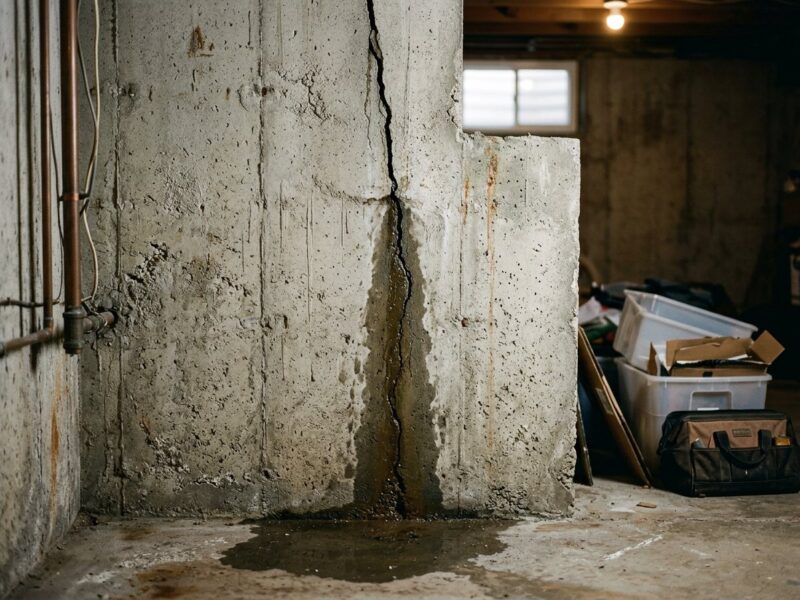
1980s and 90s poured walls
Usually one shrinkage crack that weeps through spring storms. Cheap to inject on an open wall and genuinely expensive to reach once a media room is standing in front of it.
Inject before drywall
Newer subdivision homes
Working perimeter drainage already in the ground, so a finishing project here is often reasonable. Check the grading and the age of the pump before spending money on the room above them.
Check the pump firstWhat does the waterproofing part cost?
A full perimeter interior system on an average Chicago basement runs $8,000 to $16,000, which is a fraction of most basement finishing budgets and the only part of the project that stops water.
| Work | Range | What moves the number |
|---|---|---|
| Interior drain tileper linear foot | $95–$160 | Length of the run, slab thickness, what has to be moved off the walls |
| Sump pump with battery backupinstalled | $2,800–$4,500 | Pit condition, backup capacity, discharge routing |
| Downspout extensions and regradingtypical job | $600–$2,500 | Feet of grade to rebuild, soil hauling |
Framing, drywall and flooring are not our trades and we do not mark them up or subcontract them. Every waterproofing range we quote from is published on the pricing page.
When you should not waterproof before finishing
Not every basement needs a system before the carpenters arrive. These are the cases where we tell people to keep their money.
The basement is genuinely dry
Some are. No stains, no white crusting, no smell, dry after every storm through a full spring. Those need an air plan and a correct wall detail rather than drainage. Build the wall properly and get on with the project.
No system neededYou are selling in six weeks anyway
A system rushed in to close a deal helps nobody and reads as exactly what it is. Disclose what you know, price the house accordingly and let the buyer pick their own contractor. Your attorney or agent will tell you how to handle the paperwork.
Talk to your agentThe whole problem is two downspouts
A pair of disconnected downspouts can wet a basement corner all by themselves. Extensions and regrading at $600 to $2,500 sometimes end the story entirely. Do that first and watch a season before booking anything larger.
Cheapest real fixIt comes up the floor drain
Water rising out of a floor drain during storms is sewer backup rather than seepage, and no waterproofing system addresses it. That goes to a licensed plumber and possibly a backflow device. Tell the two apart here.
Not our workQuestions homeowners ask before finishing or selling
Do I have to disclose a wet basement when selling in Illinois?
Illinois sellers are generally required to disclose material defects they know about, and water in the basement is treated as one of them. That is the principle. The specific forms, timing and wording change over time and vary with the transaction, so your real estate attorney or your agent is the right person to ask about your sale. What we can say is that a completed repair with dated paperwork is far easier to disclose than a stain nobody can explain.
Does basement waterproofing increase home value?
It rarely appraises the way an addition does, but it removes a discount. Buyers subtract far more for an unexplained wet basement than the repair would have cost, because they are guessing at the scope. A documented system with a lifetime, fully transferable warranty they can verify by calling us turns that guess into a known number. In a competitive market it also keeps a nervous buyer from walking during the inspection period.
Can I finish a basement that leaks a little?
You can, and we get the call when a little stops being a little. Seepage is seasonal, so the amount you saw during a dry year is not the amount a wet spring will deliver. If you finish anyway, keep the bottom of the wall demountable, avoid carpet along the perimeter and leave the sump pit reachable. The better answer is to spend the drainage money before the drywall arrives.
How long should I wait after waterproofing before finishing?
Long enough for the basement to see real rain. We tell people to give it one genuinely wet stretch, which around here means a spring thaw or a run of summer storms. The fresh concrete over the drainage channel also needs time to cure and release its own moisture before you trap it behind a finished wall. A month is common and a full season is safer.
Will homeowners insurance cover a finished basement that floods?
Standard policies exclude seepage and groundwater, which is what most basement water in this region actually is. Sump pump failure and sewer backup are typically optional endorsements you have to add on purpose, and flood coverage is a separate policy entirely. Read your declarations page before you finish the space and ask your own agent what is on it, rather than assuming the finishes are covered.
Should I waterproof before selling, or let the buyer handle it?
It depends on your timeline. With months to work with, a completed system with transferable paperwork usually protects the price better than a credit, because credits tend to get negotiated twice. With weeks, disclosing and pricing honestly is the cleaner path. Either way, get a written diagnosis first so you are negotiating against a real number instead of a fear. Your agent can tell you which route suits the listing.
Already finished, and now it leaks?
We do this work in finished basements every week without gutting the room. The slab edge gets opened only on the walls that are actually taking water, finishes come off in sections rather than everywhere, and the rest of the space stays intact. It is more careful work than an empty basement, and it is a long way from starting over.
See how we work in finished space

Get the water answered before the drywall goes up
Free written diagnosis within 48 hours, published pricing, and a lifetime, fully transferable warranty that follows the house to its next owner.
Or talk to a human right now
(630) 335-1128
Request your free estimate
Tell us what you're seeing. We'll call back fast and be out within 48 hours.