Foundation Repair in Naperville, Illinois
Naperville foundations are young, poured and mostly healthy, which is exactly why the diagnosis matters: the difference between a curing crack and active settlement is the difference between a $450 morning and pier money. We measure first, in numbers you can hand to your other two bidders.
- Structural warranty: 25-year transferable
- Published pricing: injection from $450, piers from $1,600
- Free structural inspection within 48 hours
 25-year transferable warranty
Who does foundation repair in Naperville?
ProSeal Basement Waterproofing repairs foundations throughout Naperville from a base in the Joliet and New Lenox corridor. Crack and rod hole injection runs $450 to $900, carbon fiber straps $600 to $1,000 each, steel beams $900 to $1,500, and settlement piers $1,600 to $3,000 per pier, every number published before an estimator sees your wall, every repair backed by a 25-year transferable warranty.
In a city of well-built poured walls, the real skill is restraint. Most Naperville cracks are shrinkage from the original cure, closed cases that need sealing, not steel. The estimator's job is proving which kind yours is, with crack gauges and elevation numbers you can put next to your other bids. When a contractor here quotes structural money without measurements, that is the tell.
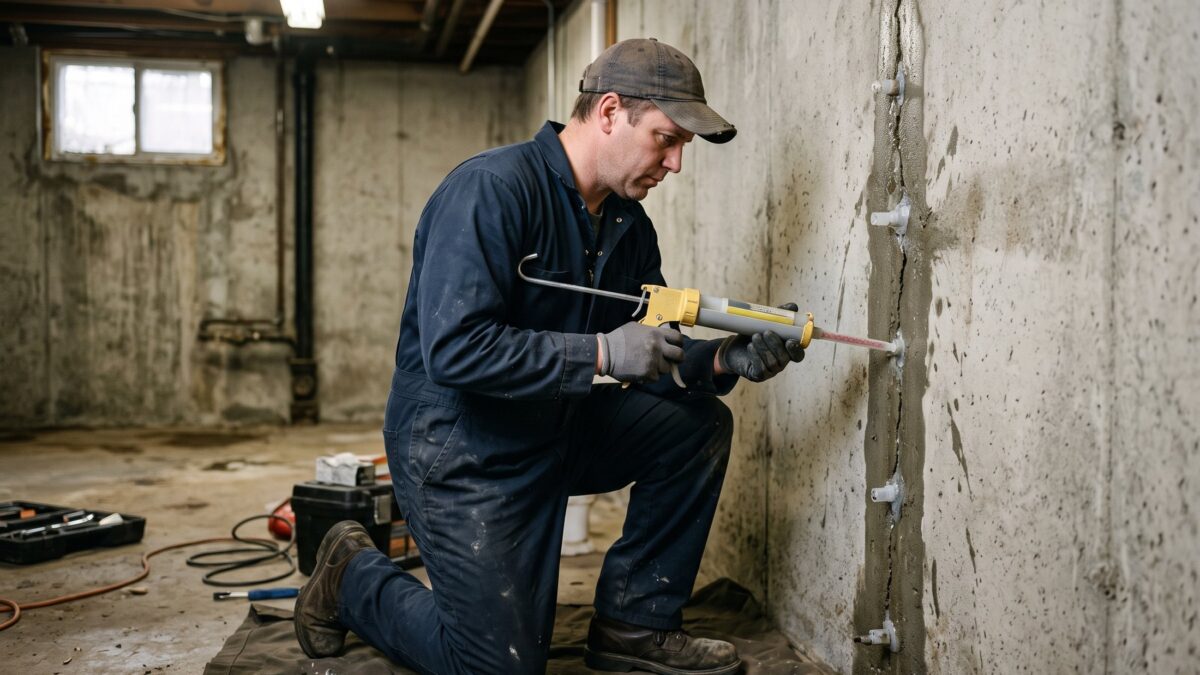
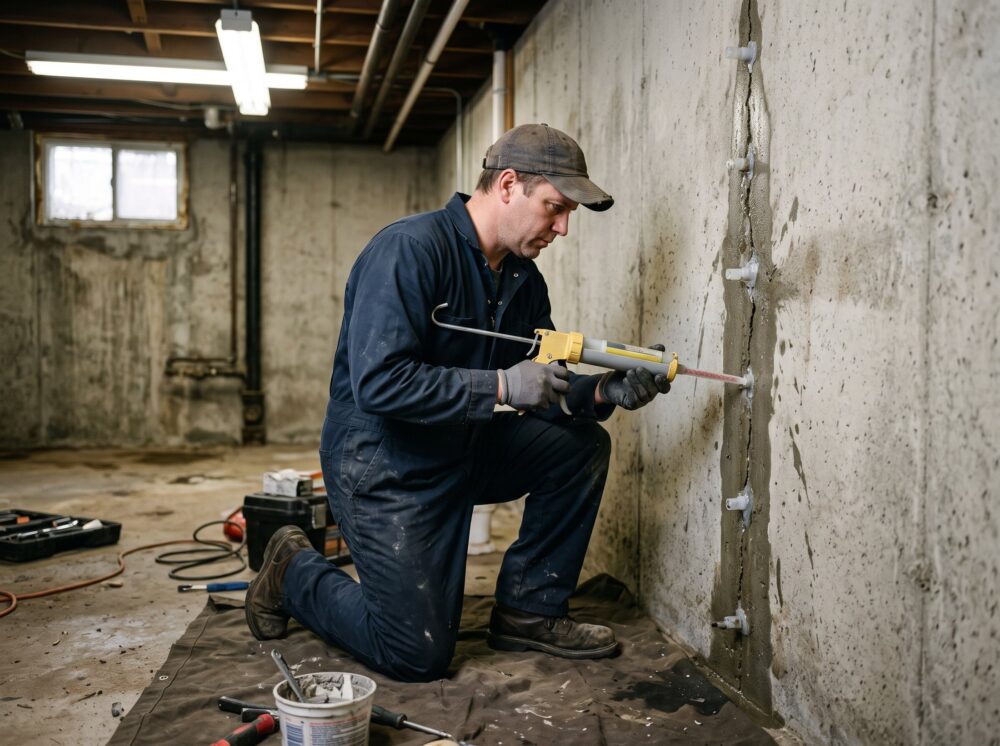 Injection ports on a poured wall: the honest fix for most Naperville cracks.
What does foundation repair in Naperville include?
Six structural tools cover what Naperville housing actually breaks, and the written plan always starts from the cheapest adequate fix. In this city that starting point is usually injection, and the plan says so when it is.
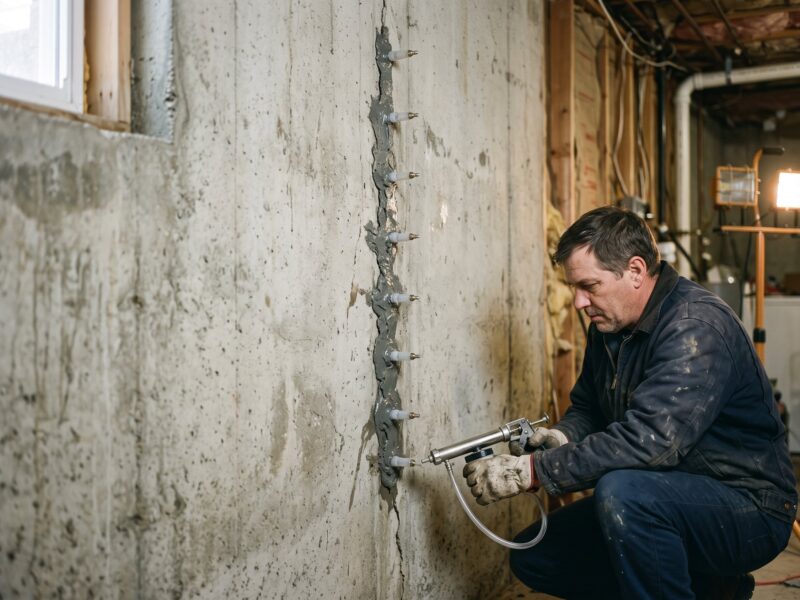 Urethane crack injection
Shrinkage cracks and rod holes in poured walls, sealed full depth from $450.
Learn more
Urethane crack injection
Shrinkage cracks and rod holes in poured walls, sealed full depth from $450.
Learn more
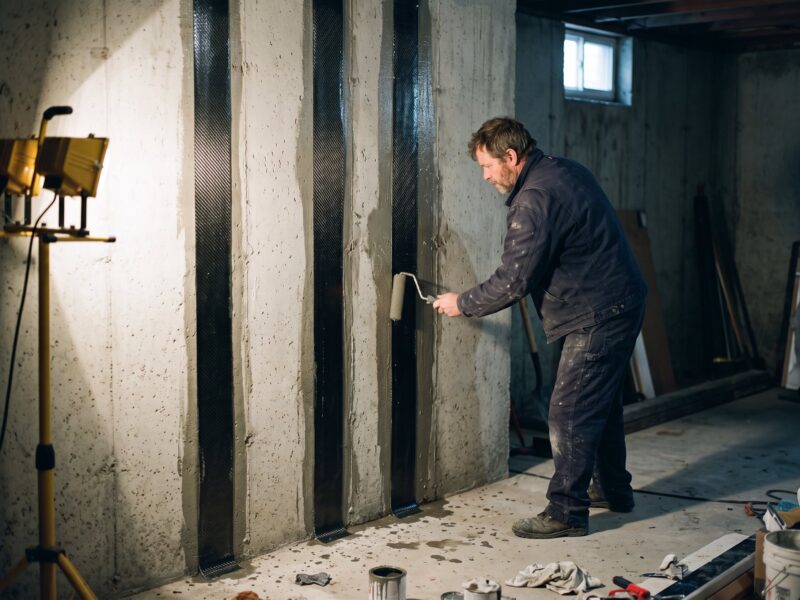 Carbon fiber straps
Low-profile reinforcement that disappears behind a refinished wall.
Learn more
Carbon fiber straps
Low-profile reinforcement that disappears behind a refinished wall.
Learn more
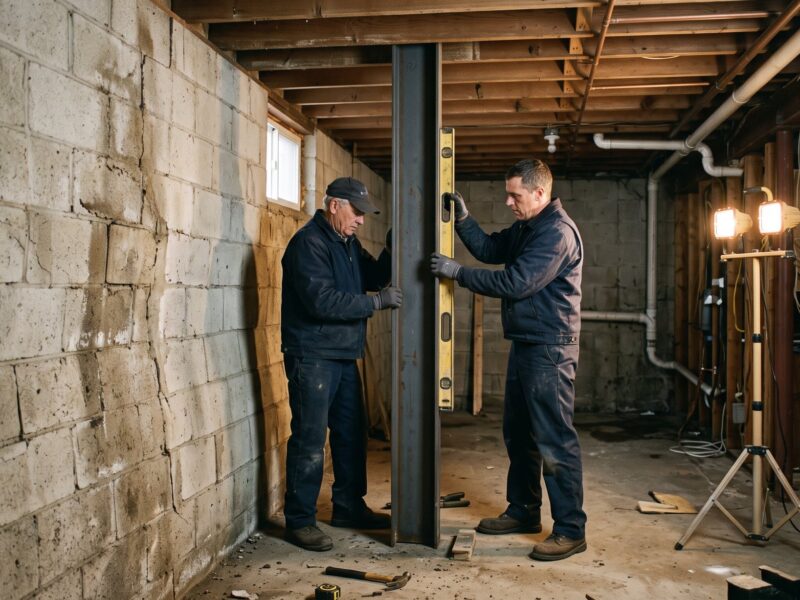 Steel I-beams & wall anchors
For the minority of walls with real inward movement on the gauge.
Learn more
Steel I-beams & wall anchors
For the minority of walls with real inward movement on the gauge.
Learn more
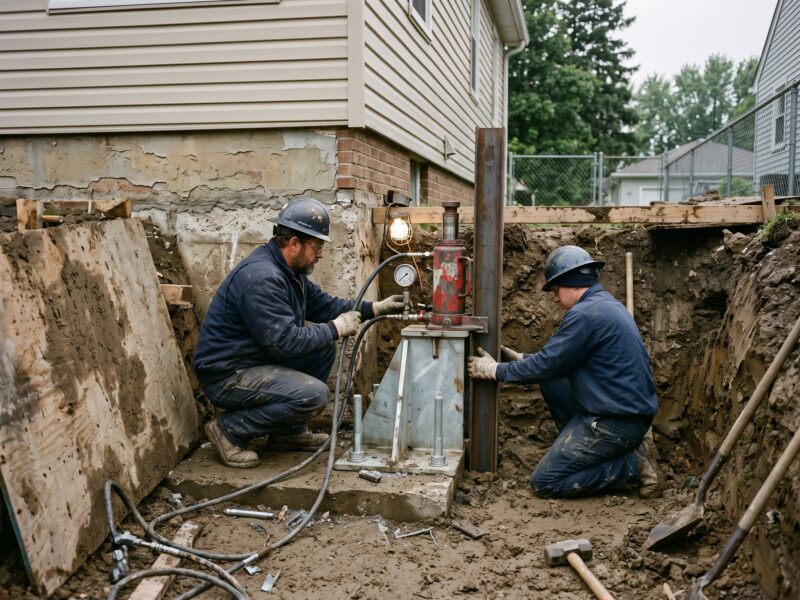 Push & helical piers
For active settlement in the subdivisions built on graded farm clay.
Learn more
Push & helical piers
For active settlement in the subdivisions built on graded farm clay.
Learn more
 House leveling
Columns and beams for sagging floors, including the older stock by the river.
Learn more
House leveling
Columns and beams for sagging floors, including the older stock by the river.
Learn more
 Not sure what you have?
Confirm whether that poured-wall crack is cosmetic or moving.
Learn more
Not sure what you have?
Confirm whether that poured-wall crack is cosmetic or moving.
Learn more
Why do Naperville foundations crack?
Naperville foundation problems sort into three files: shrinkage cracks from the original pour, settlement where graded farm clay is still adjusting under the newer subdivisions, and the separate world of the historic district's older foundations. Only one of the three routinely costs real money.
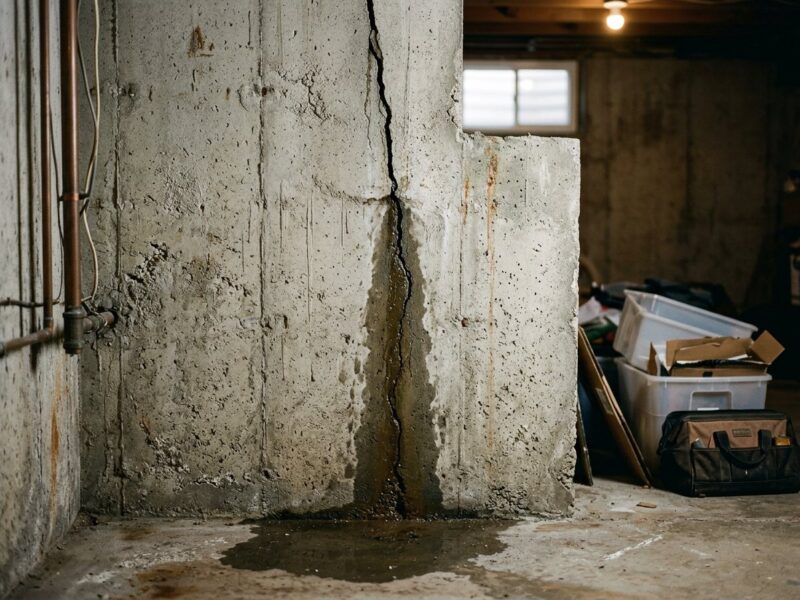
Cure cracks in poured walls
Most cracks in 1980s through 2000s poured concrete are vertical or near-vertical shrinkage from the curing process, structurally boring and cheap to seal. They earn attention when they leak, widen or run at an angle from a corner.
Settlement on graded clay
The southern and western subdivisions sit on farmland that was cut, filled and graded before building. Where fill keeps consolidating, a corner drops, cracks open over windows, and elevation readings decide whether piers are warranted.

The historic district exception
Near the Riverwalk the housing is older by a century and the foundations are a different material generation entirely. Those walls get evaluated on their own terms, with masonry judgment instead of the poured-wall checklist.
What makes Naperville ground move?
Naperville sits on clay that was farmland within living memory, regraded lot by lot as the subdivisions went in. Clay swells when wet and shrinks in drought, so every foundation here breathes a little with the seasons, and engineered fill keeps consolidating for decades after the builder leaves. Most of that movement is finished and harmless. The job is telling the finished movement from the active kind, which is why we put numbers on a wall before we put a price on it.
The finished basements raise the stakes on both errors. Under-repairing lets a moving wall damage drywall, trim and flooring that cost more than the structural fix. Over-repairing tears open a finished room for steel it never needed. Carbon fiber straps matter here for exactly that reason: they correct a wall in the space behind a stud wall, flat enough to refinish over, warrantied for the life of the repair.
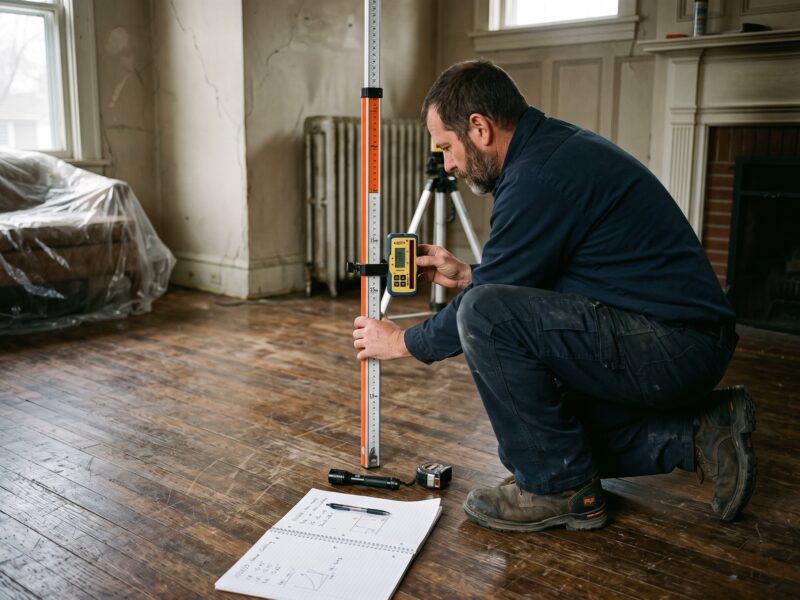
 The measurement packet: elevations and crack widths your other bidders have to answer.
Signs you need foundation repair in Naperville
Six symptoms drive Naperville structural calls. Most turn out to be minor once measured, which is precisely why measuring beats guessing: the serious ones hide among the harmless ones wearing the same cracks.
A vertical crack in the poured wall
The most common find and usually the least alarming: shrinkage from the original cure. It graduates from cosmetic to real when it leaks, widens past hairline, or angles off a corner.

Cracks opening over windows and doors
Diagonal cracks radiating from frame corners track differential settlement. Whether the movement is historic or active is an elevation question, not an opinion question.

Doors sticking, floors off level
When upstairs doors stop latching, the cause is sometimes the foundation and often a beam or column in the basement, a far cheaper repair. The inspection checks the cheap answer first.

A crack that leaks in spring
A wet crack is two problems with one solution: urethane injection fills it full depth, stops the water and closes the path, for $450 to $900 in a single morning.

A horizontal line at mid-height
The rare serious one in this stock: clay pressure pushing the wall inward. Caught early it is carbon fiber money; measured late it is steel or anchor money. Never wait on this one.

Stair-step cracks near the Riverwalk
In the historic district's older masonry, stepped cracking along joints maps how the foundation has moved. Age makes it common; width and freshness decide whether it matters.
Second opinion on a five-figure foundation quote? Bring us the paperwork. The measurement visit is free and the numbers go home with you either way.
How does foundation repair work in Naperville?
A Naperville foundation repair runs four steps built for a homeowner who is comparing bids: measure, prove, fix, verify. Most repairs finish in one to three days.
Measure everything first
Crack widths gauged, wall deflection checked, floor elevations shot across the house. In a city where most cracks are harmless, the numbers are what separate yours. Free, within 48 hours.
Day 0Get a plan you can shop
The written scope names the failure, the method and the published price, specific enough to hand to two other contractors. We would rather win on the diagnosis than on the pressure.
Day 0, same visitRepair around the finishes
Injection works through ports on the bare wall face. Straps install behind opened stud bays that close back up. Pier crews work outside from compact pits, and the finished room stays finished.
Days 1 to 3Verify against day zero
The crew re-measures against the original numbers before leaving, logs pier drive pressures where piers went in, and registers the 25-year transferable warranty to the address.
On completionReinforce or rebuild: what do Naperville walls actually need?
Almost no Naperville wall needs rebuilding. The stock is young poured concrete, and its problems are cracks and settlement, which reinforcement and piers solve in place for a fraction of rebuild money and without sacrificing the finished room above the work.
| Reinforce in place | Excavate and rebuild | |
|---|---|---|
| Best for | Cracked, settling or early-bowing walls still structurally sound, which is nearly all of them here | Walls sheared or failing outright, genuinely rare in this stock |
| The finished basement | Injection and straps work from small openings; the room is refinishable | The wall's interior finish is demolished along its full run |
| The landscaped lot | Pier pits are compact; most methods never open the yard | Full-depth excavation through mature landscaping and hardscape |
| Resale paperwork | Measurements, photos and a 25-year transferable warranty in a tidy packet | A major-structural disclosure that buyers will ask hard questions about |
| Cost | $450 injections to $3,000 piers, per the published ranges | Tens of thousands per wall before landscaping and reinstatement |
| Time | One to three days for most repairs | Weeks, with shoring, machines and a torn-up lot |
A rebuild quote on a Naperville poured wall deserves a second opinion on principle. Ours is free and arrives with a tape measure.
When do Naperville foundations move?
Foundation movement here follows the clay's moisture calendar, and each season has a job it does best. Knowing which one you are in turns a panic call into a scheduled one.
Spring: watch the cracks
Saturated clay swells against walls and old cracks weep. This is when a crack gauge earns its keep: a reading now versus fall tells you whether the wall is moving or just wet.
March to MaySummer: shrink and settle
Drought pulls water out of the graded fill and footings can drop with it. Cracks over windows widen late in a dry summer, and the south-side subdivisions do most of their annual moving now.
June to AugustFall: repair season
Calm clay, dry ground and open schedules make fall the best time to inject, strap or drive piers at an unhurried pace, with everything verified before the freeze.
September to NovemberWinter: indoor structural work
Frost owns the top of the soil but injection, carbon fiber, bracing and column work all happen inside at full speed. Winter is the quiet-schedule secret for interior repairs.
December to FebruaryHow much does foundation repair cost in Naperville?
Foundation repair in Naperville costs $450 to $900 for an injected crack, $600 to $1,000 per carbon fiber strap, $900 to $1,500 per steel beam, and $1,600 to $3,000 per settlement pier, the identical published ranges we hold in every town. Most Naperville jobs land at the injection end of that table, and we will tell you when yours does.
| Work | Range | What moves the number |
|---|---|---|
| Urethane crack injectionper crack | $450–$900 | Crack length and width, access to the full height |
| Carbon fiber strapsper strap | $600–$1,000 | Wall height, spacing the deflection requires |
| Steel I-beam wall bracingper beam | $900–$1,500 | Ceiling height, footing condition at the base |
| Push or helical piersper pier | $1,600–$3,000 | Depth to load-bearing strata, access for equipment |
The full structural table lives on the pricing page; your written Naperville quote lands inside it.
Where we repair foundations in Naperville
Structural calls span all four ZIPs, 60540, 60563, 60564 and 60565, and they cluster by construction era. Cress Creek and the north side send aging poured walls with cracks worth gauging. Ashbury, White Eagle, Tall Grass and the Springbrook Creek corridor send settlement questions from houses on graded fill, elevation surveys and the occasional pier job. The historic district near the Riverwalk sends the older-foundation work, and the Route 59 corridor sends a little of everything.
Naperville sits in our second ring: thirty to forty-five minutes from the shop depending on which side of the city and the traffic, a drive our crews make constantly. Monitoring still works at that distance, because a wall that deserves re-measuring in six months gets a scheduled return visit, not a shrug.
 The estimator arrives with gauges and a level, not a contract and a countdown.
Naperville foundation repair questions, answered straight
What is a rod hole and why is mine leaking?
When your poured wall was formed, steel rods held the forms apart and left holes through the wall at regular intervals, each supposed to be plugged. Twenty-five years later, a plug that was never quite right becomes a pinhole leak, a small and very fixable defect that causes outsized alarm when it appears behind drywall. Urethane injection seals it permanently and carries our 10-year warranty.
My 2000s house in Tall Grass has cracks over the windows. Is it still settling?
Possibly, and that is a measurable question. Subdivisions built on graded fill can keep consolidating for decades, so we shoot floor elevations and gauge the cracks. If the movement is active, piers at $1,600 to $3,000 each stop it permanently; if the readings say it finished years ago, sealing the cracks is the entire honest answer.
How much does foundation repair cost in Naperville?
From the published list, same as every town: $450 to $900 per injected crack, $600 to $1,000 per carbon strap, $900 to $1,500 per steel beam, $1,600 to $3,000 per pier. The most common Naperville outcome is the first line of that list, and no estimator of ours is paid to move you down it.
Who repairs the older foundations near the Riverwalk?
We do, with a different playbook. The historic district holds houses generations older than the subdivision stock, on foundations that predate poured concrete, and they call for masonry judgment, moisture relief and careful reinforcement rather than the standard checklist. The inspection starts by identifying what your wall actually is.
Can you reinforce a wall without wrecking my finished basement?
Usually, yes. Injection works through small ports on the wall face. Carbon fiber straps need the stud bays opened along the affected wall, then sit nearly flush so the drywall closes back over them. Steel beams cost more finish disruption, which is one more reason catching a wall at the strap stage pays twice.
I have three foundation bids that all say different things. How do I choose?
Discard any bid without measurements; a diagnosis without numbers is a sales pitch. Then compare crack widths and elevations recorded, whether the warranty transfers without fees, and whether the pricing existed before the visit. When bids disagree this much, the cheapest instrument-backed one is usually the honest one.
Will a repaired foundation hurt my Naperville resale?
A documented repair generally sells better than a mystery crack, especially in a market where buyers pay for inspections and read them. Our jobs close with day-zero measurements, photos, the scope and a 25-year transferable warranty registered to the address, a packet your listing agent hands over instead of an improvised explanation.
Do I need a permit for foundation repair in Naperville?
Structural work commonly does require one, and requirements vary with the scope, so we confirm with the city before work that needs it and handle the paperwork as part of the job. A contractor who waves the permit question away on structural repair is answering a different question: how carefully they work.
Is the cracked wall also wet?
In Naperville the crack and the leak are often the same defect wearing two symptoms, and both are hiding behind the same finished drywall. If the wall that needs measuring also weeps in spring, one inspection covers both trades and sequences the fixes so the drywall only opens once.
Basement Waterproofing in Naperville
Foundation repair near Naperville

Get the Naperville numbers before you sign anything
A free structural inspection within 48 hours, measurements you can shop to anyone, and a 25-year transferable warranty on whatever the numbers say you need.
Or talk to a human right now
(630) 335-1128
Request your free estimate
Tell us what you're seeing. We'll call back fast and be out within 48 hours.