
The quick answer
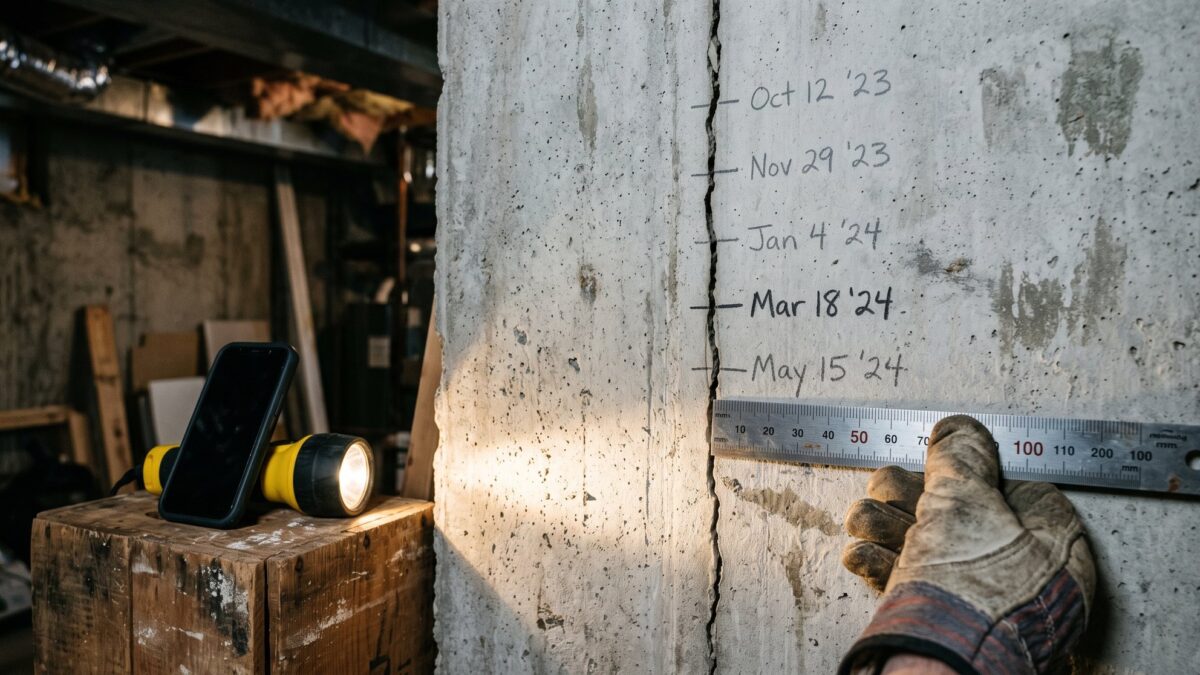
Mark both ends of the crack in pencil and write the date beside each mark. Measure its width at one fixed spot with a millimeter ruler, and photograph it with the ruler in the frame. Repeat every three months for a full year. Change across seasons, not width on day one, is what tells you whether the crack matters.
That is the entire method and it costs nothing. One look at a crack tells you almost nothing: cracked concrete is ordinary here, and most cracks in Chicago-area basements have sat where they are for thirty years. Two careful measurements six months apart tell you which kind you have, and that is the only question separating a note in your phone from real foundation repair. Most homeowners do this loosely, and a loose log is worse than none: it builds confidence in whichever direction the owner already leaned.
Why does monitoring a crack tell you anything at all?
Because in northern Illinois the ground around your foundation is never still, and the crack is your only readout. The glacial clay under Will, Cook, DuPage, Kane, Kendall, DeKalb and Lee counties swells as it takes on water, pressing on the wall through a wet spring, then dries and pulls back by late August. Every foundation here runs that squeeze and release once a year, measured or not.
A crack that moves a little is not the alarm. Almost all of them do. The alarm is a crack that does not come back. An elastic crack opens a fraction in April and closes again by September, returning to roughly the same number year after year. A ratcheting crack opens in April and only partly closes, leaving each cycle slightly wider than the last. Nobody can tell them apart in a single visit, which is why a good contractor hands you a pencil before handing you a quote.
Two local factors sharpen it. Freeze-thaw works on water sitting in an open crack all winter, widening the mouth slightly by March even in a wall that never moved. And in older suburbs the original clay tile draining the footings has usually silted closed, so soil beside the wall stays saturated for weeks after a storm, which is what makes the spring reading matter most.
What do you actually need?
A pencil, a ruler and your phone. Not a marker: ink bleeds on damp concrete and cannot be corrected, while pencil bites in, survives a damp wall and erases when you are finished. Use millimeter marks rather than sixteenths, the finer unit and far easier to compare across readings months apart. Your phone is both camera and notebook.
What monitoring a crack costs you
- Pencil, ruler and phone you already own$0
- Steel ruler with millimeter marksA few dollars
- Plastic crack monitor gauge, optionalAbout $20
- Time to set up the baselineRoughly 10 minutes
- Reading intervalEvery 3 months, plus after the spring thaw
- Minimum useful record before decidingOne full year
None of this is something we sell. A year of your own dated readings is stronger evidence than any single inspection, including ours.
How do you set it up, step by step?
Do the setup in one sitting. Everything after is a two minute visit four times a year.
Step 1: Clean the wall around the crack
Brush the concrete about a foot either side with a dry stiff brush and wipe off the dust, so your pencil marks stay put and your photographs show concrete rather than the film on it. Do not wash, seal or paint it. A painted crack is a crack you can no longer read, and that is the most common way homeowners destroy their own evidence.
Step 2: Mark both ends of the crack
Find where the crack stops at the top and at the bottom. At each end, lay down a pencil tick no more than an inch long running square across the crack, right where it disappears into sound concrete, and write today’s date beside it in numbers. These two marks answer whether the crack is getting longer, which people forget to check while staring at width. A crack that grows past its end marks is propagating, and that matters as much as one that widens.
Step 3: Build one fixed measuring station
Pick a point near the middle of the crack, or at its widest section, around chest height so it is comfortable to measure. Draw two small crosses on the wall, one either side of the crack, level with each other and about four inches apart. Measure the distance between their centers in millimeters and write it down. Label the station A on the wall.
Crack edges are ragged, so measuring the gap gives a different number depending on where you set the ruler. Two marks you drew yourself do not: if the wall separates by a millimeter, the crosses move a millimeter apart, even where the edges are too crumbly to measure honestly. On a long crack, add a second station near the bottom and call it B.
Step 4: Take the baseline readings
Record three numbers at each station. The distance between your two crosses. The crack width, taken at the widest point between them. And the offset: lay the ruler flat across the crack to see whether one face stands proud of the other, and run a fingernail across to confirm. Log offset as none, or as the size of the step. Offset outranks everything else here: a wall that has shifted out of plane has done something a wall that merely opened has not.
Step 5: Photograph it so the photos are comparable
Stand in the same place every time. Tape a mark on the floor where your feet go, or note a landmark, two joists over from the sump lid. Hold the phone square to the wall about a foot away and do not zoom, which changes the apparent geometry between visits. Keep the ruler and the crack in one frame so every photo carries its own scale.
Two tricks make these far more useful. Stick a note with the date in the corner of the frame, so the image is self-labeling even if the file loses its metadata. Then take a second shot with a flashlight held almost flat against the wall, shining along the surface rather than at it. That raking light throws a shadow off any offset or bulge and reveals movement a straight-on photo hides completely. Finish with a wide shot showing where on the wall you are, and file everything in one album.
Step 6: Write the log entry
One line in your notes app per visit: date, station A distance, crack width, offset, whether the crack or slab below was damp, and what the weather has done for the past week. The weather column is not filler. A reading in a saturated April tells a different story than the same number in a dry September, and in a year you will not remember which was which.
Step 7: Set the schedule and keep it
Put four reminders in your phone three months apart, and add one extra reading right after the spring thaw, when this region’s clay is at its most swollen and a moving crack shows its hand. Take an unscheduled reading any time water appears in the basement or a door upstairs starts sticking. Five or six readings across twelve months answers the question. Fewer than four is a guess with dates attached.
What do the readings mean after a year?
Compare the first reading with the last, then look at the shape of the middle. Here is how we read a homeowner’s record.
| What your log shows | What it usually means | What we would do |
|---|---|---|
| Every reading the same within about a millimeter | A stable crack, whatever its width | Nothing structural, keep the log annually |
| Opens in spring, back to baseline by fall | Seasonal clay movement, the normal cycle here | Keep watching, no repair on that evidence |
| Wider at each reading, never returning | Progressive movement, something is still going | Inspection, and likely an engineer |
| Crack has grown past your end marks | The crack is propagating through the wall | Inspection regardless of width |
| Offset appeared where there was none | The wall has displaced out of plane | Structural assessment now, not next season |
| Stable width, but it started leaking | Drainage changed, not the wall | Seal the path and find what feeds it |
The last row is a repair with no movement, and the second row is movement with no repair. That is the point of the exercise. A leaking but stable crack is usually a two hour injection at $450 to $900 per crack. A dry crack that keeps opening is a soil and structure problem, where sealing it only hides your instrument.
Which cracks should you not monitor at all?
Monitoring is for cracks you have the luxury of being curious about. Some are already telling you what they are, and waiting a season only costs you options. Skip the pencil and get somebody out if any of these apply.
- The crack runs horizontally across the wall. A sideways crack describes pressure from the soil, not shrinkage, and even a thin one can outrank everything else in the room. Start with whether a horizontal crack is serious.
- It steps diagonally through block mortar joints. That pattern tracks differential movement. We read it in what a stair-step crack means.
- The wall is visibly out of plumb. If a straightedge held vertically leaves a gap at mid-height, you are measuring a bowing wall, not a crack. See telling if a foundation wall is bowing.
- The two faces are no longer flush. Displacement is not a widening crack, and more measuring will not change the answer.
- It leaks during storms. Water does damage on its own timetable while you collect data.
- Doors upstairs started sticking the same season. Two symptoms in different parts of the house at once is the pattern that ends the monitoring phase.
There is also a timing case. Monitoring needs a year and sometimes you do not have one. Under contract to buy or sell, or a lender wanting an answer this month, means hiring an independent structural engineer instead, typically a few hundred dollars for a written opinion from someone with nothing to sell you. We lay out that call in when an engineer belongs in front of a repair.
What should you do next?
First, set the baseline tonight, for free. Ten minutes with a pencil, a ruler and your phone gets you end marks, one measuring station, three numbers and a dated photo. Nothing here works until that first entry exists, and the log only grows in value.
Second, repeat the exercise outdoors in the next real storm. Pace off where the crack falls on the exterior and study that strip of ground: a downspout dumping there, a window well filling, soil tipped back toward the house. Photograph it with a date. Plenty of cracks begin leaking because of something out there that a Saturday would fix.
Third, bring in a second set of eyes when the log says so, or for a sanity check on your setup. Our visit is free, lands within 48 hours, covers the wall as well as the crack, and we will say plainly when the right move is to finish your year of readings. If the numbers have started drifting one way, attach the log to a request on the free estimate form, or read them out at (630) 335-1128 for a verdict on whether they justify a trip.
Questions homeowners ask about tracking a crack
What exactly should I write down each time I check it?
Six things on one line: the date, the distance between your two pencil crosses, the crack width at that station, any offset between the faces, whether the crack or floor below was damp, and the recent weather. That last item makes the rest interpretable, since a spring reading after two weeks of rain is not comparable to a dry September one. Keep every entry, including the boring identical ones.
Is it normal for a crack to open in winter and close in summer?
Some seasonal movement is normal in Illinois clay, and a fraction of a millimeter either way is common. Direction varies by house: some cracks widen in spring as saturated soil pushes on the wall, others widen in a dry late summer as the clay pulls away. What matters is the return trip. A crack that comes back to the same number each year is cycling. One that never returns to baseline is moving.
Can I use a crack monitor gauge instead of a pencil and ruler?
Yes. A gauge is a plastic plate that mounts across the crack and reads movement off a printed grid, removing the measuring error entirely. It runs around $20 and is a fair purchase if you would rather not measure by hand. Mount it exactly per its instructions, since one loose fastener invalidates every reading. Keep taking dated photographs anyway: the gauge records width and nothing about length, leaks or offset.
I already patched the crack. Can I still monitor it?
Partly, and it is one reason we tell people not to patch a dry crack. A rigid hydraulic cement patch usually cracks again if the wall moves, so a fresh split down the middle of it is real information. What you lost is precision, because you can no longer measure width honestly. Set your two pencil crosses on sound concrete either side of the patch and track the distance between them instead.
Most cracks in this region are stable, and a year of your own free readings is the cheapest way to prove it. When a log says otherwise, the measuring is on us, inside 48 hours, with the findings in writing, and stabilization work carries a 25-year transferable warranty. Read your numbers to us at (630) 335-1128.


