
The quick answer
Settling is movement your house already finished absorbing. Failing is movement still underway. The crack itself does not tell you which you have; whether it changes does. Measure and date it, then check again in 60 to 90 days. Stable and dry means settling. Growing, spreading or leaking means the soil is still working on your foundation.
Almost every house in this region has settled. Very few are failing. That gap is where a lot of money changes hands unnecessarily, because a scared homeowner and a static hairline crack look identical to a commissioned salesperson. The honest way to sort it out is time: give the crack a season to prove what it is doing before anyone quotes a foundation repair on it. This post covers what each pattern looks like, how to run the measurement yourself, and which symptoms genuinely should not wait a season.
What is the difference between settling and failing?
Settling is a house finding its final position on the soil it was built on. Every foundation compresses the ground under it, most of that happens in the first years, and the result is minor, evenly distributed, and finished. Failing is different in kind, not degree: the support under a footing is still being lost, or the soil against a wall is still pushing harder than the wall can hold. One is history. The other is a process with a schedule.
That is why width alone is a poor test. A quarter inch crack that opened during a drought fifteen years ago and has not moved since is less concerning than a hairline that has doubled since March. Homeowners are taught to look at size because size is easy to see, and we get the question constantly, so we wrote a full answer at how wide a foundation crack has to be before you worry. Direction and change are the real diagnostics.
In Illinois the mechanism behind both is the same clay. It swells when saturated and shrinks in drought, so it can push a block wall inward one year and drop support out from under a footing corner the next. A house can therefore be settling in one place and failing in another, which is exactly why a diagnosis names a location and not just a verdict.
What does each one look like in the basement?
Read the pattern, not the panic. Here is how the same categories of symptom point in two different directions.
| What you are seeing | Usually settling | Points to a failing foundation |
|---|---|---|
| Cracks in a poured wall | Thin, vertical, even width, dry, unchanged for years | Tapered or wider at one end, growing, wet after storms |
| Cracks in a block wall | Fine cracking in mortar joints, no displacement | A horizontal line at mid-wall, or stair-steps with blocks offset |
| The wall’s shape | Straight when you sight down it | A visible belly, or a lean at the top course |
| Doors and windows | Sticking that comes and goes with the seasons | Racked frames, gaps at one corner, sticking that never releases |
| Floors | A gentle, long-standing slope you stopped noticing | A slope that got worse this year, or a new dip at one corner |
| Trim and drywall | Hairlines at door corners, repainted once and quiet since | Cracks reopening after repair, gaps opening at ceiling lines |
Two symptoms outrank everything else in that table. A horizontal crack in a block wall means soil pressure has already beaten the wall’s bending strength, and that is a now conversation, laid out in is a horizontal crack in my foundation serious. Doors across the whole house going out of square in one season means something under the house moved recently, which is a different pattern from the one wood swelling in August produces, and we sort that in why doors suddenly start sticking.
How do you tell which one you have?
You measure. This takes twenty minutes now and ten minutes a month afterward, and it settles the question better than any opinion delivered in your driveway.
- Mark the ends. Draw a short pencil line across each end of the crack and write the date beside it. If the crack grows past your mark, you will see it without measuring anything.
- Record the width. Measure at the widest point and at one other spot, and write both numbers on the wall in pencil next to the date.
- Photograph it square on. Put a tape measure in the frame so the photo carries its own scale, and shoot from the same spot every time.
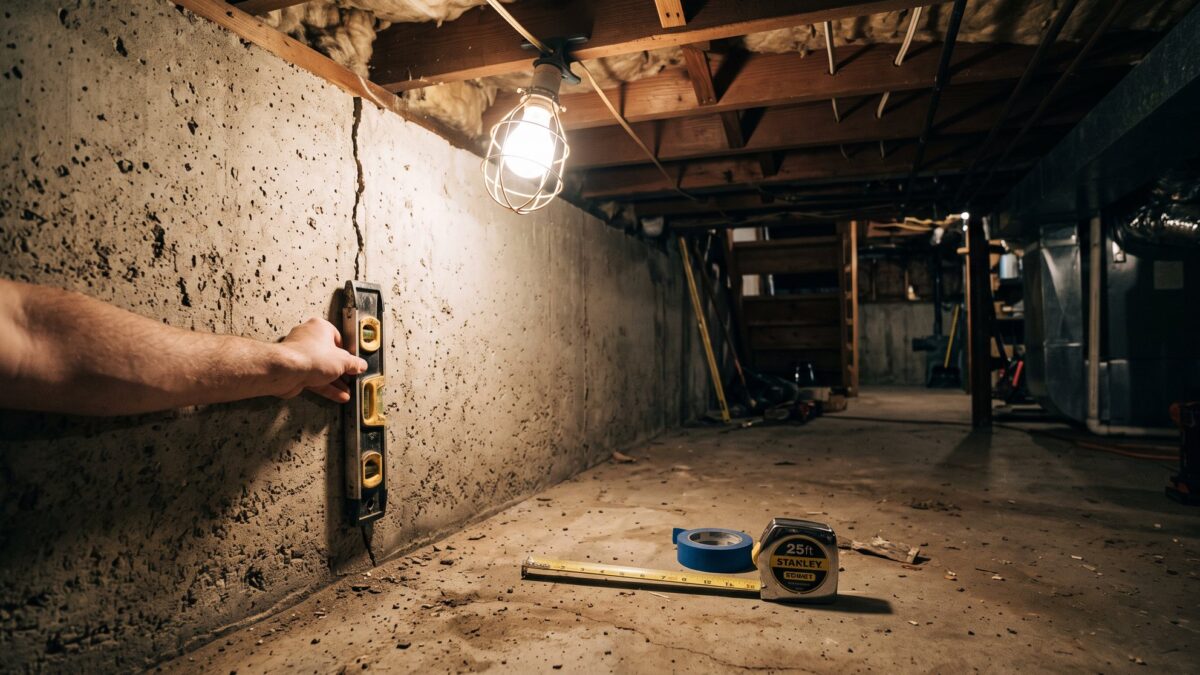
- Sight the wall. Stand at one end and look down its length, or hold a string line along it. A belly you can see is movement you can stop arguing about.
- Check for a lean. Hold a level against the wall top to bottom. A wall out of plumb at the top course is not a cosmetic finding.
- Repeat monthly through a full wet season. Spring is when clay does its worst work here, so a record that spans March through June is worth more than one taken any other time of year.
The full method, including how to read the results without talking yourself into a repair, is in how to monitor a foundation crack. What matters is that at the end of it you hold evidence. Evidence is what keeps an estimate honest, ours included.
What each answer costs
- Monitoring it yourself for a season$0 to $30
- Our inspection and written diagnosis$0, within 48 hours
- Independent structural engineer’s reviewTypically a few hundred dollars
- Sealing a stable crack that leaks$450 to $900 per crack
- Stabilizing an early bowing wall$600 to $1,000 per carbon fiber strap
- Supporting a settled footing$1,600 to $3,000 per pier
The first two lines cost nothing, which is the point: nobody should be paying to find out whether they have a problem.
What does your era of house usually tell you?
Age narrows the odds before anyone opens a toolbox.
Pre-war bungalows and two-flats
A century-old house has done all the settling it is going to do under normal conditions, so new movement in one of these is worth taking seriously rather than shrugging off as an old house being an old house. In stone and early concrete foundations, look for mortar joints that have opened, a course that has slipped out of line, or a sill plate no longer sitting flat. Old and stable is fine. Old and changing is not.
Post-war block ranches and Georgians
These houses rarely settle dramatically, because they are light and their footings are broad. What they do is bow, and the failure runs sideways rather than down. Sight along every block wall once a year, especially the one facing the driveway or the patio, where soil stays wettest. A wall that has moved even a modest amount at mid-height is not settling, and the earlier it is caught, the more likely straps beat beams on price.
1980s and 90s poured walls
Poured walls from this era crack while curing, which produces the most misdiagnosed symptom in the region. A tight vertical crack of even width, in a wall that is still straight and a floor that is still flat, is almost always cure shrinkage the house absorbed decades ago. Its only real cost is water, and if it weeps each spring, urethane injection at $450 to $900 per crack closes it with a 10-year warranty rather than a structural project.
Newer subdivision homes
Newer houses are the ones most likely to be genuinely settling right now, because their backfill and engineered fill are still compacting and the finish grade is still finding its level. Most of that is uniform and harmless. The version that matters is differential: one corner dropping while the rest of the house stays put, showing up as a door that racks, a new floor slope, or drywall cracks that come back after being patched. That pattern earns a measurement, not a wait and see.
When is doing nothing the right call?
Most of the time, honestly. Here is when we tell homeowners to keep the checkbook closed.
Nothing has changed in a year of records. A crack that measures the same across a wet spring and a dry summer has told you it is settling. Keep the photos, check it each spring, spend your money elsewhere.
The cracks are in the floor slab, not the walls. A basement slab is a surface poured over gravel, not a structural member holding up your house. Shrinkage cracks in it are ordinary. Sections lifting out of plane are a separate question, covered in why a basement floor heaves.
The only real symptom is water. Seepage through a crack in a wall that is straight, plumb and stable is a waterproofing problem wearing structural clothing. It deserves a fix, but a drainage fix, not piers. Anyone who answers a wet basement with a structural quote skipped the diagnosis.
The flip side deserves equal honesty. Movement that is genuinely underway does not pause while you decide, and repairs get more expensive as walls move further out of line, which is the whole argument in what happens if you ignore a foundation problem. Waiting is a strategy for stable cracks. It is a cost for moving ones.
What should you do next?
First, start the record today, at no cost. Pencil marks, dates, two width measurements and one square-on photo per crack. Ten minutes gets you the only piece of evidence nobody can sell you.
Second, walk the outside of the house with the same eyes. Look for soil pulled back from the wall, downspouts discharging at the corner, and ground sloping toward the house. Settling and failing both get their fuel from water sitting where it should not.
Third, get a second set of eyes on the measurements. Send us your photos or have us out to sight the walls and check the floors: the inspection is free, it happens within 48 hours, and it ends with a written verdict of stable or moving. Ask for that verdict through our free estimate page or read us your crack measurements over the phone at (630) 335-1128. If the answer is settling, we will say so and leave, which is how most of these visits end.
Questions homeowners ask about settling and failing foundations
Can a house settle unevenly and still be safe?
Yes, and many older Chicago-area houses have. Uneven settlement that happened decades ago and stopped leaves permanent quirks: a sloped floor, a door planed to fit, a stair-step crack that never changes. The house adapted, and there is nothing to repair. What matters is whether the difference is still increasing. A slope that has been there since you moved in is history; a slope that is measurably worse than last year is a live problem.
Do cracks open and close with the seasons?
They do, and it fools a lot of people. Illinois clay swells with spring rain and shrinks in a dry summer, so a crack can measure slightly wider in one season and narrower in another. That seasonal breathing shows up as small movement that returns to where it started. The pattern to worry about is one direction only: wider each time you measure, never coming back. That is why a full year of records beats one dramatic reading.
Can I check whether my floors are out of level myself?
Yes, and it is a useful ten minutes. Set a marble or a golf ball on the floor in several rooms and note whether it rolls and in which direction, then confirm with a long level or a four foot straightedge laid across the floor. Map what you find room by room. Consistent slope in one direction points at one area of the house, and that map tells any inspector where to look first.
Does a failing foundation ever give way suddenly?
Sudden collapse is rare in residential foundations here, and it usually involves an outside trigger like an excavation next to the footing or a broken water line washing soil out. The normal failure mode is slow and seasonal, which is why measuring works as a diagnostic at all. Slow does not mean harmless, though. A wall that keeps moving each spring reaches a point where repair options narrow and prices climb.
If your records say the movement is real, the next step is a measured diagnosis, not a sales pitch: we inspect free within 48 hours and back structural work with a 25-year transferable warranty. Bring your numbers to (630) 335-1128 and we will tell you honestly which side of the line your house is on.


